
How do I get cited by name in ChatGPT? Six expert profiles, from doctor to craftsman
Whether ChatGPT cites you by name depends on three things: a signed page that answers a real question, a name and title written the same everywhere, and an author page linking that name to your registration and profiles. If AI recognises you as one person, your signed page can become an answer’s source. There is no guarantee; what can be built is a recognisable name.
Why the name? A selective customer often searches for the person, not the business. Below are six experts, each hypothetical, each scene happening somewhere today. Start with the one that looks like you.
Why does your name leave a trail separate from your business?
Because AI can hold a person and a business as two separate records. Your business sits on the map with your address. Your name is scattered across articles, interviews, your chamber registration and social profiles. If these pieces are not connected, AI cannot answer “who wrote this?”.
A name is the shortcut to trust
Word of mouth always comes with a name: “Go to this craftsman, he knows his trade.” With AI the same happens, only an answer box gives the tip.
When someone else shares your name
Many people in Turkey may share your name. For AI to tell you apart, name, title, city and profession must match everywhere. For business-level signals, see how to get my business cited by ChatGPT.
Doctor and lawyer: visible by name, within the rules
Here advertising is restricted by law, but informing is not. You do not advertise; you write a plain, accurate, signed answer to the question patients or clients ask. Checking the rules first is not optional.
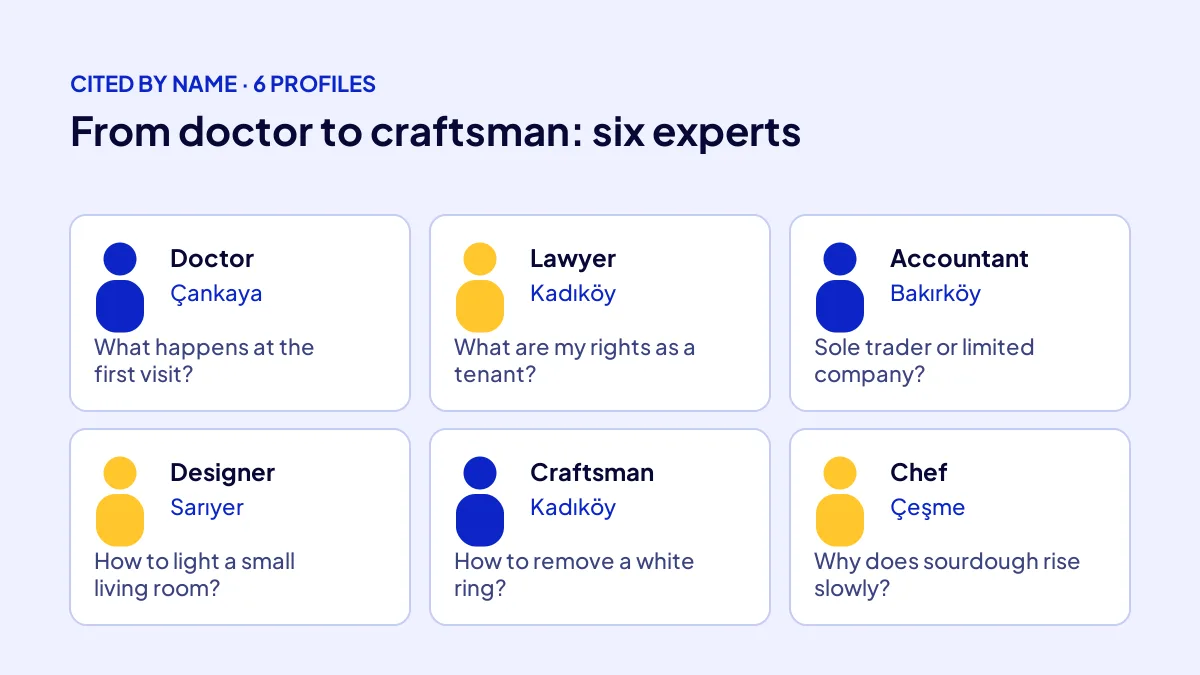
Profile 1: a doctor opening a practice in Çankaya
A dermatologist opening a practice in Çankaya, Ankara, hears the same three questions at every first visit and writes the answers under her name. No prices, no before-and-after photos, no patient reviews. Turkey’s health advertising regulation (Official Gazette, 12 November 2025) draws these lines, so check it and your medical chamber first. Why patients search for the doctor is covered in why patients search for the dentist’s name.
Profile 2: a lawyer opening an office in Kadıköy
A lawyer opening her own office in Kadıköy sees tenants arrive with the same worry: the landlord wants them out. She writes a signed article with general information. Advertising is prohibited for lawyers in Turkey, so check the limits with the Union of Turkish Bar Associations’ rules and your bar. No promised results, no fee listings.
Accountant and interior designer: signing the customer’s question
Here customers think long and ask many questions before deciding. Every question is a ready headline for a signed page. When the expert’s name sits under it, written exactly as in the chamber registration, AI gains a recognisable source.
Profile 3: an accountant opening an office in Bakırköy
An accountant in Bakırköy gets three calls a week asking “sole proprietorship or limited company?”. She writes the answer once on her site, under her name, consistent with her chamber record. Now she sends the link instead of repeating herself.
Profile 4: an interior designer in Sarıyer
An interior designer works on villas around Tarabya in Sarıyer. Her Instagram is full of photos, but her own name appears nowhere; the account is in the studio’s name. She adds a line to each portfolio project: who designed it and which problem it solved. See how to get my social accounts cited by ChatGPT for the profile steps.
Craftsman and chef: putting counter knowledge on the record
This knowledge usually lives in the hands, not in writing, and AI reads only what is written or recorded. So the work starts by moving it from the counter to a page or video, under the same name every time.
Profile 5: a furniture restorer in Kadıköy
A craftsman has repaired old furniture for thirty years, yet his name never appears online; customers walk in only on recommendation. His nephew records one job a week and writes the craftsman’s name and the answer in the description. “How do you remove a white ring from a walnut table?” now has a written answer.
Profile 6: a chef opening a seasonal patisserie in Çeşme
A patisserie chef in Çeşme keeps hearing: why does sourdough take so long to rise? She puts the answer on the recipe card, her site and a local paper interview. Three places, the same name, the same title.
What do the six profiles have in common?
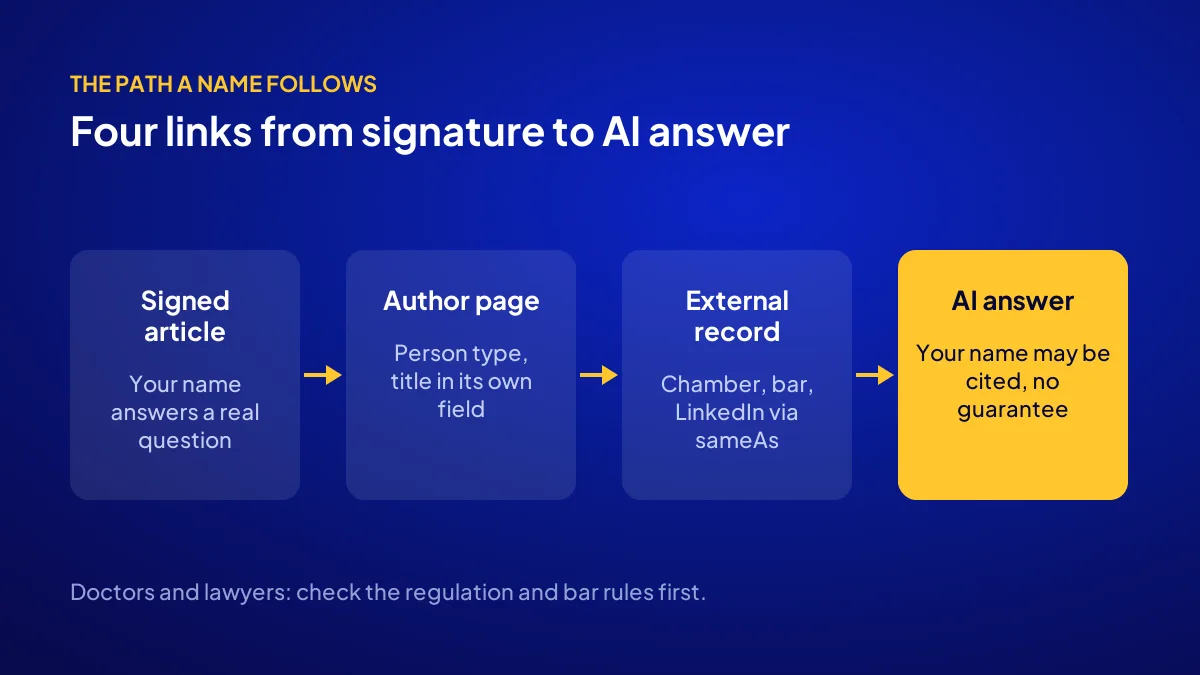
All six share three pieces: a signed page answering a real question, a consistent name and title, and an external record confirming the name. The profession changes; the trio does not.
| Profile | Sample question | Where the name is linked | Check first |
|---|---|---|---|
| Doctor | What happens at the first visit? | Signed article, chamber record | Health advertising regulation |
| Lawyer | What are my rights as a tenant? | Signed article, bar record | Advertising ban, bar rules |
| Accountant | Sole proprietor or limited company? | Site article, chamber record | Consistent name and title |
| Interior designer | How to light a small living room? | Portfolio, Instagram, LinkedIn | Personal or studio account |
| Craftsman | How to remove a white ring? | Video description, business profile | Same name in every video |
| Chef | Why does sourdough rise slowly? | Site article, local press | Food label and claim rules |
An unsigned page has no owner
An article in the studio’s name with nobody’s name under it carries information but not an expert. AI may cite the information without tying your name to it.
Nobody builds a name overnight
None of the six becomes a source with one article. Each listens, writes the answer down and spells the name the same way every time.
How does an author page introduce your name to AI?
BU BÖLÜMÜN ÖZETİ
- Titles do not go inside the name
- sameAs: a bridge to your other profiles
- A person is a person, a business is a business
An author page carries the single correct version of your name: who you are, what you do, your chamber and profiles. Google’s article structured data documentation recommends linking authors to such a page, which helps tell you apart from namesakes.
Titles do not go inside the name
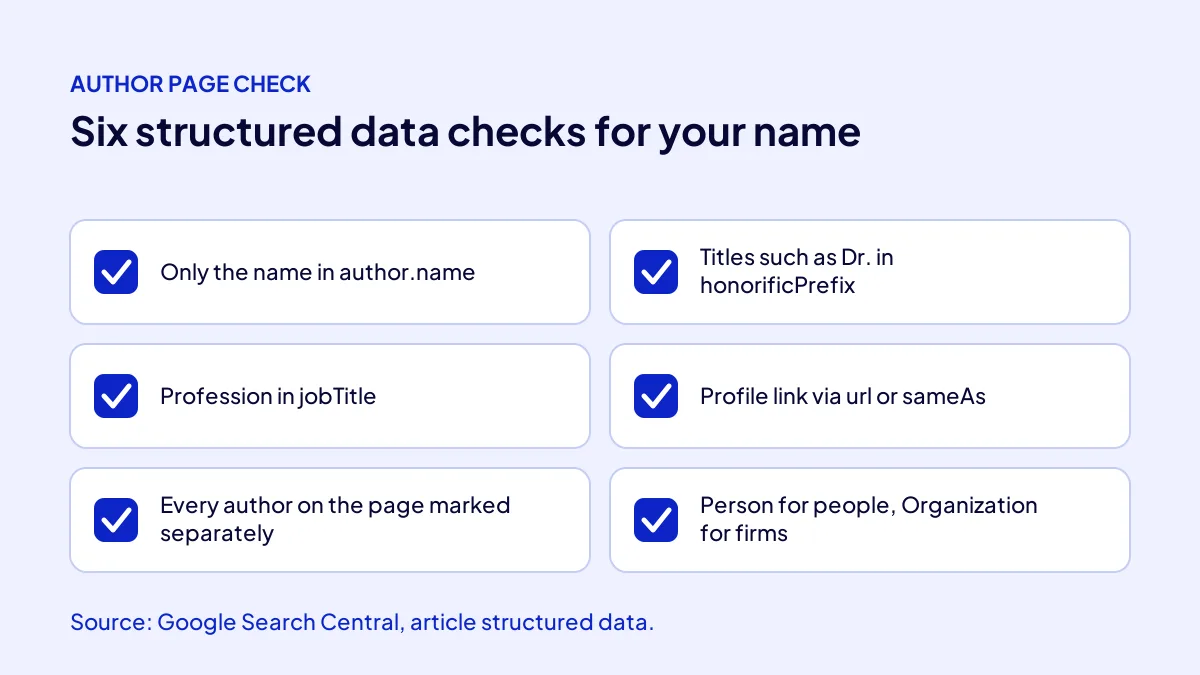
According to Google, the author.name field holds only the name. Titles such as “Dr.” go in honorificPrefix and the profession in jobTitle. Writing “Op. Dr.” into the name field goes against this advice, and fixing it is quick.
sameAs: a bridge to your other profiles
The author url or sameAs field should point to a page that uniquely identifies you: author page, LinkedIn or chamber record. Every author shown on the page belongs in the markup, each listed separately.
A person is a person, a business is a business
Google asks for Person for people and Organization for organisations. Marking a craftsman as a business tells AI “this is a shop”. For entity setup, structured data and brand profiles built for you, the AI SEO campaign delivers in 30 days for a fixed TRY 36,000 + VAT, with a 10 percent coupon, 12 businesses per period and no recommendation guarantee. Site-wide signals are in how to get my website cited by ChatGPT; steps for a physical place in how to get my business place cited by ChatGPT.
Quick Summary
- Being cited by name needs a signed page, a consistent name and an author page.
- Doctors and lawyers inform, not advertise, after checking their rules.
- Accountants and designers turn customer questions into signed pages.
- Craftsmen and chefs move counter knowledge into writing or video.
- In structured data the author name holds only the name.
- Neither citation nor recommendation is guaranteed.
Short Glossary
Author page: An author page is a page used to identify a person by gathering their name, profession and profiles in one place.
sameAs: sameAs is a structured data field used to point to a person’s or organisation’s profiles on other sites.
Person markup: Person markup is the structured data type used to state that an author is a person, not a business.
Next Step
Answer your customer’s question under your own name today; we can build the rest together. Apply for the AI SEO campaign and see where your name and business stand in AI.
Frequently Asked Questions
Source: Google Search Central — Article structured data and author markup best practices
Sık Sorulan Sorular
No. The company behind the AI decides who is cited. You can build a signed page, consistent information and an author page that make your name recognisable.
Informational articles are possible; advertising is restricted. Check the health advertising regulation and your chamber, or your bar rules, first.
No. Put only your name in author.name; the title goes in honorificPrefix and the profession in jobTitle. The visible byline can keep the title.
Keep it, but write the expert’s name in posts and the bio, and link it from your author page.
It is set up for a business; entity setup, structured data and brand profiles are included. An expert’s name that is part of the business identity is included too. No recommendation guarantee is given.
A fixed TRY 36,000 + VAT, 10 percent off with a coupon, delivered in 30 days; 12 businesses per period.
Updated: October 2026