
KOSGEB Employment Protection Program closes October 31, how much can manufacturers borrow?
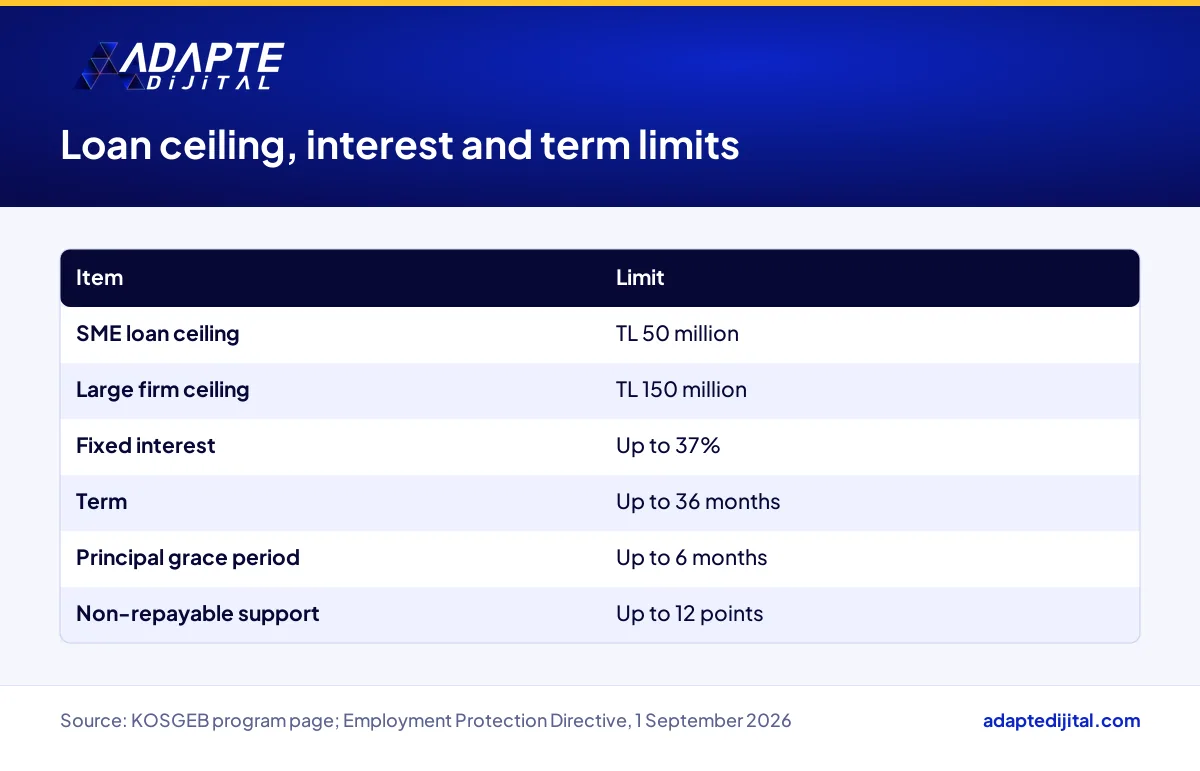
Applications for the 2026-2 period of KOSGEB’s Employment Protection Support Program close on 31 October 2026, and manufacturing SMEs can apply for loans of up to TL 50 million while large firms can go up to TL 150 million (KOSGEB program page, accessed 13 October 2026). KOSGEB is Türkiye’s Small and Medium Enterprises Development Organization. The loan amount is tied to the monthly average of earnings subject to social security premiums in the first half of 2026, and a non-repayable financing support of up to 12 points comes on top.
What it means for you: if you can keep your workforce in the second half of the year, the door is open to a loan with a fixed rate capped at 37% and a support that cuts your tax and social security debt. The window closes in 18 days, and loan approval still depends on the bank’s own assessment.
When is the deadline for KOSGEB’s Employment Protection Program?
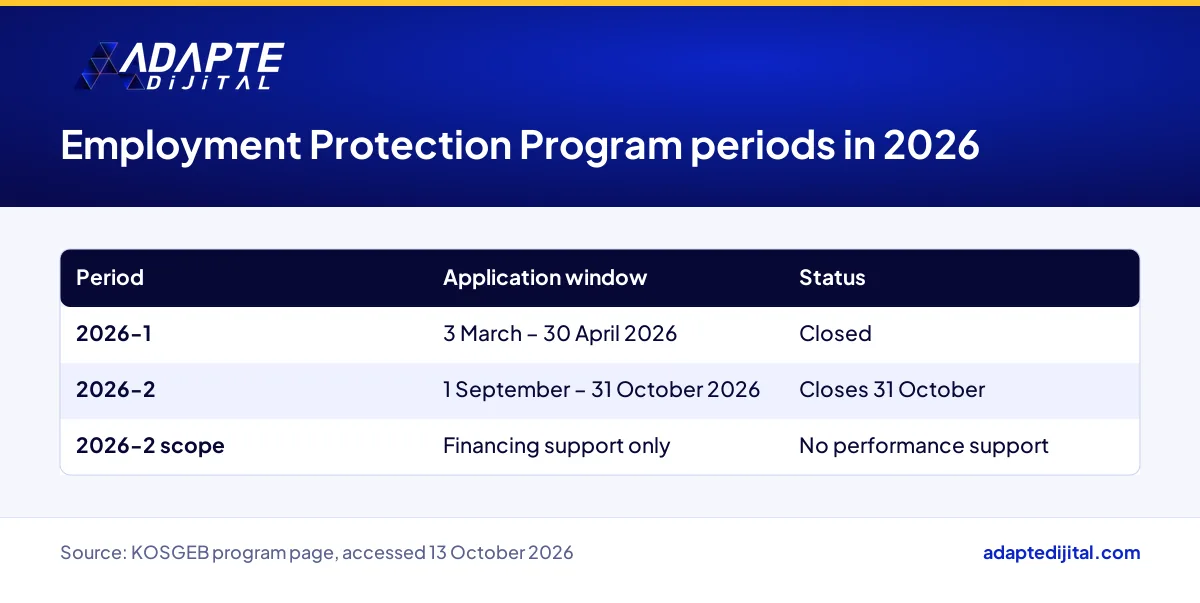
The last day is 31 October 2026. According to the program page, the 2026-2 period opened on 1 September, and it accepts applications only for financing support, with no performance support this time. The program opened twice this year: the first period ran from 3 March to 30 April. As of 13 October, 18 days remain, and bank meetings and paperwork have to fit inside them.
How is the Employment Protection loan amount calculated for a manufacturer?
The amount can equal the monthly average of total earnings subject to social security premiums, as shown in withholding and premium service returns for January to June 2026. The ceiling is TL 50 million for SMEs and TL 150 million for large firms, with no floor. A workshop with a full payroll reaches a higher amount, while a one-bench manufacturer stays at its own scale.
Which debts does KOSGEB’s 12-point non-repayable support pay?
Only tax office and SGK debts, SGK being Türkiye’s Social Security Institution. For the 2026-2 period, a maximum of 12 support points applies, and the support is non-repayable. Payment goes to an SGK account or a Go Dijital Cüzdan (digital wallet) account, not into your till as free cash. The program page gives no TL value for a point; the calculation runs through KOSGEB’s support calculation table.
Which manufacturers does the Employment Protection Program affect, and how?
The winner is the manufacturer that keeps registered staff and runs a regular payroll. Across Türkiye this autumn of 2026, textile, metalworking, furniture and food workshops can reach a loan sized to their scale through premium-based earnings. Those who struggle are firms that added a manufacturing code late or whose headcount is shrinking.
What awaits a manufacturer on the digital side of an Employment Protection application?
Almost the whole application runs on data. The KOSGEB system, e-Devlet, withholding returns, SGK records and the Go Dijital Cüzdan are links in one chain. A mismatch in any of them can stall the application or the bank’s assessment.
What should a manufacturing employer do this week, before 31 October?
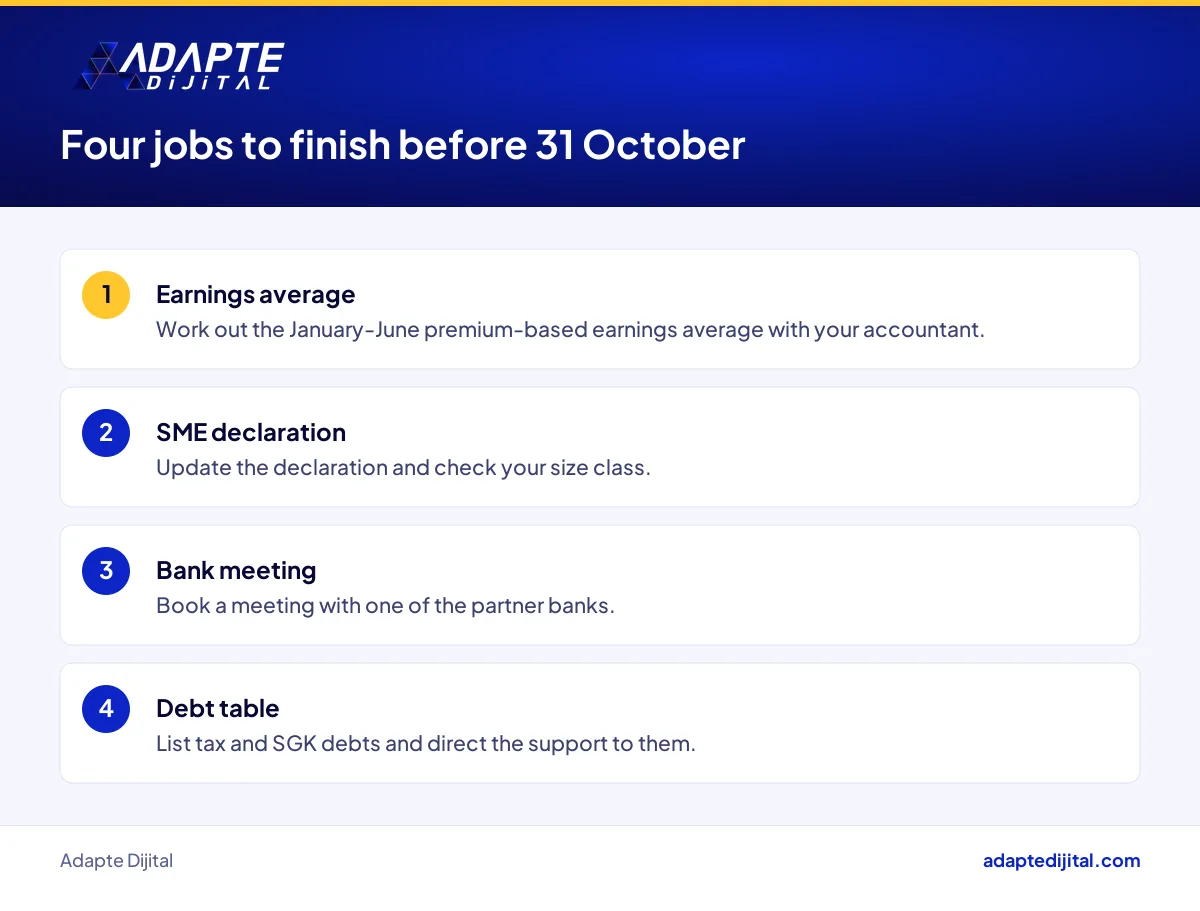
Finish three jobs this week. Work out the January-June premium-based earnings average with your accountant, update your SME declaration and book a preliminary meeting with at least one partner bank. Choose the amount not by the ceiling but by what you can carry: July-December employment and 36 months of repayments.
Quick Summary
- Applications for the 2026-2 period of KOSGEB’s Employment Protection Program close on 31 October 2026 (KOSGEB program page).
- The loan ceiling is TL 50 million for SMEs and TL 150 million for large firms (KOSGEB program page).
- The amount follows the monthly average of January-June 2026 premium-based earnings and doubles with one of two competences.
- Up to 12 support points are non-repayable and go only to tax and SGK debts (KOSGEB program page, Directive).
- Premium days must be maintained from July to December 2026, and loan approval rests with the bank.
Short Glossary
- Premium-based earnings
- Premium-based earnings is the payroll term used for the wage total on which social security premiums are calculated.
- Support point
- A support point is the unit KOSGEB uses to calculate non-repayable financing support.
- NACE code
- A NACE code is the statistical code used to classify a business’s field of activity.
Frequently Asked Questions
Next Step
If you want to weigh the loan decision together with your business’s digital and record-keeping setup, fill in the consult your expert form.
Support amounts and conditions can change; check the current terms on the institution’s official page before applying. This article is not financial or legal advice.
Sources: KOSGEB, Employment Protection Support Program (accessed 13 October 2026) · Employment Protection Support Program Directive, 1 September 2026 · Ekonomi Gazetesi, 10 September 2026
Updated: October 2026
Sık Sorulan Sorular
Partly, yes. A business that used a loan in the 2026-1 period can use the difference if that loan was below the 2026-2 ceiling. For a manufacturer that played it safe in spring, a second slice is on the table.
A business that received support as an SME in an earlier period and has since become a large firm, or the reverse, cannot benefit in the new period. Keep this in mind when you update your İşletme Beyanı, the SME declaration that sets your size class.
Under the directive, applications go through the KOSGEB system and e-Devlet, Türkiye’s e-government portal. The loan itself comes from 15 banks with a KOSGEB protocol, a list that mixes public, private and participation (Islamic) banks.
One of two routes is enough. Financial Competence requires, on 2025 data, operating profit above zero and total debt no more than 3 times operating profit. R&D Competence means an R&D or Design Center, a branch in a technology development zone, a TÜBİTAK project completed in the last five years or a patent registered in that time. We cover the technopark side in our article on KOSGEB’s Technology Center Program.
According to the program page, the fixed rate is capped at 37%, and the variable rate at TLREF+1, excluding participation banks. Commission cannot exceed 1% of the loan; for SMEs, the KKDF levy is 0% and BSMV banking tax 1%. Under the directive, the term is at most 36 months, with a principal grace period of up to 6 months.
SMEs can use guarantees from KGF, KFK or İGE, Türkiye’s credit guarantee institutions. For a small workshop with its hands tied on collateral, this makes the bank conversation easier. Approval, however, remains the bank’s decision.
The directive sets the upper bound at 15 points and leaves the applicable figure to a KOSGEB President’s announcement. For this period, the announced cap is 12 points.
Keeping jobs. The average monthly premium days of January to June 2026 must be maintained from July to December 2026. Check in the regulation and directive what happens if the condition is missed before you sign anything.
A business without a manufacturing NACE code in the records of GİB, Türkiye’s Revenue Administration, on 31 December 2025 cannot apply by adding the code afterwards. The main or secondary activity code of the head office or a branch must sit in Section C, manufacturing.
Tradesmen’s chambers have urged small manufacturers to apply. Adlıhan Dere, president of the tradesmen’s federation AESOB, stressed that TL 50 million is a ceiling, not a target, and that the amount should match the ability to repay. If cash is not turning over today, a large loan means instalment pressure tomorrow.
Accountants and suppliers. Accurate, consistent return data puts extra work on the accountant’s desk. If a workshop’s cash squeeze eases, payments along the subcontracting chain may ease too.
The program asks for a current SME declaration. The size information in it separates SMEs from large firms and so decides which ceiling applies; an outdated declaration makes things hard from the start.
The loan is set by tax returns, not by a website. Still, a site that clearly presents your manufacturing activity, product range and contact details, plus a current Google Business Profile, makes it easier to introduce the business to banks and buyers. Good records paired with a dusty online shopfront leave value sitting on the shelf.
For firms weighing support and loan decisions together, we gather current announcements under grants and incentives news. The full program conditions are on the KOSGEB Employment Protection Support Program page.
Withholding and premium service returns for the first half of 2026, your 2025 financial statements and the record showing your NACE code. If you claim R&D Competence, the center certificate, project or patent record goes into the file too.
List your tax and SGK debts that are coming due. Since the support goes only to these items, preparing the debt table early keeps the payment from sitting idle.
For businesses that want to sort out web, search and local visibility alongside their records and data, we do this work together through our digital consulting service. How centers that advise SMEs get funding from KOSGEB is covered in our article on the SEGEM Program.
The program is open to businesses that are natural or legal persons defined in the Turkish Commercial Code. If the head office or branch activity code falls within manufacturing and the SME declaration is current, the workshop may meet the application conditions.
No. According to the program page and the directive, the non-repayable support is used only to pay tax office and SGK premium debts.
The program requires the average monthly premium days of January-June 2026 to be maintained from July to December. Check what applies if the condition is not met in the regulation and directive before applying.