
KOSGEB SEGEM Program funds consulting centers TL 6,506,000 a year, who can apply?
Model factories, Competitive Sectors Program centers and consulting joint-stock companies that train and advise SMEs can receive up to TL 6,506,000 a year in 2026, at 100% and non-repayable, under KOSGEB’s Sector Development Center (SEGEM) Support Program, and the money goes to the organisation running the center, not to SMEs (KOSGEB program page, accessed 13 October 2026). KOSGEB is Türkiye’s Small and Medium Enterprises Development Organization. The program runs for 10 years, and payment depends on hitting targets.
For an SME owner, it means this: centers that serve businesses on institutionalisation, family constitutions, production and technology adoption may grow in number and staying power with this funding. According to the program page, applications are always open; the directive, however, also allows call-based applications by approval of the KOSGEB President.
Which organisations can apply to KOSGEB’s SEGEM Support Program?
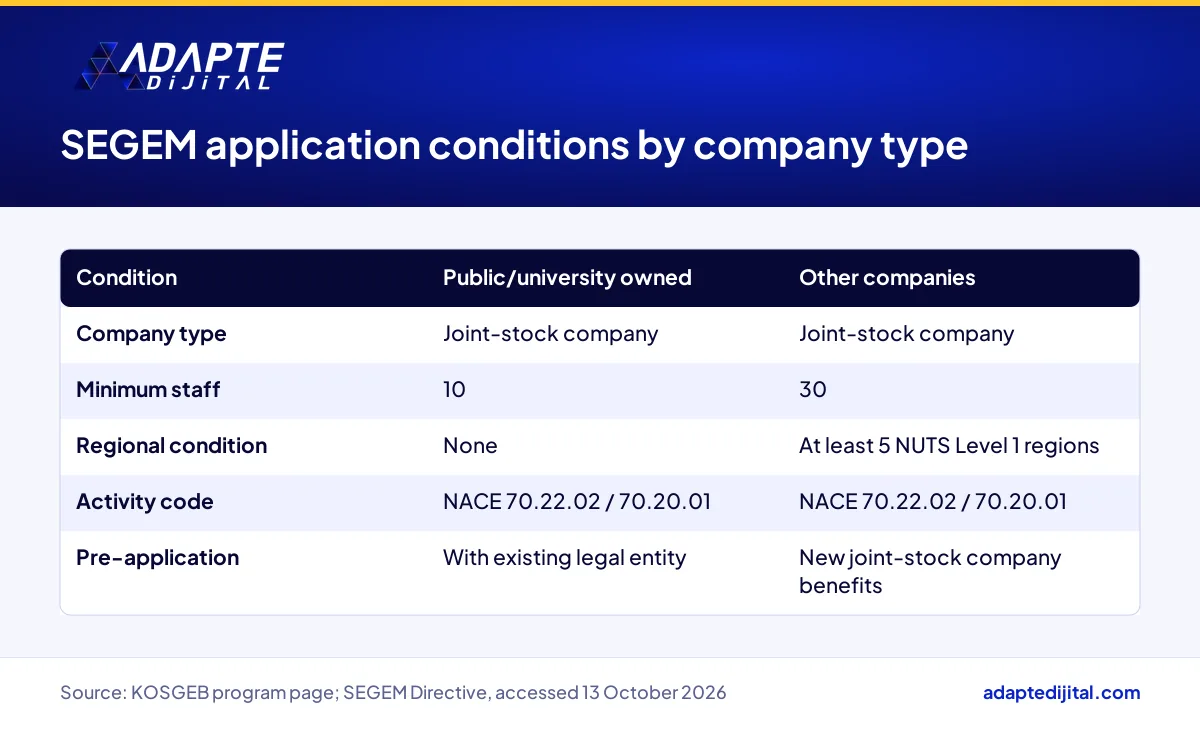
Under the directive, three groups can apply: model factories, centers within the Competitive Sectors Program, and businesses that contribute to their sector’s development. All three must be joint-stock companies, or anonim şirket in Turkish. The headcount, activity code and regional conditions then vary with the company’s ownership structure.
How is SEGEM’s 10-year funding paid out?
Based on success. Under the directive, the average of cumulative target achievement rates is multiplied by the annual ceiling to find the ceiling for each period. A single target counts at most 100%, and monitoring runs in three-month periods. So if the center misses its targets, the funding shrinks with it.
How can an SME owner benefit from SEGEM?
As the side receiving the service. SEGEM’s beneficiaries are the centers; the SME applies for their training, technical assistance and consulting. In KOSGEB’s YÖNDE program, too, SME demand is steered toward model factory services. Finding the right center is how an SME reaches this support.
A representative scene: a handover desk in a family workshop
The scene below is representative; the person and business are not real. In the office of a furniture workshop, an owner who has taken over the business from a parent closes the order book. Production runs on gut feeling, and the argument with siblings over who decides never ends. On the desk lies a news story about support for consulting centers.
Whom does the SEGEM Program affect in the consulting sector, and how?
The winners are consulting organisations with qualified staff working across several regions, along with model factories. In Türkiye’s industrial regions this autumn of 2026, these centers are looking at a ten-year frame for their operating costs. Those who struggle are small consulting firms with few staff working in a single region.
What does the digital side of a SEGEM consulting center require?
Orderly data, from application to monitoring. The pre-application is made with the SEGEM Pre-Application Form via e-Devlet, Türkiye’s e-government portal, and the process runs through the “e-services” menu on KOSGEB’s site. Because target achievement rates are monitored every three months, the center needs a system that records its progress against those targets. Information and technology adoption is also part of the program’s stated aim.
What should a consulting firm or SME owner do this week?
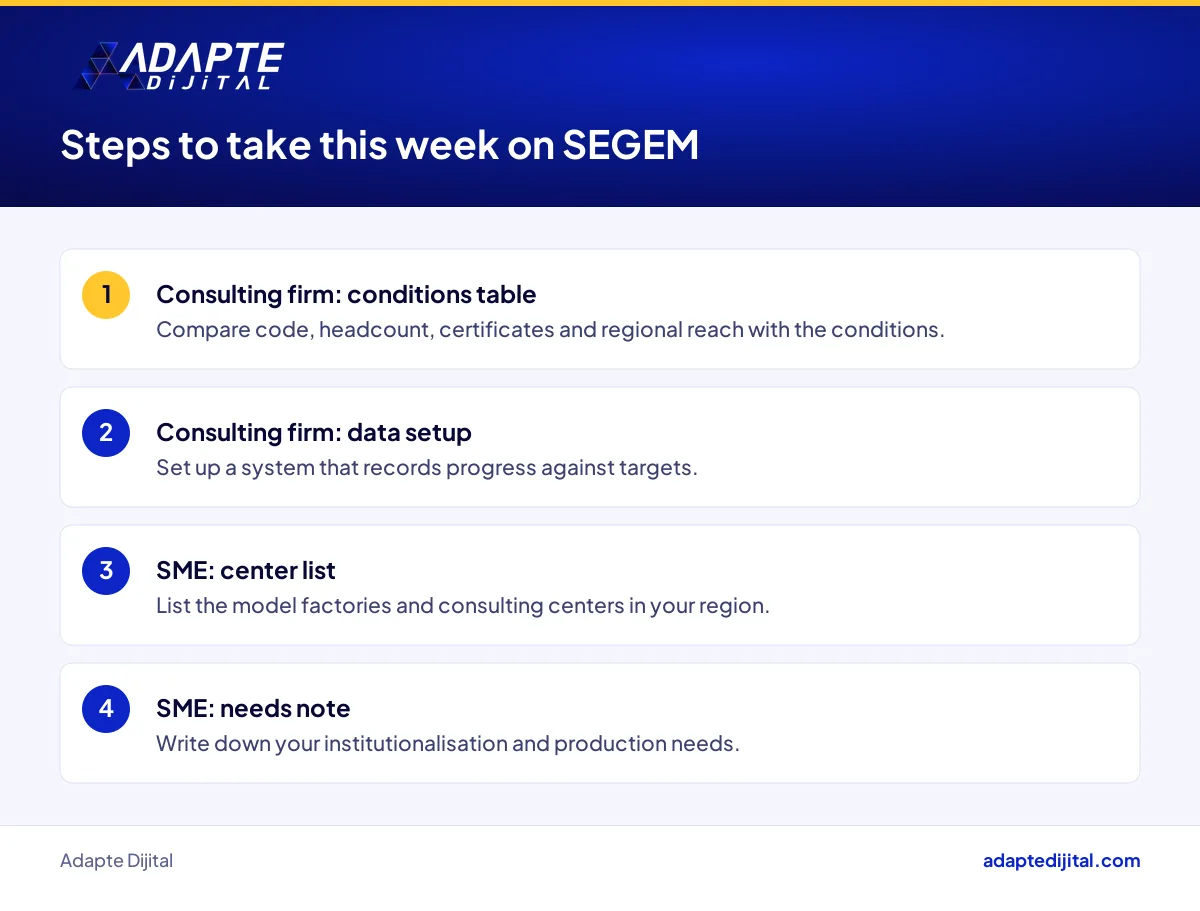
Split by role. If you run a consulting firm, compare your activity code, headcount, staff certificates and regional reach against the conditions in one table. If you own an SME, list the model factories and consulting centers in your region and write down your institutionalisation needs. Full conditions are on the KOSGEB SEGEM Support Program page.
The handover desk in the workshop finds its order not through a grant but through the right advisory door; your first job is finding that door.
Quick Summary
- The beneficiaries of KOSGEB’s SEGEM Program are consulting centers and joint-stock companies, not SMEs (Directive).
- The 2026 annual ceiling is TL 6,506,000 per operator, at 100% non-repayable, for 10 years (KOSGEB program page).
- Publicly owned companies need at least 10 staff; others need at least 30 staff and activity in 5 regions (KOSGEB program page).
- Payment depends on target achievement rates monitored every three months (Directive).
- SMEs benefit from these centers’ training and consulting services.
Short Glossary
- SEGEM
- SEGEM is the abbreviation used for the Sector Development Center program, which supports organisations that train and advise SMEs.
- Model factory
- A model factory is the name used for a learning center set up to give businesses hands-on productivity and transformation training.
- Target achievement rate
- Target achievement rate is the measure used to show how far a center has reached the targets it committed to.
Frequently Asked Questions
Next Step
If you want to review the digital readiness of your center or business together, fill in the consult your expert form.
Support amounts and conditions can change; check the current terms on the institution’s official page before applying. This article is not financial or legal advice.
Sources: KOSGEB, Sector Development Center (SEGEM) Support Program (accessed 13 October 2026) · SEGEM Support Program Directive, May 2026 · KOSGEB, YÖNDE Mentoring and Assessment Support Program page
Updated: October 2026
Sık Sorulan Sorular
A company whose capital is mainly held by a public body, university or professional organisation needs the consulting activity code (NACE 70.22.02, or 70.20.01 in the newer Rev 2.1 classification) and at least 10 employees. These companies can file a pre-application with their existing legal entity.
Other companies must be joint-stock companies, operate in at least 5 NUTS Level 1 regions (İBBS Düzey-1 in Turkish statistics), hold the same activity code and employ at least 30 people. They cannot pre-apply with their existing legal entity; if the application is approved, a newly founded joint-stock company becomes the beneficiary.
Staff can be full-time or on SME consulting contracts. They need at least a bachelor’s degree, plus either the SME Consultant (Level 6) vocational qualification certificate or training or experience in the relevant field.
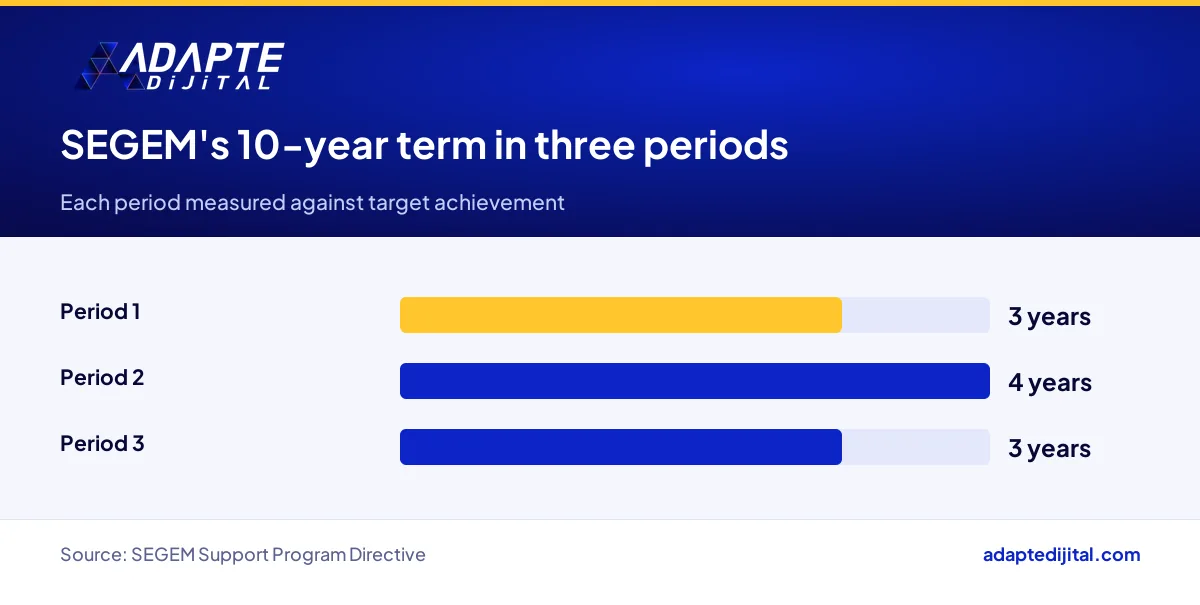
The directive splits the term into three periods: 3 years, 4 years and 3 years. Each period works as a threshold where the center’s targets are measured again.
According to the program page: personnel, software, training, consulting, organisation and promotion costs. The table on the page shows an amount only in the personnel row, and the sources do not make clear whether separate per-item limits exist.
The directive set the annual ceiling at TL 5,000,000 for the year it took effect. At the start of each calendar year it is updated by the average of CPI and domestic PPI; the announced limit for 2026 is TL 6,506,000.
The owner first looks for support the company itself could claim. Reading the program page, the owner sees the support goes to the center that gives the advice. The question changes: “Which center can help this business with a family constitution and production discipline?”
Institutionalising a family workshop is rarely solved alone. A center paid according to its own targets has a reason to deliver concrete work, and that gives the SME a reason to ask what those targets are.
For private companies, headcount, regional and activity code conditions apply together. A firm with a handful of consultants in one city has to cut its coat to fit its cloth and consider partnering with larger structures instead.
Model factories are structures set up under a cooperation protocol with the Ministry of Industry and Technology. SEGEM provides ten years of funding toward their operating costs, which means a long-term resource for training and consulting work.
SMEs that use these services, and software suppliers, since software is one of the supported costs. The supply of services on institutionalisation and productivity may widen. SMEs with an investment plan can pair consulting with financing tools such as KOSGEB’s Capacity Development Support Program.
Payment depends on cumulative target rates. If training attendance, consulting hours and results sit in scattered spreadsheets, measurement gets hard; the work goes back to square one and documents get hunted down at the end of each period.
Through search and local visibility. A center that clearly states its service topics, region and how to apply reaches the SMEs looking for it. One that stays silent online leaves its expertise sitting on the shelf.
Technology adoption is one of the centers’ service areas. For businesses considering AI investment, our article on the KOSGEB AI Loan covers a separate financing route.
The program page says applications are always open. The directive, however, states that call-based applications can be taken by approval of the KOSGEB President, so check for the latest announcement before applying.
KOSGEB staff carry out the preliminary evaluation, and juries formed by the Ministry of Industry and Technology and KOSGEB make the final one. The jury calendar and the time to a decision are not in the sources.
For centers or SMEs that want to sort out their web, search and visibility, we do this work together through our digital consulting service. Other announcements are in the grants and incentives news archive.
No. Under the directive, the beneficiaries are model factories, Competitive Sectors Program centers and joint-stock companies that contribute to their sector’s development. SMEs use these centers’ services.
The directive requires the beneficiary to be a joint-stock company. For companies without public ownership, an approved application leads to a new joint-stock company being founded, and that company receives the support.
According to the program page, applications are always open. Since the directive also allows call-based applications, check the current status on KOSGEB’s official page.