
KOSGEB Capacity Development Programme backs loans up to 20 million TL, who can apply?
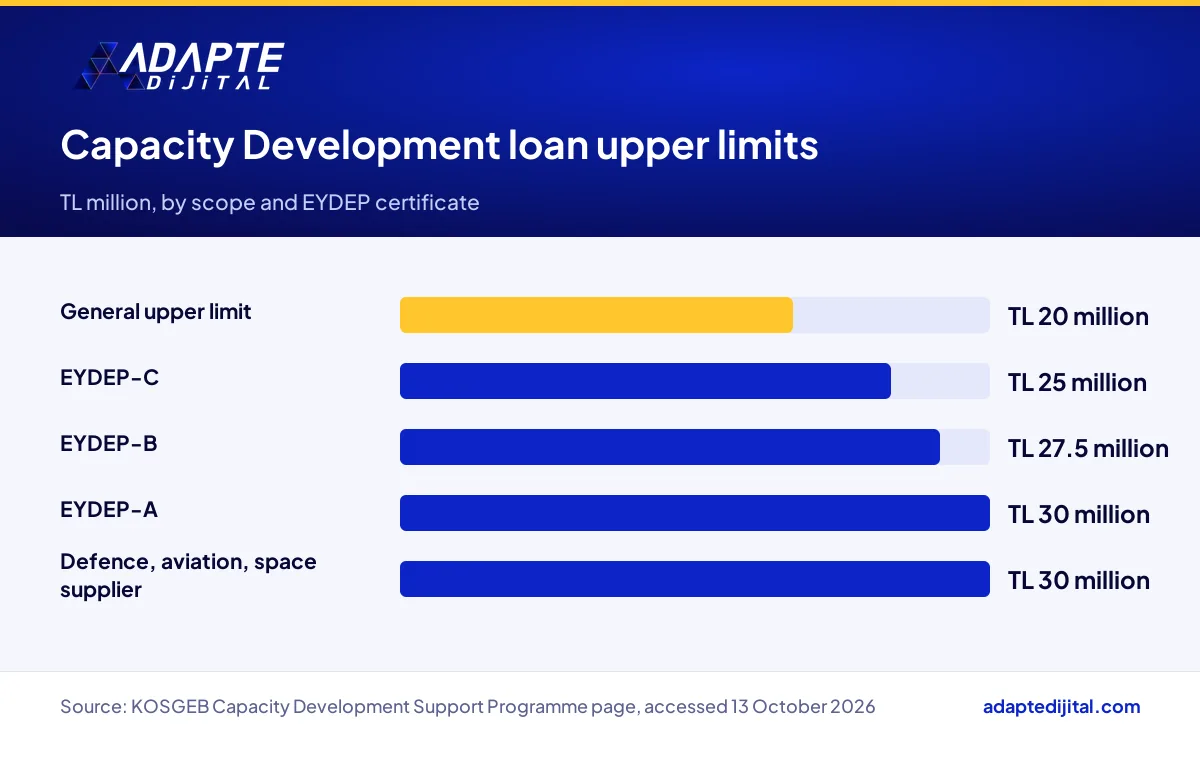
Small and medium-sized manufacturing and IT businesses can get non-repayable support on the interest or profit share of loans between TL 1,000,000 and TL 20,000,000 under KOSGEB’s Capacity Development Support Programme (KOSGEB programme page, accessed 13 October 2026). KOSGEB is Türkiye’s Small and Medium Enterprises Development Organization. For defence, aviation and space supplier development, and depending on the EYDEP certificate a business holds, the upper limit rises to TL 30,000,000.
What this means for you: you repay the loan principal to the bank, and KOSGEB’s support sits on the interest or profit-share side. Profit share is the participation-banking equivalent of interest. To get in, a business must meet the definition of a fast-growing business, and micro businesses cannot apply. The 2026 application dates are not on the programme page.
How much support does the KOSGEB Capacity Development Support Programme give, and on which loans?
The programme gives non-repayable support on the interest or profit share of loans between TL 1,000,000 and TL 20,000,000 taken from protocol banks. KOSGEB’s Capacity Development Support Programme page shows a TL 30,000,000 limit for defence, aviation and space supplier development.
Which SMEs can apply to the KOSGEB Capacity Development Programme?
Four conditions apply together: activity in NACE section C (manufacturing) or codes 61, 62, 63 or 72; an active KOSGEB Database entry with a current Business Declaration; small or medium size; and fast-growing status. Micro businesses cannot apply. How your size class is set is explained in our article on the five steps of the Business Declaration.
How do project period, loan maturity and bank choice work for a KOSGEB Capacity Development loan?
The project period is 24 months and can be extended to a maximum of 30 months by committee decision. Maximum loan maturity is 36 months, with equal quarterly instalments. The loan comes from a single institution chosen among Ziraat Bankası, Halkbank, VakıfBank and Ziraat Katılım, a participation bank.
Which businesses does the KOSGEB Capacity Development Programme suit, and which does it strain?
BU BÖLÜMÜN ÖZETİ
- Winning profile: the medium-sized manufacturer with documented growth
- Struggling profile: the micro or flat business
- Indirectly affected: exporters and the supply chain
The biggest winner is the manufacturer whose orders exceed capacity, whose machines are maxed out and whose headcount has grown. In autumn 2026, a medium-sized business in machinery, casting or automotive supply in Konya, Kayseri or Bursa fits this profile.
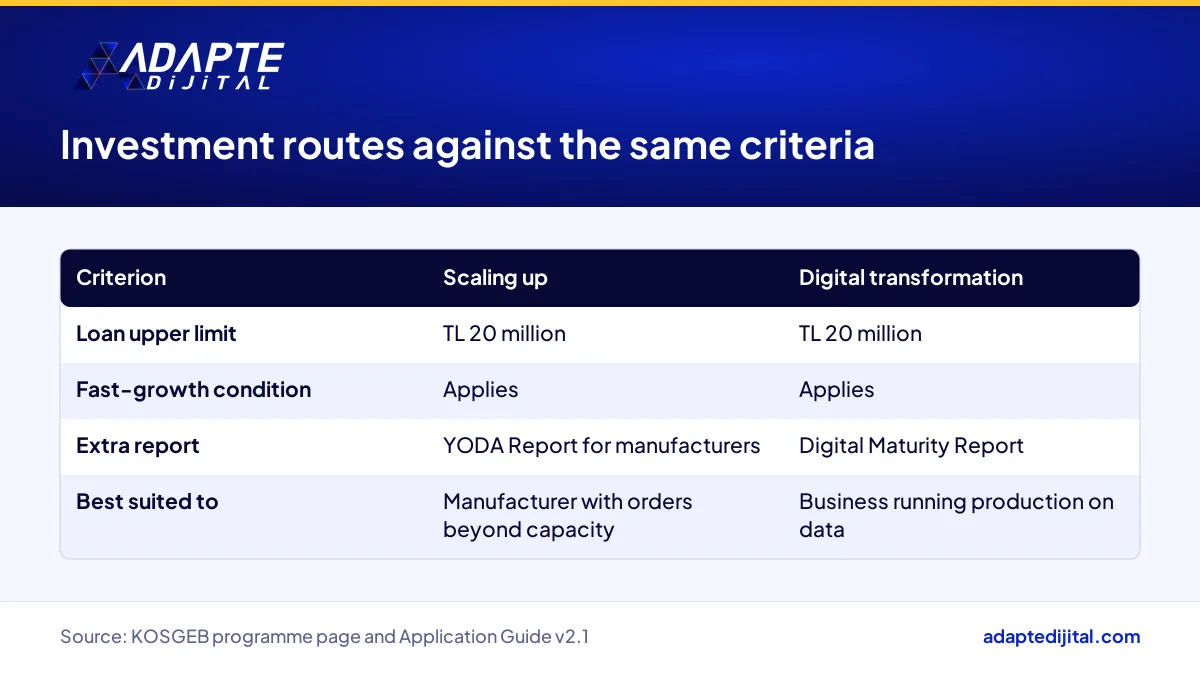
The table sets the programme’s three investment routes against the same criteria; the last row shows who each suits.
| Criterion | Scaling up | Digital transformation | Defence, aviation, space supplier |
|---|---|---|---|
| Loan upper limit | TL 20,000,000 | TL 20,000,000 | TL 30,000,000 |
| Fast-growth condition | Applies | Applies | Exempt if reported under protocol |
| Extra report | YODA Report for manufacturers | Digital Transformation/Maturity Report | No separate report stated |
| Best suited to | Manufacturer with orders beyond capacity | Business that wants to run production on data | SME in a large industrial supply chain |
Winning profile: the medium-sized manufacturer with documented growth
A business with clean three-year sales and employment data stands out because it can prove the condition. If orders are waiting at the door, machinery and mould investment and working capital can sit in the same loan.
Struggling profile: the micro or flat business
A workshop with fewer than 10 employees may stay in the micro class and cannot apply. A business whose till keeps turning over but whose turnover has been flat for three years does not meet the fast-growth definition either. If such a business is still at the founding stage, the Entrepreneur Support Programme is a closer door.
Indirectly affected: exporters and the supply chain
A producer moving into foreign markets should also weigh the Global Competitiveness Programme loan terms. An SME supplying parts to a large industrial company should ask that customer whether it falls under a protocol.
How can a KOSGEB Capacity Development loan be used for digital transformation investment?
The programme explicitly covers digital transformation investment, and software and purchased services are among the cost items. For this investment, a Digital Transformation/Maturity Assessment Report obtained within the last year is required. A business focused only on digital investment should also compare the SME Digital Transformation Programme interest support.
What should a business preparing for KOSGEB Capacity Development do this week?
BU BÖLÜMÜN ÖZETİ
- Calculate the growth condition with your own data
- Check the dates on your reports
- Sit down early with the bank and the project plan
Three preparations can start this week: test the growth condition with numbers, check report dates, and open a creditworthiness conversation with a bank. Applications go through the SME Information System, via the “Kapasite Geliştirme Destek Programı İşlemlerinin Yapılması” menu, with an e-Devlet login.
Calculate the growth condition with your own data
Check whether total premium days in the base year reach 3,600. Then work out the average annual growth in employment and net sales over three years. If one is below 10%, focus on the other.
Check the dates on your reports
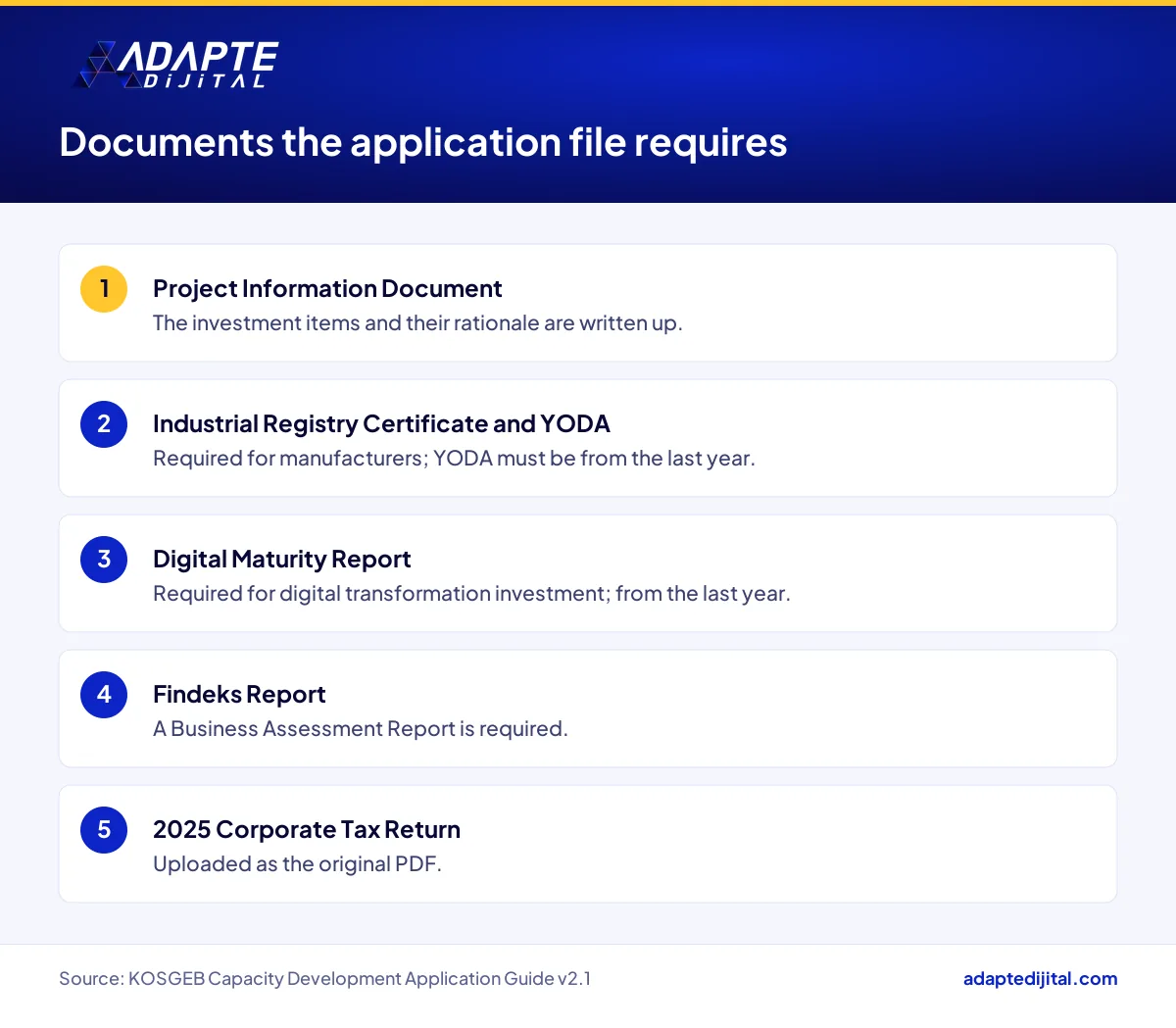
The YODA Report and the Digital Transformation/Maturity Report must have been obtained within the last year. Manufacturers also need an Industrial Registry Certificate. A report older than a year does not meet the requirement.
Sit down early with the bank and the project plan
Talk to one of the four protocol banks about your creditworthiness before the period opens. If you want to build the investment plan and the sales channel together, our digital consulting team handles that work.
Quick Summary
- The programme gives non-repayable support on the interest or profit share of loans between TL 1,000,000 and TL 20,000,000 (KOSGEB programme page).
- With an EYDEP certificate or defence supplier scope, the limit rises to TL 30,000,000 (KOSGEB programme page).
- Only small and medium, fast-growing manufacturing and IT businesses can apply (KOSGEB Directive).
- The project period is 24 months, maximum loan maturity 36 months, and the support rate is 20 points in the guide (KOSGEB Application Guide).
- Each business can use the programme only once (KOSGEB Application Guide).
Short Glossary
- Fast-growing business
- Fast-growing business is the definition used for a business that starts with at least 10 employees and grows employment or sales by an average of 10% a year over three years.
- YODA Report
- The YODA Report is the assessment document used in manufacturers’ applications, which must have been obtained within the last year.
- Support rate
- The support rate is the measure used by KOSGEB to express its contribution to the interest or profit share of the loan, given as 20 points in the guide.
Frequently Asked Questions
Next Step
To assess your growth condition and project size together, fill in the consult your expert form. Other current programmes are listed on our grants and incentives news page.
Support amounts and conditions can change; check the current terms on the institution’s official page before applying. This article is not financial or legal advice.
Sources: KOSGEB, Capacity Development Support Programme page (accessed 13 October 2026) · Capacity Development Application Guide, version 2.1 (August 2026) · Capacity Development Support Programme Directive
Updated: October 2026
Sık Sorulan Sorular
According to the programme page, the limit is TL 25,000,000 for an EYDEP-C certified business, TL 27,500,000 for EYDEP-B and TL 30,000,000 for EYDEP-A. The lower limit is TL 1,000,000 in every case.
The Application Guide gives the support rate as 20 points. The figure is set by a decision of the KOSGEB Presidency, and the rate on the date the loan is disbursed applies. The guide does not explain how those points translate into the interest or profit-share rate, so do not read it as a percentage.
The programme page lists five cost items: personnel, machinery-equipment and moulds, software, purchased services and working capital. YODA and Model Factory services also count under the interest/profit share support. The Directive sets no separate cap for purchased services or personnel.
Under the Directive, it is a business with at least 10 employees (3,600 premium days) in the base year that grew employment or net sales by an average of 10% or more a year over a three-year period. Growth in either indicator is enough. The employee base, however, is required from the start.
Alongside manufacturing, the programme page lists NACE codes 61, 62, 63 and 72. So the programme is open not only to factories but also to software houses and technology firms.
Teknogirişim Badge holders and supplier development businesses reported under a protocol are exempt. The protocol partners include the Presidency of Defence Industries, the Turkish Space Agency, TÜRKSAT and THY Teknik.
Under the Directive, an application goes through a check, then financial analysis, then an on-site inspection and finally the committee. Projects are scored out of 100, and anything below 50 is rejected. A positive creditworthiness assessment from at least one protocol bank is also required.
Periods are set in the Application and Assessment Calendar Form. There is no concrete date for the 2026 period on the programme page. An application not approved by the deadline is not assessed.
According to the Application Guide, only once. So set the loan amount against a three-year investment plan.
Production planning software, a quality tracking system, a B2B ordering portal or export e-commerce infrastructure may relate to the software and purchased-services items. Which spending counts as eligible becomes clear during the project assessment. Get your own quotes from suppliers and list them line by line in the Project Information Document.
A Findeks Business Assessment Report and the 2025 corporate tax return are required. When sales, stock and order data are scattered, the financial analysis stage gets harder.
More capacity means more product to sell. If B2B search, sector marketplaces and ad channels are not ready when the new line starts, output sits in the warehouse. Add to your loan plan which digital channel will sell the extra capacity.
No, under the Directive micro businesses cannot apply. The programme is open only to small and medium-sized businesses.
No, the business repays the loan to the bank. KOSGEB’s non-repayable support covers the interest or profit share of the loan.
According to the programme page, Ziraat Bankası, Halkbank, VakıfBank and Ziraat Katılım are the protocol institutions. A project can use a loan from only one institution.