
KOSGEB SME Digital Transformation Program subsidizes TL 20M loans, how to apply?
Small and medium-sized manufacturers in Türkiye can get non-repayable support for the interest on investment loans of TL 1 million to TL 20 million used for machinery, equipment, software and hardware under KOSGEB’s SME Digital Transformation Support Program (KOSGEB program page and Directive, Revision 06, accessed 13 October 2026). KOSGEB is Türkiye’s Small and Medium Enterprises Development Organization. The entry ticket is an approved digital transformation assessment report from an authorised consultant.
What it means for you: report first, loan second. Micro businesses and firms outside manufacturing cannot use the program. If you are a small or medium manufacturer with positive equity and an operating profit in at least one of the last three years, the process runs in eight steps.
Which businesses can apply to KOSGEB’s SME Digital Transformation Program?
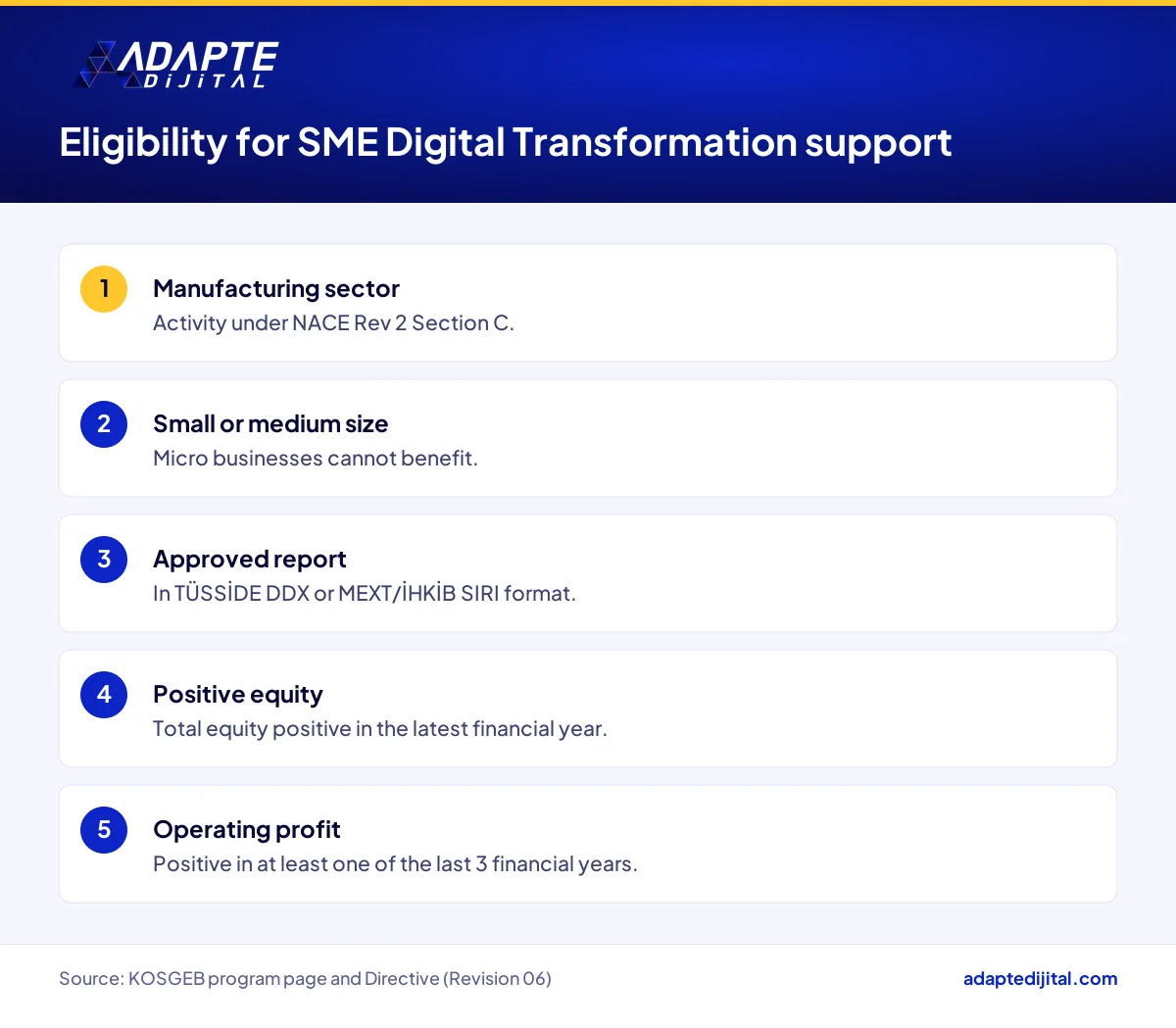
Businesses operating under NACE Rev 2 Section C (Manufacturing) that are small or medium-sized on the application date (Directive, Article 7). Micro businesses are excluded, and the firm must hold an approved report from a consultant authorised by TÜSSİDE, the MESS Technology Center (MEXT) or the İHKİB Digital Transformation Center. Two financial conditions apply on top.
How large a loan does SME Digital Transformation interest support cover?
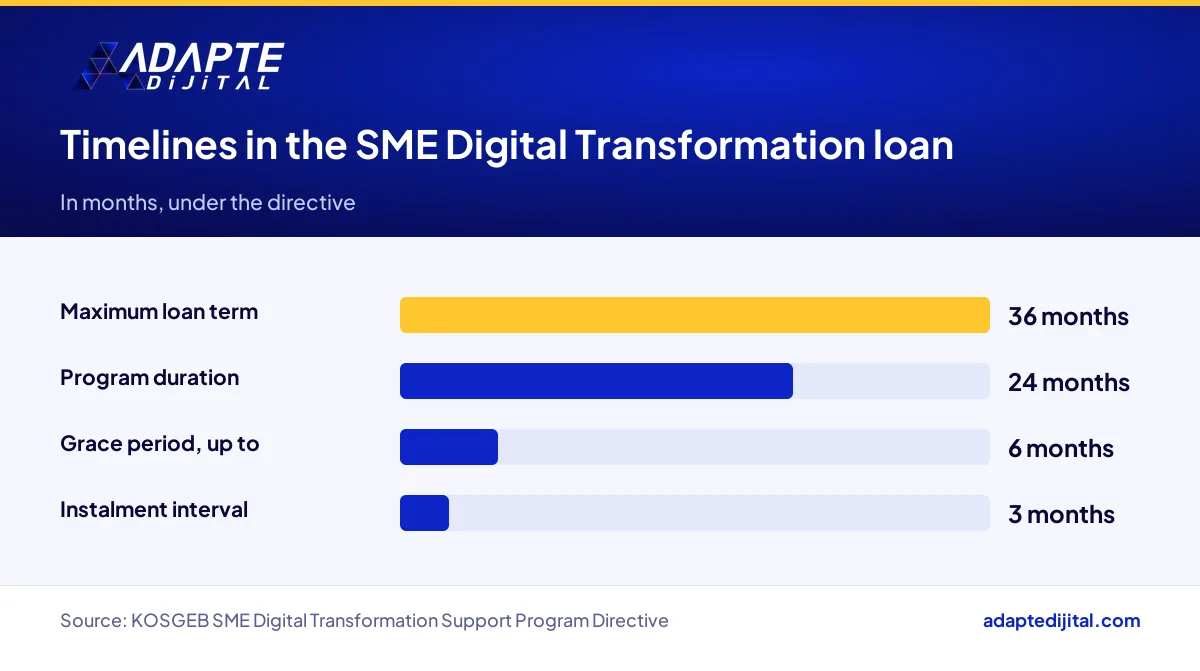
The investment loan floor is TL 1,000,000 and the ceiling TL 20,000,000 (Directive, Article 6). The table on the program page appears to swap the two figures; the FAQ and the directive both say TL 1-20 million, and this guide follows the directive. The maximum term is 36 months with equal quarterly instalments. If the bank agrees, a grace period of up to 6 months is possible.
How does an SME Digital Transformation application work, step by step?
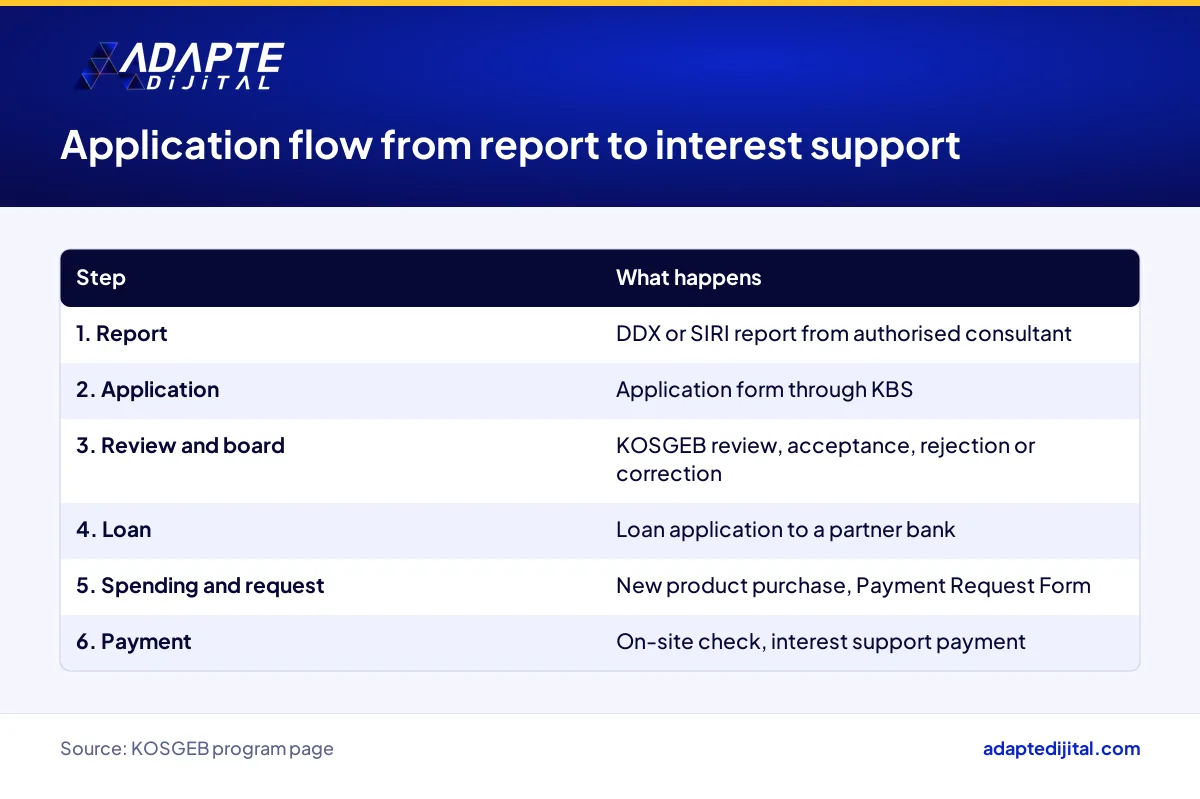
The process runs in eight steps from report to interest payment. You apply with an application form through the KOSGEB system or the e-Devlet link, Türkiye’s e-government portal, given on KOSGEB’s program page. The sources give time limits only where stated below; for costs, get your own quote.
- Report: get an approved DDX or SIRI assessment report from an authorised consultant; ask the consultant for a quote on cost.
- Application form: while the report is valid, fill in the form through KBS, the KOSGEB SME Information System.
- KOSGEB review: the application is checked against the conditions.
- Board decision: the board accepts, rejects or asks for corrections.
- Loan application: after acceptance, apply to one of the partner banks.
- Spending and instalments: buy new machinery, software and hardware, and pay the instalments.
- Payment request: submit the Payment Request Form through the system.
- On-site check: after the inspection report, the interest support is paid.
Which manufacturers does SME Digital Transformation support affect, and how?
The winner, in Türkiye this autumn of 2026, is the small or medium manufacturer with a solid balance sheet that wants to automate its production line. Those who struggle are businesses still at micro scale or failing the financial tests. Machinery, software and hardware suppliers and the pool of authorised consultants feel the effect indirectly.
How does SME Digital Transformation investment show up on a manufacturer’s digital side?
Because the program supports software and hardware, the investment’s output becomes measurable production data. Indicators such as machine downtime, scrap rate and order lead time start speaking the same language as the report’s roadmap.
What should a manufacturer do this week about SME Digital Transformation support?
Finish four checks this week: sector and size, financial statements, report status and investment list. The directive does not clearly tie the program to a call period, and the 31 May 2025 date in its Provisional Article 1 has passed. Do not commit spending before confirming with KOSGEB that the application route is open.
Quick Summary
- The program gives non-repayable support for the interest on TL 1-20 million investment loans taken by small and medium manufacturers (Directive).
- Micro businesses and sectors outside manufacturing cannot use the program.
- An approved digital transformation report in DDX or SIRI format is required before applying.
- The maximum loan term is 36 months, the program lasts 24 months and each business can use it once (Directive).
- The loan can only be taken from TEB, Türkiye İş Bankası and Yapı ve Kredi Bankası.
Short Glossary
- DDX
- DDX is the model used by TÜBİTAK TÜSSİDE to measure the digital maturity of manufacturing SMEs and draw up a roadmap.
- NACE Section C
- NACE Section C is the part of the economic activity classification used to define manufacturing.
- Grace period
- A grace period is the banking term used for the time at the start of a loan when no instalments are paid.
Frequently Asked Questions
Next Step
If you want your investment list, financial conditions and report timeline in one plan, fill in the consult your expert form, and we will review your application file together.
Support amounts and conditions can change; check the current terms on the institution’s official page before applying. This article is not financial or legal advice.
Sources: KOSGEB, SME Digital Transformation Support Program page (accessed 13 October 2026) · KOSGEB, SME Digital Transformation Support Program Directive (Revision 06, 9 October 2026)
Updated: October 2026
Sık Sorulan Sorular
Under the directive, total equity in the latest financial year must be positive. Operating profit must also be positive in at least one of the last three financial years. A workshop with negative equity and three loss-making years stops here.
The application must be made within the report’s validity or roadmap period. If the report states no period, the deadline is one year from the report’s approval (Directive, Article 7). The format is DDX for TÜSSİDE and SIRI for MEXT and İHKİB.
The loan funding comes from the EBRD, so activities on the EBRD’s list of ineligible sectors and activities cannot enter the program. Check that list before applying.
The support rate, expressed in points, is set by an approval of the KOSGEB President. The system calculates the interest support with a Support Calculation Table, using the rate valid on the date the loan is actually drawn. Since the current rate is not clearly stated on the page or in the directive, confirm it with KOSGEB before writing any figure into your budget.
The program runs for 24 months, and a business can use it only once. So bundle everything in the roadmap that fits within 24 months into one package.
The program page does not state the loan’s interest rate or bank conditions. These come from the partner banks’ own offers: TEB, Türkiye İş Bankası and Yapı ve Kredi Bankası. Getting written offers from all three is the clearest way to compare collateral and fees.
One mistake is ordering the machine before the report and the board decision, which reverses the program’s own sequence. Another is buying second-hand equipment, since the program requires purchased products to be new. A third is leaving the report in a drawer past its one-year window; once it lapses, no application is possible without a new report.
Yes. The digital transformation assessment support in KOSGEB’s YÖNDE Program covers this analysis 100 percent, non-repayable, up to TL 20,000 per service. Using YÖNDE for the report and this program for the loan interest ties both supports to the same investment.
Let’s say a metal, plastics, food or textile manufacturer wants to renew a CNC machine, move to production tracking software or add sensors to a line. That firm sits right in the program’s target. When orders are there but the line cannot keep up, having part of the interest burden covered shortens the investment’s payback.
Micro businesses, wholesale, retail and service sectors cannot apply. A manufacturer with negative equity or three years of operating losses also misses the conditions. For machinery investment backed by a loan, KOSGEB Capacity Development loan support is another option, with its own conditions. All current programs are in our grants and incentives news archive.
For machinery and software sellers, the buyer’s questions no longer stop at price; the buyer also asks whether the product is new and whether the invoice fits the project. DDX and SIRI consultants are the first stop, because every manufacturer seeking the loan needs their report first.
A manufacturer with shorter lead times and well-kept quality data can show them as concrete facts on its website and B2B marketplace storefront. When buyers searching for suppliers see capacity, certification and delivery information, the quote requests that come in are better qualified.
Machinery, software and hardware bought with the support cannot be sold, leased or transferred until one year after the final loan maturity. Keep equipment inventory and licence records tidy for that whole period.
Confirm in your records and your KOSGEB SME declaration that your activity code falls under Section C and that your size class is small or medium.
Get quotes from consultants authorised by TÜSSİDE, MEXT or İHKİB; the DDX consultant list is on the TÜSSİDE portal. Put the report’s approval date in your calendar, because the one-year application window starts that day.
Collect quotes for new products only, for every machine, software licence and piece of hardware, and see that the total fits the TL 1-20 million band. Checklist: manufacturing code, small or medium size, positive equity, operating profit in at least one year, valid report, quotes for new products, loan offers from three banks. We turn the roadmap into an investment plan with clients through our digital transformation management service.
No. Under the directive, the business must be small or medium-sized on the application date; micro businesses cannot use the program.
No. According to the program page, purchased products must be new to count as supported expenses.
From consultants certified or authorised by TÜSSİDE, MEXT or İHKİB; for the cost of the report, look at the assessment support in the YÖNDE program.