
Reis Gıda backs women farmers since 2019, how should a food brand build its supply?
Ahead of World Women Farmers’ Day on 15 October and World Food Day on 16 October, Reis Gıda issued a statement highlighting women producers and put its Reis Bakliyat Köyleri (Reis Pulse Villages) programme, started with women farmers in 2019, back in the spotlight (Perakende.org, 14 October 2026). The statement is not a new project launch, and the report gives no current scope: no number of villages, women producers or purchase volumes.
For a packaged pulses brand in Türkiye in autumn 2026, with the UN naming 2026 the International Year of the Woman Farmer, the supply story becomes part of the shelf decision. It only holds up with contracts, records and traceability behind it.
What is in Reis Gıda’s women farmers statement, and what is missing?
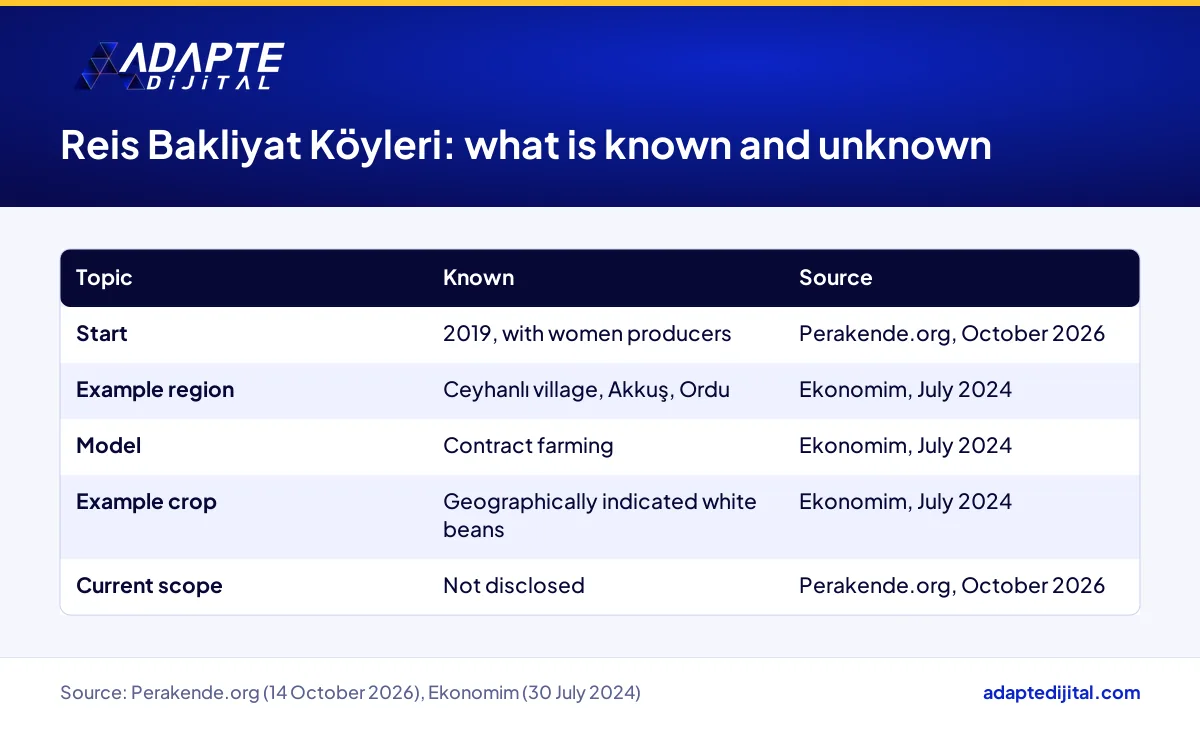
The statement gives the programme’s name, its start year and the company’s commitment to producers. According to Perakende.org, a Turkish retail news site, Reis Bakliyat Köyleri began with women producers in 2019. How many villages, how many women, which crops and on what price terms are all missing from the report.
How can a food brand like Reis Gıda build supply with local and women producers?
In three steps: choose the region and crop, sign a written contract, keep measurable records. The model visible in Reis’s Akkuş example is contract farming. Purchase guarantees and price terms do not appear in any source. If you build your own model, put those two points at the very top of the contract.
Who does Reis Gıda’s focus on women producers affect, and how?
It matters most to packaged pulses and dry food brands, since the brand next door on the shelf faces the same question. The winners are small and mid-sized brands that already source from local producers and can document it. The ones under pressure carry a local-sourcing claim on the label without keeping the records. Supermarket buying teams and private-label contract manufacturers feel it indirectly.
How should a brand like Reis Gıda tell a women-producer story on the shelf and on the pack?
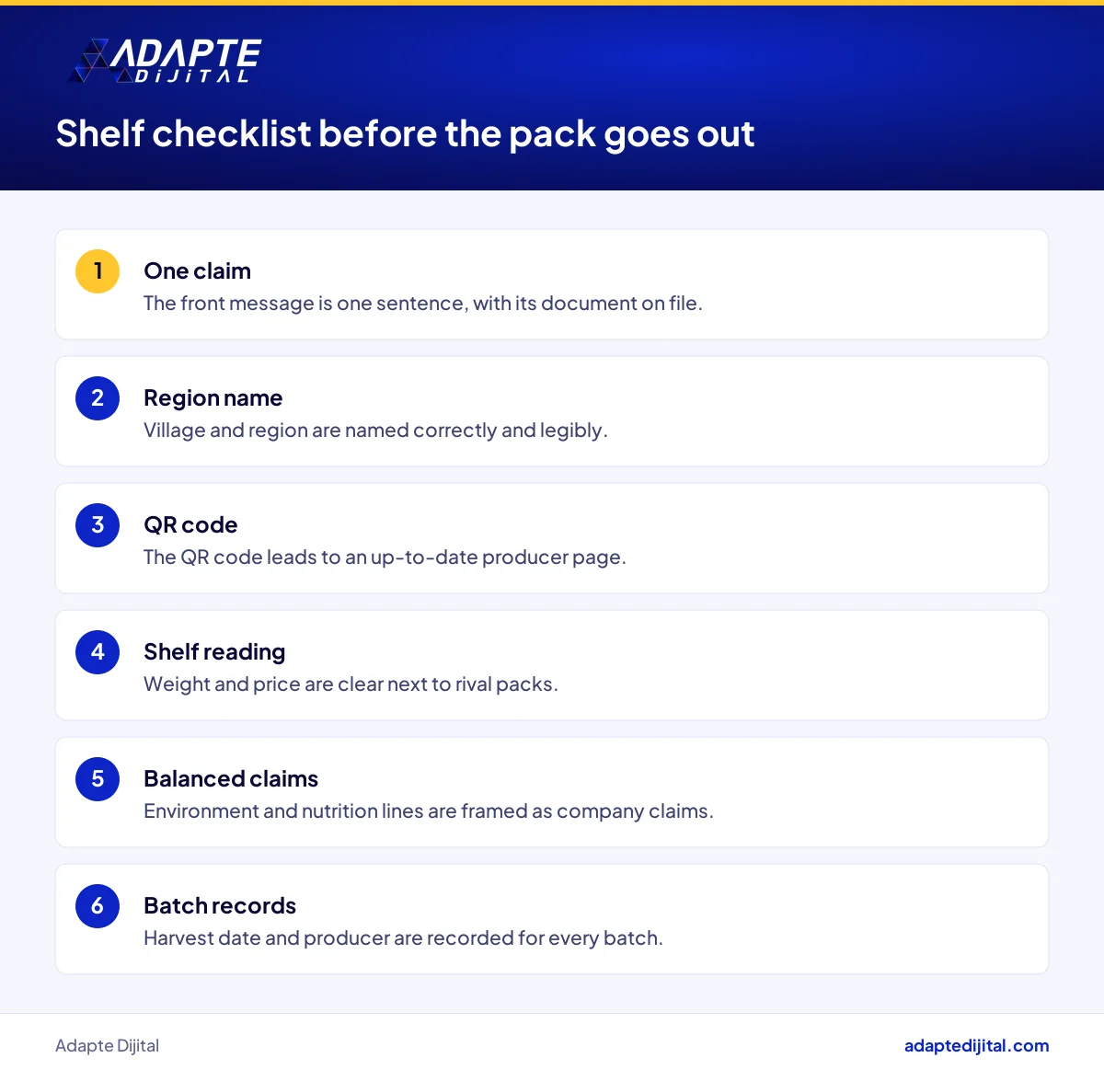
Briefly, with proof, and with one message. In front of the shelf, the shopper takes in price, weight and the one line on the front in a few seconds; the longer story belongs on the back or behind a QR code. Every word on the front should be one you can back with a document when asked.
How does a producer story like Reis Gıda’s become visible online?
The page behind the QR code, the search result and the marketplace listing should all say the same thing. The shopper scans the pack in store, searches the brand at home and reads reviews on the marketplace. Three different stories cost trust, so let one producer page feed every channel.
What should a food brand owner learn from Reis Gıda and do this week on supply?
Three jobs fit into this week: map your current suppliers by region and producer, gather the evidence for every claim on your label in one file, and book a first meeting with a pilot village or cooperative.
Quick Summary
- Reis Gıda issued a statement on women producers ahead of World Women Farmers’ Day on 15 October (Perakende.org, 14 October 2026).
- According to the report, the Reis Bakliyat Köyleri programme began with women producers in 2019; its current scope was not disclosed.
- In the Ordu Akkuş example, organic and geographically indicated white beans are grown under contract farming (Ekonomim, July 2024).
- The FAO projects that closing farm productivity and wage gaps could add about 1 trillion dollars to global GDP (FAO, April 2023).
- A women-producer message earns trust on the shelf when contracts and traceability records back it.
Short Glossary
- Contract farming
- Contract farming is the supply model used when a buyer and a producer agree on volume and quality before planting.
- Geographical indication
- A geographical indication is the type of registration used to identify and protect a product whose qualities come from a specific region.
- Traceability
- Traceability is the method used to show, with records, every stage a product passes through from field to shelf.
Frequently Asked Questions
Next Step
If you want to weigh your supply story before taking it to the shelf and online, fill in our consult your expert form.
Sources: Perakende.org, Reis Gıda’s women farmers statement, 14 October 2026 · FAO, women in agrifood systems report announcement, 13 April 2023 · Ekonomim, Reis Gıda Bakliyat Köyleri report, 30 July 2024 · FAO, International Year of the Woman Farmer 2026 page (linked in the text)
Updated: October 2026
Sık Sorulan Sorular
Işılay Reis of Reis Gıda speaks in the statement; the report does not give her title. According to Işılay Reis, supporting producers and domestic farming has long been a core responsibility for the company.
A July 2024 report by Ekonomim, a Turkish business outlet, describes the project in Ceyhanlı, a village in the Akkuş district of Ordu, on a plateau at 1,400 metres. There, organic and geographically indicated white beans are grown under a contract farming model, aimed mainly at local women and young producers. The report adds that similar projects run in other regions.
According to Reis Gıda, efficient use of soil and water supports sustainability, and traditional products keep their natural structure and nutritional value. The company also describes pulses as a source of protein, fibre, vitamins and minerals. These are the brand’s own claims; the report includes no independent measurement.
Pick a crop the region already knows; a geographically indicated product brings a quality standard and a ready-made story. Villages where women already farm may give you a head start, though that is a judgement call, not a rule.
Purchase volume, quality criteria, when the price is set and payment terms. Producers need a plain-language contract and a face-to-face explanation before they sign. With women producers, whose name the contract and payments go under is a separate decision.
A brand that cannot show which village and batch a pack came from cannot defend its story either. If batch numbers, harvest dates and producer records start in the first season, later certification and audits get easier. Without records, the story is just talk.
When a product with a women-producer or local-sourcing message comes up for listing, the buying team wants proof. A sample contract, a producer list and batch records can shorten the time to listing.
It can, but it takes steady volume and the same quality every season. Inconsistent quality can end even a good story in the first season.
A producer story takes space on the pack: village name, region, QR code. For another example of packaging carrying a social message, see Fersan’s protocol with MEMEDER.
The shelf checklist comes down to six questions. Is the front claim one sentence, with the document on file? Is the village or region named correctly, and does the QR code lead to the producer page? Are weight and price legible next to rival packs, and are the environmental and nutrition lines framed as “according to the company”?
Unmeasured environmental claims, unsourced nutrition promises and hard-to-verify words such as “best” or “first”. Wording like that can fall under advertising and labelling rules. Verify with the official source; this is not legal or financial advice.
A shelf is less a shop window than a crowded bus stop: everyone glances in a hurry and reads the clearest sign. The women-producer message can be part of that sign, not all of it.
Region, crop, harvest period, working model and the date of the last update. If there are figures, give their source and date; if there are none, do not invent them. Use photos of real producers, with permission.
Shoppers search “where do these beans come from”, “are they organic”, “do they have a geographical indication”. A product page that answers those plainly has a better chance of being cited in search results and AI answers.
A one-day post does not build lasting visibility. The FAO’s International Year of the Woman Farmer 2026 page draws attention all year to women’s access to land, finance and training. Plan brand content around harvest and season, not a single day.
For each SKU, write down which region the raw material comes from and through which middlemen. The product with the fewest middlemen is the first candidate for a direct contract. Start the list with the products that add most to your average basket value.
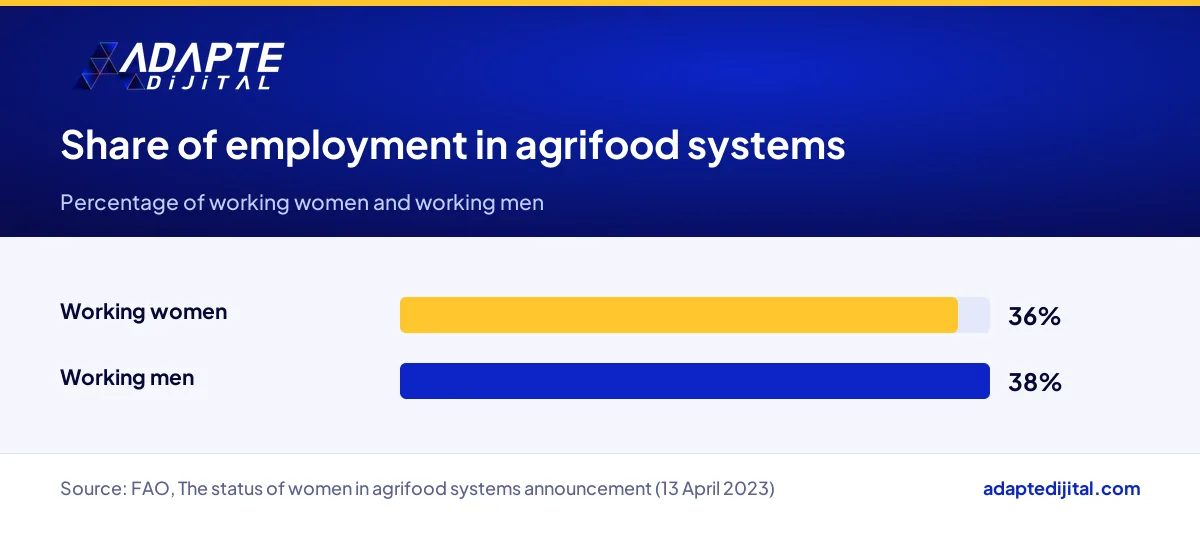
According to the FAO’s 2023 report, 36% of working women and 38% of working men are employed in agrifood systems. The same report projects that closing the gender gap in farm productivity and the wage gap in agricultural employment could add about 1 trillion dollars to global GDP and cut the number of food-insecure people by 45 million. These are projections, and a brand should never present them as its own contribution.
Aligning the supply story with product, packaging and digital channels is part of our brand consultancy work. For the decision logic on the chain-growth side, see our piece on Dürümle’s Forum Diyarbakır opening.
The Perakende.org report of 14 October 2026 gives no number of villages, women producers or product volume. For the current scope, wait for the company’s official statements.
You can, but you need to prove it with contracts, a producer list and batch records. Check labelling rules with the official source; this is not legal advice.
The sources give no figure on this. Cost depends on purchase guarantees, quality criteria and the number of middlemen, so test it against your own supply numbers.