
Eataly Istanbul gives six comms tasks to Pura Vida, what should a restaurant outsource?
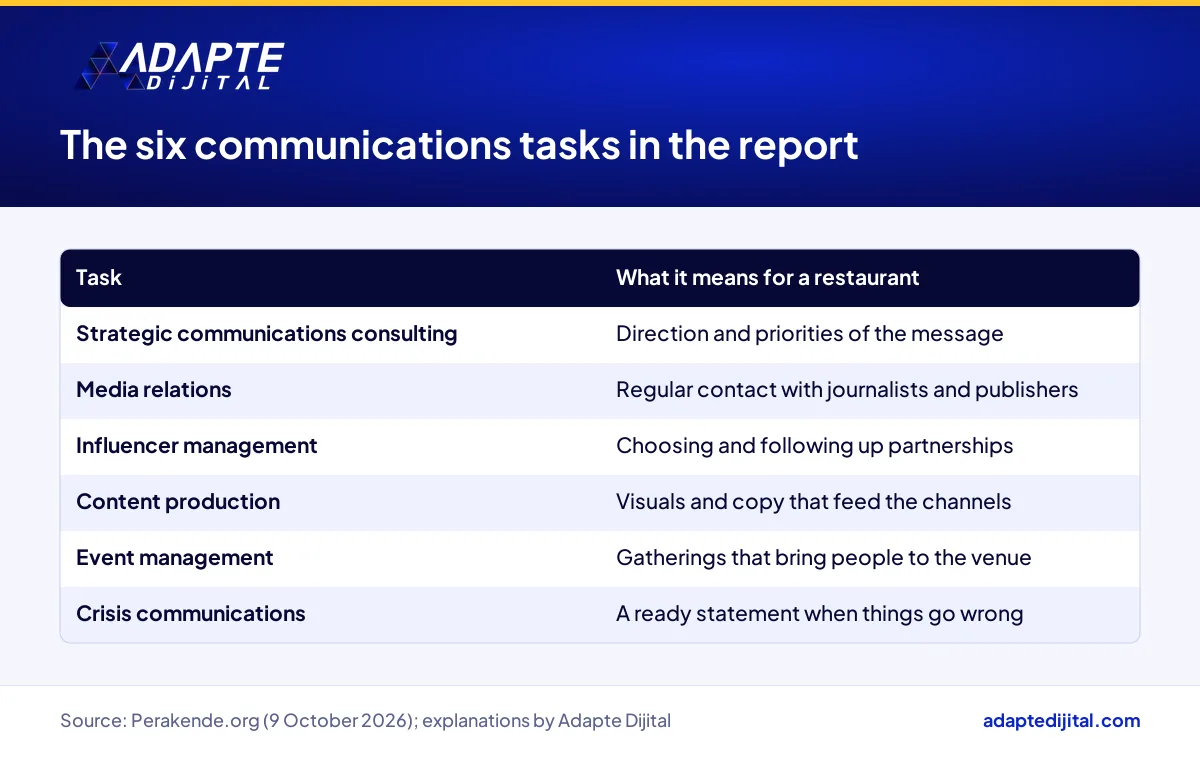
Pura Vida İletişim, an independent communications agency, will handle communications for Eataly Istanbul and Terrazza Italia, the restaurant that operates under the Eataly roof (Perakende.org, 9 October 2026). The scope covers six areas: strategic communications consulting, media relations, influencer management, content production, event management and crisis communications.
If you run a restaurant or a food retail business in Istanbul in autumn 2026, here is what it means: communications is not one job but a set of tasks you can define one by one. The report gives no contract length, budget or start date. What it does give is the list of tasks, and that list makes a solid skeleton for your own agency brief.
What does Eataly Istanbul’s communications brief to Pura Vida İletişim cover?
It covers six tasks and two brands together. According to the report, the aim is to bring Eataly’s and Terrazza Italia’s stories to a wider audience by highlighting each brand’s own identity and experience. The report does not say when the contract starts, how long it runs or who the previous agency was. The sources also do not name the company that operates Eataly in Türkiye.
Which communications tasks should a restaurant like Eataly Istanbul outsource?
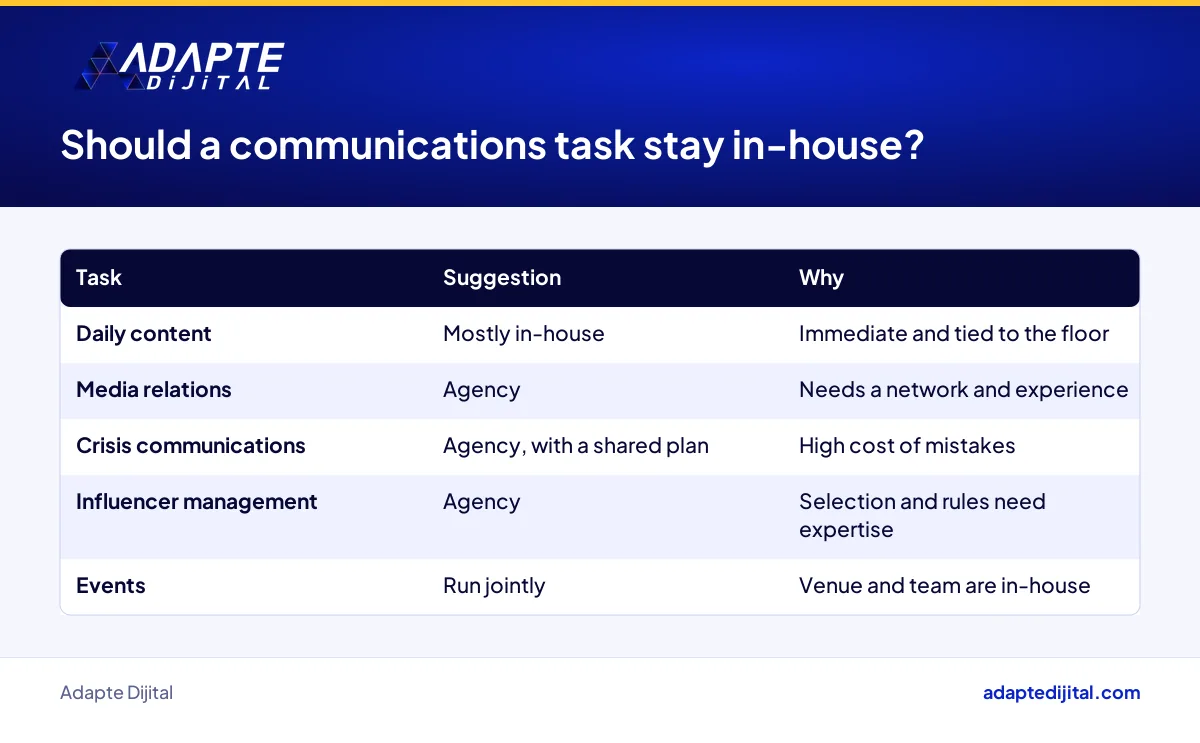
Outsource the tasks your team lacks expertise for and that need continuity. Media relations and crisis communications call for experience most restaurant teams do not have on staff. Daily content, on the other hand, needs to be close to the kitchen and the dining room, so keeping some of it in-house protects speed. In the Eataly case, all six tasks go to one agency, but every business works at a different scale.
What should a restaurant write in a communications brief, as Eataly Istanbul’s six-task scope suggests?
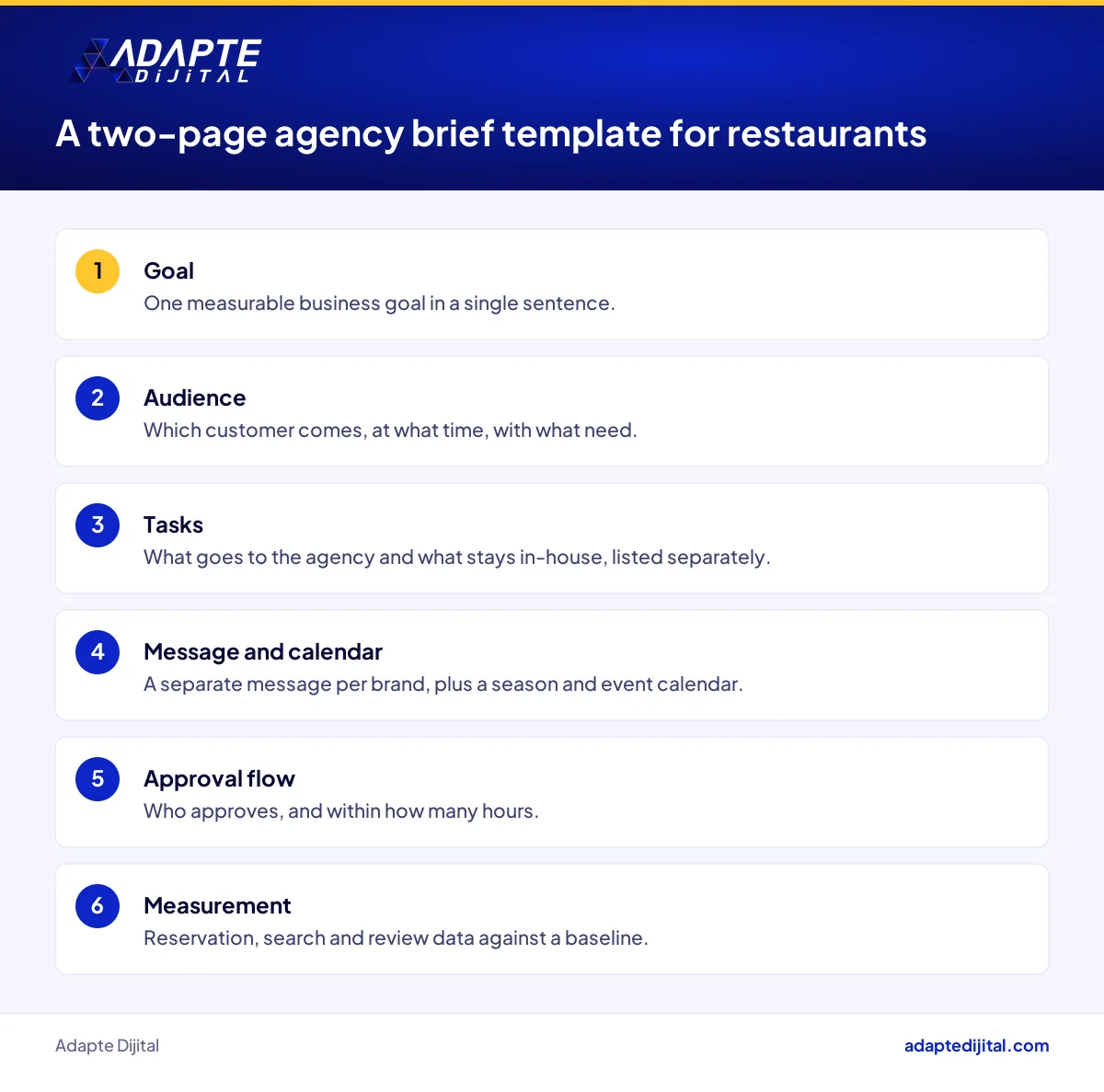
Seven headings: goal, audience, tasks, message, calendar, approval flow and measurement. A brief lets the agency spend its first month working instead of guessing. A good brief fits on two pages and gives one clear answer under each heading.
Who does Eataly Istanbul’s agency decision affect, and how?
Upscale restaurants that run communications in-house may take it as a prompt to rethink their own job descriptions. The likely winners are restaurants and food retailers that write their communications tasks down clearly. The ones under pressure tell an agency “make us known” and give no yardstick. Indirectly affected are food tenants in malls and publishers who produce food content.
How can a restaurant like Eataly Istanbul measure agency communications online?
With reservation, search and review data. After a press story or an influencer post goes out, track branded searches, reservation numbers and direction requests on the business profile. Communication that is never measured looks great in a report, but if the till stays quiet, nobody notices.
What should a restaurant owner do this week before working with an agency, as Eataly Istanbul did?
Three jobs fit into this week: list who currently does which communications job, pick the tasks to hand off, and write the two-page brief. Those three turn the agency meeting from an introduction into a working session.
Building the digital media side together
Bringing the brief’s digital tasks, meaning ads, content and measurement, into one plan is part of our digital media consulting work. You can read how communications priorities shift when a chain’s management team changes through CarrefourSA’s appointments.
Quick Summary
- Pura Vida İletişim will handle communications for Eataly Istanbul and Terrazza Italia (Perakende.org, 9 October 2026).
- The scope covers six tasks: strategy, media relations, influencers, content, events and crisis communications.
- The sources give no contract length or budget and do not name the company that operates Eataly in Türkiye.
- Terrazza Italia is listed in the MICHELIN Guide Istanbul selection without a star or Bib Gourmand distinction.
- A restaurant’s agency brief should cover goal, audience, tasks, message, calendar, approval and measurement.
Short Glossary
- Brief
- A brief is the short document used to give an agency a job’s goal, scope and expectations in writing.
- Crisis communications
- Crisis communications is the area of communications used to plan what a brand tells the public and customers during an event that puts it in difficulty.
- Media relations
- Media relations is the communications work used to keep a steady flow of information between a brand and journalists and publishers.
Frequently Asked Questions
Next Step
If you want to sharpen your communications brief before meeting an agency, fill in our consult your expert form.
Sources: Perakende.org, Eataly and Terrazza Italia communications report, 9 October 2026 · MICHELIN Guide, Terrazza Italia page (accessed 14 October 2026) · ICE, Eataly Türkiye page (linked in the text)
Updated: October 2026
Sık Sorulan Sorular
According to Perakende.org, Eataly is an Italian food hall that combines restaurant areas with a wide-ranging grocery market. According to ICE, the Italian Trade Agency, Eataly is an Italian chain founded in 2004, with a store at Zorlu Center in Istanbul.
Terrazza Italia sits on Zorlu Center’s bridge level, with a terrace overlooking the city skyline (Perakende.org). According to the report, chef Claudio Chinali’s menu combines Italian culinary tradition with local Turkish produce. The restaurant appears in the MICHELIN Guide Istanbul selection; the guide page shows no star or Bib Gourmand distinction.
Strategy sets the direction of the message. Media relations and influencer management carry visibility, and content production feeds the channels. Event management brings people into the venue, while crisis communications protects the brand when things go wrong.
The dish of the day, a new product reaching the shelf, short videos from the kitchen. These are immediate jobs tied to the floor. Sending photos to an agency every day can be slower than one person on the team posting from a phone.
A food complaint, a wave of bad reviews or a service failure can grow within hours. If nobody has written down who speaks and what gets said, the floor manager ends up improvising on the phone. A crisis plan prepared in advance reduces that risk.
Paid posts, or posts made in return for products, may need clear ad labelling. Advertising rules in Türkiye can change, so verify with the official source; this is not legal or financial advice.
Picture a restaurant owner sitting by the till after service, filling in the template line by line. Under goal, one sentence such as “fill more weekday lunch tables”. Under audience, the office worker who comes in at lunch; under tasks, only media relations and events. Calendar, approval flow and measurement follow with the same simplicity.
Yes, but each brand needs its own message line. In the Eataly case, the separate identities of the grocery market and the terrace restaurant are stressed. A market shopper looks for shelves and products, a restaurant guest for a table and an experience; one sentence cannot speak to both.
If agency content circulates for three days between the chef, the general manager and the owner, the news goes stale. Write down at the start who approves what and within how many hours. Approval speed is the least visible but most decisive part of communications.
Eataly Istanbul operates inside Zorlu Center, where mall traffic and a venue’s own audience are two different things. We look at how chains choose mall locations through Dürümle’s Forum Diyarbakır opening. When the location decision and the communications decision are made together, less of the opening goes to waste.
Not all six tasks. For a neighbourhood restaurant, a good business profile, regular content and one person who knows what to say in a crisis are often enough. Tasks get added one by one as the business grows.
A foreign food retailer in Türkiye has to explain both the product and the culture behind it. According to ICE’s Eataly Türkiye page, the Italian Trade Agency runs a cooperation to promote Italian products at Eataly’s store in Türkiye. Institutional promotion and brand communications should sit on the same calendar.
Branded searches, reservations and orders, profile visits, review count and rating. Record a starting value for each indicator before work with the agency begins. Comparisons only make sense against that baseline.
Use a separate booking code or link for each partnership. Match reservations in the days after the post to that code. Likes alone are not a sales signal; look at whether tables fill.
Being in a selection such as the MICHELIN Guide gives search results a trusted outside reference. The restaurant’s own site and business profile should carry that information accurately. Price level, address and cuisine type should read the same on every channel.
Ask three questions for each task: does someone on the team know this job, is it regular every week, and is the cost of a mistake high? If nobody knows it and mistakes are costly, outsource it. Regular but simple jobs can stay in-house.
Ask about restaurant and food experience, who is reachable in a crisis and how often reporting happens. Contract length and termination terms belong in the first meeting too.
The Perakende.org report of 9 October 2026 gives no contract length, start date or budget. Check the parties’ official statements for that information.
Not every task needs an agency. Handing off the tasks your team cannot cover and where mistakes are costly, while keeping daily content in-house, is a balanced route for most small businesses.
No, but a budget range helps the agency propose a realistic plan. Without one, proposals cannot be compared with each other.