
Digital company scheme enters the 2027-2029 programme, what will a one-stop office bring?
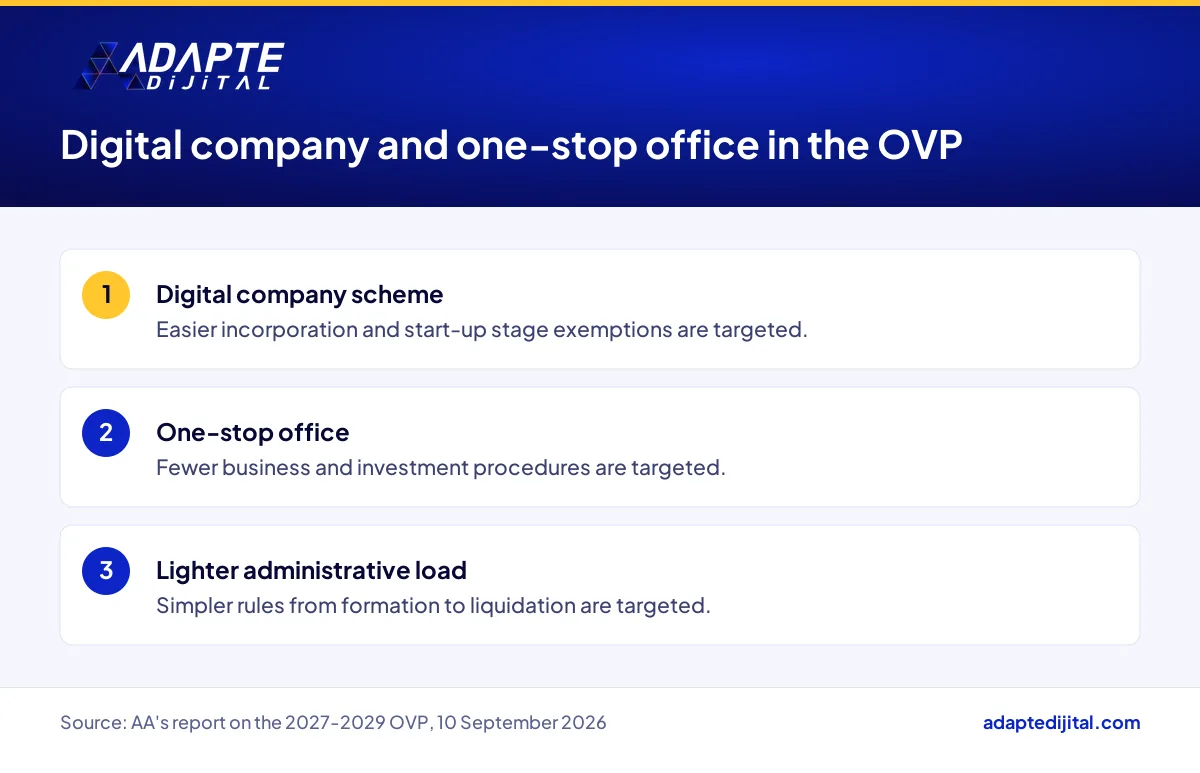
Türkiye’s 2027-2029 Medium-Term Programme targets a digital company (dijital şirket) scheme offering easier incorporation and start-up stage exemptions for technology-based ventures, plus a one-stop office to cut business and investment procedures (AA’s report on the programme, 10 September 2026). The programme, known in Türkiye as the OVP, was published by Presidential Decision 11752 in the Official Gazette of 6 September 2026, issue 33362 (repeat issue).
What this means for you: these are goals, not rights in force. No timetable, responsible body or scope for the exemptions has been announced, and the Ministry’s digital company definition had not been published as of 14 October 2026. The only concrete provision in force today is the 3-year exemption from TOBB and chamber dues under Law 7582.
What does the 2027-2029 Medium-Term Programme foresee for the digital company scheme?
According to AA’s report, three things: easier incorporation and start-up exemptions through the digital company scheme, fewer procedures through a one-stop office, and lighter administrative burdens from company formation to liquidation. The programme was prepared jointly by the Presidency of Strategy and Budget and the Ministry of Treasury and Finance. Reports do not give the section or measure number.
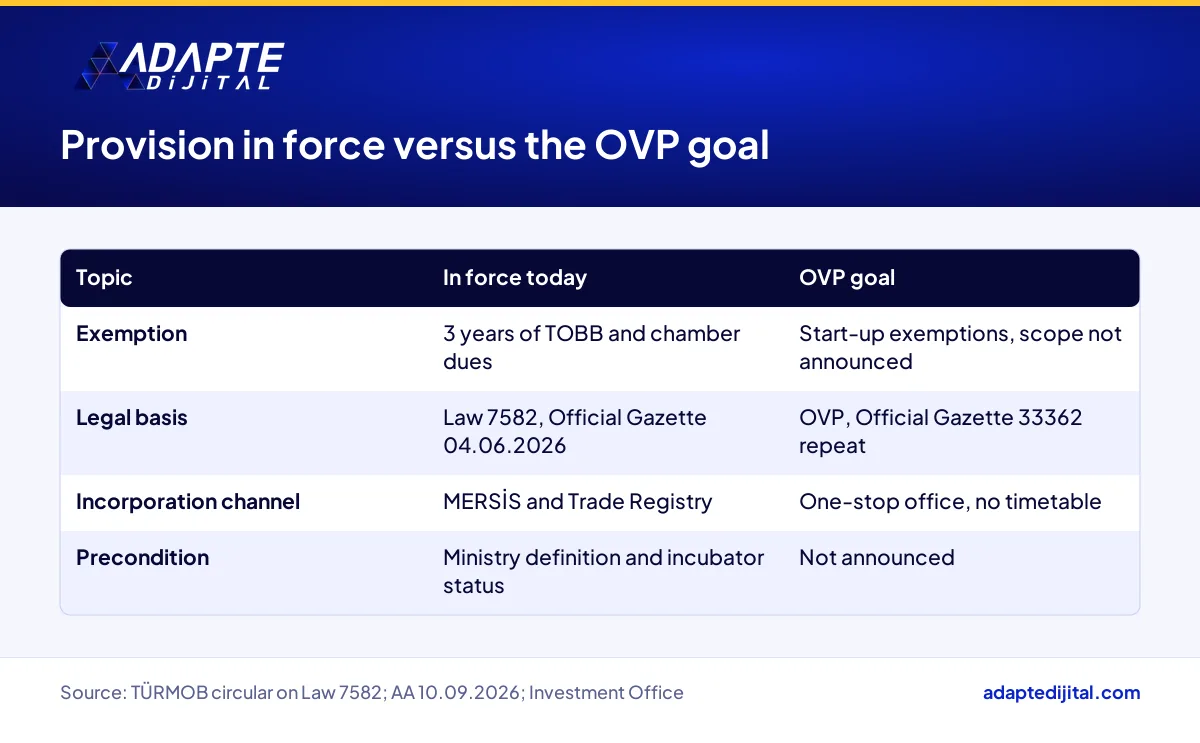
How does the OVP’s digital company goal differ from today’s 3-year dues exemption?
The dues exemption is a law in force; the OVP exemptions are goals. Law 7582 exempts companies that fit the Ministry’s definition and are founded by entrepreneurs with incubator status from TOBB, chamber and exchange fees and dues for up to 3 years. TOBB is Türkiye’s Union of Chambers and Commodity Exchanges. Whether the OVP’s start-up exemptions are the same thing is unknown.
When and how will a one-stop office change a founder’s incorporation procedures?
There is no official answer on timing. According to AA’s report, business and investment procedures will be reduced through a one-stop office to be set up. Which body will host it, whether it will run through the same channel as the digital company, and its timetable have not been announced.
Who do the digital company and one-stop office goals affect, and how?
New technology-based ventures are affected most: software houses, SaaS startups, small app development teams. Founders with foreign partners would be the second group to gain if the document trail gets shorter. Accountants, incorporation consultants and technopark managers are affected indirectly, because their workflows may be redrawn.
What could the digital company scheme and one-stop office change on the web and data side?
If incorporation is meant to run fully digitally, a company’s first data will enter the state’s systems digitally. Here’s something most people don’t know: much of that groundwork already pays off today. An e-signature, a registered electronic mail address and a tidy digital archive help with current procedures as well. A website, domain and business email naturally belong in the same file.
What should a founder thinking of delaying incorporation to 2027 do this week?
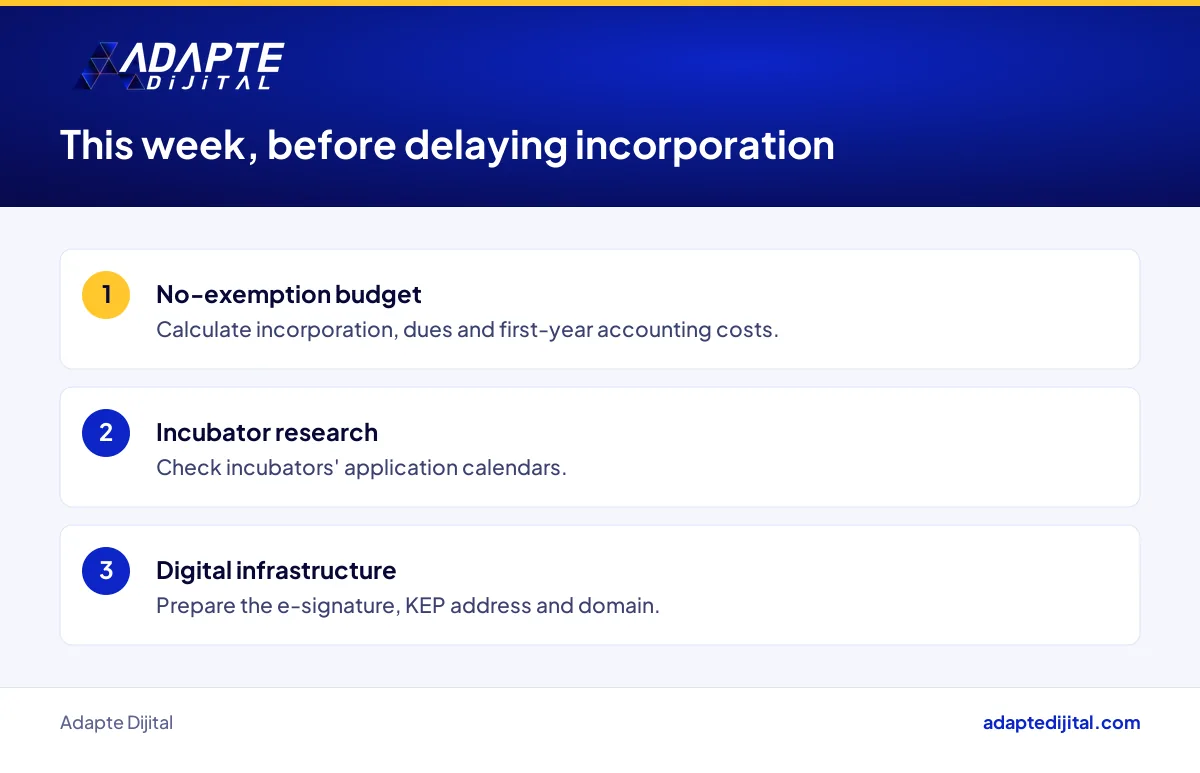
Tie the decision to your sales calendar, not to the OVP. Three tasks fit into this week: calculate setup costs without any exemption, look into incubator options, and set up your digital infrastructure. Waiting idle can mean losing customers over an exemption with no date.
Quick Summary
- The 2027-2029 OVP was published in the Official Gazette of 6 September 2026, issue 33362 (repeat issue).
- According to AA’s report, the OVP targets easier incorporation and start-up exemptions through the digital company scheme (AA, 10 September 2026).
- The one-stop office’s host body, timetable and workings have not been announced.
- The only provision in force today is the 3-year TOBB and chamber dues exemption under Law 7582 (Official Gazette, 4 June 2026).
- The Ministry’s digital company definition had not been published as of 14 October 2026.
Short Glossary
- Medium-Term Programme
- Medium-Term Programme is the official plan, issued by Presidential Decision, used to set Türkiye’s three-year macroeconomic targets and policy priorities.
- One-stop office
- One-stop office is the name of the administrative service model used to handle business and investment procedures from a single point.
- Incubator entrepreneur
- Incubator entrepreneur is the status used under Law 4691 for founders operating in an incubation centre.
Frequently Asked Questions
Next Step
To review your incorporation timeline together, fill in the consult your expert form. Our digital company page, where we collect every question on the topic, also sums up the current status.
The definition and conditions of the digital company scheme are not final yet; check the latest information with the Ministry of Industry and Technology, KOSGEB and the Official Gazette before deciding. This is not legal or financial advice.
Support amounts and conditions can change; check the current terms on the institution’s official page before applying. This article is not financial or legal advice.
Sources: Anadolu Agency, Business and investment environment to be strengthened with institutional and digital steps (10 September 2026) · Official Gazette, 6 September 2026, issue 33362 (repeat issue), Presidential Decision 11752 · Presidency of Strategy and Budget, OVP 2027-2029 press release (6 September 2026) · TÜRMOB, circular on Law 7582 · KOSGEB, Entrepreneur Support Programme renewed (12 October 2026)
Updated: October 2026
Sık Sorulan Sorular
The programme was published by Presidential Decision 11752 in the Official Gazette of 6 September 2026, issue 33362 (repeat issue). The Presidency of Strategy and Budget announced it the same day in an OVP 2027-2029 press release. That press release does not mention the digital company or the one-stop office.
AA’s report is dated 10 September 2026 and says it was compiled from the OVP. The programme itself was published on 6 September. Keep the two dates apart when citing.
The exact wording of the relevant OVP measure could not be read for this article. The points are therefore given as AA’s report, not as a quotation from the programme. The safest way to check the wording is the Official Gazette’s issue 33362 (repeat issue).
The exemption has two conditions: fitting the Ministry’s digital company definition and holding incubator entrepreneur status. Since the definition is not out, the provision stays on paper. Our article on what a digital company is in Türkiye explains where it sits in the law.
That has not been announced. No tax, fee or dues item is listed. Writing the exemption into your business plan as income before this is cleared up makes things harder, not easier.
KOSGEB, Türkiye’s Small and Medium Enterprises Development Organization, renewed its Entrepreneur Support Programme on 12 October 2026. It provides non-repayable support equal to the platform registration fee for businesses that fit the digital company definition. That support also depends on the same definition.
According to the Investment Office guide, registration runs through MERSİS, Türkiye’s central trade registry system, and is completed the same day at Trade Registry Offices. The “one-stop” label is also used for the existing registry offices. In other words, the registration desk is fast; the load sits in the steps before and after it.
Steps before and after registration run separately. While a founder goes from door to door, the product schedule slips. A one-stop office will be worth as much as the number of steps it actually combines.
No official reason has been given. According to AA’s report of 27 August 2025, the Ministry aimed to launch the scheme by the end of 2025, with incorporation run through a single window and fully digitally. The goal now sits in the medium-term programme.
Lower setup costs in the first years would ease the burn rate of a startup with tight cash flow. Until the exemption items are announced, that gain cannot be calculated.
If a one-stop office combines procedures, routine incorporation work may shrink and compliance advice may come forward. That would mean redefining service packages.
The exemption in the law depends on incubator entrepreneur status, which ties it to incubation centres. Our article on technoparks, incubators and TEKMER explains where that status is gained.
A qualified electronic certificate, a registered electronic mail (KEP) address and a digital archive where documents are kept in order. These are useful today, and having them in place early makes any transition smoother.
As incorporation speeds up, the time between founding and the first customer gets shorter. Have your domain, a one-page site and a Google Business Profile ready in the same week you incorporate. A customer who searches and finds nothing moves on.
Budget incorporation, chamber dues and first-year accounting as if no exemption existed. If that amount is smaller than the revenue a delay would cost you, the case for waiting gets weak.
Once the definition is out, the exemption will look for incubator entrepreneur status. Ask the incubators you are considering about their application calendars early.
The incorporation decision cannot be separated from the business model decision. We do this work: our adaptive business model and digital transformation management service plans the incorporation timeline and digital infrastructure together.
No, the OVP exemptions are goals and their scope has not been announced. The provision in force today is the 3-year dues exemption in Law 7582, and it also depends on the Ministry’s definition.
No timetable or responsible body has been announced. AA’s report only says procedures will be reduced through a one-stop office.
Your sales calendar should decide. Since no launch date has been announced, the length of the delay is unknown too; calculating costs without the exemption and comparing is the sounder route.