
What is a digital company in Türkiye, what does the law say and who can benefit today?
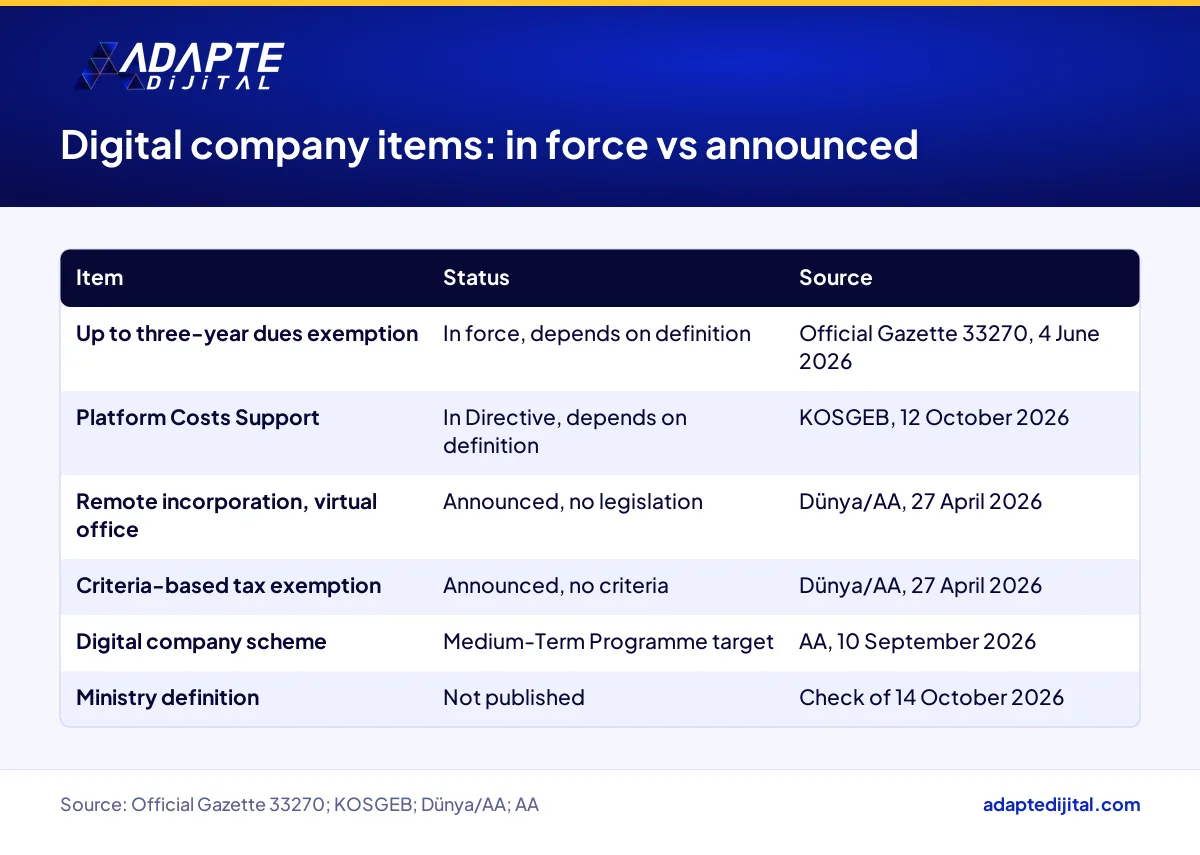
A digital company (dijital şirket) is the name Turkish law gives to companies set up and run in line with a definition that the Ministry of Industry and Technology has yet to publish, and as of 14 October 2026 that definition has not been published (Official Gazette, Issue 33270, 4 June 2026). The term appears in the law as a condition for an exemption and a support, not as a separate kind of company. The only enacted provision is Article 11 of Law 7582, which exempts qualifying companies from TOBB, chamber and exchange fees and dues for up to three years from the date of incorporation. TOBB is the Union of Chambers and Commodity Exchanges of Türkiye, and that exemption also depends on the definition.
What this means for you: a digital company is not yet a status you can apply for; it is a scheme on its way. A founder who is ready can incorporate today under the usual company forms, but the dues exemption and the platform support stay out of reach until the definition appears. KOSGEB, Türkiye’s Small and Medium Enterprises Development Organization, tied its new Platform Costs Support to the same definition on 12 October 2026.
What is a digital company in Türkiye, and which law mentions it?
A digital company is a company set up and run in line with a definition the Ministry of Industry and Technology will determine. The concept entered Turkish law through Article 11 of Law 7582, which added paragraph 16 to Article 3 of Law 5746 on research, development and design support. You can read the full text in the Official Gazette issue No. 33270 of 4 June 2026.
It is a condition, not a separate company form
Limited companies and joint-stock companies stay exactly as they are. Law 7582 and the KOSGEB Directive both use the digital company label as a condition for an exemption and a support. Some online commentary says otherwise; no official text does.
The same article holds a separate rule for technostartups
Article 11 also added paragraph 15. For non-public companies holding the technostartup (teknogirişim) badge, the related Turkish Commercial Code provisions do not apply to a conditional capital increase based on a convertible loan agreement. It concerns the badge, not digital companies.
Where does the digital company scheme stand today, and has the definition been published?
BU BÖLÜMÜN ÖZETİ
- The year-end target from August 2025 was missed
- The April announcement and the Medium-Term Programme point the way
- KOSGEB built a support that waits for the definition
No, it has not. As of 14 October 2026, no definition, regulation or procedural text on digital companies could be found from the Ministry of Industry and Technology. The legal provision took effect on its publication date, 4 June 2026, but applying it depends on the definition.
The year-end target from August 2025 was missed
The Ministry’s 2025 Institutional Financial Status and Expectations Report set a single-window, fully digital incorporation for technostartups as a goal for the end of 2025 (Anadolu Agency, AA, 27 August 2025). That target was not met, and no new date has been given.
The April announcement and the Medium-Term Programme point the way
On 27 April 2026, Minister of Industry and Technology Mehmet Fatih Kacır announced remote incorporation, virtual offices, automated accounting, and a tax exemption and cost incentive for companies meeting criteria that were not shared. According to AA on 10 September 2026, the 2027-2029 Medium-Term Programme (OVP in Turkish, the government’s three-year economic plan) lists the digital company scheme among its goals. Both show direction; neither creates a right today. The sequence is in our digital company timeline.
KOSGEB built a support that waits for the definition
KOSGEB’s Entrepreneur Support Programme Directive, dated 5 October 2026, and its announcement of 12 October tie the Platform Costs Support to businesses that fit the definition. The support equals the platform registration fee set by the Ministry and is non-repayable, with no TL ceiling in the Directive. What the platform is and how much the fee will be have not been announced.
Who can benefit from the digital company exemption and KOSGEB support today?
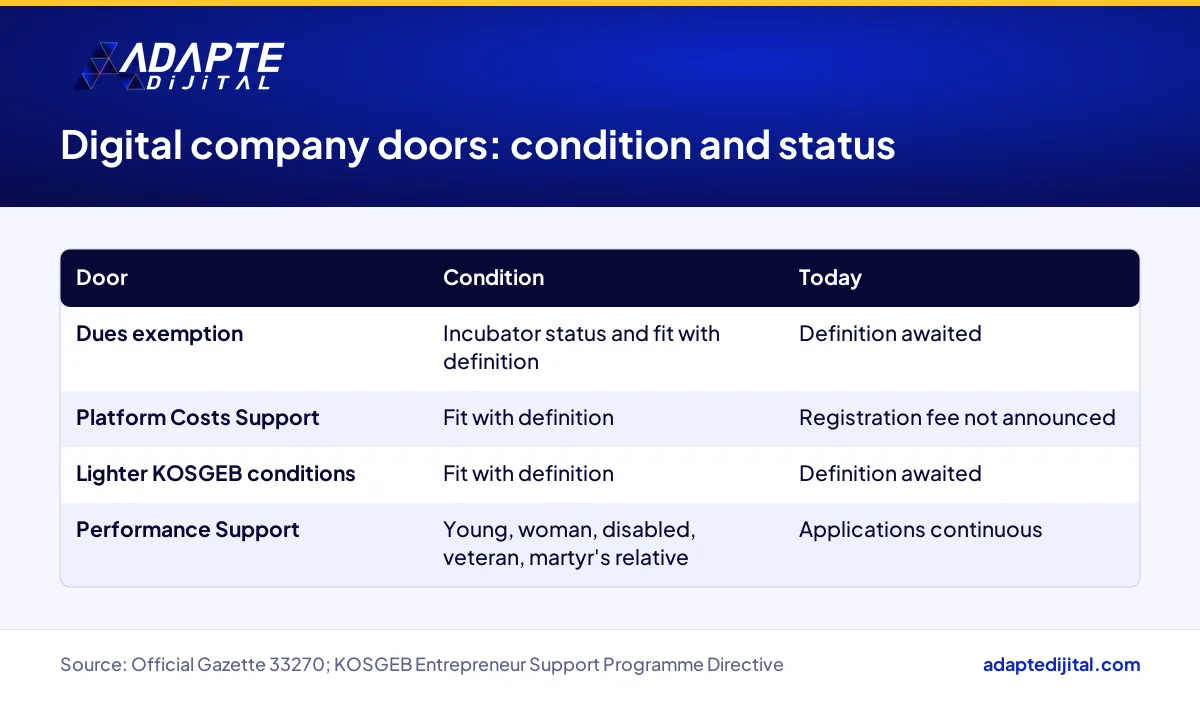
Strictly speaking, nobody yet, because both doors depend on the definition. The dues exemption needs two things at once: incubator entrepreneur status under Law 4691, and a company set up and run in line with the Ministry’s definition. The KOSGEB Platform Costs Support needs fit with the definition. Until the definition exists, there is no yardstick to prove that fit.
KOSGEB conditions get lighter for qualifying businesses
Under the Directive, a business that fits the definition does not need the entrepreneurship training, the 50% shareholding, the past-company restriction or the sole-representation condition when applying for Business Setup Support. For businesses outside the definition, those conditions still apply in full.
Performance Support does not wait for the definition
The second part of Business Setup Support, Performance Support, is not tied to the digital company condition. Businesses whose founder is young, a woman, disabled, a veteran or a relative of a fallen soldier can apply for non-repayable support of up to eight gross minimum wages if they meet the Directive’s terms. That door is open today.
Which founders does the digital company rule affect, and how?
BU BÖLÜMÜN ÖZETİ
- Likely winner: a tech team going through incubation
- Waiting: the foreign founder who wants to incorporate from abroad
- Indirectly affected: trading SMEs and accountants
It matters most to tech founders at the incorporation stage and to foreign investors who want a company in Türkiye. Let’s say a developer in Istanbul plans a first company in autumn 2026: once the definition appears, lighter dues and easier terms may follow. An SME that is already trading feels the effect only indirectly.
Likely winner: a tech team going through incubation
A team that already holds incubator entrepreneur status and has not yet incorporated is the profile closest to both the exemption and the platform support. When cash barely flows, losing chamber dues for up to three years is a small but real relief.
Waiting: the foreign founder who wants to incorporate from abroad
Minister Kacır put it plainly: “Foreign investors will be able to set up a company fully remotely through passport-based KYC.” How remote incorporation will work under the law, including the trade registry and MERSİS, has not been explained. MERSİS is Türkiye’s Central Registry System for companies. Today that route is not in force.
Indirectly affected: trading SMEs and accountants
Because the exemption counts from the date of incorporation, an existing e-commerce or services SME does not look like a direct target of the rule. Accountants and incorporation advisers, on the other hand, cannot give a firm answer to “let’s set it up as a digital company” until the definition appears.
What does the digital company idea mean for your website, data and online records?
The idea rests on running the business from a screen, from incorporation to accounting. The announced items, namely remote identity checks, virtual offices, automated accounting and a one-stop office, all put weight on consistent digital records. What the definition will require is unknown.
The one-stop office and the “give data once” proposal
The one-stop office target in the Medium-Term Programme aims to cut the administrative load from incorporation to liquidation (AA, 10 September 2026). A column by Ertan Barut in the Turkish daily Dünya on 28 September 2026 proposes MERSİS and the TOBB registry network as a shared backbone, with a “give data once” principle. That is a proposal, not an official plan.
Trade name, domain and website should be settled in the same week
If the trade name in the registry and the name people find in search results drift apart, a customer searches for you on Google, finds a different name and walks away. Your domain, company email and a one-page website should be ready on the day you incorporate.
Which three tasks should a founder considering a digital company finish this week?
BU BÖLÜMÜN ÖZETİ
- Monday: ask about incubator entrepreneur status
- Wednesday: put the KOSGEB deadline in the calendar
- Friday: prepare the company’s digital identity
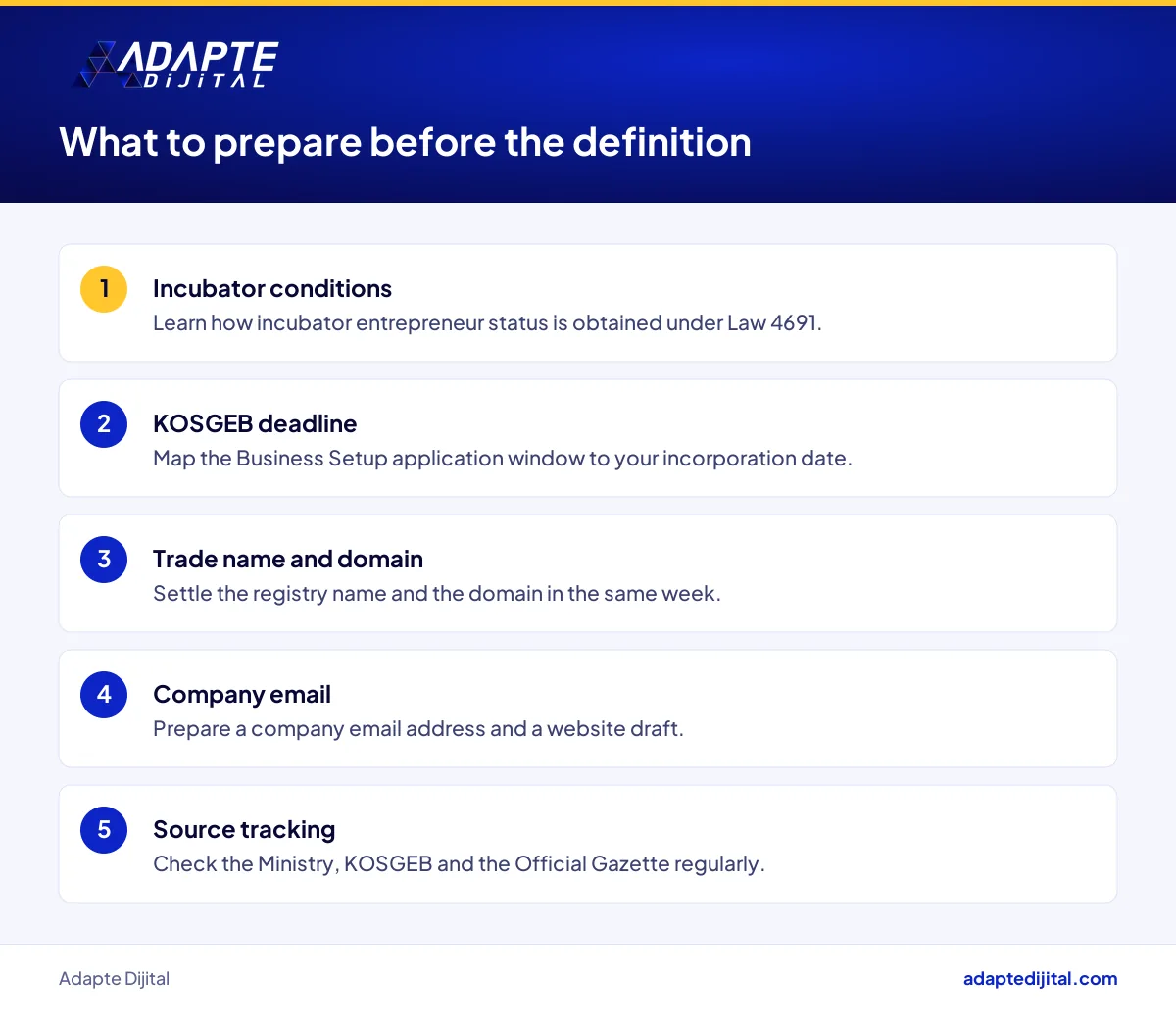
There are three: find out whether the incubator entrepreneur route is open to you, map the KOSGEB deadlines to your incorporation date, and prepare the company’s digital identity. All three can be done before the definition appears.
Monday: ask about incubator entrepreneur status
Find out how incubator entrepreneur status is obtained under Law 4691. It is the first condition for the dues exemption. A good starting point is our digital company page, where we collect every question on the topic.
Wednesday: put the KOSGEB deadline in the calendar
Business Setup Support applications are continuous and run through e-Devlet, Türkiye’s e-government gateway. Check the time limit against your incorporation date on the programme page. The guide on whether to wait for the definition or incorporate now walks through how waiting affects these deadlines, criterion by criterion.
Friday: prepare the company’s digital identity
A shortlist of trade names, a domain, a company email address and a website draft are this week’s work. We handle incorporation, business model and digital transformation planning together in our digital transformation management service.
Quick Summary
- A digital company is a label for companies that fit a Ministry definition still to be published, not a separate company form.
- The exemption under Law No. 7582 covers TOBB, chamber and exchange fees and dues for up to three years from the date of incorporation (Official Gazette No. 33270).
- The exemption needs both incubator entrepreneur status and fit with the Ministry’s definition.
- KOSGEB Platform Costs Support depends on the definition; Performance Support does not (KOSGEB Directive).
- As of 14 October 2026, the Ministry has not published the digital company definition.
Short Glossary
- Incubator entrepreneur
- Incubator entrepreneur is the status used to describe a founder who has qualified as such under Law 4691, the Technology Development Zones Law.
- Platform Costs Support
- Platform Costs Support is the name used for the KOSGEB support paid to businesses fitting the digital company definition, equal to the platform registration fee.
- One-stop office
- One-stop office is the term used for the goal of handling company procedures through a single point.
Frequently Asked Questions
Next Step
If you want to plan your incorporation timeline around the open definition, fill in the consult your expert form.
The definition and conditions of the digital company scheme are not final yet; check the latest information with the Ministry of Industry and Technology, KOSGEB and the Official Gazette before deciding. This is not legal or financial advice.
Support amounts and conditions can change; check the current terms on the institution’s official page before applying. This article is not financial or legal advice.
Sources: TÜRMOB circular on Law No. 7582 (4 June 2026) · Official Gazette, Issue No. 33270 (4 June 2026) · KOSGEB, Entrepreneur Support Programme renewed (12 October 2026) · Dünya/AA, Minister Kacır’s announcement (27 April 2026) · AA, Medium-Term Programme report (10 September 2026)
Updated: October 2026
Sık Sorulan Sorular
Under the new paragraph, companies set up and run in line with the definition by founders who have qualified as incubator entrepreneurs under Law 4691 are exempt from the fees and dues in Article 24 of Law 5174. The exemption runs for up to three years from the date of incorporation. That item covers TOBB, chamber and exchange payments. The paragraph contains no tax exemption.
Here’s something most people don’t know: the exemption goes only to companies founded by people who have qualified as incubator entrepreneurs under Law 4691, the Technology Development Zones Law. A founder who never considered that route may stay outside the exemption even after the definition appears.
There is no separate incorporation route under the digital company label, and the Ministry’s definition had not been published as of 14 October 2026. You can incorporate today under the existing company forms. Whether the definition will later apply to those companies has not been announced.
The law only exempts TOBB, chamber and exchange fees and dues for up to three years from the date of incorporation. The criteria and legal basis of the tax exemption Minister Kacır mentioned have not been announced.
The provision took effect on its publication date, 4 June 2026. Applying it depends on a definition the Ministry of Industry and Technology has not yet published.