
Tesla Roadster by the Numbers: What 0.81 Seconds, 230 mph and 300 Miles Mean
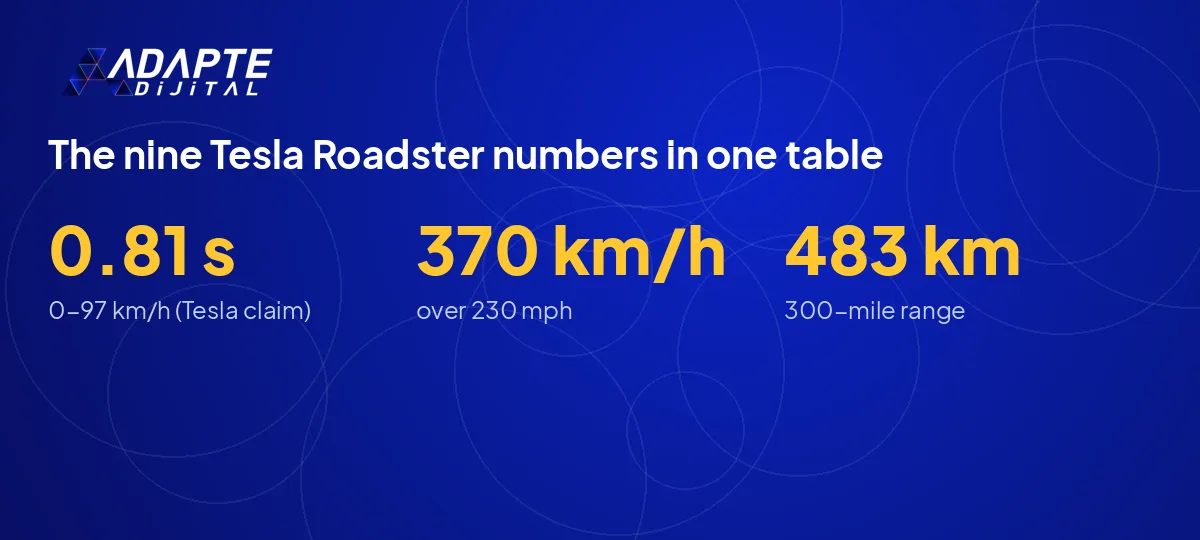
The Tesla Roadster does 0-60 mph in 0.81 seconds, tops 230 mph and has a 300-mile range. Tesla announced all three numbers at the launch in Waco, Texas on October 15, 2026, and none of them has passed independent verification. In metric terms: 0-97 km/h in 0.81 seconds, a top speed above 370 km/h and a range of about 483 km. All nine numbers are in the table below, each with its source.
What the numbers share is this: the suction, thruster and acceleration figures are claims by Lars Moravy, Tesla’s VP of Engineering, or by Elon Musk. The weight is absent from the official spec page and comes from Musk and Marques Brownlee. The production year is 2028, with Musk’s note “for real this time”. Below, every number gets a one-line “what this means” comment.
The nine Tesla Roadster numbers in one table
The table lists every numeric value in the fact sheet with its source and verification status. The “Claimed by” column shows who said the number. No row has an independent measurement, and the timing method for the separately recorded 0-60 test was not explained on the livestream.
| Number | Metric equivalent | Claimed by | Source |
|---|---|---|---|
| 0.81 s (0-60 mph) | 0-97 km/h | Tesla, separate recording | Ynet, Autoblog, TechCrunch |
| 2G suction | Twice the car’s weight | Lars Moravy | Yahoo Finance, InsideEVs |
| 600 L of air | Compressed air | Lars Moravy | TechCrunch |
| 10 thrusters | Rocket version | Lars Moravy | TechCrunch, Yahoo Finance |
| Over 230 mph | Over 370 km/h | Tesla | The Autopian, TechCrunch |
| 300 miles | About 483 km | Tesla | TechCrunch |
| Mach 0.5 target | About 616 km/h | Musk, long term | The Autopian, TechCrunch |
| 4,000+ lb | Over about 1,800 kg | Musk / MKBHD | Marques Brownlee on X, TechCrunch |
| 2028 | Production year | Musk | TechCrunch, Edmunds |
What does 0.81 seconds mean for Tesla Roadster 0-60?
According to Tesla, 0.81 seconds is the time the car takes to reach 60 mph, or 97 km/h, from a standstill. Ynet, Autoblog and TechCrunch report the figure. The measurement came from a separate recording, and the timing method was not explained on the livestream. Musk’s target is quoted as “under one second”, and there is no independent verification.
What this means
A sub-one-second 0-60 is hard to reach on tire grip alone. Mate Rimac said in 2024 that it was “possible with thrusters”. The figure implies the Tesla Roadster 0-60 time comes from the cold-gas thrusters, not from wheel power. So the number does not apply to the Performance version; it belongs to Thrust and Rocket.
What do 2G suction and 600 liters of air measure?
According to Moravy, the suction fan presses the car to the ground with 2G, twice its weight; the system works even at a standstill and makes upside-down driving possible. Moravy also said the thrusters use 600 liters of compressed air, and the tank refills while driving. Yahoo Finance reports the same system as “250 kilos of compressed air”; because the two sources give different units, only the liter value is used here.
What 2G means
If the car weighs over 4,000 lb, 2G of suction means roughly 8,000 lb of downforce. That calculation multiplies two claims from the fact sheet; it is not a measurement. InsideEVs and The Autopian compare the system to the fan-based suction of the McMurtry Spéirling. The 2G suction fan article explains upside-down driving step by step.
What 600 liters means
According to Tesla’s post on X, every usable space in the car is filled with carbon-fiber-wrapped pressure vessels. The 600 liters should be read as the total volume of those tanks. The Rocket version being single-seat suggests the tanks took the second seat’s place; TechCrunch gives the seat count, and Tesla does not explain the reason.
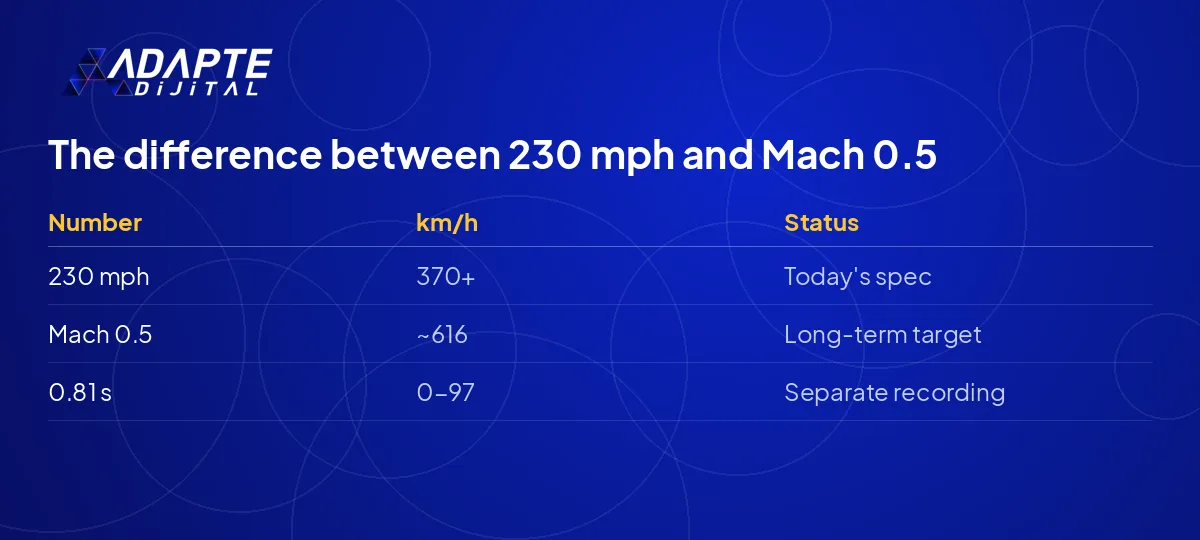
What is the difference between 230 mph and Mach 0.5?
According to Tesla, 230 mph is today’s top speed; the metric equivalent is over 370 km/h. Mach 0.5 is a long-term target; according to The Autopian and TechCrunch, it is about 383 mph, or 616 km/h. The first is a spec, the second is a promise. The 150 mph gap between the two numbers shows the distance between today’s car and the target car.
Mach 0.5 is half the speed of sound at sea level. Marques Brownlee’s phrase “hit half the speed of sound” refers to this target. No source gives a date for Mach 0.5; the 2028 production year belongs to the 230 mph car.
What this means
230 mph matches the target class of the car announced in 2017 at a $200,000 base price. Mach 0.5 is the speed region of an aircraft, not a track car. How Musk justifies that target is covered in the Snake River and Mach 0.5 article.
What do 300 miles of range and 4,000 lb of weight say together?
According to TechCrunch, range is 300 miles, about 483 km, on all three versions; that is a Tesla claim. Weight is missing from the official spec page; according to Musk and MKBHD, it is over 4,000 lb, or over about 1,800 kg. Read together, the two numbers describe a heavy sports car carrying a battery and pressure tanks, not a light track car.
Range does not change by version
Performance, Thrust and Rocket all get the same 300-mile figure. Because the thrusters run on compressed air, they may not draw range from the battery; that is an inference, and no source states it outright. The hardware differences between the three versions are tabled in the version comparison.
10 thrusters and 2028: hardware and calendar
According to Moravy, the Rocket version has 10 cold-gas thrusters; Thrust has rear thrusters only, and Performance has none. 2028 is the production year Musk gave with the note “for real this time”. The 2017 unveiling promised 2020 delivery; the car was then delayed in 2020, 2021, 2023 and 2024. The 10-thruster count matches the “about 10 small rocket thrusters” in the 2018 post.
How the nine numbers break down: four are Moravy claims (2G, 600 L, 10 thrusters, production site), three are Tesla or Musk claims (0.81 s, 230 mph, 300 miles), one is a third-party report (4,000 lb), one is a calendar date (2028). Independent measurements: zero.
What the thruster count means
According to Autoblog and The Autopian, early builds get rear thrusters only; other axes come later. So 10 thrusters describes the full system, while “early build” means fewer. According to GadgetPilipinas, the thrusters change direction within a fraction of a second using fully electric actuators. The thruster mechanism is detailed in the cold-gas thrusters article.
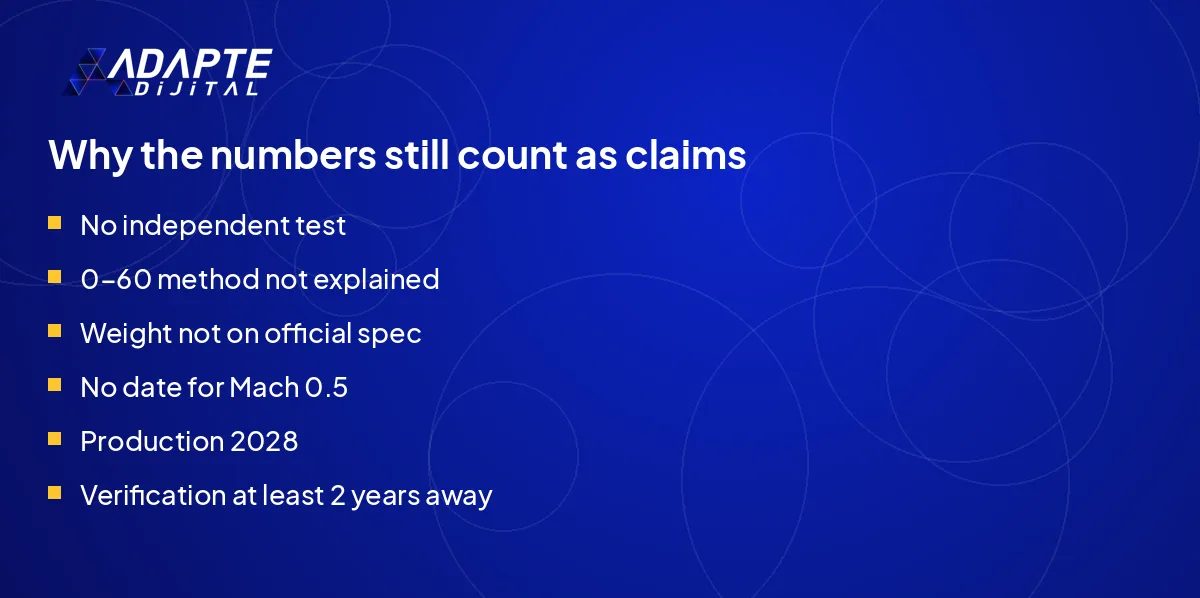
Why do the numbers still count as “claims”?
Because no independent body has tested the car. Thomas Hundal of The Autopian writes that skepticism about legal approval and reaching the targets is “absolutely warranted”. Before the demo, Musk said “success is not guaranteed”, so until a production car reaches the road, the numbers should be read as manufacturer claims. With production set for 2028, verification is at least two years away.
The definition of the car behind the numbers is in the What is the Tesla Roadster article, the whole flying car era is in the pillar article, and the full set is in the flying cars archive.
Frequently Asked Questions
Quick Summary
- 0-60 mph in 0.81 seconds (0-97 km/h), Tesla claim; separate recording, method not explained.
- Top speed over 230 mph (over 370 km/h); long-term target Mach 0.5 (about 616 km/h).
- Range 300 miles (about 483 km), the same on all three versions.
- 2G suction, 600 liters of air and 10 thrusters are Lars Moravy’s claims.
- Weight of 4,000+ lb (over about 1,800 kg) is not on the official spec; production in 2028.
- None of the nine numbers has passed independent verification.
Short Glossary
Mach is a unit that expresses a speed as a ratio to the speed of sound.
G-force is the ratio of the acceleration acting on a body to the acceleration of gravity.
Range is the total distance a vehicle can travel on a single charge.
Sources
- Tesla – Roadster reservation page
- TechCrunch – Tesla reveals SpaceX-powered Roadster that flies and falls with style
- The Autopian – The Tesla Roadster is more insane than you could possibly have imagined
- InsideEVs – Tesla Roadster backflip and 2G suction
- Autoblog – Next-gen Tesla Roadster debuts with air thrusters
Updated: October 2026
Sık Sorulan Sorular
Acceleration was not measured in the live demo; the demo showed upside-down driving, a backflip and a jump. The 0.81-second value comes from a separate recording. That keeps the number a Tesla claim. Until the measurement method is published, it should enter comparison tables with a “claimed” note.
Tesla’s official Roadster page gives no weight. The number comes from Brownlee’s “a 4,000+ pound car will do a backflip” line and TechCrunch’s report of it. It is the only unofficial number here, and it may change before production.
According to Tesla, 0.81 seconds; the metric equivalent is 0-97 km/h. The measurement came from a separate recording, the method was not explained on the livestream, and there is no independent verification.
According to Tesla, over 230 mph, which is over 370 km/h. The long-term target is Mach 0.5, about 616 km/h; no date has been given for that target.
According to TechCrunch, 300 miles, about 483 km, the same on all three versions. The value is a Tesla claim and has not been independently tested.