
Setting Up an AI Content Labelling System: Which Business Door Do Transparency Rules Open?

An AI content labelling system is the internal order that records which content a business produced or altered with AI and, where needed, tells the reader. The transparency obligations in the European Union’s AI Act began to apply on 2 August 2026. When a rule arrives, someone is needed to fit the rule into the business. 🚪
This article is an earning-gate file: it describes what kind of business door setting up this order opens, and for whom. This article is not a promise of income or investment advice; it describes what one business door looks like. This article is for information only and is not legal advice; consult a lawyer about your own situation. Forward-looking statements are labelled as forecasts, and the regulatory facts were checked against European Commission pages on the day of writing.
What is this door, and why is it opening now?
The door opens because a rule has come into force. The rule is new, and few people know how to apply it in day-to-day work.
Where things stand today
According to the European Commission, the transparency obligations have applied since 2 August 2026. Providers of generative systems already on the market before that date were given until 2 December 2026 for machine-readable marking. A voluntary code of practice published in June 2026 has two sections, one for providers and one for organisations that deploy these systems.
Who can walk through this door?
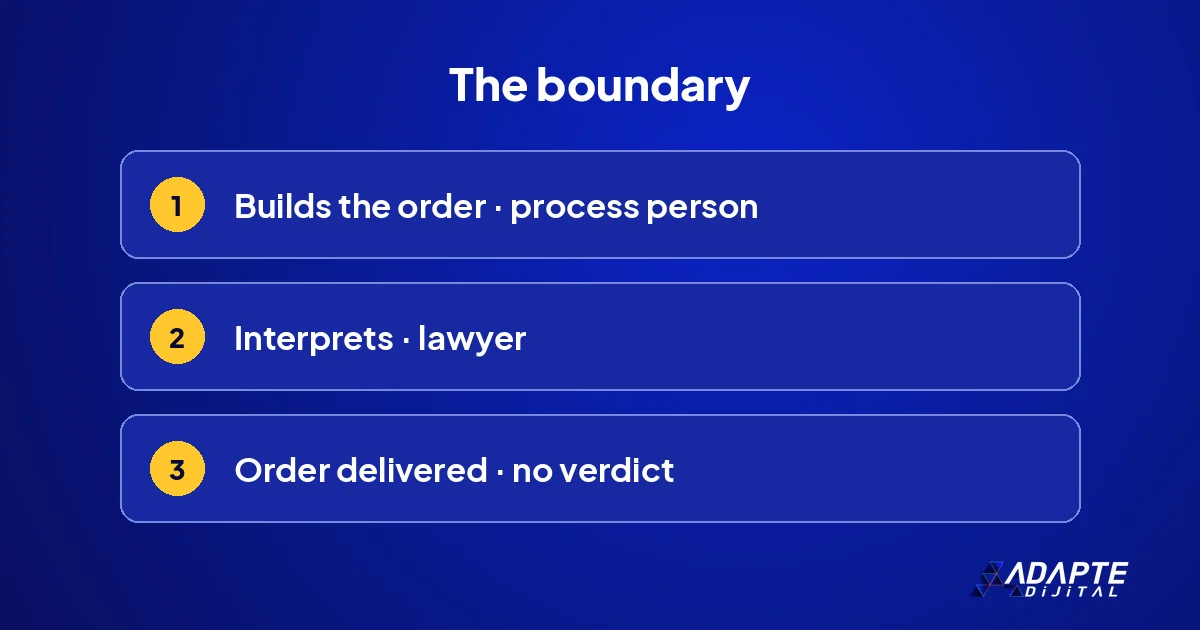
This door does not replace a lawyer; it builds the order a lawyer needs in order to give useful advice.
The skills needed
Someone who knows content processes fits this work: a person who can map the steps an article, an image or a video goes through inside a business, from brief to publication. Basic legal literacy is enough; where interpretation is needed, you go to a lawyer. Knowing how teams quietly use AI tools helps too, a topic we cover in when your team uses AI without telling you. 🧠
The capital needed
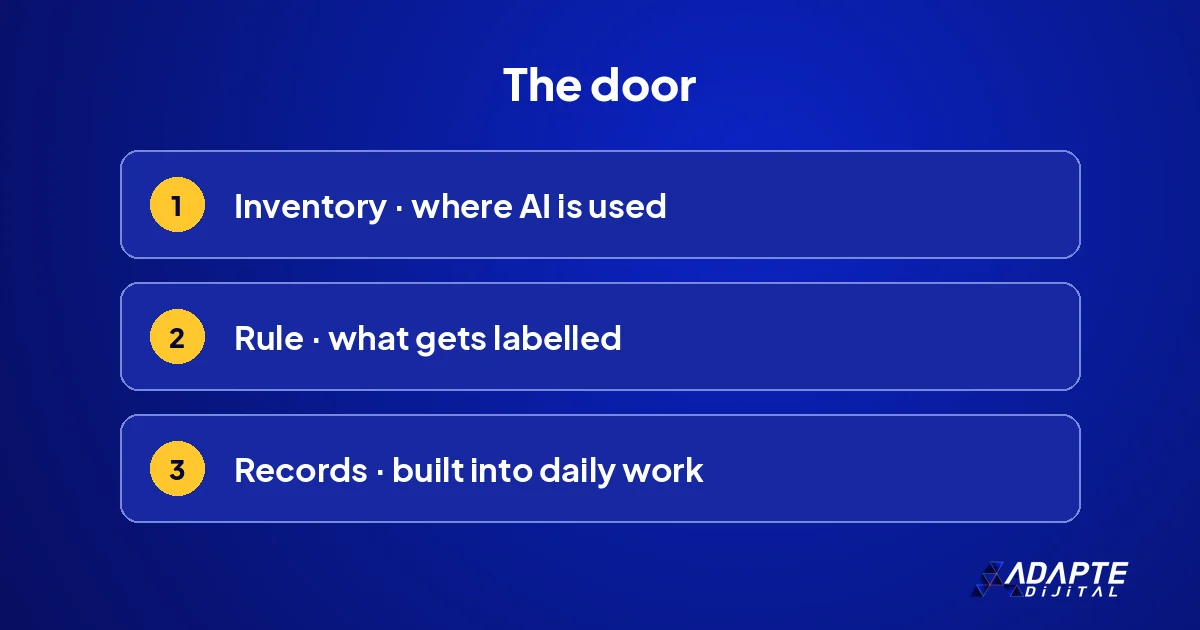
No capital is required. What is needed is a template set: an inventory sheet, a labelling rule and a record form. Whoever prepares these once reuses them with every client, refining them each time. The templates are this door’s capital, and their quality is what clients actually pay for.
Where does the first client come from, and how does income form?
BU BÖLÜMÜN ÖZETİ
- The first client
- Forms of income
- What not to promise
The first client is a business that has heard about the rule but does not know what to do about it.
The first client
The closest candidate is a business that produces content with AI regularly and publishes abroad: an exporter with a multilingual site, a publisher, an agency. The first question to them is simple: do you have a written list of where you use AI? The answer is usually no, and that answer opens the conversation. 🤝
Forms of income
The natural form is a one-off setup: the inventory is drawn up, the rule is written, the team is briefed and everything is handed over. The second form is update work whenever the rule or guidance changes. We give no figures; there is no settled market price for this service yet, so price by the time and responsibility involved.
What not to promise
“You will be compliant” cannot be promised; compliance is a legal assessment. What can be promised is order: the inventory is complete, the rule is written, records are being kept. Order is delivered; a verdict is not. Writing that sentence into the proposal protects both sides. 📝
What are the costs and the biggest risks?
BU BÖLÜMÜN ÖZETİ
- Cost lines
- The misinterpretation risk
- The exaggeration risk
The cost is low and the responsibility high. Drawing the line at the start is part of the job.
Cost lines
The lines are time spent reading the rules and guidance, preparing templates and the cost of working with a lawyer. The regulatory texts are long and get updated; reading them is not a job done once. Budget a few hours every month just to stay current. ⏳
The misinterpretation risk
It is not always clear which content must be labelled. According to the Commission, assistive functions for standard editing fall outside the marking obligation, but where that boundary begins requires interpretation. Doing that interpretation alone is a risk. The lawyer interprets; you implement what they decide.
The exaggeration risk
Selling by describing the rule as broader than it is and frightening the business destroys trust quickly. Not every business is subject to every obligation. Telling a business that falls outside the scope is part of the job. How personal data and AI tools interact is a separate question; see personal data in AI tools. ⚠️
What does the door’s horizon look like, and the first 90 days?
The first two items are forecasts; the third is the steps you can take today.
The first 90 days
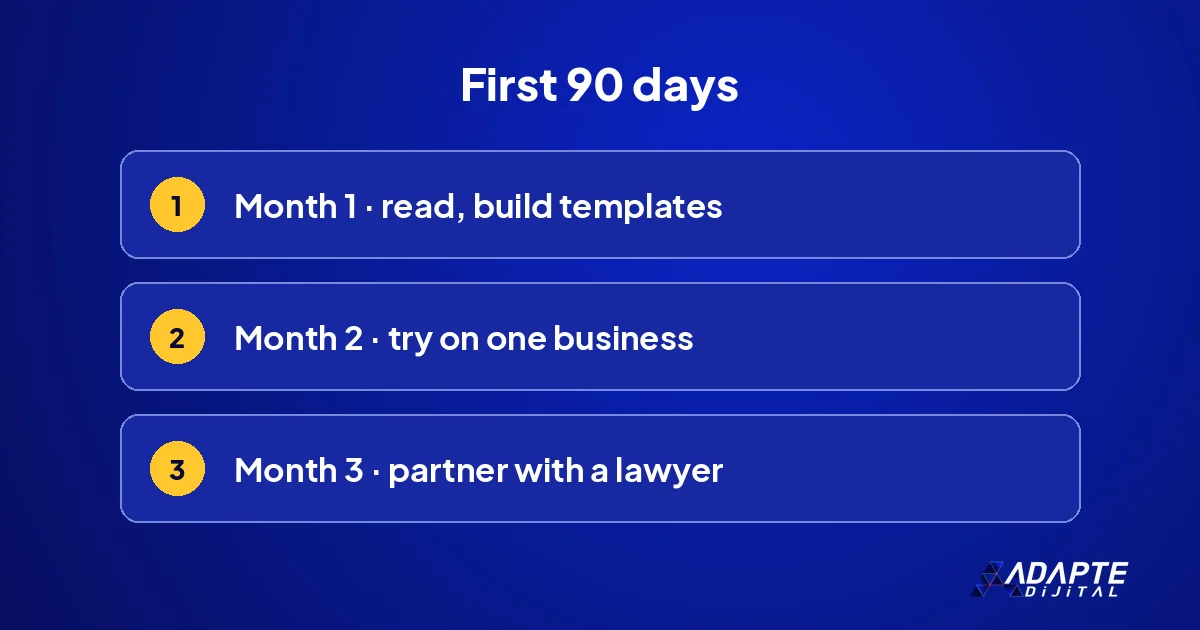
Month one: read the guidance and the code of practice, prepare your three templates. Month two: try the templates on your own work or on a business you know. Month three: set up a partnership with a lawyer and define the limits of the service in writing. A service without written limits is a service with unclear responsibility. Update log. 12 November 2026: first publication. The forecasts on this page are re-read when they fall due; a forecast that turns out wrong is not deleted but corrected here. 🗓️
How do you approach this door with Adapte Digital?
BU BÖLÜMÜN ÖZETİ
- A single delivery package
- What we do on the audit side
- Where to start
We look at this topic from the audit side: first we see what is used, where and by whom.
A single delivery package
Adapte Digital does not charge a monthly management fee. Work starts with a single delivery package whose scope is written down in advance: 36,000 TRY + VAT. If the work grows, the new need is defined as a separate add-on package, priced by what will be delivered rather than by the hours spent. 📦
What we do on the audit side
We review a business’s digital assets and content process and hand over a written inventory; AI use is one section of that inventory. We do not give legal opinions. What a digital audit covers in general is set out in what a digital audit is.
Where to start
Current packages and capacity are on our campaign pages; scope and price are written there before work begins. 🧭
Quick Summary
- The door: mapping AI use and embedding the labelling rule.
- EU transparency obligations have applied since 2 August 2026.
- This work does not replace a lawyer; it builds the order a lawyer needs.
- Compliance is not promised; order is delivered.
- Telling an out-of-scope business so is part of the job.
Short Glossary
- Labelling
- Telling the reader that content was produced or altered with AI.
- Inventory
- A written list of the tasks in which a business uses AI.
- Machine-readable mark
- A mark that software can read to detect AI-generated content.
Frequently Asked Questions
Next Step
This week, list every task in your business that uses AI in one sheet: task, tool, responsible person. That sheet is the start of your inventory.
Sources: European Commission — Code of Practice on Transparency of AI-generated Content · European Commission — Transparency obligations under Article 50 of the AI Act · EU Artificial Intelligence Act — Article 50
Updated: November 2026
Sık Sorulan Sorular
What is sold is a setup: an inventory of where AI is used in the business, a written rule saying which content is labelled and how, and a simple record-keeping routine that fits into daily work. The buyer can be any business that produces content with AI; the priority is businesses publishing for European audiences, where the rule bites first. 🎯
The rule is in force, yet most businesses have not even written down where they use AI. The first job is not legal interpretation but an inventory. Producing an inventory needs not a lawyer but someone who understands processes. That gap is precisely where the business door sits, and it is wide open today. ⏱️
One person can start, but must build a working relationship with a lawyer. The person who builds the order and the person who interprets the law should be different people. Attempting to give legal opinions is the easiest mistake to make at this door, and the most expensive one to recover from. 👥
Forecast: demand will come first from business partners in Europe. Buyers and platforms will ask their suppliers for written statements about how they use AI. A business in Türkiye will learn about the rule not from the news but from a form sent by its customer. 🔭
Forecast: labelling will eventually be built into the tools themselves, and the manual work will shrink. What stays is the work of drawing up inventories and writing rules. AI content work in general raises the same balance of speed and care, which we discuss in AI content production: speed or quality.
No. It is an EU regulation and its scope depends on the situation. Consult a lawyer about yours; this article is not legal advice.
Not to build the order; process knowledge is enough. Wherever interpretation is needed, work with a lawyer.
According to the Commission, assistive functions for standard editing fall outside the marking obligation. A lawyer should assess where the line falls in your case.