
AI Compliance Preparation for Turkish Businesses Selling to the EU: Who Will Offer It?
AI compliance preparation for EU exporters means getting the website, chat tools and content routine of a Turkish business that reaches European customers ready for AI transparency rules. Exporters know their product; they do not know AI rules. The gap between the two is a business door. 🚪
This article is an earning-gate file. It covers who can walk through the door, what is sold and where the work becomes risky. This article is not a promise of income or investment advice; it describes what one business door looks like. This article is for information only and is not legal advice; consult a lawyer about your own situation. Forward-looking statements are labelled as forecasts, and regulatory facts were checked against European Commission pages on the day of writing.
What is this door, and why is it opening now?
A business that exports meets the rules of the market it sells into. AI rules are the newest item on that list.
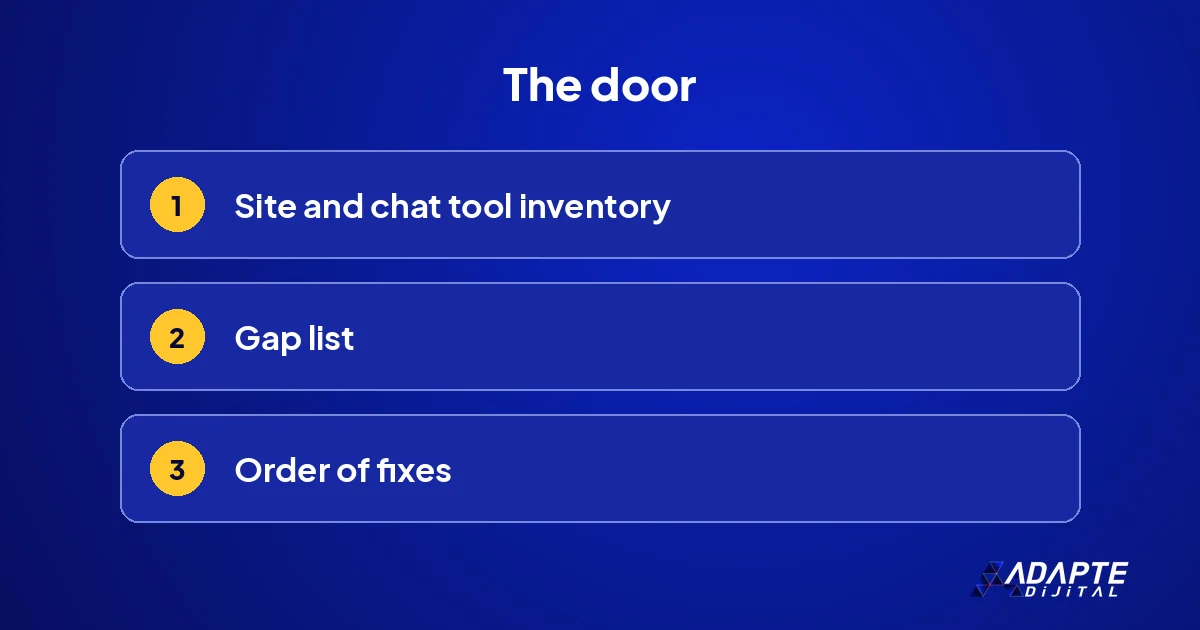
Where things stand today
According to the European Commission’s guidance, providers must design systems so that people are clearly told when they are interacting with an AI system. The transparency obligations have applied since 2 August 2026. Whether and when a Turkish business falls within scope is a legal assessment that depends on its situation.
Who can walk through this door?
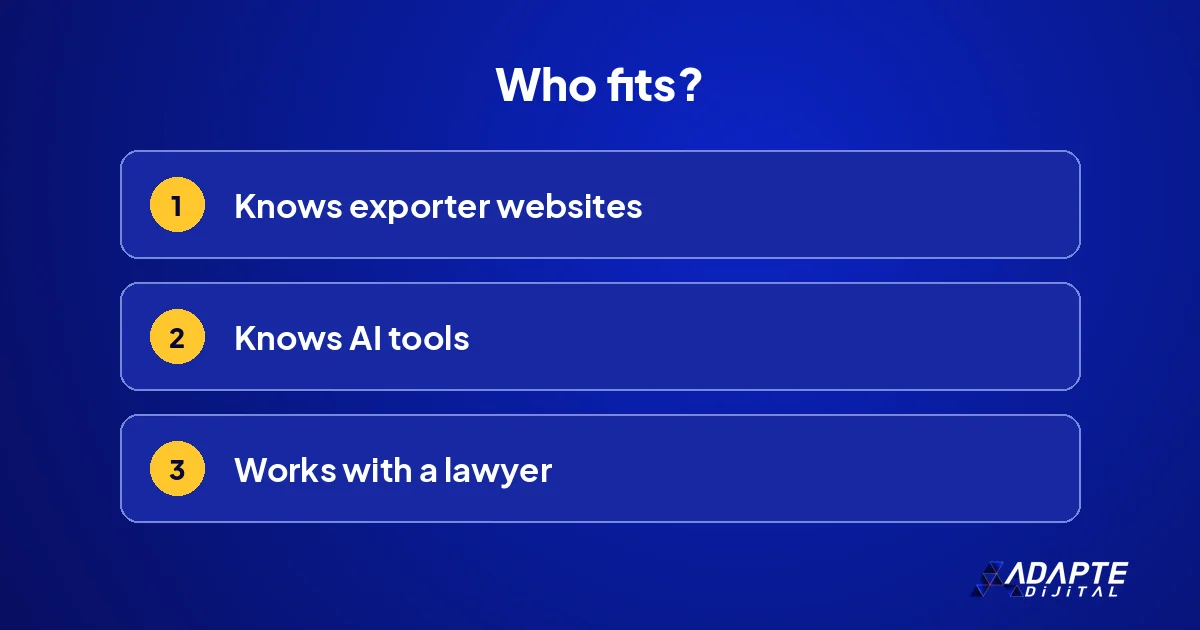
This door is open to someone who combines two kinds of knowledge: the digital side of foreign trade and the practical use of AI.
The skills needed
Someone who knows exporters’ websites, multilingual structures and customer communication tools fits well. You need to understand how AI tools connect to a site. Basic legal literacy is enough; assessment is left to a lawyer. Experience auditing foreign-facing sites helps, as described in digital audits for foreign brands in Türkiye. 🧠
The capital needed
No capital is needed; a checklist and a report template are enough. The value comes from the accuracy of the list. Build the list from official sources and write its date on it; an item without a source does not go on the list, however plausible it sounds.
Where does the first client come from, and how does income form?
BU BÖLÜMÜN ÖZETİ
- The first client
- Forms of income
- What not to promise
The route to exporters is well known: associations, chambers and foreign trade consultants.
The first client
The first client is an exporter who has received a question or a form about AI use from a buyer in Europe. At that moment they do not know what to answer. The second source is consultants who already work with exporters; for them this service completes their own offer. 🤝
Forms of income
The natural form is a one-off preparation file. The second is help with filling in the forms buyers send. The third is training for groups of exporters. We give no figures; there is no settled market price, and inventing one would mislead both sides.
What not to promise
“You will have no problems in Europe” cannot be promised. What can be promised is that the inventory is complete and the gap list is clear. The file should state openly on its cover that it contains no legal opinion. The file is preparation, not a guarantee. 📝
What are the costs and the biggest risks?
BU BÖLÜMÜN ÖZETİ
- Cost lines
- The scope-misjudgement risk
- The liability risk
At this door, the most expensive mistake is talking as if you know what you do not.
Cost lines
The lines are time spent reading official texts and guidance, the cost of working with a lawyer and keeping the checklist current. The regulation changed during the year; whoever stops reading ends up with an out-of-date list. This work does not end; it is updated. ⏳
The scope-misjudgement risk
Not every exporter is subject to every obligation. A business that only sells products and uses no AI on its site has very little to do. You must be able to say so. Selling to someone who does not need it is the fastest way to close this door for yourself.
The liability risk
If the person delivering the file does not state its limits in writing, they may be held responsible for problems that surface later. The contract should state the scope, that it contains no legal opinion, and its date. How to read an audit report is covered in reading a digital audit report. ⚠️
What does the door’s horizon look like, and the first 90 days?
The first two items are forecasts; the third is work you can start today.
The first 90 days
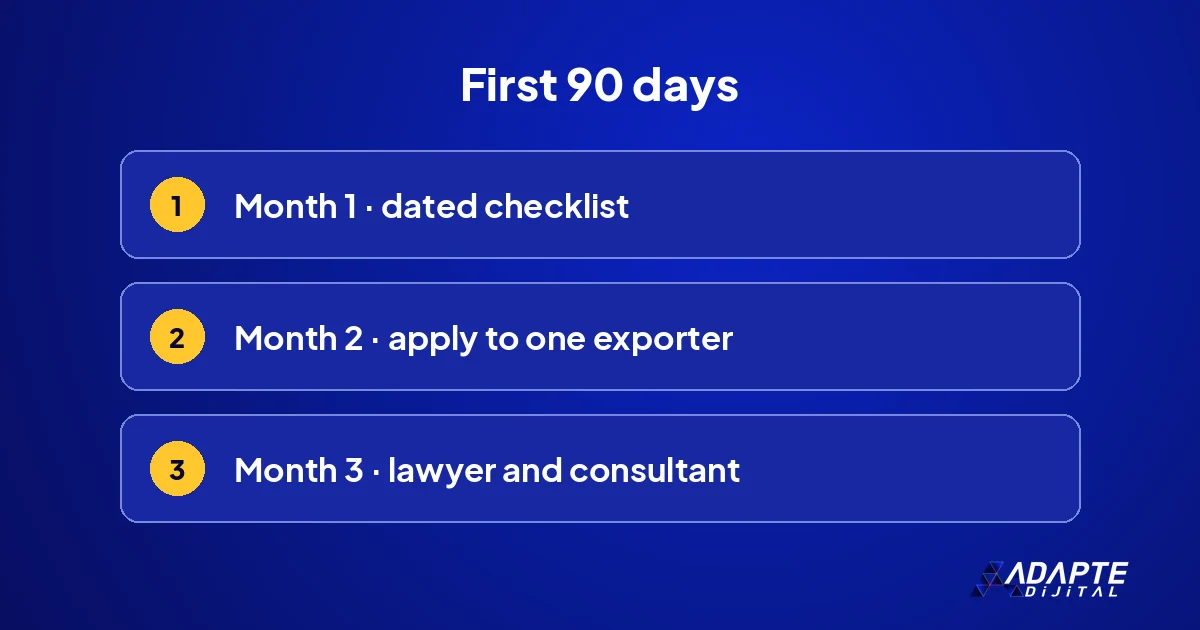
Month one: build a dated checklist from official sources. Month two: apply it to one exporter’s site and write up the findings. Month three: partner with a lawyer and a foreign trade consultant. This door is not walked through alone. Update log. 12 November 2026: first publication. The forecasts on this page are re-read when they fall due; a forecast that turns out wrong is not deleted but corrected here. 🗓️
What does Adapte Digital do on exporters’ websites?
BU BÖLÜMÜN ÖZETİ
- How we work
- What we look at in a review
- Where to start
We review a business that sells to Europe as a whole; AI use is one of the headings in that review.
How we work
Adapte Digital does not charge a monthly management fee. Work starts with a single delivery package whose scope is written down in advance: 36,000 TRY + VAT. If the work grows, the new need is defined as a separate add-on package, priced by what will be delivered rather than by the hours spent. 📦
What we look at in a review
We look at the multilingual structure, customer communication tools and how content is produced, and we deliver what we find as an ordered list. We do not make legal assessments; that is a lawyer’s job.
Where to start
Which packages are open is shown on our campaign pages; price and capacity are written there before work begins. 🧭
Quick Summary
- The door: a preparation file for an exporter’s Europe-facing presence.
- The candidate client is an exporter who received an AI question from a buyer.
- Legal assessment belongs to a lawyer.
- A business that does not need it should be told so.
- The file’s scope and date must be written down.
Short Glossary
- Preparation file
- A written document showing the current state, gaps and order of fixes.
- Transparency obligation
- The duty to make sure people know they are dealing with AI or AI-generated content.
- Supplier form
- A document in which a buyer asks a supplier for a written statement.
Frequently Asked Questions
Next Step
This week, list every tool on your Europe-facing site that uses AI: chat, translation, product descriptions. That list is your starting point.
Sources: European Commission — Code of Practice on Transparency of AI-generated Content · European Commission — Transparency obligations under Article 50 of the AI Act · EU Artificial Intelligence Act — Article 50
Updated: November 2026
Sık Sorulan Sorular
What is sold is a preparation file: an inventory of where AI is used on the business’s Europe-facing website and in its customer communication, a list of gaps and an order of fixes. The buyer is a business that sells products or services to Europe and uses a chat tool or AI-generated content on its site, often without having thought about the rule. 🎯
Most exporters added a chat tool to their site, or translated product descriptions with AI, without thinking about this rule. Now the rule is in force. Whoever does the first review becomes the person who explained the topic first, and that position tends to bring the follow-up work too. ⏱️
One person can do the review. For the legal assessment, working with a lawyer who knows EU law is essential. Personal data is a separate subject, especially when data crosses borders; we cover it in cloud and cross-border transfers. 👥
Forecast: as European buyers add AI questions to supplier forms, demand will rise. Exporters will meet this topic not as a compliance project but as a form to be filled in, and they will want someone who can help fill it correctly. 🔭
Forecast: within one or two years this preparation will become a routine part of a general digital audit and stop being a separate service. Those who enter early will be the ones doing those audits. Chat tools are the most common trigger; see AI in customer service.
That is a legal assessment and depends on the situation. A business that uses no AI on its site may have very little to do. Consult a lawyer.
No. Personal data is a separate subject. This service looks at the inventory of AI use and transparency preparation.
No. It shows the current state and gaps; it is not a legal opinion, and that must be written on it.