
Machine Trust at Three Months: From First Fixes to a Regular Compliance Flow
Three months into machine trust, the first month’s fixes have become part of daily work. Labelling decisions are written down and an owner is in place; the question now is whether the arrangement is really being followed. The third month is the month of the first internal audit. 🔍
This page is the second step of the machine trust horizon series. It covers what is realistic in three months, how to run an internal audit, what is changing in tools and which signs point to a problem. Forecasts are labelled as forecasts. This article is for information only and is not legal advice; consult a lawyer about your own situation.
What is realistic in three months?
BU BÖLÜMÜN ÖZETİ
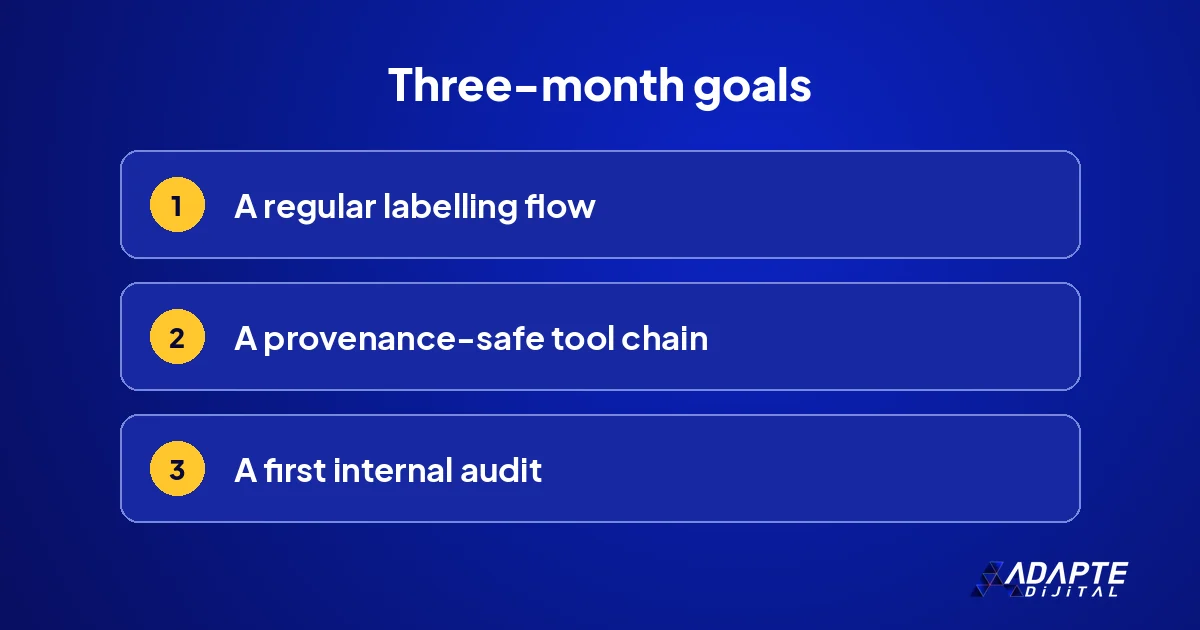
- A regular labelling flow
- A provenance-safe tool chain
- A first internal audit
Three months is enough for the labelling and logging arrangement to run several cycles and for the first gaps to show.
A regular labelling flow
By the third month, labelling decisions are no longer made one by one; they become a step in content production. When an article, image or ad is prepared, a field records whether AI was used, and the label follows from it. A label built into the flow is not forgotten. Content with an empty field goes back to the owner before publication, so the decision is always made consciously. 🔁
A provenance-safe tool chain
In three months it becomes clear which tools add provenance information and which strip it. The stripping step is either replaced or its settings are corrected. The weakest link in the chain is often compression or resizing. That step is tested once and the result recorded, so later changes can be compared against it.
A first internal audit
At the end of the third month, a small sample of published content is checked against the rule. The first audit is for learning, not for punishing. Gaps are sorted by whether they come from the rule, the tool or habit, because each needs a different fix. The audit note becomes the starting point for the next round. 📝
How do you run an internal audit?
BU BÖLÜMÜN ÖZETİ
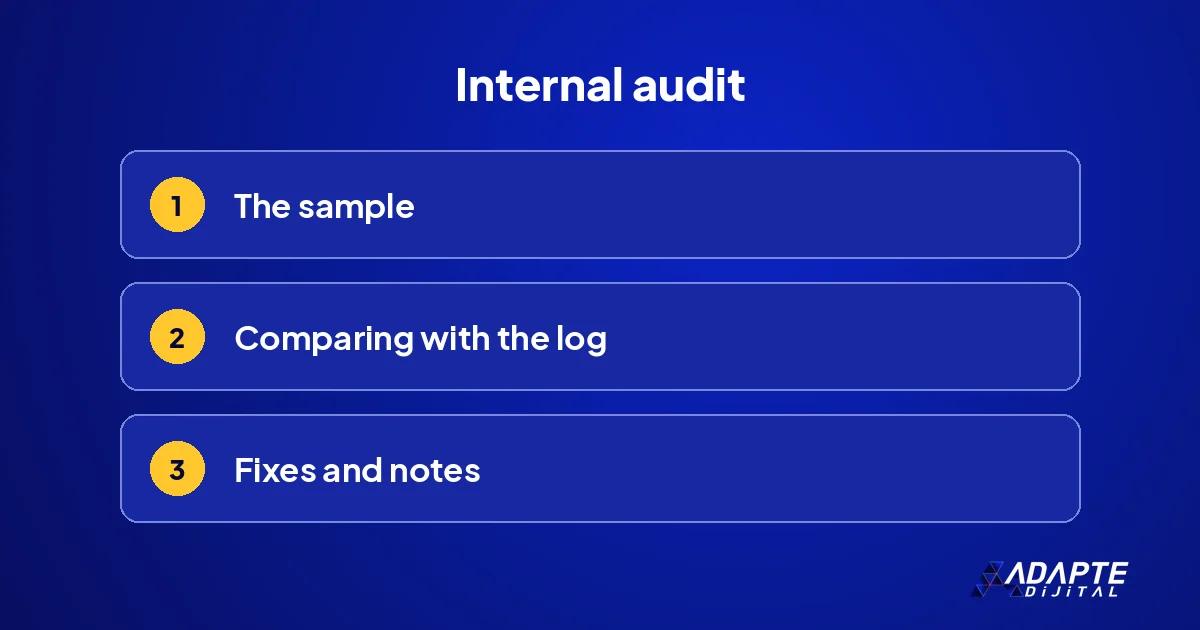
- The sample
- Comparing with the log
- Fixes and notes
An internal audit does not have to be complicated. Three steps are enough for a small business.
The sample
A few examples of each type are picked from the last three months: articles, images, ads and chatbot conversations. Random selection stops only the good examples from being reviewed. The sample can be small, but it should cover every content type the inventory lists. 🎲
Comparing with the log
For each example, the inventory record is opened: which tool was used, who produced it, what the labelling decision was. The record and the published content are compared. If they do not match, the problem lies either in record-keeping or in applying the rule. Most mismatches come from haste and habit rather than bad intent.
Fixes and notes
The gaps found are fixed and recorded in a short note: what was found, why it happened, what changed. The fix note is the starting point for the next audit. A compliance calendar helps keep these reviews on schedule, as explained in how to build a compliance calendar. Note-taking is the lasting output of an audit. 🗒️
What is changing in tools?
BU BÖLÜMÜN ÖZETİ
- Producers’ markers
- Verification tools
- Your own publishing chain
AI tools and platforms are changing fast on provenance. Three developments affect the plan for the third month.
Producers’ markers
In May 2026, OpenAI announced that it had joined the C2PA steering committee and was adding Google’s invisible watermark alongside C2PA information to images generated with ChatGPT. Major tools have started marking their outputs. That means files the business already holds may carry provenance information, so the record of which tool was used matters even more. 🧩
Verification tools
Google announced that it would bring C2PA verification and invisible watermark detection to Search and Chrome. That moves provenance information to a place ordinary users, not just experts, will see. Stripped provenance will be easier to notice during this period, which raises the cost of a careless publishing chain.
Your own publishing chain
The content management system, image plugin and content delivery network can keep provenance information or strip it. In the third month, the chain is tested again and the settings recorded. When the chain changes, the test is repeated. A new plugin can quietly break an old arrangement, and nobody notices until proof is needed. 🛠️
Which signs point to a problem?
BU BÖLÜMÜN ÖZETİ
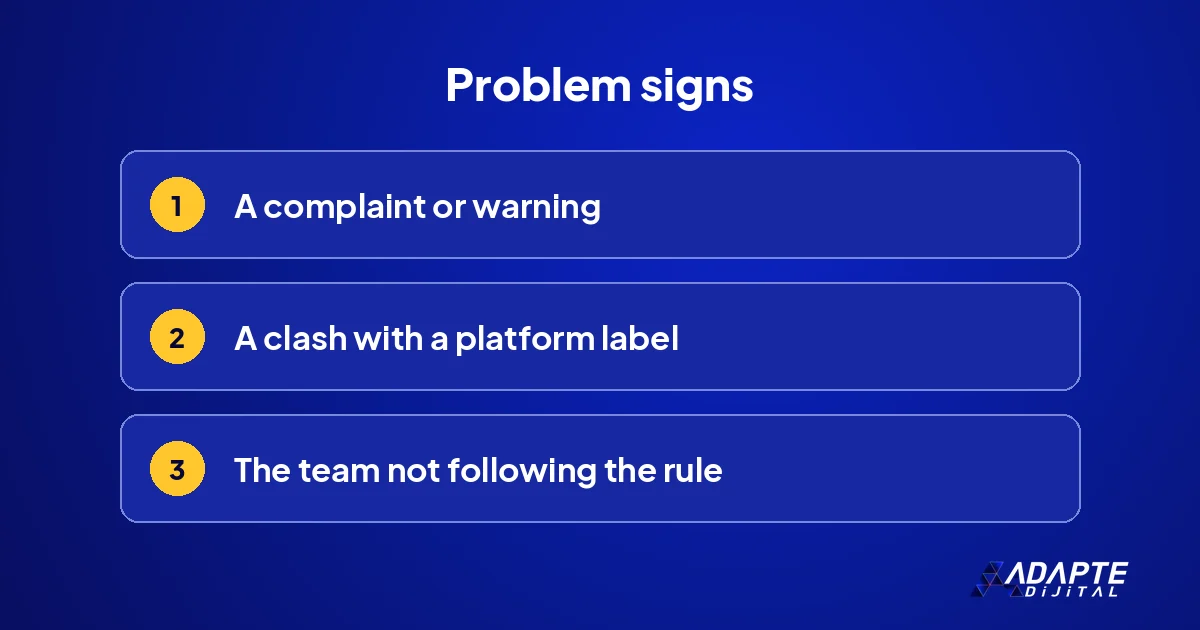
- A complaint or a warning
- A platform label contradicts yours
- The team is not following the rule
Some signs show that the arrangement is not being followed or is not enough. Three need particular attention.
A complaint or a warning
If a customer, a platform or a business partner noticed that content was AI-generated and asked about it, the labelling arrangement may be incomplete. Even a single complaint is reason enough to enlarge the sample. The answer starts with checking, not with defending, and the outcome is recorded. ⚠️
A platform label contradicts yours
If a social platform marks your content as AI-generated but you did not label it, either a tool added provenance information or the rule was not applied. The contradiction shows the weak point in the arrangement. Check which tool added the marker, and add your own label if the content was indeed generated with AI.
The team is not following the rule
If the same gap keeps appearing in audits, the problem may lie in how the rule is understood rather than in people. A short team briefing is usually enough. The European rule also links AI literacy to the transparency obligations. The next audit checks whether the gap has shrunk. 👥
What is rising on this horizon?
BU BÖLÜMÜN ÖZETİ
- Today: the guidelines and code are published
- Forecast: enforcement begins
- Forecast and log
The three-month horizon looks at the first quarter of 2027. The first item is today’s status; the next two are forecasts.
Today: the guidelines and code are published
The European Commission published the code of practice on marking and labelling in June 2026 and its Article 50 guidelines in July 2026; the code was assessed as adequate by the Commission and the AI Board. The details of application are now in writing. How the code works is explained in the AI content code of practice. 📚
Forecast: enforcement begins
Forecast: over the coming quarter, the first enforcement practice of supervisory authorities in Europe and the first decisions of Türkiye’s Advertising Board on ads containing AI content will appear. Those decisions will clarify how the rules are read in practice, and they will reward businesses that kept records.
Forecast and log
Forecast: businesses that run an internal audit in the third month will not be caught unprepared when the first decisions arrive. Update log. 12 November 2026: first publication. The forecasts on this page are re-read when they fall due; a forecast that turns out wrong is not deleted but corrected here. The previous step is machine trust: first month; the next is machine trust: six months.
How does the third month work with Adapte Digital?
BU BÖLÜMÜN ÖZETİ
- A single delivery package
- What is delivered
- Where to start
Third-month work is an internal audit: the sample is reviewed, gaps are fixed and the audit note is handed over.
A single delivery package
Adapte Digital does not charge a monthly management fee. Work starts with a single delivery package whose scope is written down in advance: 36,000 TRY + VAT. If the work grows, the new need is defined as a separate add-on package, priced by what will be delivered rather than by the hours spent. 📦
What is delivered
The output is an internal audit report, a fix list and a note on the tested publishing chain. The audit becomes a template your team can repeat every quarter.
Where to start
The written scope of each package, with current pricing and capacity, is on our campaign pages. 🧭
If you see a business opportunity here, we wrote a separate article on AI brand monitoring services.
Quick Summary
- By three months, the labelling decision becomes a step in the content flow.
- The first internal audit uses a sample, a log comparison and a fix note.
- Major tools mark their outputs; verification is coming to Search and Chrome.
- Complaints, clashes with platform labels and repeated gaps are warning signs.
- Forecasts are revisited in the update log.
Short Glossary
- Internal audit
- A business checking, through a sample, whether it follows its own rules.
- Sample
- A small, randomly chosen group of content that is reviewed.
- Publishing chain
- The tools and steps content passes through from production to publication.
Frequently Asked Questions
Next Step
Pick five random pieces of content you published in the last three months and check whether the labelling decision for each is in the log. Our campaign pages list the delivery packages that cover this work.
Sources: European Commission — Code of Practice on marking and labelling AI-generated content · Content Authenticity Initiative — The State of Content Authenticity in 2026
Updated: November 2026
Sık Sorulan Sorular
Ideally someone who did not produce the content. In a small business, the owner of machine trust can do it; what matters is random selection.
First check which tool added provenance information. If the content was indeed AI-generated, add your own label as well.
It is enough to start. As rules and tools change, the frequency is adjusted to the business’s risk.