
Machine Trust at One Year: The Annual Review and Preparing for the High-Risk Timetable
One year into machine trust, the whole period since the rules took effect is reviewed and the arrangement gets its annual check. A year builds up enough data to see whether the labelling, provenance and logging arrangement really works. 🗓️
This page is the fifth step of the machine trust horizon series. It covers what is realistic in a year, what to look at in the annual review, what Europe’s high-risk timetable brings and what to protect over the long term. Forecasts are labelled as forecasts. This article is for information only and is not legal advice; consult a lawyer about your own situation.
What is realistic in a year?
BU BÖLÜMÜN ÖZETİ
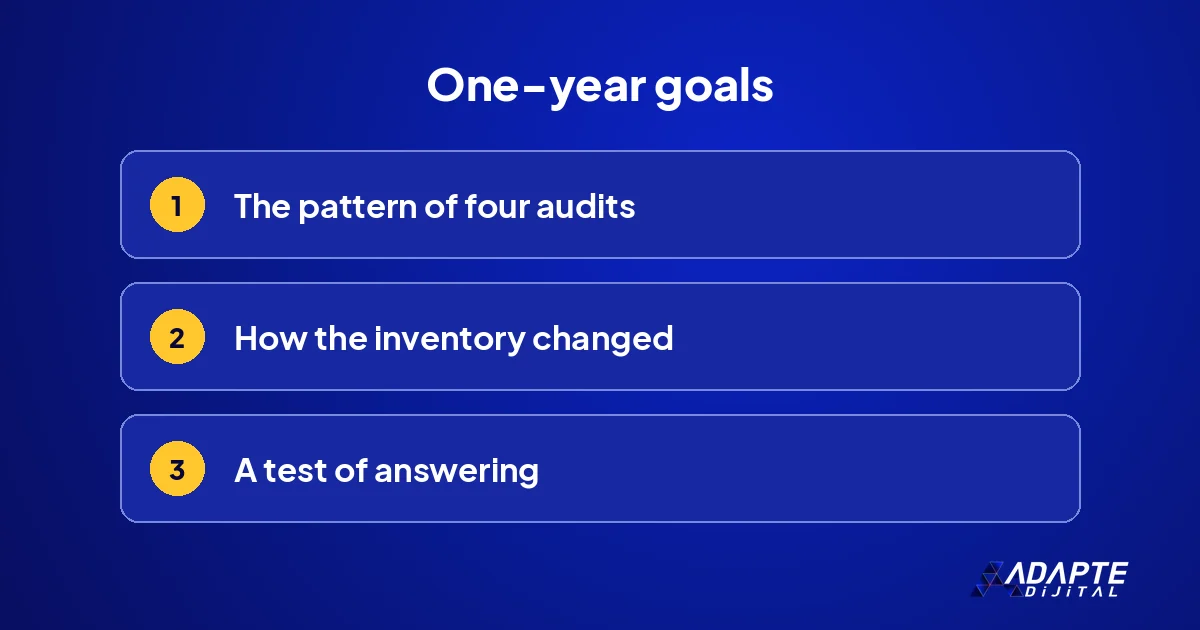
- The pattern of four audits
- How the inventory changed
- A test of answering a question
A year is enough for the arrangement to pass four audit cycles and for the pattern of gaps to show.
The pattern of four audits
In a year, four quarterly audits have been run. Placed side by side, their notes show which gaps are persistent and which are temporary. A persistent gap points to a problem in the rule or the tool. A temporary gap usually relates to busy periods. The pattern shows what individual audits cannot. 📊
How the inventory changed
Over a year, you can see how many tools were added, how many removed and which uses grew. A fast-growing use is the priority audit topic for the next year. Tools still listed but no longer used are cleaned out; a bloated inventory hides the real risk.
A test of answering a question
At the end of the year, the arrangement is tested: for a randomly chosen piece of content or agent action, how long does it take to answer “who did this, with which tool, approved by whom?” If the answer comes within minutes, the arrangement works. If it takes hours, the logging arrangement is reviewed. ⏱️
What does the annual review look at?
BU BÖLÜMÜN ÖZETİ
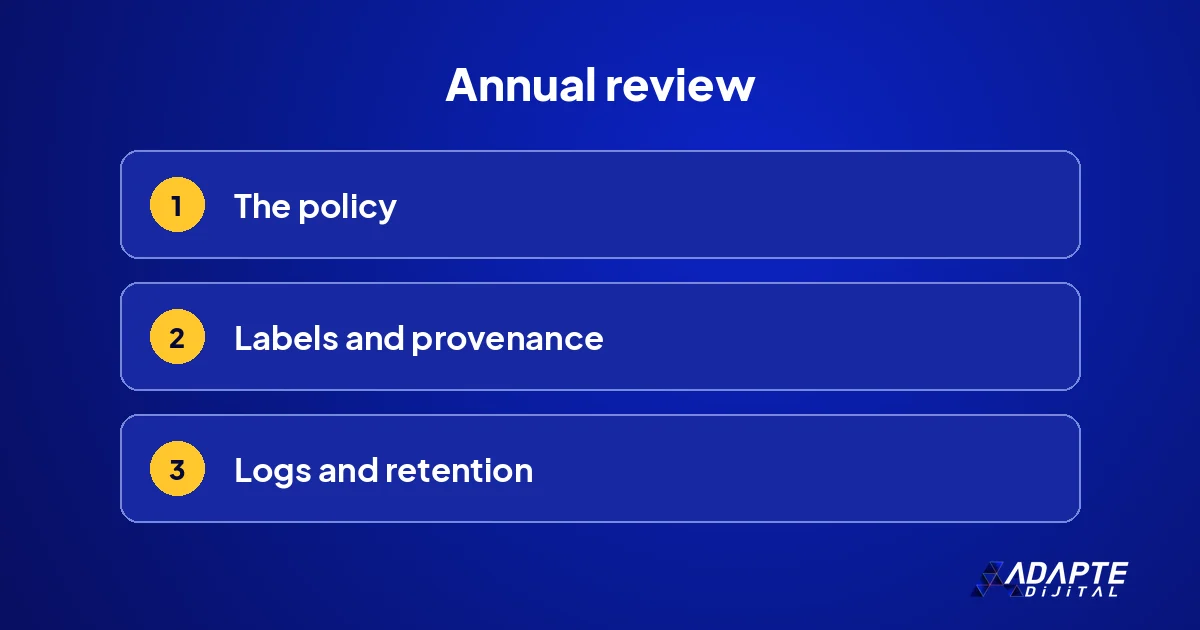
- The policy
- Labels and provenance
- Logs and retention
The annual review is broader than a quarterly audit. Four documents are read together.
The policy
The AI usage policy is reread in light of a year’s experience: which rule was never applied, which situation was missing, which banned tool was used anyway? A rule that is not applied is either removed or clarified. The policy should stay short and workable. 📄
Labels and provenance
The scope of the labelling rules is reassessed in light of European guidance and decisions in Türkiye. Whether the publishing chain keeps provenance information is tested once more. Plugins and tools that changed during the year may have changed the result of that test.
Logs and retention
The fields of agent logs, the retention period and access rights are reviewed. Logs past their retention period are deleted or anonymised according to the policy. A log kept beyond its retention period is an unnecessary personal data risk. The outcome is recorded in a short annual report. A deeper look at internal AI use is described in business AI usage audit. 🗂️
Europe’s high-risk timetable
The one-year horizon coincides with the date the European rule sets for high-risk systems. That date matters for some Turkish businesses.
2 December 2027
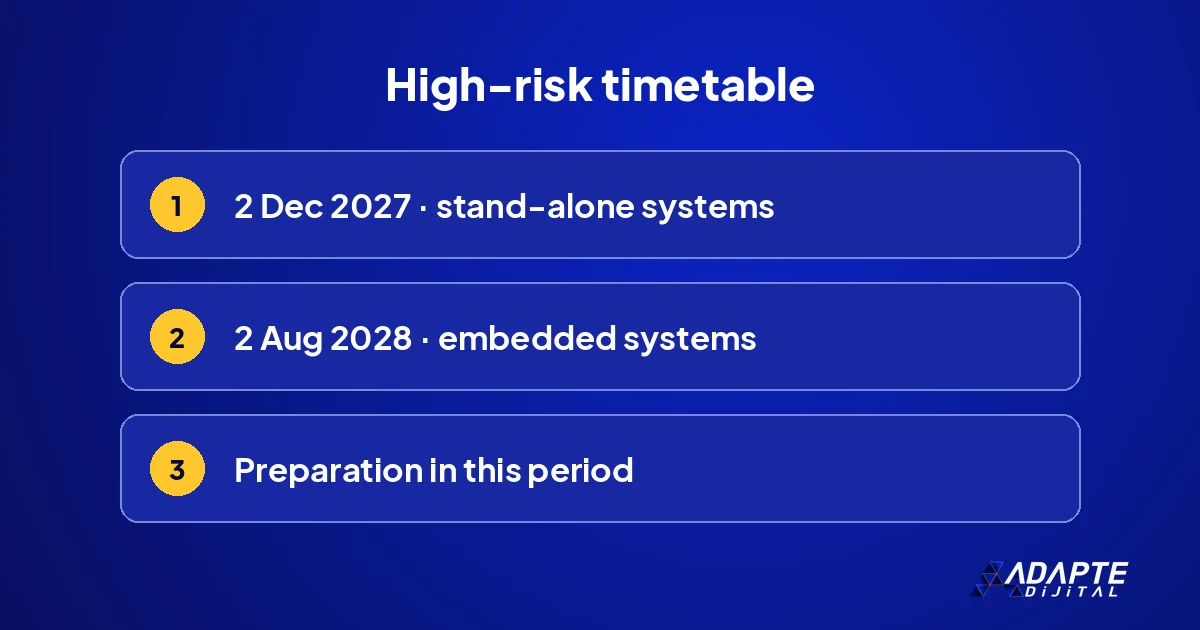
Under the amending regulation, obligations for stand-alone high-risk systems listed in the Act’s annex will apply from 2 December 2027; for systems embedded in products, the date is 2 August 2028. The one-year horizon falls just before that date. Preparation should be completed in this period. 📅
What preparation involves
High-risk systems face requirements such as risk management, data quality, technical documentation, record-keeping, human oversight and transparency; the deploying business has its own obligations too. These requirements are heavy and need expert support. Work with a lawyer and a technical team, and connect the work with the data protection side covered in KVKK and EU rules together. ⚖️
What is protected over the long term?
BU BÖLÜMÜN ÖZETİ
- The inventory habit
- A culture of transparency
- An evidence archive
Rules and tools change, but some things keep their value. Three are the most lasting gains of a year.
The inventory habit
Knowing where AI is used is the first question of every new rule. An inventory kept up to date for a year lets the business answer any future regulation quickly. This habit is the most valuable output of the year. If the habit fades, the arrangement falls apart. 📋
A culture of transparency
A culture in which the team does not hide AI use and labels are taken for granted lasts longer than rules. Culture makes the policy easier to apply. AI literacy training feeds that culture, and the European rule also requires AI literacy in its own right.
An evidence archive
A year of audit notes, provider answers, decision reasons and signed original content forms an evidence archive. The archive is the business’s strongest support when a question or complaint arrives. Evidence is gathered today, not at the moment it is needed. 🗄️
What is rising on this horizon?
BU BÖLÜMÜN ÖZETİ
- Today: the dates are set
- Forecast: debate on AI rules deepens in Türkiye
- Forecast and log
The one-year horizon looks at the end of 2027. The first item is today’s status; the next two are forecasts.
Today: the dates are set
The amending regulation clarified the high-risk dates: 2 December 2027 for stand-alone systems and 2 August 2028 for systems embedded in products. Uncertainty has fallen and a preparation calendar can be built. The transparency article has applied since 2 August 2026. 📆
Forecast: debate on AI rules deepens in Türkiye
Forecast: on a one-year horizon, the debate on AI-specific rules in Türkiye will deepen; the AI provisions of the advertising regulation and the data protection authority’s publications will be read as its first concrete steps. An arrangement built for Europe will largely fit possible Turkish rules too.
Forecast and log
Forecast: businesses that complete the annual review at the end of the year will be ready when the high-risk timetable arrives. Update log. 12 November 2026: first publication. The forecasts on this page are re-read when they fall due; a forecast that turns out wrong is not deleted but corrected here. The previous step is machine trust: nine months; the next is machine trust: two years.
How is the first year reviewed with Adapte Digital?
BU BÖLÜMÜN ÖZETİ
- A single delivery package
- What is delivered
- Where to start
The annual review is a report and a plan: the arrangement is tested, gaps are written down and the second-year plan is handed over.
A single delivery package
Adapte Digital does not charge a monthly management fee. Work starts with a single delivery package whose scope is written down in advance: 36,000 TRY + VAT. If the work grows, the new need is defined as a separate add-on package, priced by what will be delivered rather than by the hours spent. 📦
What is delivered
The output is an annual review report, an updated policy and a preparation list for high-risk uses. Legal points are flagged for your lawyer with the evidence attached.
Where to start
The written scope of each package, with current pricing and capacity, is on our campaign pages. 🧭
If you see a business opportunity here, we wrote a separate article on content provenance records.
Quick Summary
- In a year, the pattern of four audits separates persistent from temporary gaps.
- The annual review reads the policy, labels, provenance and logs together.
- In Europe, stand-alone high-risk systems face a 2 December 2027 date.
- The inventory habit, a culture of transparency and an evidence archive are protected.
- Forecasts are revisited in the update log; this article is not legal advice.
Short Glossary
- Annual review
- A full reassessment of the compliance arrangement in light of a year’s experience.
- Evidence archive
- The body of audit notes, provider answers, decision reasons and signed content.
- AI literacy
- Staff having the knowledge and skills to use AI consciously and within the rules.
Frequently Asked Questions
Next Step
Pick a random piece of content and time how long it takes to find who produced it, with which tool and with whose approval. Our campaign pages list the delivery packages that cover this work.
Sources: EUR-Lex — Regulation (EU) 2024/1689 (Artificial Intelligence Act) · Usercentrics — EU AI Act high-risk delay and Article 50 transparency
Updated: November 2026
Sık Sorulan Sorular
Businesses that use AI for screening job candidates, assessing employee performance or evaluating credit or insurance, where the output is used in Europe. High-risk uses flagged in the inventory at six months turn into a detailed preparation plan in this period, with owners and deadlines.
A few days are enough for a small business. If quarterly audit notes were kept regularly, the work is much shorter.
It may, if you use AI in areas such as recruitment, credit or insurance and the output is used in Europe. Consult a lawyer.
Today there are AI provisions in the advertising regulation and publications from the data protection authority. Our forecast is that the debate will deepen; giving a firm date would be wrong.