
Where Does AI Risk Hide in a Company? Keys, Endpoints and Shadow Tools
AI risk in most companies sits not in a large system but in small, forgotten places: a key in a code repository, a plugin’s settings page, an employee’s personal account. The risk is not where anyone is looking. 🗝️
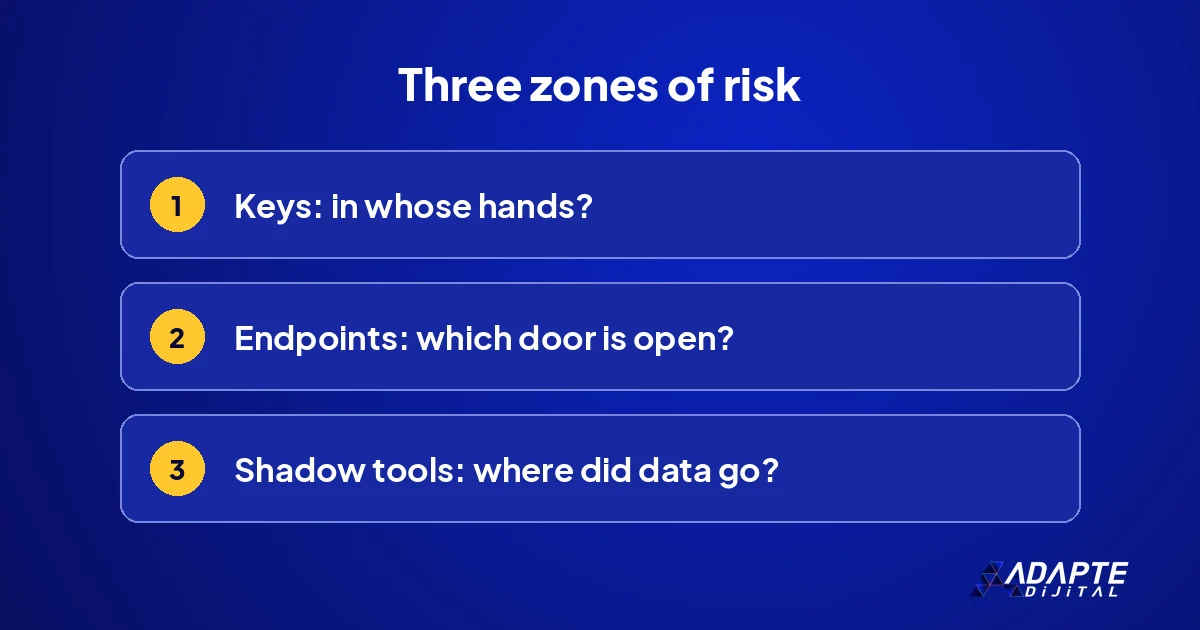
This article maps those places. There are three zones: keys, endpoints and shadow tools. The article describes the defender’s side only. The scenario file is fiction. It does not describe a real company; it is written to show how the risk works.
Scenario file: what was left in the repository of an intern who left two years ago?
BU BÖLÜMÜN ÖZETİ
- The test
- Two years later
- How it is found
Picture a software agency. Two years ago an intern wrote a small test application using the company’s model key.
The test
To get the application running quickly, the intern writes the key straight into the code. For easy sharing, the code is uploaded to a public repository. The test is admired and then forgotten. The intern leaves; the repository and the key stay where they are. The key is still tied to the company’s main account. 🧑💻
Two years later
An automated tool that scans public repositories finds the key. Whoever finds it starts using it for their own work. The company’s website is unaffected and no system goes down. Only the provider’s invoice grows. Nobody connects the rise on the invoice with that old test.
How it is found
The problem surfaces through a question from accounting. Nobody knows where the key is used, because there is no list of keys. The key is revoked and three working systems stop together. A single key had been used both in testing and in production. 🔗
Zone one: where are keys forgotten?
A key is the authority to spend on behalf of your account. Whoever carries it spends in your name.
The places a key sits
Code repositories come to mind first, but they are not the only place. The settings pages of site plugins, connections inside automation tools, shared documents, chat messages and old laptops carry keys too. The report also notes that AI-assisted commits leak secrets at roughly twice the rate. As speed rises, so does the number of forgotten keys. 💻
Zone two: which endpoints are left open?
BU BÖLÜMÜN ÖZETİ
- Boxes on the site
- Plugins and connections
- Test environments
An endpoint is any door through which an outside request reaches the AI. You opened some of them; a plugin opened others.
Boxes on the site
A chatbot, a smart search, a product question box and a content suggestion field are all endpoints. If they work without a login, anyone can use them. If there is no request limit, so can a script. How the load arriving through this door turns into an invoice is in the denial of wallet attack. 🚪
Plugins and connections
When you install a plugin, a new endpoint often opens with it: an address that can be called from outside, a form, a connection. Even when the plugin is removed, its setting and its key may stay in the database. A plugin nobody uses is a door nobody watches. An audit looks at the AI settings of every plugin, active or not.
Test environments
Development and test sites are usually less protected than the live site but use the same key. There is no password, no limit and no monitoring. Being closed to search engines does not mean being closed to scans. A separate key with a low cap for testing shrinks this risk in a single move. 🧪
Zone three: what do shadow tools carry?
BU BÖLÜMÜN ÖZETİ
- IBM’s findings
- The missing access control
- What it looks like in a small business
A shadow tool is an AI tool used without the company’s knowledge. There is no ill intent; there is an employee who wants to finish the job quickly.
IBM’s findings
According to IBM’s 2025 Cost of a Data Breach report, 20 per cent of the organisations studied reported a breach caused by shadow AI. In organisations with high levels of shadow AI, the average cost of a breach was 670,000 dollars higher. The problem is not the tool but the fact that it is invisible. 🌫️
The missing access control
According to the same report, 13 per cent of organisations reported a breach involving their AI models or applications. In 97 per cent of those, there was no proper AI access control. The report also says that most breached organisations had no governance policy for AI. If who can reach what is not written down, everyone can reach everything.
What it looks like in a small business
In a small business a shadow tool is usually a personal account: the customer list is pasted into a personal chat account, a contract is uploaded to a free tool. The data has left the company and cannot be taken back. A ban rarely works; the use goes underground. What works is offering an approved tool and a short rule. We describe how to have that conversation in my team uses AI without telling me, and the rule in how to write an AI usage policy.
How is a risk map drawn?
BU BÖLÜMÜN ÖZETİ
- The cost formula
- The three-column table
- Five questions asked in an audit
The map is not a security product. It is a table with three columns, and it can be drawn in a day.
The cost formula
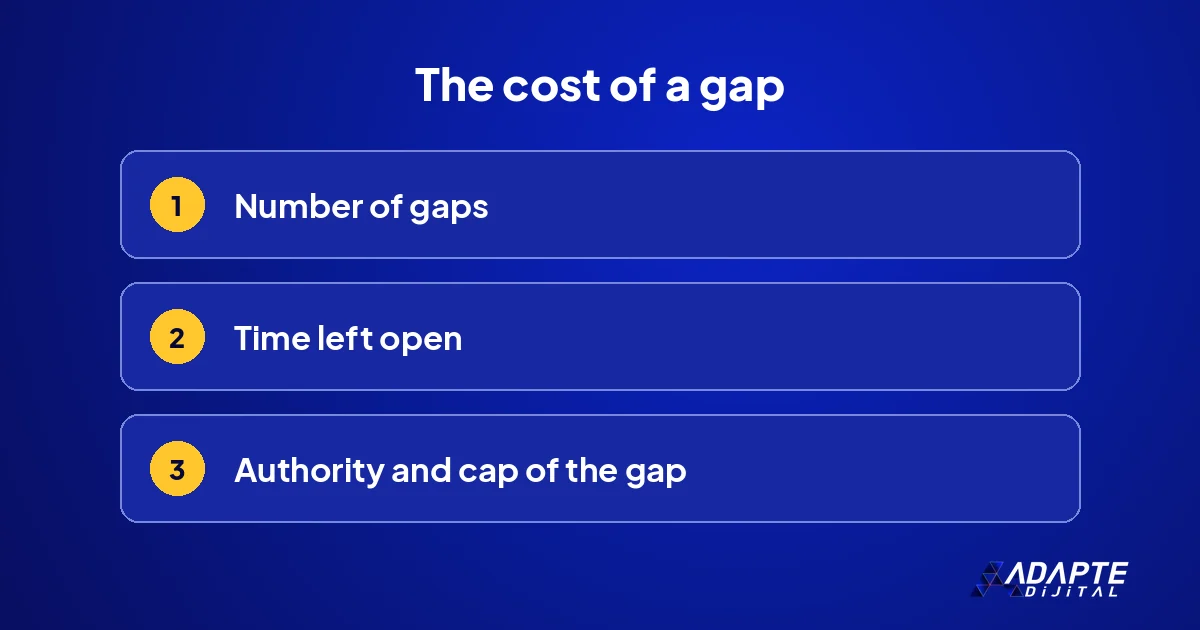
Think of the cost of a gap like this: number of gaps × time left open × authority of the gap. The inventory shows the number of gaps. Time left open is when the key was last rotated. Authority is what that key can reach and what its spending cap is. A main key with no cap that has not been rotated for years raises all three multipliers at once. 🧮
The three-column table
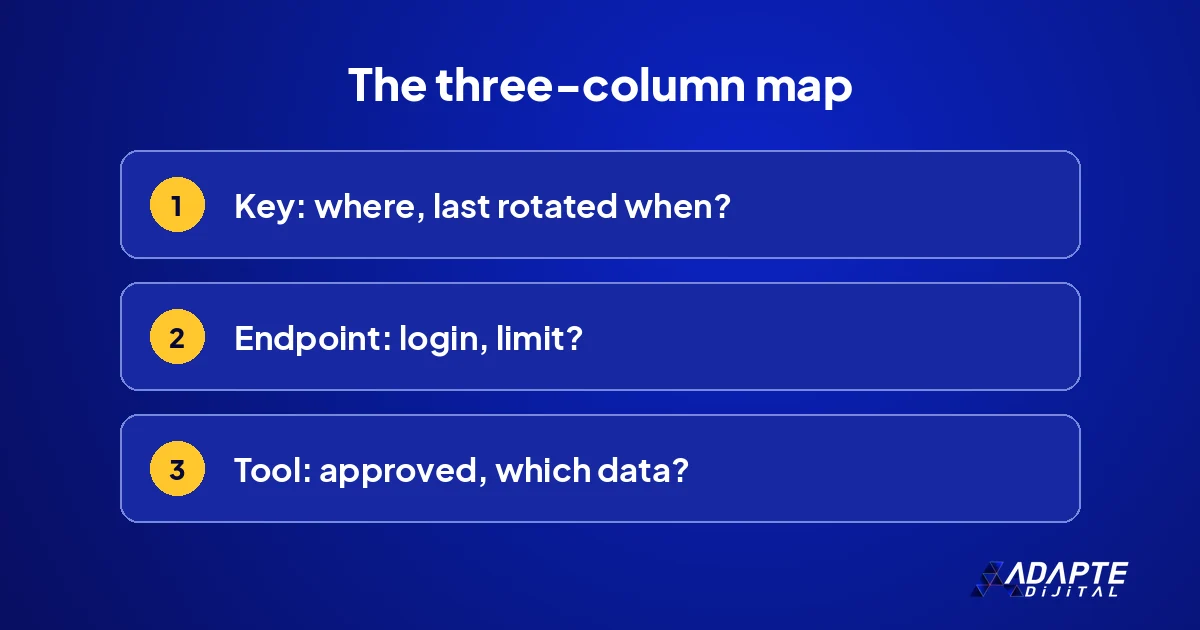
In the first column write the keys: which provider, where it sits, when it was last rotated. In the second write the endpoints: which box, whether it needs a login, whether it has a limit. In the third write the tools the team uses: whether approved, and which data goes in. Every empty cell is a finding.
Five questions asked in an audit
One: how many keys do you have, and where does each one sit? Two: when was the oldest key last rotated? Three: do test and production use separate keys? Four: how many AI boxes work without a login? Five: is there a list of the tools the team uses? Forecast: providers will widen the scans that automatically revoke leaked keys. Update log. 18 November 2026: first publication. Forecasts on this page are re-read when they fall due; one that proves wrong is corrected here, not deleted. Real cases of what follows a leak are in AI bill shock incidents.
How does Adapte Digital draw the risk map?
BU BÖLÜMÜN ÖZETİ
- A single delivery package
- What is delivered
- Where to start
The attack file starts with this table: keys, endpoints and tools are counted one by one and their owners are written down.
A single delivery package
Adapte Digital does not charge a monthly management fee. Work starts with a single delivery package whose scope is written down in advance: 36,000 TRY + VAT. If the work grows, the new need is defined as a separate add-on package, priced by what will be delivered rather than by the hours spent. 📦
What is delivered
The output is the three-column risk map, the keys that need rotating and the list of doors to close, in order of how much authority each one carries.
Where to start
Our current packages and capacity are listed on our campaign pages; scope and price are written there before any work starts. 🧭
Quick Summary
- AI risk hides in three places: keys, endpoints and shadow tools.
- According to GitGuardian, leaked secrets belonging to AI services rose 81 per cent in 2025.
- According to IBM, 97 per cent of those with an AI-related breach had no access control.
- The cost of a gap: number of gaps × time left open × authority of the gap.
- A three-column risk map can be drawn in a day.
Short Glossary
- Endpoint
- An endpoint is the address through which an outside request reaches a system.
- Shadow AI
- Shadow AI is the AI tools employees use without the company’s knowledge or approval.
- Key rotation
- Key rotation is the practice of revoking an access key at intervals and issuing a new one.
Frequently Asked Questions
Next Step
Ask one question today: how many AI keys does the company have, and where is each one kept? If the answer does not come within a minute, the first column of the map is empty.
Sources: GitGuardian — The State of Secrets Sprawl 2026 · IBM — 2025 Cost of a Data Breach Report: Navigating the AI rush · Sysdig — LLMjacking: Stolen Cloud Credentials Used in New AI Attack
Updated: November 2026
Sık Sorulan Sorular
According to the report GitGuardian published in March 2026, 28.65 million new secrets were written into public GitHub commits in 2025, a rise of 34 per cent on the year before. The number of leaked secrets belonging to AI services rose by 81 per cent to more than 1.27 million. The fastest-growing kind of leak is the AI key. 📊
According to the same report, 64 per cent of the leaked secrets confirmed as valid in 2022 had still not been revoked in January 2026. So even when a leak is noticed, the key is often not changed. The reason is simple: nobody knows where the key is used, and revoking it may break something. Without a list, revoking takes courage.
Unfamiliar hours, models or volumes in the provider’s usage dashboard are the first sign. Some providers and code hosting services also scan for leaks; read their warning emails.
Tie it to events rather than a fixed rule: rotate when someone leaves, when a plugin is removed and when you have a doubt. Beyond that, rotating a few times a year is a reasonable habit.
A ban usually hides the use. Offering an approved tool and stating plainly which data may not be entered gives a better result.