
Documents and the Service Definition in Online Service Sales

In a business selling services online the paperwork is built from learnable items: the commencement notice and tax certificate, chamber registration, a workplace opening and operating licence for the activity address, the electronic commerce information duties, and the professional certificates that arise with the service. What separates a business here lies elsewhere: showing the limits of what is sold through records.
In businesses working here we set up one system: a service definition and cancellation file. It has four record layers, takes little time to build, and repays itself in fewer cancellation and refund arguments. Below we describe how it is built and why it works.
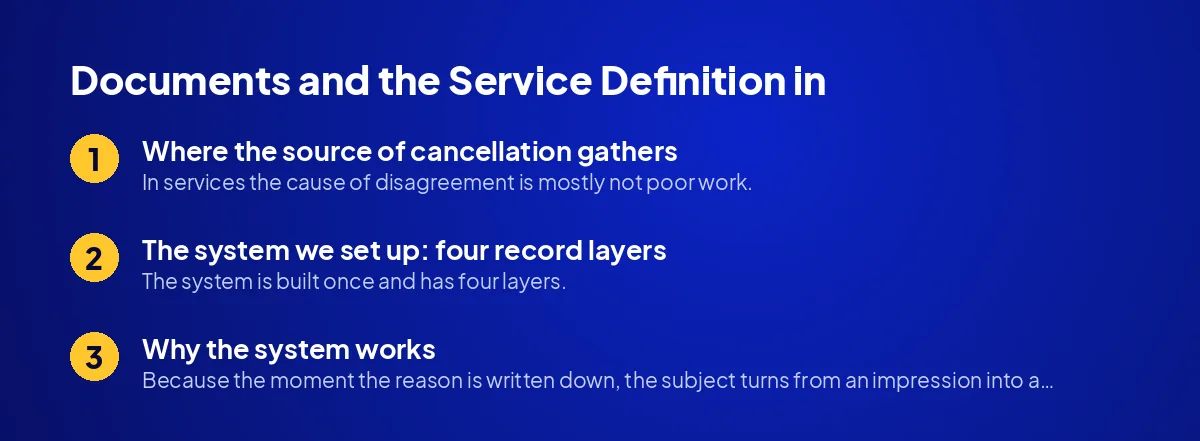
Where the source of cancellation gathers
In services the cause of disagreement is mostly not poor work. The customer finds the scope of what was bought different from what was expected.
That gap has three typical sources: where the service begins and ends never written down, the right to revision left vague, and the manner of delivery discussed aloud but never recorded. All three come from a missing definition the sales page could have settled.
The system we set up: four record layers
BU BÖLÜMÜN ÖZETİ
- 1. The scope record
- 2. The duration and delivery record
- 3. The revision and repetition record
- 4. The cancellation reason record
The system is built once and has four layers. Each answers a question that arrives after the sale.
1. The scope record
For each service, what is done, what is excluded and the form of delivery are held in one place. That line appears on the sales page and becomes an annex to the contract.
2. The duration and delivery record
The day the service began, the stages it passed and the moment delivery counts as complete are recorded. The moment of starting is the critical line here.
3. The revision and repetition record
How many corrections were made, and which request counted inside the scope and which outside, are entered. That an out-of-scope request is priced separately becomes visible here.
4. The cancellation reason record
Every cancellation request is gathered under four headings: misread the scope, found the duration long, changed their mind before the start, was not satisfied with the result. Those four proportions show which part of your sales page is thin.
Why the system works
Because the moment the reason is written down, the subject turns from an impression into a measurement. It becomes visible which package, which price band and which manner of description concentrate the gap in expectation.
The picture we see: most cancellations come from service pages with a weak scope line. When the exclusions are written plainly there, the cancellation rate falls without the price being touched.
The paperwork: which framework runs
| Heading | Institution | Note |
|---|---|---|
| Commencement and tax certificate | Tax office | Activity code must cover the service |
| Chamber registration | Tradesmen’s or trade chamber | By business structure |
| Licence for the activity address | District municipality | Assessed by address and activity |
| Electronic commerce information | Yours, published on site | Scope confirmed with the Ministry of Trade |
| Distance contract arrangement | Yours, contract and process | Pre-contractual information and consent |
| Service-specific professional certificate | Relevant authority or chamber | Arises with the service |
| Personal data arrangement | Yours | Privacy notice and retention period |
| Invoice and collection record | Yours | Must match the payment record |
This table is a preparation framework, not a closed list. If the service you sell falls into a regulated professional field a further line of paperwork arises; describe your service definition and ask the relevant authority.
Why the right of withdrawal works differently in services
In a sale made at a distance the consumer is to be informed before purchase and the conditions of the right of withdrawal stated plainly. In service sales this heading parts from goods.
The reason: a product can be sent back, a service already given cannot. So the fact that performance has begun stands in a place of its own on the withdrawal side. How many days of right arise, and where the right falls outside scope, change with the nature of the service; rather than writing a fixed number of days, describe your service and take confirmation from the current legislation and the Ministry of Trade. The process you describe to the customer and the one you run must be the same.
Recording the moment the service began
The practical equivalent of that paragraph sits in one record: when did the service begin. We treat that line as the core of the system.
- A record of the moment the customer consented to the service starting
- Which channel the consent came through and its wording
- The date and time of the first output or first meeting
- Customers who cancelled before the start held on a separate list
The fourth item is a small habit but the most useful record of all. A cancellation before the start is not assessed in the same file as one mid-service.
Payment and invoice timing
In services the moment of collection sets the heat of the argument directly. Where a service is paid for in advance, the customer cancelling expects the whole sum back.
We build a two-move arrangement: no collection before scope consent, and the method of calculating partial performance written into the contract from the outset. Without that second sentence the conversation starts from nothing every time.
Where the provider’s competence sits in the file
Some services cannot be sold on a business registration alone; a certificate is sought from the person working. Consultancy, technical service, training and health-related fields stand apart here.
Selling on the internet does not remove that duty. Write your service definition and ask the relevant professional body; take the answer in writing and keep it on file.
The position of the activity address
The heading most often overlooked online is the position of the place where the work is actually done. The sale runs on the internet; the work happens at an address.
That address’s fitness for the activity and its zoning status are a separate matter. If you will receive customers, employ a team or keep equipment, the assessment most likely changes. Ask the municipality about your office or workshop address in writing.
The order in which the system is built
- Add a scope and exclusion line to every service package
- Write the form of delivery and when delivery counts as complete
- Define the right to revision by scope, not by number
- Tie the consent to starting the service to a record
- Begin gathering cancellation reasons under four headings today
- A month later, correct the package definition where cancellations gather
The sixth item is where the system repays itself. The first five are set-up; the sixth is the gain.
The method in summary
Here the paperwork is the learnable part of the job. What sets a business apart is showing the limits of the service through records, and making the reason for cancellation measurable.
Address-linked licence items are read off the municipality’s tariff; since that tariff is renewed within the year, do not tie a budget to a fixed number. For the full order of the authorities see the business licence roadmap, and for investment and running-cost ranges our business services sector page. If you sell an intermediation service, our estate agency article shows one application of this system; if the output is physical, our printing and digital press article shows another.
In Short
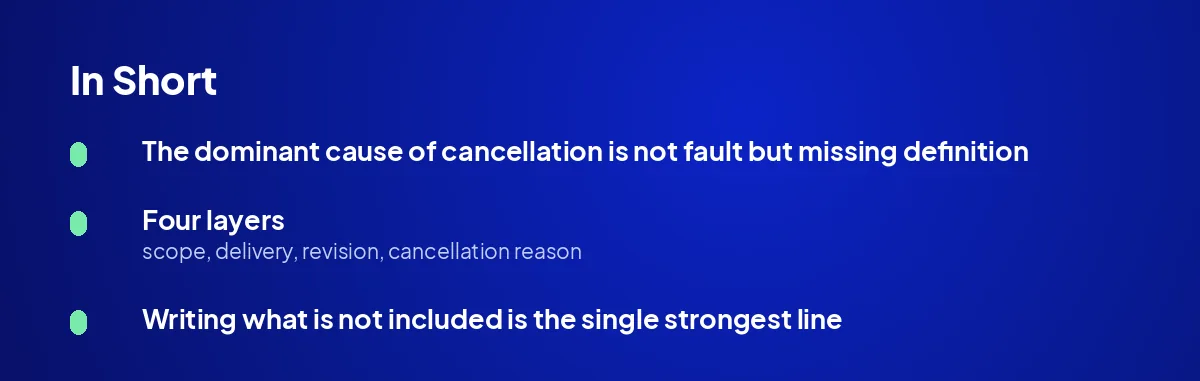
- The dominant cause of cancellation is not fault but missing definition
- Four layers: scope, delivery, revision, cancellation reason
- Writing what is not included is the single strongest line
- The record of when the service began is the core of the system
- The right of withdrawal works differently in services
- Day counts and exceptions change with the nature of the service
- No collection is taken before scope consent
- Partial performance is calculated as the contract sets out from the start
- In some services a certificate is sought from the person working
- Selling online does not lift that certificate duty
- The licence position of the working address is separate
Quick Glossary
Service definition: the text explaining the scope, the exclusions and the form of delivery of the work sold. Beginning of performance: the moment the service is taken up and the customer has consented to it. Partial performance: the calculation made where a contract ends with part of the service complete. Pre-contractual information: the step at which scope, price and rights are explained before the sale closes.
Next Step
Let us build your service definition and cancellation file: consultation request form.
Frequently Asked Questions
Updated: September 2026
Sık Sorulan Sorular
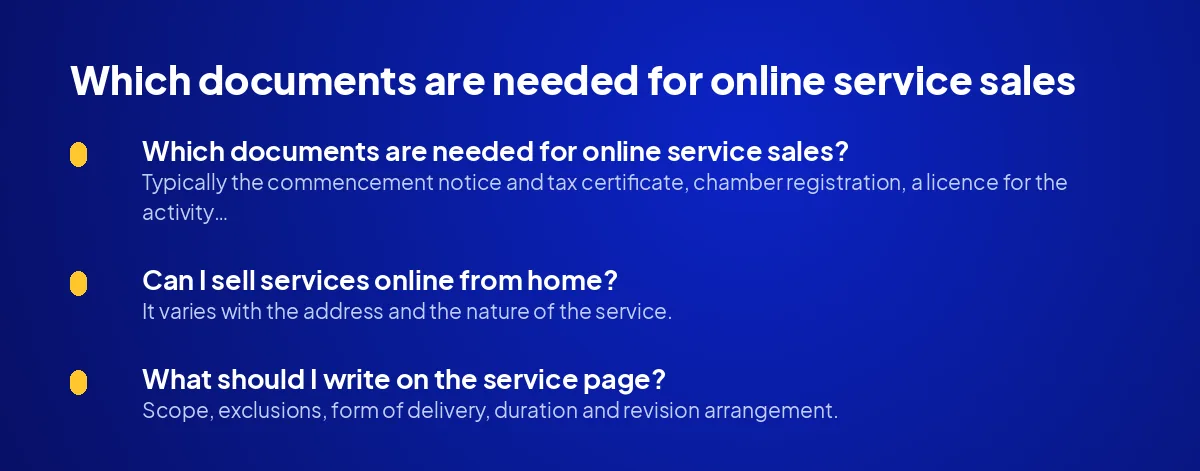
Typically the commencement notice and tax certificate, chamber registration, a licence for the activity address and the electronic commerce information duties.
It varies with the address and the nature of the service. If you receive customers, confirm the position with the municipality in writing.
Scope, exclusions, form of delivery, duration and revision arrangement. Those lines form the basis of any cancellation argument.
Day counts and exceptions change with the nature of the service. Describe your own service and take confirmation from the current legislation.
That performance has begun stands in a place of its own. So tie the starting consent and the partial performance calculation to records early.
You can, but collecting before scope consent enlarges the argument. Set the order so consent comes first.
You may, if the service falls into a regulated professional field. Write your service definition and ask the relevant authority.
A privacy notice, a retention period and an access authorisation arrangement are set up. Determine the scope from your data flow.
A few days’ work, depending on how many services you have. The return shows in the first month’s records.