
Plumbing and Technical Service Company Documents: What the Coming Period Brings

The answer to the question of documents needed for a plumbing and technical service company has changed quietly over the past decade. This work once ran on a van, a tool bag and a telephone number. Today the same work faces headings such as the vocational qualification certificate (MYK), authorisation by the distribution company and chamber registration.
This article does not stop at today’s list. It also discusses direction: on which three headings authorised plumbing will separate in the coming period, and which record built today becomes valuable then.
Today’s framework: which lines run in a plumbing firm
Three lines run here at once, and each has a different authority. The first is the business line: tax, chamber and licence. The second is the personal line: the competence of the person doing the work. The third is the authorisation line.
That third line is the least known. In natural gas, water and some heating and cooling work, authorisation of the firm by the relevant distribution company or trade chamber can come into play. Which job needs which authorisation varies by region and by type of work, so write out your own service list and take confirmation directly from the distribution company and the chamber.
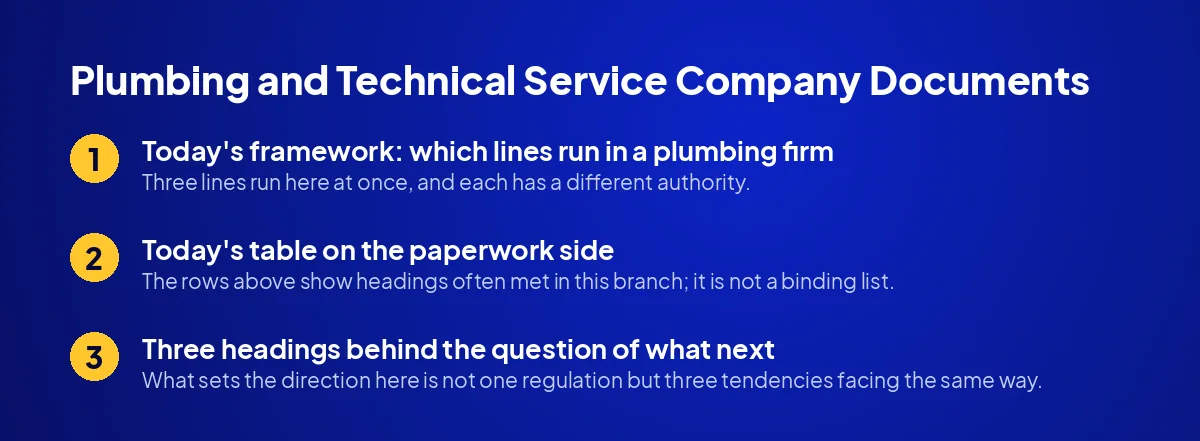
Today’s table on the paperwork side
| Heading | Authority | Note |
|---|---|---|
| Commencement and tax certificate | Tax office | Activity code must cover your service list |
| Chamber registration | Tradesmen’s or trade chamber | By business structure |
| Workplace opening and operating licence | District municipality | Varies with workshop and store layout |
| Vocational qualification certificate (MYK) | Certification side | May be sought from the person working |
| Distribution company authorisation | Relevant distribution company | Arises by type of work and region |
| Trade chamber authorisation | Relevant chamber | Scope differs by chamber |
| Vehicle and equipment record | Yours | Equipment inventory of the service van |
| Social security workplace declaration | Social security institution | Before the first technician |
The rows above show headings often met in this branch; it is not a binding list. How far the fifth and sixth rows cover you depends on the work you actually do.
Three headings behind the question of what next
What sets the direction here is not one regulation but three tendencies facing the same way. All three say the same thing: the record of the work is becoming as valuable as the work.
First heading: the authorisation record goes digital
Today a customer generally accepts that the firm in front of him is authorised because he is told so. That point is changing.
Once authorisation can be checked, the way work is found changes with it. A firm with a checkable record moves apart from an uncertificated crew doing the same job in the same street. That separation breaks price competition, because the customer no longer compares two quotations under one item.
Second heading: measurement and efficiency
In heating, cooling and water systems, measuring the result of the work done is coming to the fore. That a boiler has been connected and that it is running efficiently are two different statements.
In the coming period a technical service’s output will be discussed by the value measured as much as by the installation carried out. That changes what goes on the service docket: the value measured is recorded alongside the work done. A firm able to measure draws an extra service item from this.
Third heading: service history becomes a portable record
The third tendency is the least discussed and will bring the most work. The service history of a building or an appliance today sits largely in the plumber’s memory.
When that knowledge turns into a portable record, two things follow. Selling a maintenance agreement becomes easier, because a system with a recorded past has a predictable next need. And when the property changes hands the record passes to the new owner, so the firm does not lose the customer.
What the three headings share
The three tendencies meet in one sentence: the future in this trade belongs to the firm that records the work, not merely the one that does it.
That sentence is a forecast, not a ruling. Even so it points a practical way for the system you could build today: records cannot be set up afterwards, because a service history cannot be produced retrospectively.
The record system that can be built today
The arrangement below looks like a cost item today and turns into an asset in three years.
- For every call, a record of address, appliance, make, model and work done
- The code of the spare part used and its warranty period written on the docket
- The name and certificate position of the technician who did the work
- Where measured, values noted before and after the work
- The next maintenance date reminded to the customer in writing
- Customer consent taken before the work and together with the price
The fifth item is a turnover item on its own. Once maintenance reminders are running, the work that comes in is cheaper and more loyal than work brought by advertising.
Why the authorisation line ties to the distribution company
The logic of this line: a fault in the work affects not only the customer but the network. On the gas and water side that effect is a safety matter directly.
So authorisation limits which operations a firm may carry out, and in what scope. Ask your regional distribution company in writing which authority is sought for which operation and how the application is made. That scope differs from region to region and is updated over time.
Two firm types that will separate
Two firms doing the same work in the same street look alike today. Within a few years they will be two different businesses.
The first type does the job that comes by telephone and writes a docket. The second does the same job and builds the record too: appliance history, measurement, maintenance calendar. The second type’s turnover comes not from one-off jobs but from renewed agreements. That separation will be quiet; it will arrive through customer habit, not through a regulation.
Three steps to take today
- Write out your service list and ask about the authorisation scope. Taking work you do not do off the list is also a decision
- Plan the qualification side for every technician in the team; if the certificate rests with one person the firm depends on him
- Keep the service record digital from day one; a history cannot be made from paper dockets
The direction in summary
Here the documents are not an obstacle but a means of separation. Competing on price against an uncertificated crew is hard; competing as a certificated and recorded firm is possible.
As for licence and charge items, writing a fixed amount would be wrong; the municipality’s own tariff runs and it is updated annually. You can follow the general order of the authorities in the business licence roadmap; investment, expenditure and earnings ranges are laid out on our business services sector page. If you are thinking of widening the field service into pest control, our pest control company article helps; if you will build a shop-based service model, our dry cleaning article is a good comparison.
In Short
- Here the business line, the personal line and the authorisation line run together
- The authorisation line answers to a distribution company or trade chamber
- Which job needs which authority varies by region
- The vocational qualification certificate may be sought from the person working
- Authorisation becoming checkable breaks price competition
- The measured result is turning into an output discussed as much as the installation
- Once service history is portable, maintenance agreements sell more easily
- A service record cannot be produced retrospectively; the system is built today
- Maintenance reminders bring work more cheaply than advertising
- A certificate resting with one person makes the firm depend on him
- Licence amounts are read off the district tariff and are not fixed
Quick Glossary
Authorisation: acceptance by the relevant distribution company or chamber that a firm may carry out certain technical operations. Service history: the record in which every operation on an appliance or system is held with its date and content. Maintenance agreement: the arrangement tying checks and servicing at set intervals to a contract in advance. Measurement record: the line noting values before and after the work for comparison.
Next Step
Let us draw up your service list and your authorisation road map: consultation request form.
Frequently Asked Questions
Updated: September 2026
Sık Sorulan Sorular
Typically the commencement notice, chamber registration, a licence for the activity address and a vocational qualification certificate in the person working.
It is not; it varies by type of work and region. Write out your service list and ask your own regional distribution company.
Usually it narrows, because operations touching the network fall outside scope. Draw the line with your service list.
The address the activity runs from and the store layout decide it. Ask the district municipality in writing.
A certificate may be sought in the person, depending on the work you do. Confirm the expectation with the relevant authority before hiring.
Address, appliance, operation, part and technician are held together. If you measure, write the values on the same line.
A recorded service history and a written scope text. Without both, the agreement is argued afresh at every renewal.
The part’s own warranty and the labour warranty run separately. Show them as two lines on the docket.
Authorisation scope and certificate conditions are updated over time. Confirm your own scope afresh once a year.
Source: Ministry of Environment, Urbanisation and Climate Change — Technical Application Principles