
What Are UCP and ACP? The Shopping Language of AI Agents, Explained Plainly
UCP and ACP are two open standards that let AI agents talk to stores. UCP is the Universal Commerce Protocol that Google developed with retailers; ACP is the Agentic Commerce Protocol published by OpenAI and Stripe. Both govern how an agent finds a product, builds a cart and starts a payment. 🧩
This article explains both standards in language a store owner can follow: what each one is, how it works, how they differ, what changed in 2026 and what it means for a store in Türkiye. The information was compiled on 12 November 2026 from official announcements and industry sources.
What is UCP?
The Universal Commerce Protocol was designed so that an agent can run the whole shopping journey, from discovery to after-sales, with a store in a shared language.
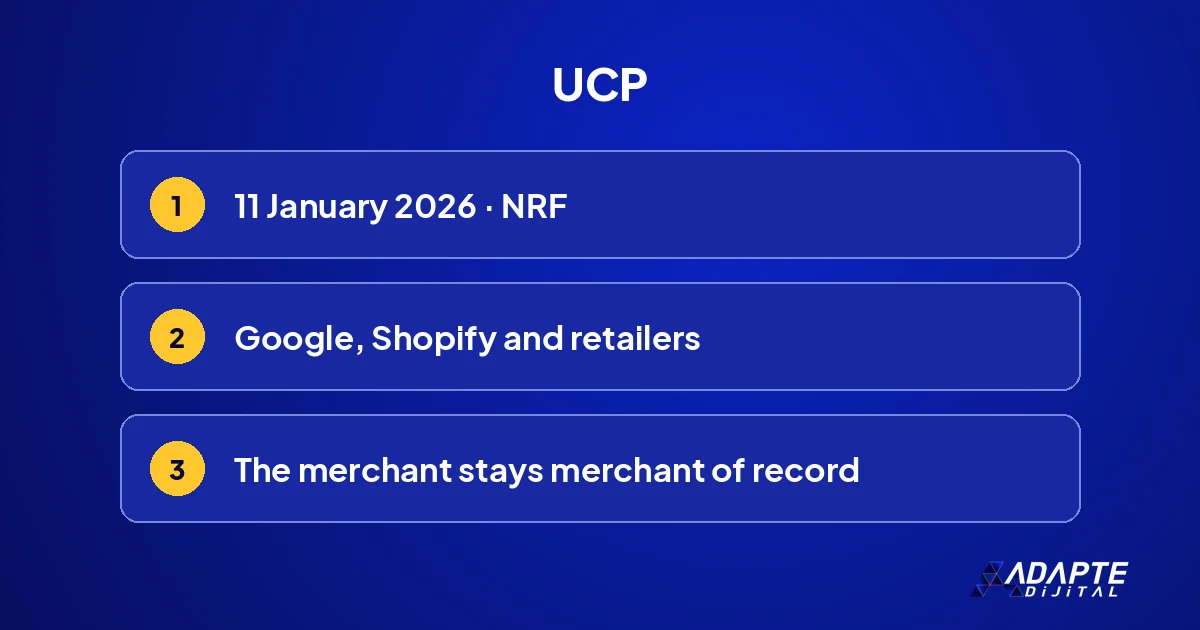
The merchant stays in place
One of UCP’s core principles is that the store remains the merchant of record. Price, stock, shipping and order logic stay with the store; the agent only uses them. The customer is the store’s customer, not the agent’s. This principle also means the store’s responsibility for returns and warranties continues, just as it would for an order placed on its own site. 🏪
What is ACP?
The Agentic Commerce Protocol is an open specification that governs the payment flow between an agent and a store and the sharing of product data.
The payment token
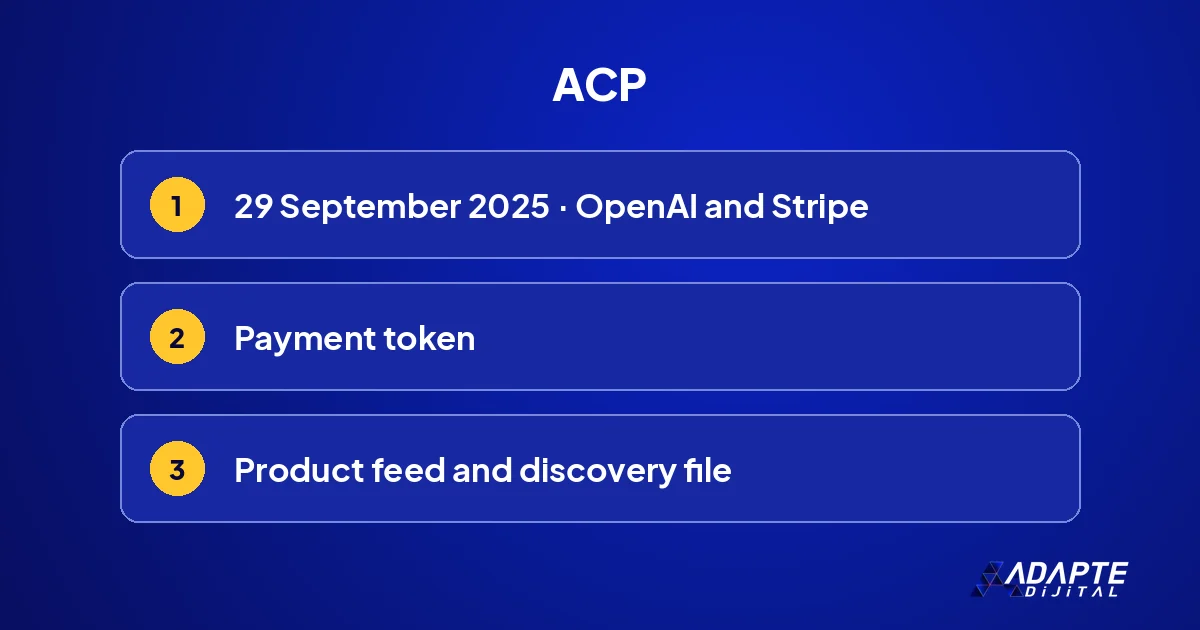
In ACP, the customer’s card details are never handed to the agent. Instead, a payment token limited by amount, merchant and time is created and passed to the merchant. The token is an authorisation valid only for that purchase. The specification also defines a separate payment authorisation route for merchants who do not use Stripe, so the protocol is not tied to a single payment processor.
Product feed and discovery file
Another part of ACP is the product feed specification, which defines how products are presented to an agent with identity, price, stock and policy fields. The April 2026 version also added a discovery file through which a store introduces itself. The feed specification keeps its role even though in-chat checkout was scaled back. It is the part of ACP a store is most likely to use first. 📄
How do they differ?
BU BÖLÜMÜN ÖZETİ
- Governance
- Where they are used
- Maturity
The two standards solve the same problem but start from different places. The differences show most clearly in governance, where they are used and how mature they are.
Governance
UCP is governed through a multi-partner structure led by Google; its technical council expanded in April 2026. ACP’s founding maintainers are OpenAI and Stripe. Both are open specifications, but their decision-making differs. That difference affects how quickly each feature arrives and who gets a say in it, which is worth watching as the standards mature. ⚙️
Where they are used
UCP’s first implementations are on Google’s surfaces: AI Mode, the Gemini app and, since May 2026, regular search results. ACP was born for ChatGPT and is opening to other assistants through Stripe’s agentic commerce suite. For a store, these are two different doors that open onto the same product data. Which door a customer walks through depends on the assistant they use, not on the store.
Maturity
UCP expanded throughout 2026: cart, catalog, identity linking, multi-item carts, hotels and food delivery. On the ACP side, checkout inside ChatGPT was scaled back in March 2026. The maturity of a protocol and the success of a product are not the same thing; the two should be tracked separately. A protocol can keep improving even while one company’s shopping feature changes course. 🔍
What happened in 2026?
BU BÖLÜMÜN ÖZETİ
- UCP’s expansion
- The step back in ChatGPT
- The common ground: product data
This year was eventful for both standards. Three developments directly affect how stores prepare.
UCP’s expansion
In March came new capabilities and onboarding through Merchant Center; in May, the Universal Cart, Affirm and Klarna support and YouTube Shopping ads; in October, the Merchant Center integration hub opened in the United States. Each step took checkout to more surfaces. For now, though, all of these steps are US-focused, and other markets are still waiting for dates. 🚀
The step back in ChatGPT
On 16 February 2026, OpenAI opened buying in ChatGPT to all US users. On 24 March, it said the first version was not flexible enough and announced that merchants would use their own checkout experiences. ChatGPT turned its focus to product discovery, which is why ACP’s feed side came to the fore. The agent still shapes the choice; the store now completes the sale.
The common ground: product data
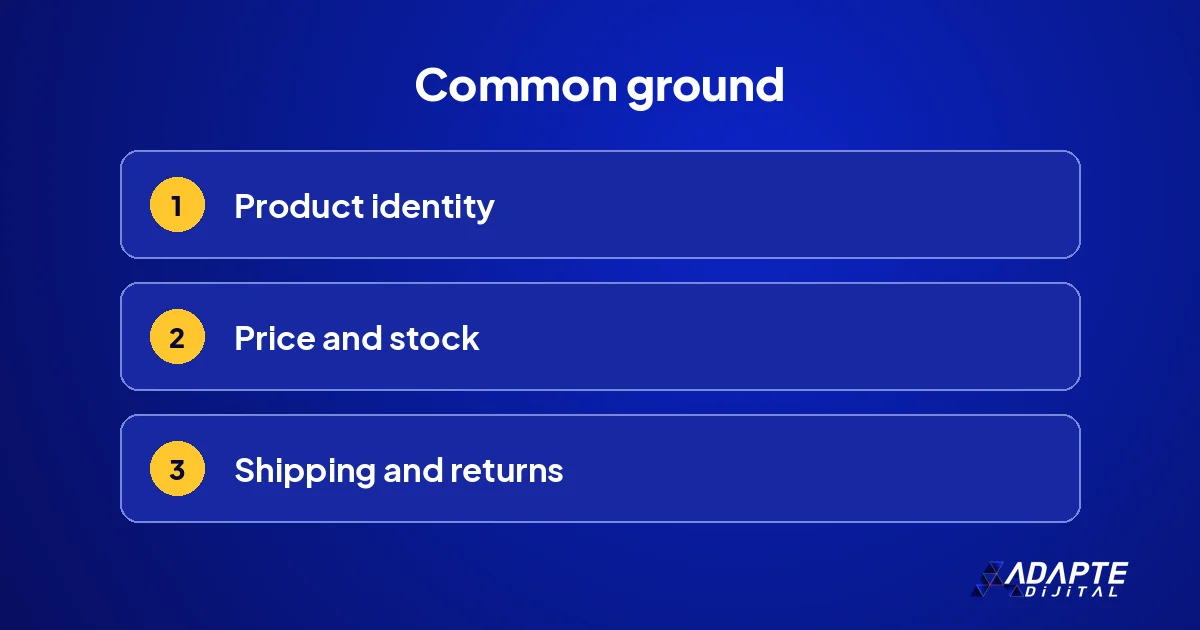
The shared lesson of both stories is this: where the buy button sits may change, but the product data an agent reads is needed in every scenario. Identity, price, stock, shipping and return fields are the foundation of both standards. These fields are covered in detail in the product data agents read, with the most common gaps that keep products out of comparisons. 🧱
What does it mean for a store in Türkiye?
The checkout side of both standards has not opened in Türkiye yet. That does not mean the subject is far away.
No purchases today
Google’s UCP-powered checkout is in the United States; the announced expansion order is Canada, Australia and then the United Kingdom. Checkout inside ChatGPT is limited to approved merchants. No date has been announced for Türkiye. But agents already read store data when recommending products, and a recommendation brings the customer to the store’s own site, where the sale can still be made. 🇹🇷
The same preparation
Whichever standard arrives first, a store’s work is largely the same: product identity, correct prices and stock, clear shipping and return information, and a clean feed and structured data. It is not two separate preparations but one foundation. Where Turkish e-commerce stands in this shift is discussed in agentic commerce in Turkish e-commerce.
How does Adapte Digital approach UCP and ACP readiness?
BU BÖLÜMÜN ÖZETİ
- A single delivery package
- What is delivered
- Where to start
We put the foundation the protocols read ahead of protocol installation: product data, policy data and the feed setup are put in place and handed over to you.
A single delivery package
Adapte Digital does not charge a monthly management fee. Work starts with a single delivery package whose scope is written down in advance: 36,000 TRY + VAT. If the work grows, the new need is defined as a separate add-on package, priced by what will be delivered rather than by the hours spent. 📦
What is delivered
The output is a data table built around the fields both standards share, a feed check note and a protocol roadmap for your platform. How feeds are tuned in practice is explained in shopping feed optimization.
Where to start
Our current packages and capacity are listed on our campaign pages; scope and price are written there before any work starts. 🧭
To turn this topic into a business of your own, start with our article on agent commerce auditing.
Quick Summary
- UCP is the open agent commerce standard Google announced with retailers in January 2026.
- ACP is the open specification OpenAI and Stripe published in September 2025.
- UCP expanded in 2026; checkout inside ChatGPT was scaled back in March 2026.
- The shared foundation of both is product identity, price, stock, shipping and return data.
- There is no date for Türkiye; the order of preparation is data, feed, then protocol.
Short Glossary
- UCP
- Universal Commerce Protocol; the open-source agent commerce standard Google developed with retailers.
- ACP
- Agentic Commerce Protocol; the agent checkout and product feed specification published by OpenAI and Stripe.
- Payment token
- A digital key that grants payment authority limited to a specific merchant, amount and time, without sharing card details.
Frequently Asked Questions
Next Step
Ask your platform provider about its plans for UCP and ACP and note the answer with a date. Our campaign pages list the delivery packages that cover this work.
Sources: Google Developers Blog — Under the Hood: Universal Commerce Protocol (UCP) · Stripe — Stripe powers Instant Checkout in ChatGPT and releases the Agentic Commerce Protocol · Swell — Agentic Commerce Protocol and ChatGPT Checkout, Explained (2026)
Updated: November 2026
Sık Sorulan Sorular
Google announced UCP on 11 January 2026 at the NRF retail show in New York. The standard was developed with Shopify, Etsy, Wayfair, Target and Walmart, and more than 20 companies, including Adyen, Mastercard, Stripe and Visa, endorsed it. It is open source; the specification was published openly and accepts contributions from outside Google. That openness is meant to let any platform or store implement it without a private agreement. 🏛️
UCP describes what a store can do in pieces called “capabilities”, such as checkout, cart, catalog and identity linking. The cart, catalog and identity linking capabilities were added on 19 March 2026. The protocol can run over REST, MCP and A2A, and it was designed to work with Google’s AP2 framework for payment authority. The store chooses which capabilities to offer, so it can start small and add more as it gains confidence.
OpenAI and Stripe published ACP on 29 September 2025, together with Instant Checkout in ChatGPT. At first, ChatGPT users in the United States could buy from US Etsy sellers without leaving the conversation. The specification is open source, and PayPal joined as a payment provider in October 2025. Stripe later built its agentic commerce suite on top of it, which opened the protocol to assistants beyond ChatGPT. 🤝
Data first, then the feed, the protocol last. If the data is not in order, opening a protocol endpoint only speeds up the errors. While you wait for your platform’s official support, settle the data and feed arrangement. When the protocol arrives, what lies behind the door will be ready. For WooCommerce stores, the steps are described in preparing WooCommerce for agent commerce. 🧭
They are developing under different companies’ leadership and compete in some areas. But from a store’s point of view both ask for the same core data; a store prepared for one is largely prepared for the other.
The specifications are open, and a store with a technical team can build its own endpoints. For most stores, the more realistic path is to settle data and feeds while waiting for official platform support.
Although checkout inside ChatGPT was scaled back, the specification is still being developed and its product feed side is in use. Its direction is not settled yet; it is worth following current announcements.