
Agent-Ready Website at 3 Months: Two Layers, Structured Data and First Measurement
Month three of an agent-ready website is when the fixes made in the first month turn into a lasting arrangement and the first measurement takes place. If the first month answered “where do agents get stuck?”, the third asks “are the fixes showing up in enquiries?” 📈
This page is the second step in the agent-ready web horizon series. It covers what changes in three months, which layers to prepare, a three-month plan, the mistakes of this period and what is rising over this time frame. Forecasts are marked as forecasts.
What changes in three months?
BU BÖLÜMÜN ÖZETİ
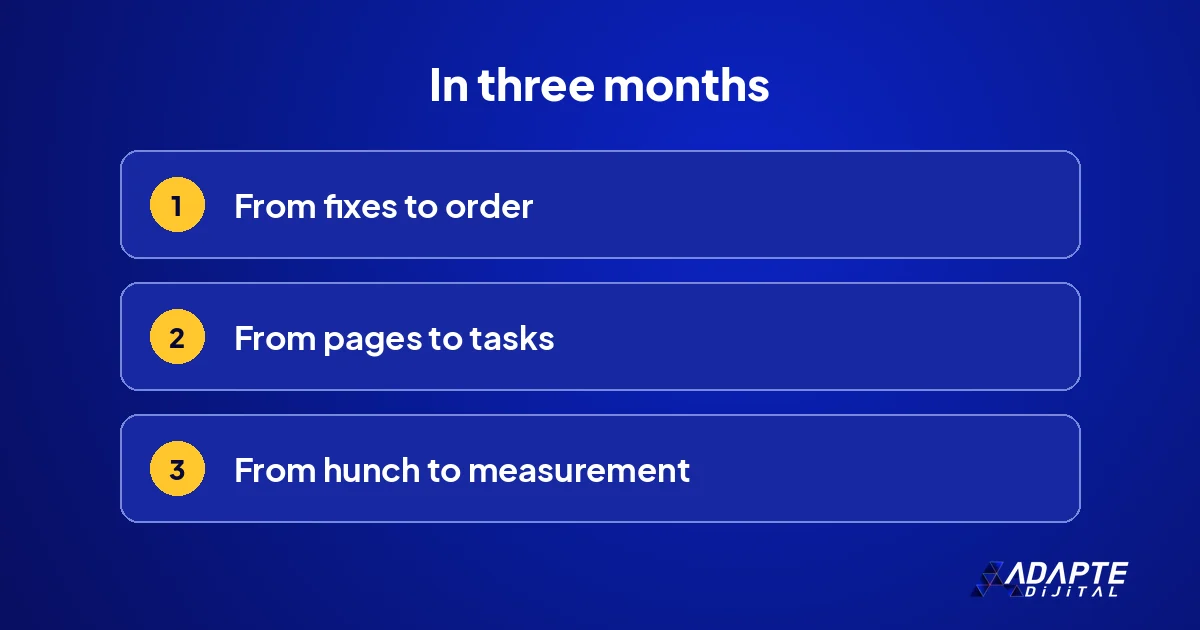
- From fixes to order
- From pages to tasks
- From hunch to measurement
Three months is when agent readiness starts to move from a project to the site’s ordinary maintenance.
From fixes to order
In the first month, forms and information are fixed one by one. In the third, those fixes are tied to rules: labels become mandatory when a new form is added, and scope and price are written as text when a new service page is created. A fix tied to a rule does not break as the site grows. The rules are gathered in a short site guide that anyone editing the site can find. 📐
From pages to tasks
The first month focuses on whether pages can be read; the third looks at whether tasks can be completed from start to finish. Does the agent find the quote form, fill it in, submit it and understand the confirmation message? Testing each task end to end reveals the missing link, which is often the confirmation step rather than the form itself.
From hunch to measurement
The test notes kept since the first month and analytics data make a first comparison possible in month three: visits from assistants, form completion rates and the quality of incoming enquiries. The numbers may be small; what matters is seeing the trend. Putting test notes next to analytics shows which fix worked for which task. 📊
Which layers are prepared?
BU BÖLÜMÜN ÖZETİ
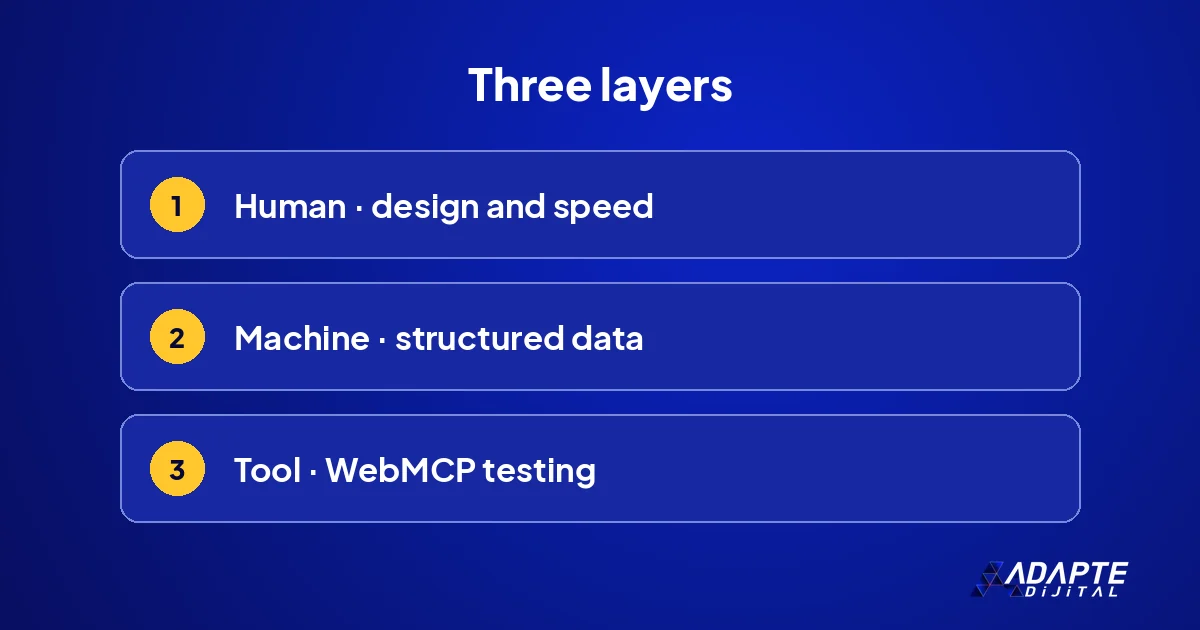
- The human layer
- The machine layer
- The tool layer
In month three, the site is treated as three layers that complement one another.
The human layer
Design, speed, readability and trust signals shape the human visitor’s experience. Agent readiness should not damage this layer; it should strengthen it. An accessible and fast site serves both people and agents, and ways to improve speed are covered in website speed. This layer protects the order gained in the first months. 🎨
The machine layer
Structured data, a tidy sitemap and a clear page structure let machines understand the site. This layer carries the same information as the human layer, only in a different form. The two layers saying the same thing is the basis of trust. Whether structured data matches the page is checked with a few randomly chosen pages, and the layer is updated whenever content changes.
The tool layer
The third layer is the tools the site offers agents directly. For most sites this layer is at the testing stage today; WebMCP’s declarative forms are the easiest place to start. What the interface is, is explained in what WebMCP is. The tool layer makes sense once the first two layers are solid. Without them, a tool simply exposes weak data faster. 🧰
A three-month plan
BU BÖLÜMÜN ÖZETİ
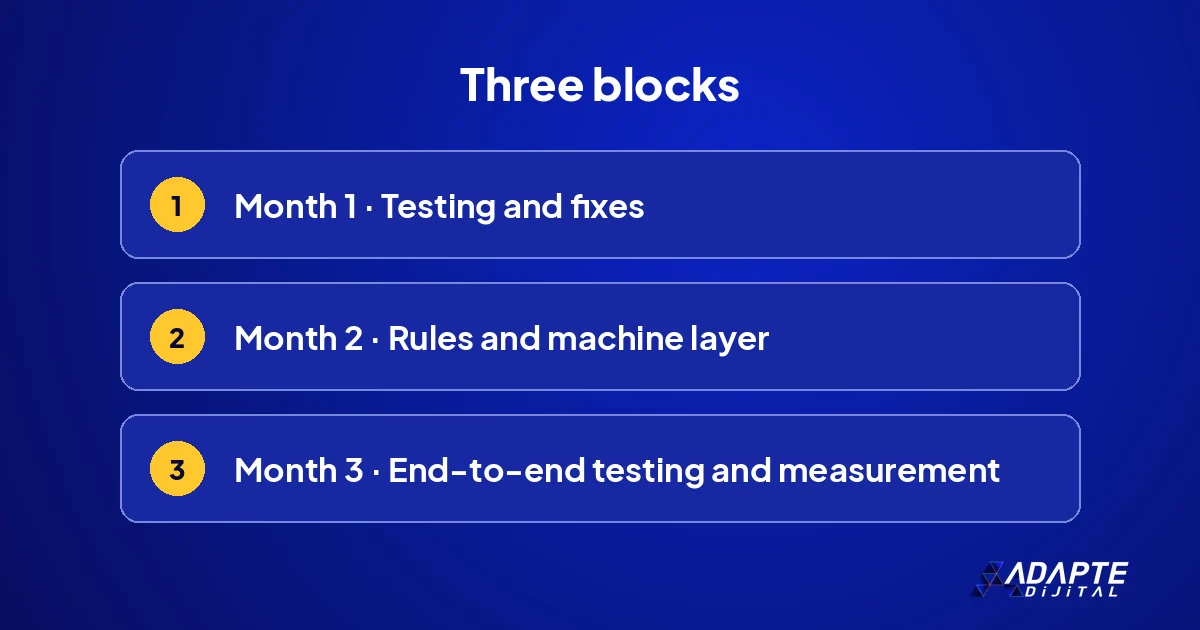
- Month one: testing and fixes
- Month two: rules and the machine layer
- Month three: end-to-end testing and measurement
The plan is built as three blocks that advance month by month. Each block relies on the output of the one before.
Month one: testing and fixes
A task inventory is drawn up, tasks are attempted with an agent, and forms and basic information are fixed. The output of this month is the problem list and a status note. The detailed task list is on the first-month page, together with the mistakes that most often slow this stage. 🧱
Month two: rules and the machine layer
Form and page rules are written down, structured data is extended to every service and contact page, and access settings are reviewed. The rules are gathered in a guide, so new content follows the same order. The guide is kept where everyone who adds content can reach it. This is the month the arrangement becomes lasting.
Month three: end-to-end testing and measurement
Every task is tested again from start to finish, and assistant visits and form completion rates are read in analytics. A site that wants to can try WebMCP with a single form in a test environment. At the end of the month, a short report is written and becomes input for the six-month plan. 📝
Which mistakes happen in three months?
BU BÖLÜMÜN ÖZETİ
- Building a separate site for agents
- Deciding without measuring
- Closing access by mistake
The mistakes of this period come from believing the arrangement has settled.
Building a separate site for agents
Setting up a separate version for agents, with content different from what human visitors see, can look tempting. But it creates inconsistency and a risk of cloaking. The right way is to present the same content in two forms: visual for people, orderly data for machines. That keeps the site consistent and within search engines’ rules. 🚫
Deciding without measuring
It is easy to draw big conclusions from the small changes seen over three months. A rise in one month may come from a campaign, a fall from a platform change. When the trend points the same way for several months, a decision becomes solid. Reading a trend requires the same measurement to be done the same way every month.
Closing access by mistake
When security settings are tightened, wanted assistants are often blocked by mistake. A change in bot protection can leave an agent unable to see the site at all. Access settings are checked with an agent test after every change, so a mistake is caught in hours rather than discovered weeks later in falling enquiries. 🔒
What is rising over this time frame?
BU BÖLÜMÜN ÖZETİ
- Today: WordPress is preparing
- Forecast: ready-made options multiply
- Forecast and log
Over a three-month horizon, important steps are being taken at the platform level. The first item is today’s status; the next two are forecasts.
Today: WordPress is preparing
WordPress 7.0, released in May 2026, introduced an AI Client that connects to AI services through a single interface; the Abilities API that arrived with 6.9 and the official MCP Adapter turn site abilities into tools agents can call. A large share of sites in Türkiye run on this platform, and plugin and theme updates can bring these changes straight to them. 📅
Forecast: ready-made options multiply
Forecast: within the next three months, WordPress plugins and themes will begin to offer ready-made options that open forms and basic actions to agents. Sites with a solid foundation will be better placed to try these options safely.
Forecast and log
Forecast: within three months, sites that measure assistant visits separately will begin to see on which pages agents complete tasks. Update log. 12 November 2026: first publication. The forecasts on this page are re-read when they fall due; a forecast that turns out wrong is not deleted but corrected here. The next step in this series is agent-ready website at 6 months.
How does month three work with Adapte Digital?
BU BÖLÜMÜN ÖZETİ
- A single delivery package
- What is delivered
- Where to start
Month three is an arrangement job: rules are written, the machine layer is extended, tasks are tested end to end and a report is handed over.
A single delivery package
Adapte Digital does not charge a monthly management fee. Work starts with a single delivery package whose scope is written down in advance: 36,000 TRY + VAT. If the work grows, the new need is defined as a separate add-on package, priced by what will be delivered rather than by the hours spent. 📦
What is delivered
The output is a site guide, extended structured data, an access check note and a first measurement report. How to judge a site’s success with numbers is covered in measuring website success.
Where to start
The written scope of each package, with current pricing and capacity, is on our campaign pages. 🧭
If you want to offer this as a service, start with our article on booking and quote integration.
Quick Summary
- Month three is when fixes are tied to rules and the first measurement happens.
- The site is treated as three layers: human, machine and tool.
- The plan has three blocks: testing, rules and the machine layer, and end-to-end testing with measurement.
- Building a separate site for agents and closing access by mistake are the mistakes of this period.
- Forecasts are re-read in the update log.
Short Glossary
- Site guide
- A short internal document that gathers form, page and content rules.
- End-to-end test
- Testing a task from start to finish, for example from finding a form to the confirmation message.
- Form completion rate
- The share of people who open a form and go on to submit it.
Frequently Asked Questions
Next Step
Ask an agent to complete your three most important tasks, such as a quote, a booking and a contact request, from start to finish, and note for each whether it finished or got stuck. Our campaign pages list the delivery packages that cover this work.
Sources: WordPress Developer Blog — Introducing the WordPress MCP Adapter · Chrome for Developers — WebMCP Declarative API · Schema.org — Vocabulary for structured data
Updated: November 2026
Sık Sorulan Sorular
If the first two layers are solid, trying it with a single form in a test environment makes sense. For wider use on a live site, waiting for the standard to settle is safer.
The team or agency that manages the site; on WordPress sites, SEO plugins provide basic markup. What matters is that the data matches the information on the page.
Track visits from assistants as a separate channel in analytics, and read form completion rates for those visits separately.