
An Agent-Run Company at Six Months: What Changes When Lines Pass Work to Each Other?
An agent-run company at six months is the stage at which a second line joins the first and the two begin to hand work to each other. By month three, one job runs end to end with agents; the question of month six is how to carry that order into a second job without breaking the first. As lines connect, both the gains and the risks grow. 🔗
This page is the third step of our horizon series. It explains how to choose the job for the second line, which rule connects two lines and which problems typically appear around month six. Statements about today come from our own work; every forward-looking statement is labelled as a forecast and will be re-read when it falls due.
What is realistic in six months?
BU BÖLÜMÜN ÖZETİ
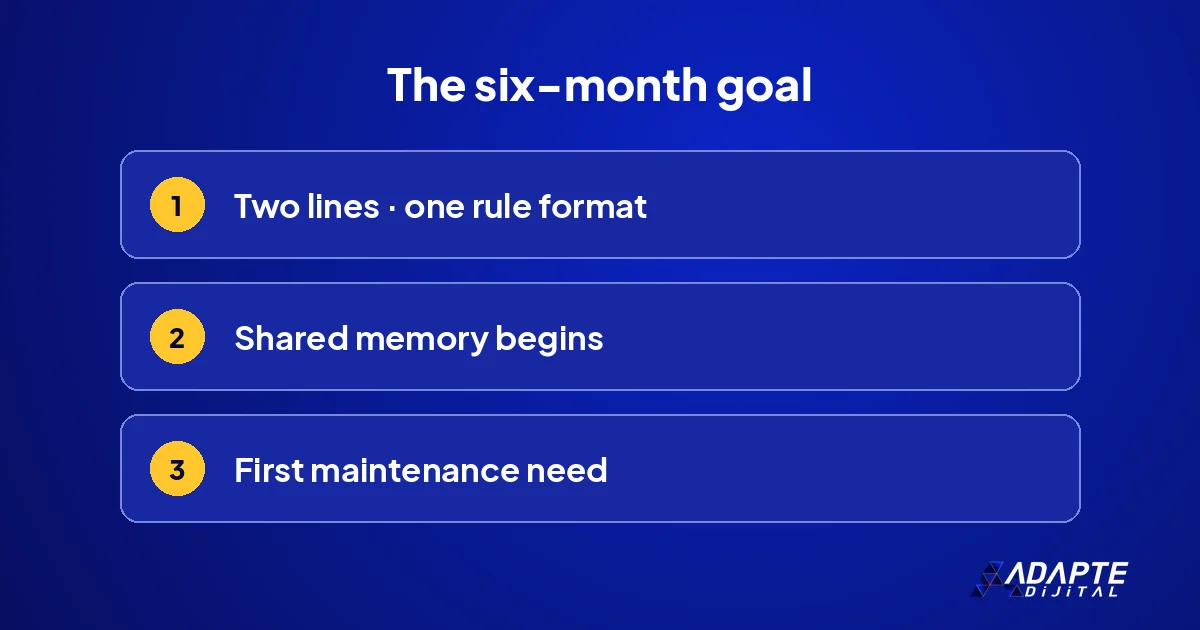
- Two lines, one way of writing rules
- The start of shared memory
- The first maintenance need
Six months are enough for a business that has settled its first line to build a second one and watch it for two months. They are not enough to transform a department; the goal is two lines working together without friction.
Two lines, one way of writing rules
The realistic picture is two lines in two different jobs, for example content preparation and weekly reporting. Each has its own rules pages, but both use the same format for writing rules. When the format is shared, the second line takes far less time to build than the first, because half of the thinking has already been done and tested. 🧱
The start of shared memory
The two lines begin to need the same information: the price list, customer rules, forbidden phrases. Keeping that information in two places creates contradictions sooner or later. Around month six a shared rules file is opened and both lines read from it, so each piece of information has a single owner and a single place to be corrected.
The first maintenance need
The first line’s rules start to age within six months: products change, prices change, a campaign ends. If the rules are not updated, the agent keeps working correctly on outdated information and produces wrong results with full confidence. An hour of rule review goes into the calendar once a month, with a named person responsible for it. 🔧
How do you choose the second job?
BU BÖLÜMÜN ÖZETİ
- The job that eats the most hours
- A job connected to the first line
- A job whose data is ready
The second job can look easier than the first, but a poor choice also overshadows the gains of the first line. Three criteria make the choice simpler and easier to defend.
The job that eats the most hours
The second job on the list of where the team spends its week is a strong candidate. The hours are established with a week of records, not with estimates. A job chosen without records usually turns out to be the most visible job rather than the most expensive one, and the gains disappoint. ⏱️
A job connected to the first line
If you choose a job that uses the first line’s output as its input, the two lines form a natural chain: prepared content is reported on, and the reported results guide new content. Connected jobs create more value together than two unrelated lines, because each improves the other’s input.
A job whose data is ready
A job whose records are scattered is a job for data clean-up, not for a line. The job whose data sits in one tidy place is chosen first; for the scattered one, a clean-up is planned before anything else. Usage cost also needs watching as lines multiply; see how to control AI subscription costs. 🗂️
How are two lines connected?
BU BÖLÜMÜN ÖZETİ
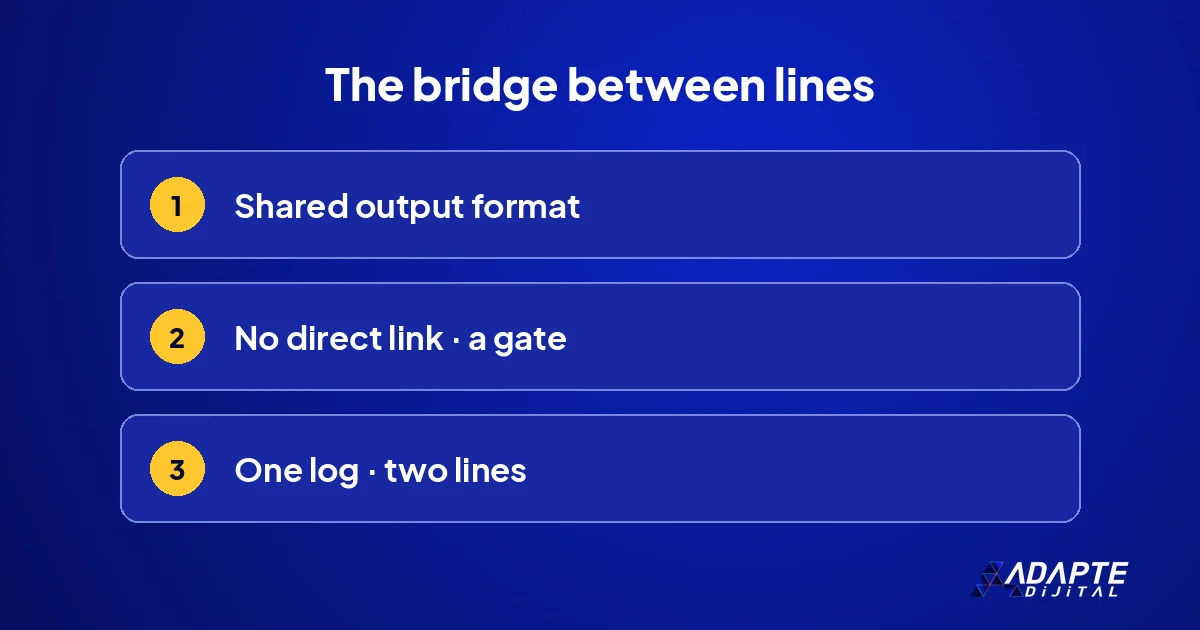
- A shared output format
- No direct link, always a gate
- One log, two lines
The bridge between two lines is more delicate than a handover inside one line, because two separate sets of rules meet for the first time. Three rules govern that meeting.
A shared output format
If one line’s output is the other’s input, the format is written in advance: which fields, in what order, in what file type. If the format changes, the receiving line misreads it. A format change is made only with the approval of the owners of both lines, and the date of the change is recorded. 📐
No direct link, always a gate
One line’s agent does not hand work straight to the other’s agent; there is a check in between. The gate is simple: is the format right, are the required fields filled? A bridge without a gate carries an error from one line into the other and makes it much harder to find where the error started.
One log, two lines
Both lines keep their records in the same log. When something goes wrong, you can see from one place which line and which step broke. Separate logs let a problem disappear in the space between two lines, where neither owner feels responsible for it. 🗒️
Which problems appear around month six?
BU BÖLÜMÜN ÖZETİ
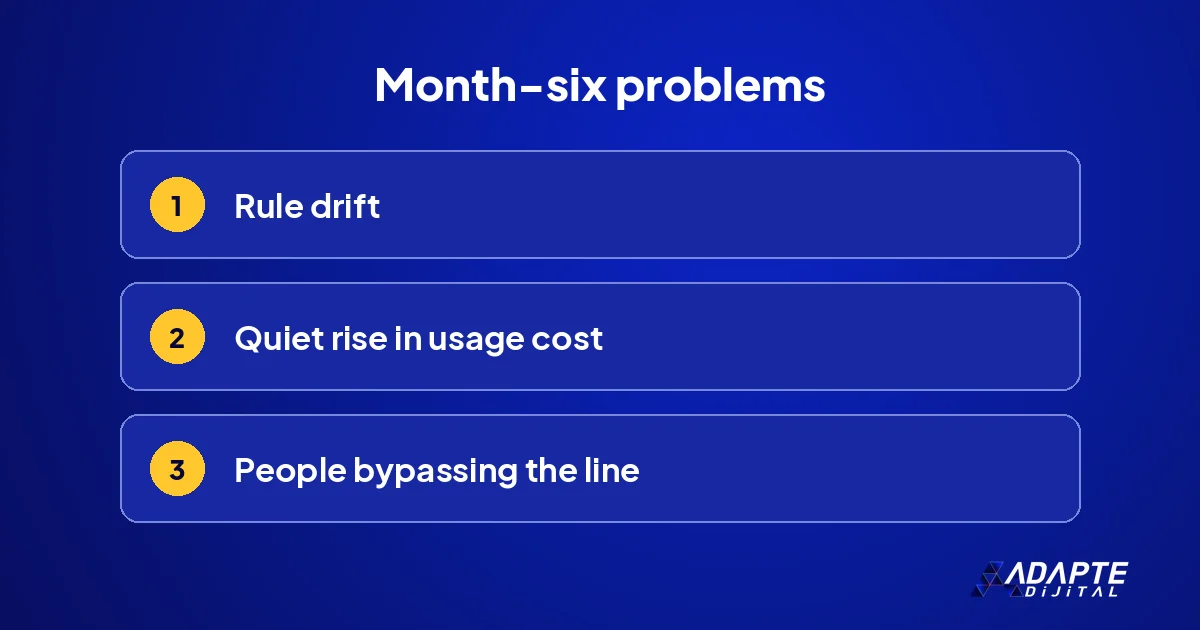
- Rule drift
- A quiet rise in usage cost
- People bypassing the line
Month six is when the first excitement fades and real business problems become visible. Three of them repeat almost everywhere, and all three are manageable if they are named early.
Rule drift
People start following habit rather than the rules page, while the agent follows only the rule. As the gap widens, the outputs start to look “wrong” to people. The fix is either to update the rule to match the habit or to correct the habit; one of the two is chosen explicitly and written down. 🧭
A quiet rise in usage cost
As the number of lines and the volume of work grow, model usage cost grows too. If nobody looks monthly, the bill climbs above expectations. Cost per job is tracked in one row per line; when it rises, the rule is reviewed before the model. The method of measuring is covered in measuring an AI investment.
People bypassing the line
In an urgent case someone skips the line, does the job by hand and does not record it. Once is not a problem; as a habit, it breaks the measurement. Bypassed work is recorded too; if bypassing happens often, the line does not fit that job and should be redesigned. ⚠️
What is rising on this horizon?
BU BÖLÜMÜN ÖZETİ
- Today: skills and memory
- Forecast: standards between lines
- Forecast and log
The six-month horizon looks at the first half of 2027. The first item is today’s observation; the other two are forecasts.
Today: skills and memory
The leading open-source agent frameworks of 2026 advanced on persistent memory and reusable skills. That makes it easier for a shared rules file to be read by more than one line. The frameworks change quickly, so their release notes deserve a regular glance before any upgrade. 🧠
Forecast: standards between lines
Forecast: in the coming months, shared formats and protocols for agents handing work to each other will spread. That will make connecting two lines easier, but it will not remove the need to adapt the format to your own work and your own exceptions.
Forecast and log
Forecast: businesses that build a second line will start to define the rules file as a separate responsibility. Earlier steps are in the three-month horizon. Update log. 12 November 2026: first publication. The forecasts on this page are re-read when they fall due; a forecast that turns out wrong is not deleted but corrected here. The next step is the nine-month horizon. 🔭
How do six months go with Adapte Digital?
BU BÖLÜMÜN ÖZETİ
- A single delivery package
- What is delivered
- Where to start
We build the second line by reusing the rules of the first. That shortens setup and keeps information in one place.
A single delivery package
Adapte Digital does not charge a monthly management fee. Work starts with a single delivery package whose scope is written down in advance: 36,000 TRY + VAT. If the work grows, the new need is defined as a separate add-on package, priced by what will be delivered rather than by the hours spent. 📦
What is delivered
In second-line work, the deliverables are the new rules pages and the definition of the bridge between the two lines. We choose together which job becomes the second line, usually starting from a week of time records.
Where to start
Our current packages and capacity are listed on our campaign pages; scope and price are written there before any work starts. 🧭
If you see a business opportunity here, we wrote a separate article on agent security hardening.
Quick Summary
- The six-month goal is a second line and a written bridge between lines.
- The second job: the one eating most hours, connected to line one, with data ready.
- Lines connect through a gate, never directly.
- Rule drift, rising cost and bypassing are the typical problems.
- Forecasts are re-read and corrected when they fall due.
Short Glossary
- Line bridge
- The written format and check connecting one line’s output to another’s input.
- Shared rules file
- An information file with one owner, read by more than one line.
- Rule drift
- The growing gap between people’s habits and the written rule.
Frequently Asked Questions
Next Step
For one week, record which job takes how many hours of your team’s time; the second job on that list is the candidate for your second line.
Sources: DeepLearning.AI — Hermes Agent Challenges OpenClaw · Five Minute AI Brief — Open Source Agentic AI: A Practical Brief
Updated: November 2026
Sık Sorulan Sorular
Two. If the second line reuses the first line’s rules and format, it is built quickly. A third line waits until the two are seen working together.
They should not. A gate that checks format and required fields sits in between, so an error in one line does not travel into the other.
Because the model runs more as work and lines grow. Tracking cost per job for each line every month shows the rise early.