
The First Month of an Agent-Run Company: Which Agent Job Can You Set Up Today?
The first month of an agent-run company is not a month of big transformation. It is the month when a single job passes to an agent, is watched and is measured. Agent frameworks can be set up today; what is missing is not the tool but the decision about which job to hand over. A business that gets the first month right builds the following months quickly. 🗓️
This page is the first step of our horizon series. It explains what is realistic within a month, how to pick the job and what to look at when the month ends. Statements about today come from our own practice; every forward-looking statement is labelled as a forecast, and the page is updated monthly.
What is realistic in the first month?
BU BÖLÜMÜN ÖZETİ
- One job, one agent
- What does not change
- What you hold at month end
Handing an entire company to agents in a month is impossible, and trying is expensive. What is realistic is building one job end to end and watching it for four weeks. Setting expectations at that level prevents the first disappointment.
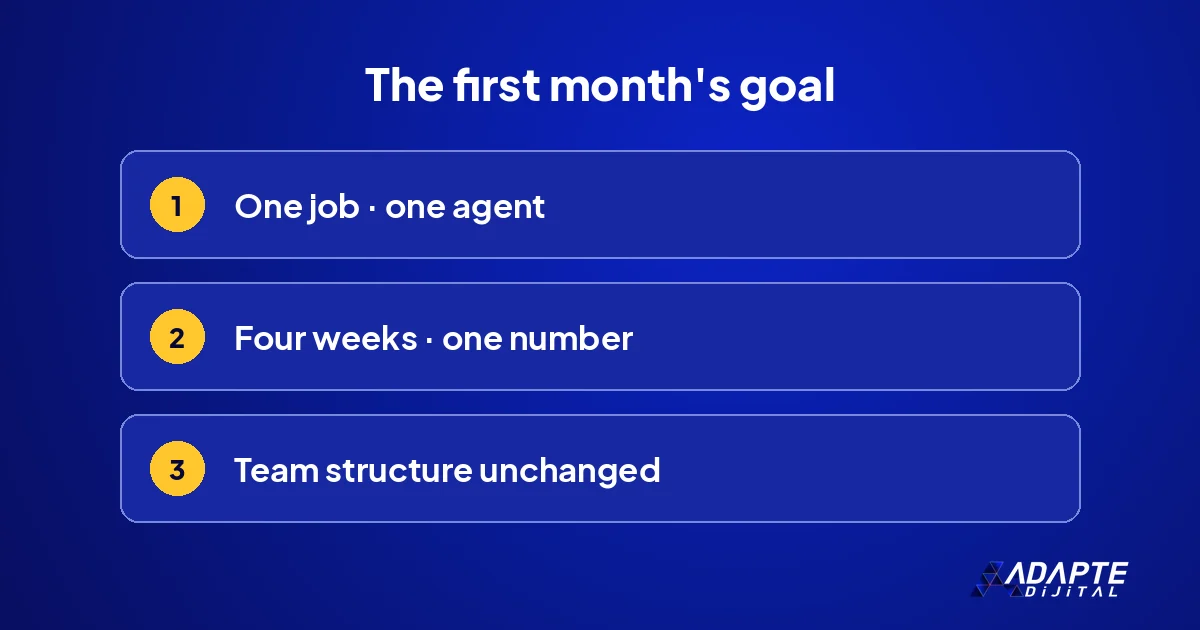
One job, one agent
The whole aim of the first month is for a single job to pass from human hands to an agent. The job should be small but real: something repeated every week, that takes time and that nobody enjoys. The reason for starting with one job is not caution but measurement; if three things change at once, you cannot tell which one worked. A single change gives you a single, readable result at the end of the month. 🎯
What does not change
In the first month team structure, customer relationships and decision rights stay as they are. The agent only prepares; the final decision is still made by a person. That is not distrust of the agent; it is a measurement period. It also eases the team’s worries, a topic we cover in will AI replace my employees. People who see that their role is not disappearing cooperate more readily with the trial.
What you hold at month end
After thirty days you should hold three things: a written rules page, a four-week work log and one number. That number is the difference between how many hours the job used to take and how many it takes now. Without the number, the trial did not happen. The log matters as much as the number, because it shows which corrections were needed and when they stopped. 📏
Which job should you choose?
BU BÖLÜMÜN ÖZETİ
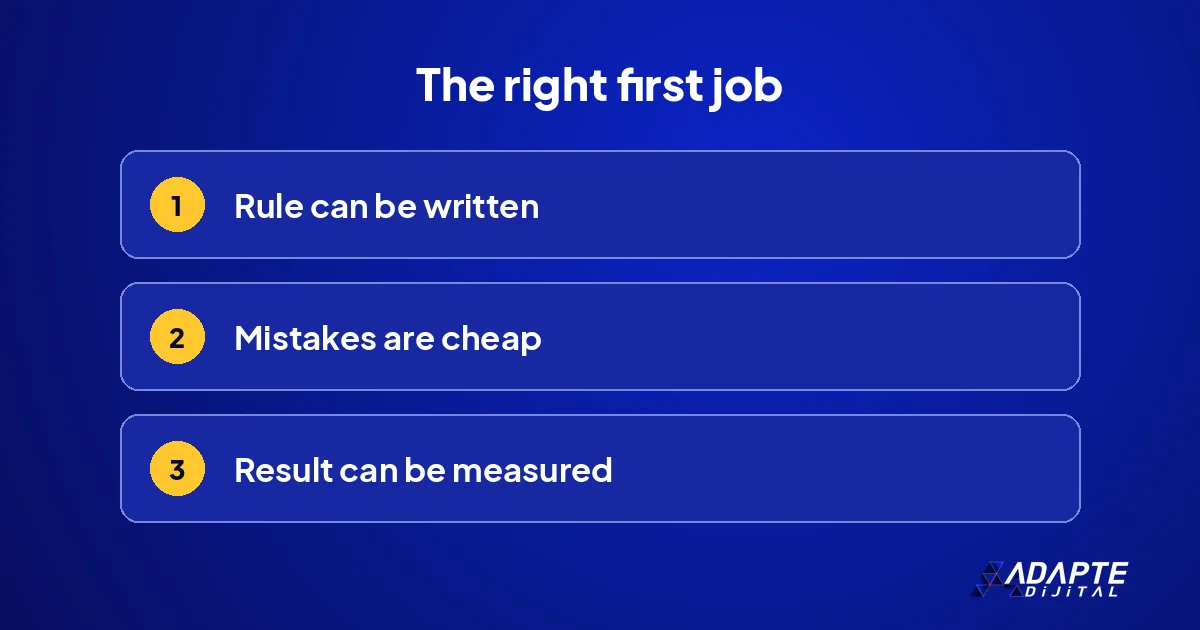
- A job whose rule can be written
- A job whose mistakes are cheap
- A job whose result can be measured
Starting with the wrong job makes the choice fail, not the agent. Three criteria are enough to spot the right first job, and a job that meets all three exists in almost every business.
A job whose rule can be written
If you can describe how the job is done on one page, an agent can do it. Jobs that begin with “it depends” are not ready yet. Sorting incoming requests by topic, compiling the weekly sales summary and filling in a standard quote are good candidates. A job that cannot be written cannot be handed over. Writing the rule is itself useful, because it often reveals steps nobody had noticed. ✍️
A job whose mistakes are cheap
The first job will have mistakes; what matters is what they cost. An error in an internal report is fixed and forgotten. A wrong price sent to a customer damages trust. So the first job should stay inside the company, and anything that goes outside passes human approval. Cheap mistakes let you learn without paying for the lesson twice.
A job whose result can be measured
Pick a job you can compare before and after: how many minutes did it take, how many errors appeared, how many days was it late? If you do not take the measure at the start, at month end you can only discuss impressions. Investment decisions are not made on impressions. We explain the method in measuring an AI investment. 📊
How is the first agent job set up?
BU BÖLÜMÜN ÖZETİ
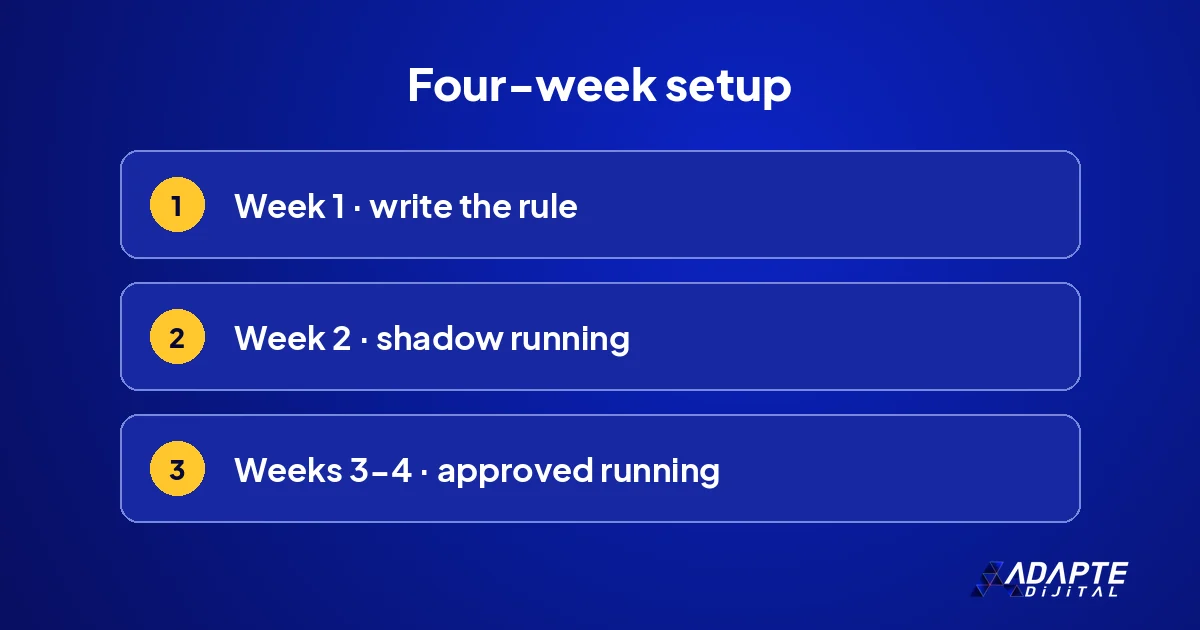
- Week 1: write the rule
- Week 2: shadow running
- Weeks 3 and 4: approved running
Setup is more about order than technology. Think of it as four weeks and four steps, each placed on top of the previous one.
Week 1: write the rule
The job’s input, steps, output and checking measure are written on one page. Write it together with the person who does the job today; they know the exceptions that never appear on paper. This page is the agent’s job description and becomes the template for every agent that follows. Keep the language plain enough that someone new could follow it. 📝
Week 2: shadow running
The agent does the job but its result is not used; a person does the same job and the two are compared. Differences are added to the rules page. Shadow week is the only period in which mistakes are seen without causing harm, and it should never be skipped, however good the first results look.
Weeks 3 and 4: approved running
The agent’s output starts to be used, but every output passes a person’s approval. The approver notes everything they correct. If the number of corrections falls by month end, the job is settling in. If it does not fall, the problem is the rule, not the agent. Go back to the rules page before blaming the tool. ✅
What mistakes are made in the first month?
BU BÖLÜMÜN ÖZETİ
- Starting with the tool
- Giving too much permission
- Expanding without measuring
Most first attempts break in the same three places. None of them are technical; all of them come from haste.
Starting with the tool
The most common mistake is installing an agent tool first and then looking for work for it. The order is backwards: job and rule first, tool second. Tool selection can even wait until the end of the first month, because the rules page itself shows which tool will be enough. Many businesses find a simple setup suffices once the rule is clear. 🧰
Giving too much permission
Giving the agent access to everything to make the trial easier is the riskiest decision of the first month. The first job usually needs access to a single folder or a single spreadsheet. Permission follows the job, not convenience. Access can always be widened later; a mistake made with broad access is much harder to undo.
Expanding without measuring
When results look good in week two, it is tempting to move to five jobs at once. No new job is added until four weeks of records are complete. Early expansion drags the one working job into uncertainty as well, and you lose the clean measurement you were building. ⏳
What is rising on this horizon?
BU BÖLÜMÜN ÖZETİ
- Today: the tools are ready
- Forecast: early movers will pull ahead
- The next step
Predicting what happens within one month is easier, because most of it has already begun. The following are today’s observations and near-term forecasts.
Today: the tools are ready
In 2026 open-source agent frameworks reached a wide user base, and personal agents running through messaging apps became common. Finding a tool is no longer the problem. The bottleneck is that businesses have not written their own processes down. A business with written processes can trial a tool in days. 🧩
Forecast: early movers will pull ahead
Forecast: in the coming months the gap between businesses that set up one job properly and those that never start will become visible. The gap will come not from technology but from written processes. Whoever writes the first rules page writes the second much faster, and the third almost without effort.
The next step
Update log. 12 November 2026: first publication. The forecasts on this page are re-read when they fall due; a forecast that turns out wrong is not deleted but corrected here. At the end of a month the next question is how to move from one agent to a team; we cover that in the three-month horizon. 🔭
How does the first month go with Adapte Digital?
BU BÖLÜMÜN ÖZETİ
- A single delivery package
- The first deliverable: the rules page
- The infrastructure side
We started our own system with a single job too. We follow the same order with clients; the difference is that we write the rule together.
A single delivery package
Adapte Digital does not charge a monthly management fee. Work starts with a single delivery package whose scope is written down in advance: 36,000 TRY + VAT. If the work grows, the new need is defined as a separate add-on package, priced by what will be delivered rather than by the hours spent. 📦
The first deliverable: the rules page
The first output of the work is not an agent but the written rule for the chosen job. That page stays with you and remains valid whatever tool you use later. Choosing the job is the first step of our AI consulting work, and we usually do it in a single working session with the person who does the job today.
The infrastructure side
If the content and data an agent reads are not in order, the agent will not work in order either. We describe how we keep our own content line in order in how an agent content line works. Current packages and capacity are listed on our website. 🧭
Planning to do this work for other businesses? Our article on freelancers who build agent teams for SMEs shows what that door looks like.
Quick Summary
- The first month’s goal is handing one job to an agent.
- The right first job has a written rule, cheap mistakes and a measurable result.
- Setup is four steps: rule, shadow running, approved running, measurement.
- The tool is chosen last; permission follows the job.
- The forecasts on this page are updated monthly.
Short Glossary
- Shadow running
- A comparison period in which the agent does the job but its result is not used.
- Rules page
- A one-page definition of a job’s input, steps, output and checking measure.
- Forecast
- An estimate based on today’s observations that has not yet happened.
Frequently Asked Questions
Next Step
This week, choose the one job that takes most of your time and whose rule can be written, and put it on a single page. That page is the start of your first agent.
Sources: DeepLearning.AI — Hermes Agent Challenges OpenClaw · Five Minute AI Brief — Open Source Agentic AI: A Practical Brief
Updated: November 2026
Sık Sorulan Sorular
For a single job, yes. Writing the rule, shadow running and approved running fit into four weeks. Handing the whole company over in a month is not realistic.
The tool is chosen last. Write the rule first; the rule shows which tool is enough. The field changes quickly, so check current documentation before choosing.
The job’s time before and after, the number of corrections and the work log. If corrections are falling, the job is settling in.