
An Agent-Run Company at Nine Months: What to Consolidate Before the First Full Year?
An agent-run company at nine months should be consolidating rather than adding lines. By now two or three lines exist, rules have multiplied and permissions have widened. Instead of carrying all of that into the first full year, the business takes a deliberate stop: it measures, merges and simplifies. 🧰
This page is the fourth step of our horizon series. It explains what to measure at month nine, how scattered rules pages are gathered into one rulebook and how permissions are reviewed again. Forward-looking statements are labelled as forecasts and will be re-read when they fall due, with corrections kept in the log.
Why is month nine a deliberate stop?
BU BÖLÜMÜN ÖZETİ
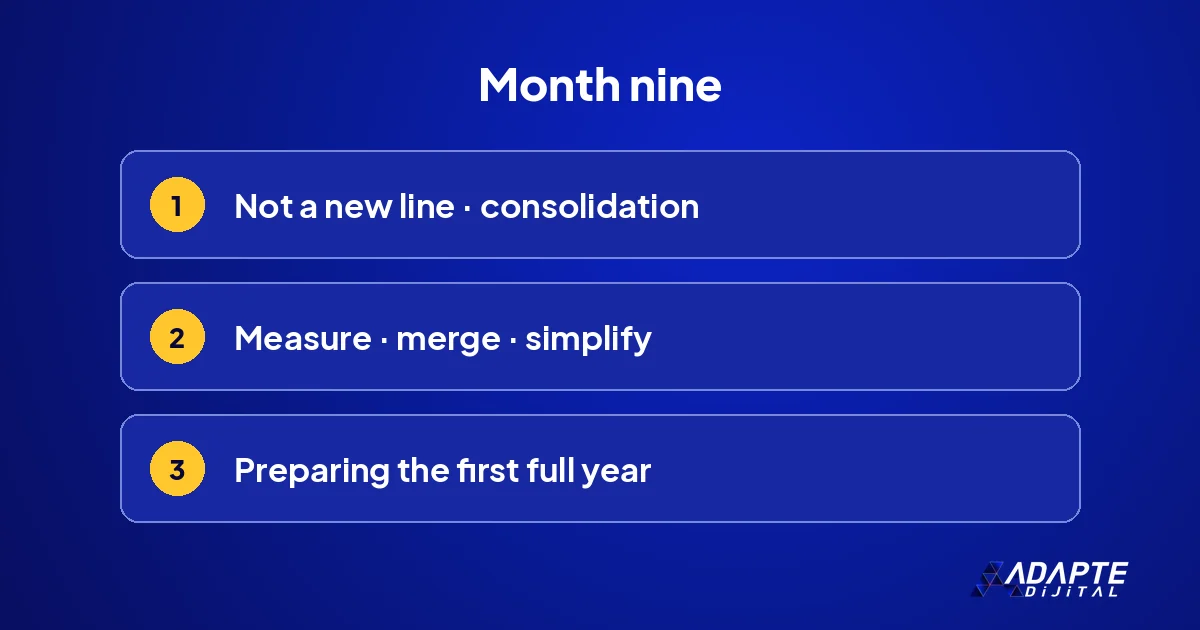
- The load that builds up
- Budget season
- New people on the team
Lines can be added every month, but every new line also adds upkeep. Stopping to look at month nine decides how fast the second year can go.
The load that builds up
In nine months rules pages multiply, and some begin to contradict each other. Nobody has read all of them. The load is invisible, yet it gets a little heavier with every new line. Cleaning up accumulated rules becomes more valuable than writing new ones, and a team that cannot tell which rule still applies stops trusting the agent’s output. 📚
Budget season
Most businesses set next year’s budget in the last quarter. The figures gathered at month nine become the basis for how much goes to agents. A budget without figures rests on guesses, which tend to be either too optimistic or too cautious. Nine months of records are the strongest document you have for defending the second year’s budget.
New people on the team
Someone new may have joined within nine months. They see the line for the first time and show better than anyone whether the system can be understood. A newcomer’s questions are the list of rules that were never written down properly, and they deserve to be collected rather than answered one by one. 🙋
What should be measured?
BU BÖLÜMÜN ÖZETİ
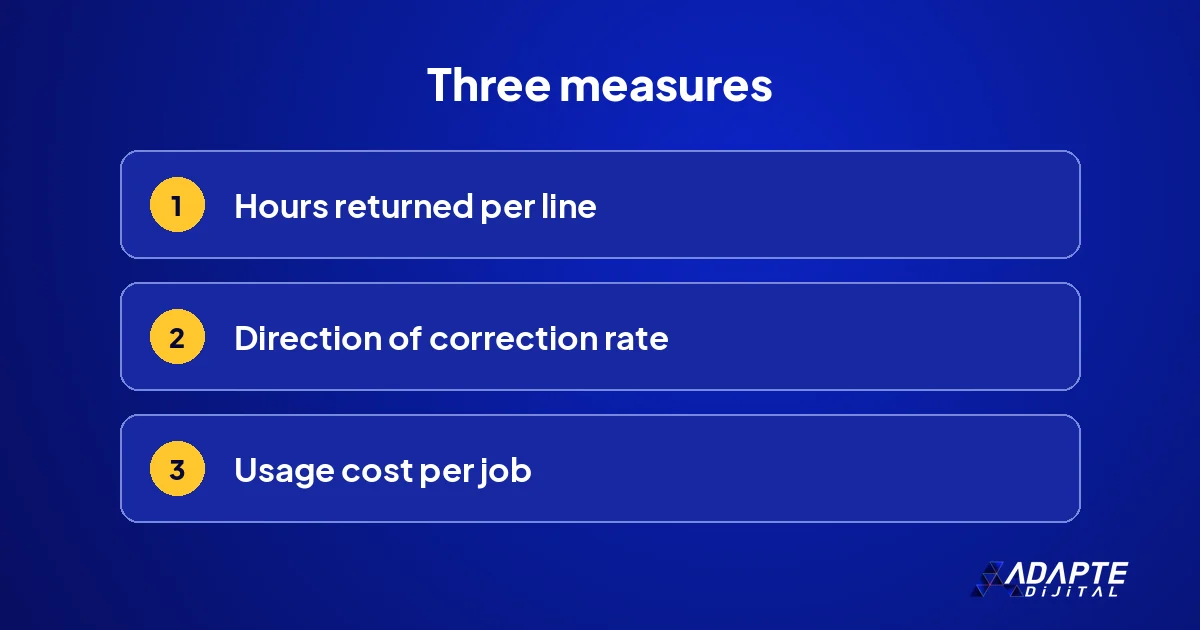
- Hours returned per line
- The direction of the correction rate
- Usage cost per job
Measurement is the basis of the stop. Three figures show whether the lines are really paying off, and all three fit in one table updated on the same day each month.
Hours returned per line
For each line, the job’s previous duration is compared with today’s. The difference is written down as weekly hours. If this figure is missing, either the measure was never taken in month one or the line really does not save time; both are things the business needs to know. Write the figure together with the line’s owner; a number produced alone invites argument. ⏱️ The method behind these figures is set out in measuring an AI investment.
The direction of the correction rate
The share of outputs people correct is tracked month by month. A falling rate means the line is settling; a flat rate means the rule is incomplete; a rising rate means the rule has gone stale. The direction of the rate says more than the rate itself, which is why a single month’s figure is never read on its own.
Usage cost per job
The model usage bill is divided across the lines to find cost per job, and that cost is placed beside the cost of the same job done by hand. If the agent costs more than a person, the cause is usually an unnecessarily long rule rather than the model. We started this measurement in the six-month horizon; here it is completed. 💳
How is the rulebook merged?
BU BÖLÜMÜN ÖZETİ
- Removing duplicates
- Settling contradictions
- One owner, one place
Scattered rules pages are gathered into one book. The aim is not a longer document but a document with fewer contradictions, and one that a new person can follow.
Removing duplicates
If the same rule is written on several pages in different words, it is moved to one place and the other pages refer to it. A duplicate becomes a contradiction the day one copy is updated and the other forgotten. During the merge, the reason each rule exists is noted in one sentence, so it can be judged later. 🧹
Settling contradictions
When two rules disagree, the rule owner decides which one applies and writes down the date of the decision. Leaving a contradiction to the agent means leaving the result to chance. Decisions kept in a separate section in date order stop the same debate from reopening a few months later.
One owner, one place
The merged book has a single owner and a single location. Changes go through that person and are logged in the book with dates. A rulebook without a clear owner scatters again within a few months; with an owner, it becomes the most useful document the business has. 📘
How are permissions reviewed again?
BU BÖLÜMÜN ÖZETİ
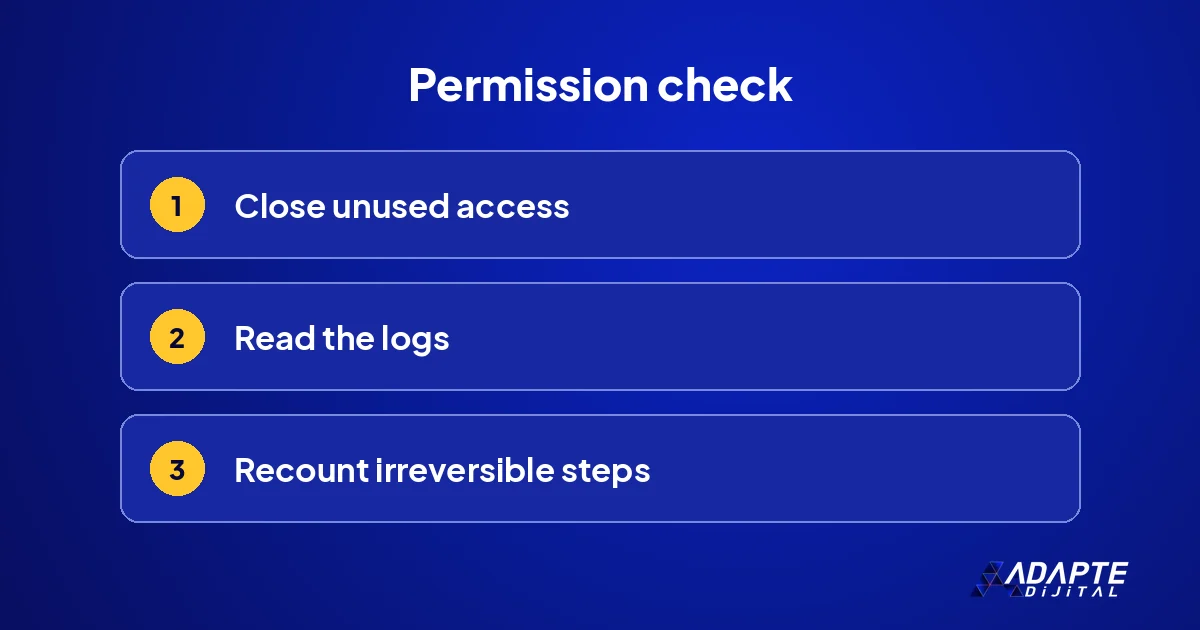
- Closing unused access
- Reading the logs
- Recounting the irreversible steps
In nine months, access granted to agents and people has widened. Some of it is no longer needed. The stop is also a good moment to narrow permissions.
Closing unused access
A list of access is drawn up for every agent and every person; access not used in the last three months is closed. Unused access brings no benefit, only risk. Closed access can be reopened if needed, and each closure is recorded with its date so nothing is lost. 🔐
Reading the logs
The last quarter’s activity log is scanned: actions at unexpected hours, access to unusual files, errors that repeat. If nobody reads the log, keeping it serves no purpose. Reading it as an hour-long monthly calendar item keeps it from being postponed. How we draw permission limits is covered in agent permissions and approval gates.
Recounting the irreversible steps
Each irreversible step, such as publishing, sending, deleting and paying, is checked one by one to confirm it still needs human approval. Shortcuts added over time may have quietly bypassed the rule. Shortcuts are where rules break most often, which is why this check is done step by step rather than from memory. ⚠️
What is rising on this horizon?
BU BÖLÜMÜN ÖZETİ
- Today: weak measurement tools
- Forecast: questions about agent oversight
- Forecast and log
The nine-month horizon looks at the summer of 2027. The first item is today’s situation; the other two are forecasts.
Today: weak measurement tools
Most agent frameworks make doing work easier but leave measuring its value to the business. Most businesses have to keep the table of hours and cost per line themselves. A simple spreadsheet is enough, as long as the same person fills it in every month. 📊
Forecast: questions about agent oversight
Forecast: in the coming months customers and partners will ask more often which jobs agents do and who approves them. A business with an orderly rulebook and log will be able to answer in a day, and that answer will start to matter in tenders and supplier forms.
Forecast and log
Forecast: businesses that take the month-nine stop will build more lines with fewer errors in their second year. Update log. 12 November 2026: first publication. The forecasts on this page are re-read when they fall due; a forecast that turns out wrong is not deleted but corrected here. The next step is the one-year horizon. 🔭
How does month nine go with Adapte Digital?
BU BÖLÜMÜN ÖZETİ
- A single delivery package
- What is delivered
- Where to start
The stop works like an audit: we look, measure, simplify and hand over the result.
A single delivery package
Adapte Digital does not charge a monthly management fee. Work starts with a single delivery package whose scope is written down in advance: 36,000 TRY + VAT. If the work grows, the new need is defined as a separate add-on package, priced by what will be delivered rather than by the hours spent. 📦
What is delivered
The output of this work is a merged rulebook, a measurement table per line and a narrowed permission list. We decide together which line to look at first, usually the oldest one.
Where to start
Which packages are open, and at what price, is shown on our campaign pages, item by item. 🧭
One way to build a business on this knowledge is set out in our article on sector-specific agent packages.
Quick Summary
- Month nine is a time to consolidate, not to add lines.
- Three measures: hours returned, direction of corrections, cost per job.
- Scattered rules pages are merged into one book with one owner.
- Unused access is closed and irreversible steps are recounted.
- Forecasts are re-read when they fall due.
Short Glossary
- Deliberate stop
- A period in which the existing setup is measured and simplified without adding lines.
- Correction rate
- The share of agent outputs that people correct.
- Rulebook
- The merged rules, with one owner, that all lines follow.
Frequently Asked Questions
Next Step
Put three figures for each line into one table: hours returned, correction rate and cost per job. Update it on the same day every month.
Sources: DeepLearning.AI — Hermes Agent Challenges OpenClaw · Five Minute AI Brief — Open Source Agentic AI: A Practical Brief
Updated: November 2026
Sık Sorulan Sorular
They can be, but existing lines should be measured and rules merged first. Otherwise the new line is built on contradictory rules.
Look at hours returned per line, the direction of the correction rate and cost per job. Together they give a clear picture.
At least once a quarter. Access unused for three months is closed, and irreversible steps are checked for human approval.