
The AINEO Architecture: Which Parts Make Up the System That Runs Our Own Website?
The AINEO architecture is the layout of the plugin family Adapte Digital built to run its own website. This is not a product pitch but a lab report: it shows which parts an agent-driven system is made of on a real, busy site. Everything described here runs on our own website today. 🧪
The system is not one large piece of software. It is made of small parts, each doing one job: one brings content in, one manages the signals sent to search engines, one pairs languages, one builds links. In this article we describe the parts, the boundaries between them and the rules our own mistakes taught us, including the ones that cost us traffic before we fixed them.
What is AINEO, and why was it built?
BU BÖLÜMÜN ÖZETİ
- The problem: a site too big to run by hand
- The decision: parts that do one job
- The principle: rehearse first
AINEO is a set of plugins running on WordPress, each responsible for a separate task. It was built because a site with thousands of articles cannot be managed by hand without errors piling up.
The problem: a site too big to run by hand
Our site holds thousands of articles. At that scale, checking every title, description, category and link by hand is not realistic. Manual work is both slow and inconsistent; the same rule is applied one way on Monday and another way on Friday. Building a system was not a preference but a necessity. Without it, every improvement would have been undone by the next batch of content. 🏗️
The decision: parts that do one job
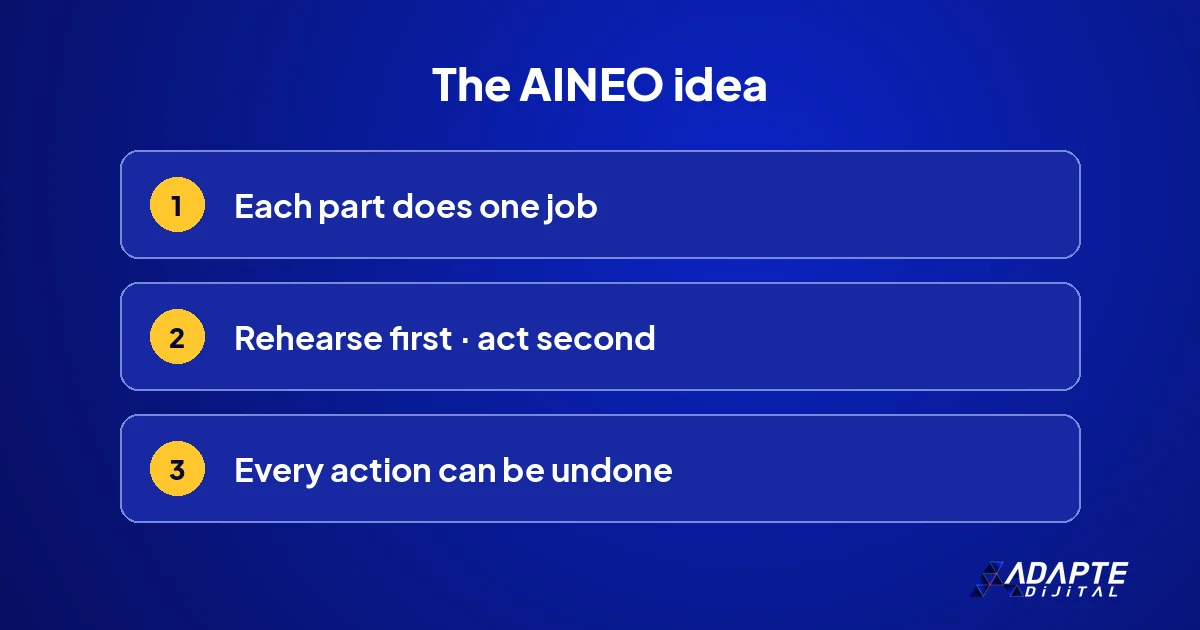
Instead of one plugin that does everything, we built parts that each do one job. When one part breaks, the others keep working. Changing one part does not require touching the rest. This is the software equivalent of role separation in agent teams, and it made our debugging dramatically faster because every error has an obvious home.
The principle: rehearse first
Every part that changes the site first shows what it is going to do, then does it. The rehearsal step lets us see a mistake before it reaches the live site, on a list we can read line by line. We do not run bulk operations without a rehearsal. This single habit has prevented more damage than any clever feature. 🔍
Which parts make up the system?
BU BÖLÜMÜN ÖZETİ
- Carrying content: Consys
- Managing search signals: AISEOSYS
- Language and linking parts
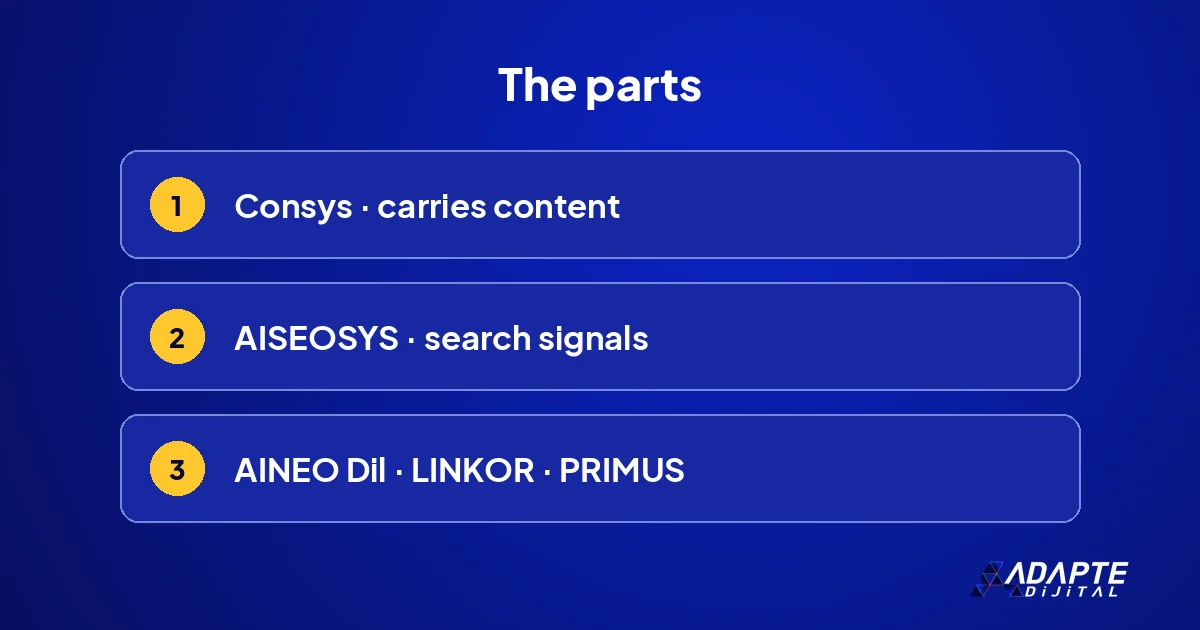
The easiest way to describe the parts is in three groups by what they do: those that carry content, those that manage search signals and those that build connections.
Carrying content: Consys
Consys brings prepared articles into the site from a single package file. It matches articles by their address and can add new ones or update existing ones. Every article arrives as a draft; the decision to publish stays with a person. We walk through the line that feeds it in how an agent content line works. Packages are tested in rehearsal mode before anything is written. 📦
Managing search signals: AISEOSYS
AISEOSYS manages the signals sent to search engines from one place: page titles and descriptions, the canonical address, language pairings, the sitemap and service clusters. A service cluster is the structure that ties a service page to the guide articles that explain that service, so search engines can see the topic as one connected body of work.
Language and linking parts
AINEO Dil pairs Turkish and English pages so each page is shown to readers in its own language. LINKOR suggests links from pages that perform well in search data to related pages, and can undo every link it adds. PROMARKETOR places campaign boxes inside articles. Each of these does one thing and stays out of the others’ fields. 🔗
How are the parts connected?
BU BÖLÜMÜN ÖZETİ
- The single-source rule
- The gate rule
- Licence and line-up
Keeping parts separate means the boundaries between them must be written down. Three rules draw those boundaries.
The single-source rule
Every piece of information has one owner. The owner of the page title is AISEOSYS; no other part writes titles. If two parts write the same information, nobody knows which version is valid. We learned this rule while cleaning up duplicate signals that came from two places at once and confused search engines for weeks. 🎯
The gate rule
One part’s output cannot pass to the next without meeting the condition. Before a content package enters the site, its length, heading count, link count and similarity score are measured. A package that fails the measure is not delivered. The measuring is done by scripts, not by eye, so it is identical every time.
Licence and line-up
PRIMUS manages which part runs on which site. Not every site needs every part; a small site may need two parts, while a large site runs them all. The line-up is built around the site, not the other way round. The same rule applies to agents in the first month of an agent-run company: capability follows the need. 🗂️
Which mistakes taught us what?
BU BÖLÜMÜN ÖZETİ
- Information wiped during updates
- Several addresses for one article
- Missing signals on key pages
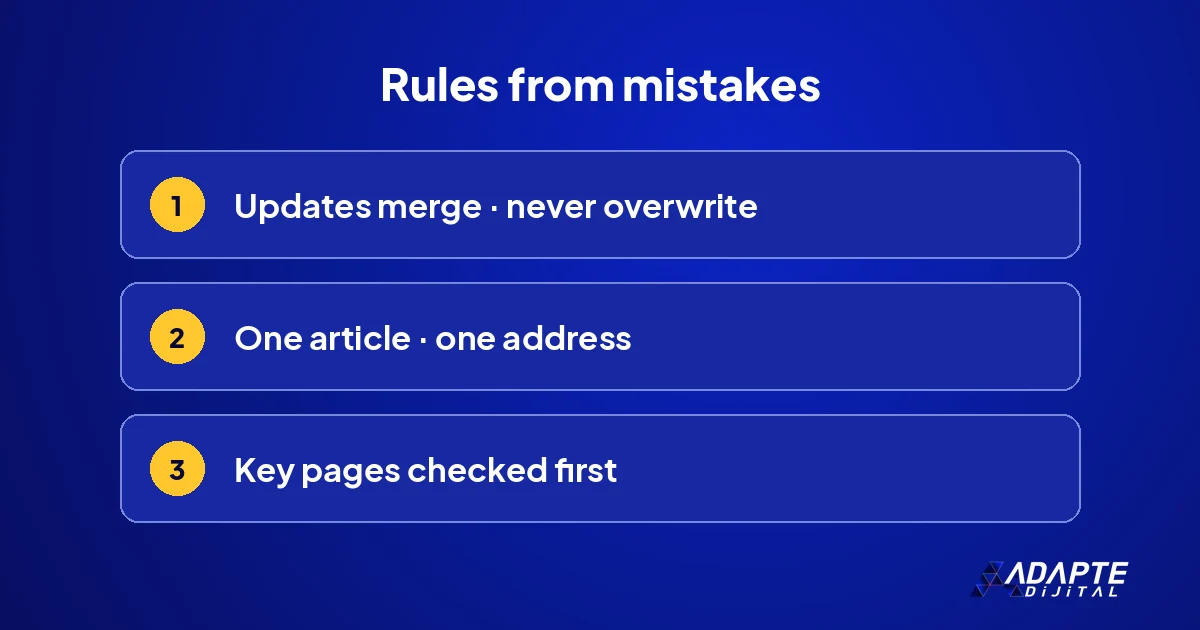
This is the most valuable part of a lab report. Three mistakes set the system’s current rules.
Information wiped during updates
In the first version, updating an article also reset the fields missing from the package: the publication date and author were lost. The rule changed: these fields became mandatory in update packages. The general lesson is simple and applies far beyond our plugin: an update should merge, not overwrite. 🧯
Several addresses for one article
Because of our category structure, the same article could open from more than one address, and search engines treated them as separate pages. With a one-off repair we redirected 6,921 internal links in 2,159 articles to the canonical address and permanently redirected 1,464 old paths. The search data stopped splitting the same article in two.
Missing signals on key pages
Our articles had complete search signals, but our service and campaign pages did not; one page even named its other-language twin as the canonical address. The most important pages were the least checked pages. Today all seven service clusters are managed from the same layer, and those pages are checked first. 🩹
What does this architecture tell other businesses?
BU BÖLÜMÜN ÖZETİ
- Start with small parts
- Make it reversible
- Forecast: systems will be explained
AINEO is our system, but the three ideas behind it fit any business. They hold even if you build your own system with different tools.
Start with small parts
Instead of searching for one system that solves everything, start with a small part that solves one job. Small parts are quick to build and quick to teach you something. The same logic shapes how we see the coming year in the one-year horizon: several small lines, one shared rulebook. 🧩
Make it reversible
A part that cannot undo its work stops you from experimenting. Every bulk operation without a way back is a risk you carry silently. Design the way back first, then the operation. It feels slower at the start and saves you the day something goes wrong.
Forecast: systems will be explained
Forecast: businesses that work with agents will be asked more often to explain how their systems work, by customers and by regulators. That is one reason we wrote this article. Update log. 12 November 2026: first publication. The forecasts on this page are re-read when they fall due; a forecast that turns out wrong is not deleted but corrected here. 📓
How does Adapte Digital set this system up for clients?
BU BÖLÜMÜN ÖZETİ
- A single delivery package
- Order first, content second
- Where the scope is written
We set up the structure that runs on our own site for client sites in the same order and as a single delivery.
A single delivery package
Adapte Digital does not charge a monthly management fee. Work starts with a single delivery package whose scope is written down in advance: 36,000 TRY + VAT. If the work grows, the new need is defined as a separate add-on package, priced by what will be delivered rather than by the hours spent. 📦
Order first, content second
In a setup, addresses and search signals are fixed first, service clusters are built next and content comes in last. If the order is reversed, new content piles up on top of old errors. Content production with AI only pays off on a clean foundation; we discuss that trade-off in AI content production: speed or quality.
Where the scope is written
What this setup includes is written item by item on our campaign pages; current pricing and capacity are listed there. We prefer written scope to promises, for the same reason we prefer gates to good intentions. 🧭
To turn this topic into a business of your own, start with our article on agent-run content site portfolios.
Quick Summary
- AINEO is a family of small plugins, each doing one job.
- Every piece of information has one owner; no two parts write the same thing.
- Bulk operations are rehearsed first and can be undone.
- Most of our rules came from our own mistakes.
- The same structure is set up on client sites as a single delivery.
Short Glossary
- Canonical address
- The address declared to search engines as the main one among addresses that lead to the same content.
- Service cluster
- A structure that ties a service page to the related guide articles.
- Rehearsal mode
- A way of running an operation that shows its result before changing the site.
Frequently Asked Questions
Next Step
Check whether two different tools on your site write the same information; if they do, take one of them off that job.
Sources: WordPress Developer Resources — Plugin Handbook · Google Search Central — Consolidate duplicate URLs · Google Search Central — Creating helpful, reliable, people-first content
Updated: November 2026
Sık Sorulan Sorular
This article is not a product listing. AINEO is the system running on our own site and on sites we set up; its scope is described on our campaign pages.
The parts were written for WordPress. The principles behind them hold on any platform: single-purpose parts, a single source, rehearsal and undo.
Agents prepare and measure content; plugins carry it into the site and manage the signals. Publishing decisions and rules stay with people.