
Boyner appoints Mazhar Özsoy for e-commerce, how do stores and online become one?
Boyner has named Mazhar Özsoy Deputy General Manager for E-Commerce at Boyner Büyük Mağazacılık, its department store business, where he will lead e-commerce and digital growth strategy with a focus on a seamless, unified customer experience across sales channels (Perakende Türkiye, 1 September 2026). Özsoy spent 2016 to 2026 at Hepsiburada, the Turkish online marketplace.
What it means for you: for a retailer with both stores and online sales, e-commerce is no longer a separate department but a channel serving the same customer as the store. When Boyner defines the role as “one experience across channels”, a mid-sized retailer has good reason to question its own setup.
Who is Mazhar Özsoy, Boyner’s new deputy general manager for e-commerce?
Mazhar Özsoy holds a bachelor’s degree in electronics engineering and a marketing MBA, both from Yeditepe University. His career runs through telecoms, travel technology and e-commerce. According to Yeni Birlik Gazetesi, he started on 1 August 2026; Boyner has not confirmed that date.
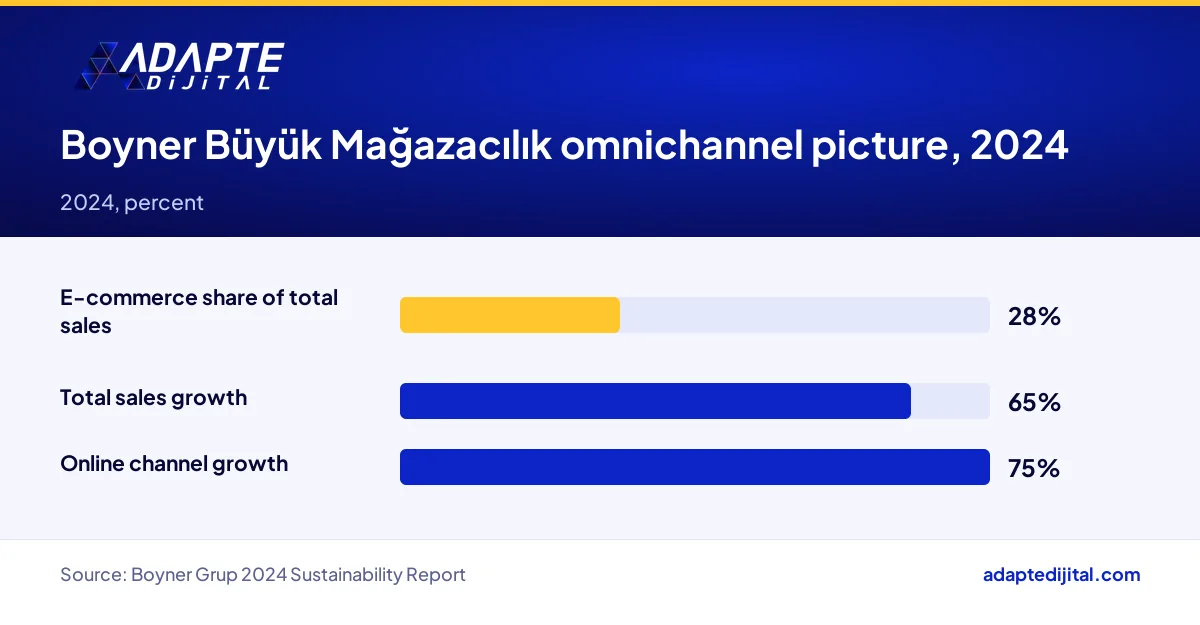
How did Boyner’s store and online channels look in its 2024 data?
They show strong online growth on top of a wide store network. According to the Boyner Grup 2024 Sustainability Report, e-commerce reached 28% of total sales at Boyner Büyük Mağazacılık in 2024. The online channel grew 75% and total sales grew 65%. In 2024 the company operated 126 stores in 44 provinces.
What does it take to merge store and online sales into one customer experience?
It takes three things: a single stock view, a single customer record and one management line that measures both channels together. A customer should be able to buy in store what they saw online, and online what they tried in store. For that, stock, prices and promotions must be equally accurate in both channels.
What does Boyner’s appointment mean for you, and which retailers does it affect?
Most directly affected are clothing, footwear and homeware retailers that sell both in stores and online. Mid-sized chains that run the two channels with separate teams and separate stock will find it harder. Tenants in AVMs, the Turkish term for shopping malls, and fast delivery logistics firms feel it indirectly.
How do web, search and local visibility come together in omnichannel retail?
They come together when the product page on your website, the store listing on the map and the search results all give the same information. A customer searches for the product, finds the nearest store on the map and checks the stock. If any link in that chain is broken, the sale closes in a competitor’s store.
What should a retailer with stores and online sales do this week?
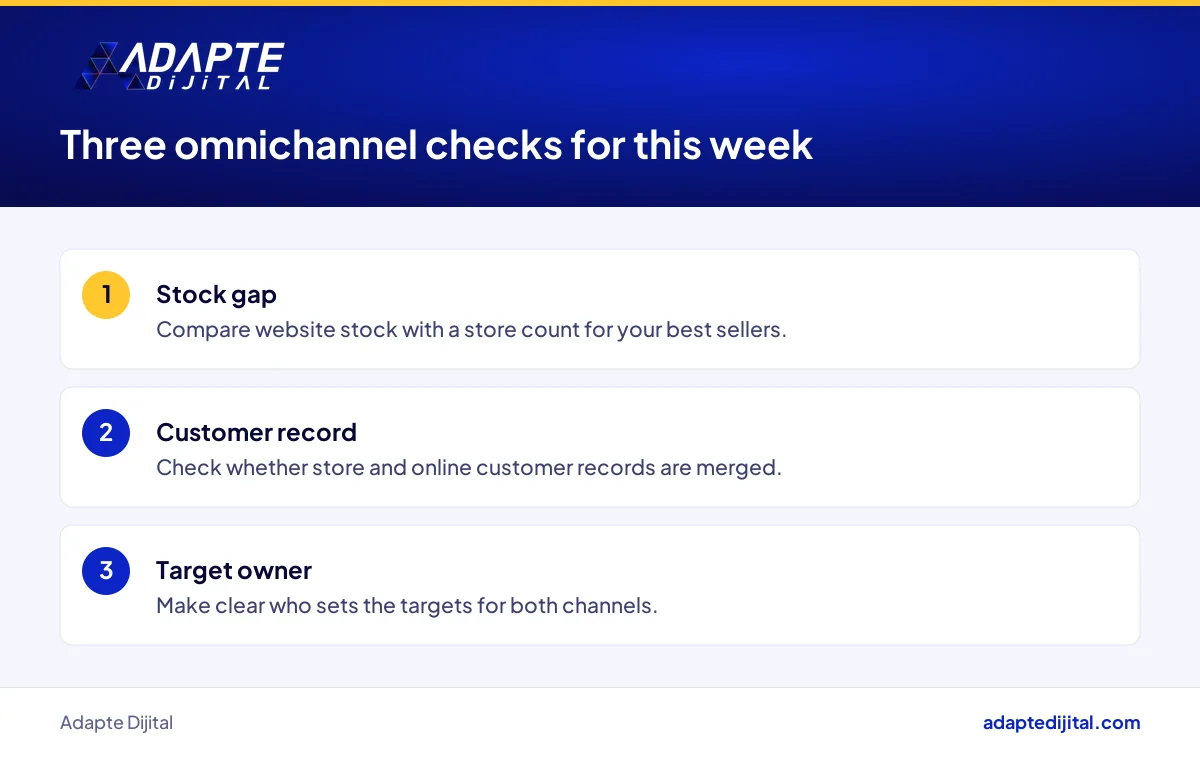
Do three things this week: compare the online stock figure with store stock for your best sellers, check whether store and online customer records are merged, and make clear who sets the targets for both channels. The answers show where your omnichannel setup is broken.
Quick Summary
- Mazhar Özsoy became Deputy General Manager for E-Commerce at Boyner Büyük Mağazacılık (Perakende Türkiye, 1 September 2026).
- The role focuses on a seamless, unified customer experience across sales channels.
- E-commerce reached 28% of Boyner’s total sales in 2024 (Boyner Grup 2024 Sustainability Report).
- In 2024, Boyner Now delivered from 32 locations in 11 provinces in an average of 71 minutes (same report).
- The strategy for the new era and the current e-commerce share have not been announced.
Short Glossary
- Omnichannel
- Omnichannel is the retail term used for merging store, web and mobile channels into one customer experience.
- Fast delivery
- Fast delivery is the service name used for getting an order from a store or nearby warehouse to the customer within minutes.
- Single stock view
- A single stock view is the phrase used for seeing store and warehouse stock across all channels at the same time.
Frequently Asked Questions
Next Step
If you would like to talk through how to bring your store and online channels into one experience, fill in the consult your expert form.
Sources: Perakende Türkiye, 1 September 2026 · Boyner Grup 2024 Sustainability Report · Yeni Birlik Gazetesi · Turkish Ministry of Trade, 2025 e-commerce data
Updated: October 2026
Sık Sorulan Sorular
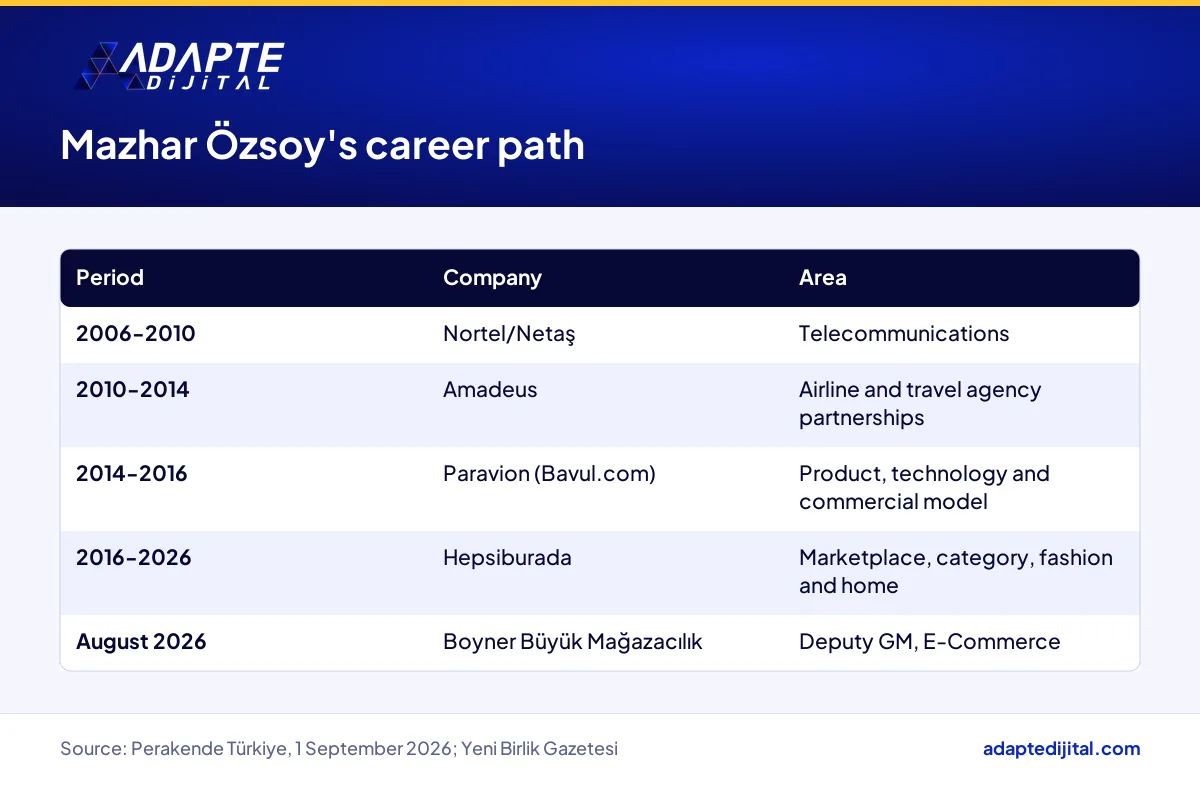
According to Perakende Türkiye, Özsoy worked at Nortel/Netaş from 2006 to 2010 and at Amadeus from 2010 to 2014, on strategic partnerships with airlines and travel agencies. From 2014 to 2016 he was responsible for product, technology and the commercial model at Paravion (Bavul.com). He then spent 2016 to 2026 at Hepsiburada.
He served as Marketplace Development Group Director, Category Group Director and Vice President for Fashion and Home categories. Drawing conclusions about Boyner’s new strategy from this background would be a mistake; the company has announced no such plan.
It does not say whom Özsoy reports to or who his predecessor was. Boyner’s e-commerce share for 2025 and 2026 has not been disclosed either. We could not find a dedicated corporate announcement or a filing on KAP, Türkiye’s public disclosure platform.
No, it belongs to 2024. No current share for 2025 or 2026 has been published. So the figure should not be read as today’s picture.
In 2024, the Boyner Now fast delivery service ran from 32 locations in 11 provinces, with an average delivery time of 71 minutes. It is a model in which delivery starts from the store. Here the store is not only a point of sale but also a small warehouse.
According to Turkish Ministry of Trade data, retail e-commerce in Türkiye grew 51.8% in 2025 to TL 2.5 trillion. Clothing and footwear accounted for 14% of transactions. The same data shows average parcel delivery time falling to 42.2 hours.
If the website says “in stock” and the store does not have the item, the customer walks out the door. When store stock feeds the online channel in real time, order cancellations and wasted shipments drop. Boyner Now shows that store stock can be put to work this way.
If the same customer appears under one identity in store and another online, both promotions and messaging are split. When loyalty, return history and average basket size sit in one record, you actually know your customer.
If the store manager and the e-commerce lead are measured against separate targets, each channel tries to book the other’s sales to its own account. Boyner’s description of the role as a “unified experience across channels” points to the idea of one responsibility that manages this divide.
Clothing and footwear made up 14% of e-commerce transactions in Türkiye in 2025. Let’s say a shopper tries a size in your store and finishes the purchase on their phone that evening. A brand that cannot connect those two moments risks handing the sale to a competitor.
In Istanbul’s shopping malls in autumn 2026, a store earns its keep not only through sales per square metre but also through the delivery and returns service it gives online orders. When tenant mix comes up for discussion, we see this service role reaching the table too.
A senior appointment in retail opens a new chapter for suppliers and business partners. We look at a similar change through CarrefourSA’s new CEO appointment. You can also follow our retail page, where we interpret the retail agenda for you.
Yes, “in stock at this store” and “click and collect” shorten the customer’s decision time. If the product page can show store stock at SKU level, online traffic also flows into the store.
If a store’s opening hours, address or phone number are wrong on the map, the customer gets lost on the way. Keep every store’s local listing up to date, including during campaign periods.
A product left in an online basket should appear in the same report as a product sold in store. In a market where women accounted for 56% of e-commerce spending in 2025, reading the customer profile separately in each channel gives you half a picture.
Pick your best-selling products and put the website stock next to a store count. If they differ, an item may be sitting on the shelf gathering dust while the website says “sold out”.
Give the store and online teams a shared target. Let both teams design returns, exchanges and click-and-collect together. We cover how to balance stock and cash in our article on Koton’s first-half stock management.
Merging store and online into one customer experience means handling e-commerce infrastructure and store operations together. At Adapte Dijital we do this with retailers through our e-commerce consulting service.
The report mentions no such plan. Drawing that conclusion from Özsoy’s background would be a mistake.
Yes, you can start with a single stock view and a single customer record. Then widen the scope step by step to fit your size.
Not necessarily, but both channels need a shared target and a shared way of measuring. Otherwise the channels end up competing with each other.