
What happens if I don’t register my trademark? 6 ways to lose an unregistered name
Say you make handmade soap in Beylikdüzü, Istanbul, and you have given it a lovely name. Now a question keeps coming back: what happens if I don’t register my trademark? The short answer is this. You can keep using the name, but on paper it is not yours. In Türkiye, trademark rights come from registration, and whoever files the same name before you moves into the stronger position.
The risk shows up once business picks up. Labels are printed, customers know the name, and then a warning letter or a marketplace rejection leaves your effort on the table. Below are the six ways a name slips away, what each costs and the order that prevents the loss.
Is a name yours without registration?
Not fully. Under Türkiye’s Industrial Property Law No. 6769, trademark rights are acquired through registration. If you use an unregistered name in trade, you do have some routes to object, but you carry the burden of proof. That means invoices, dated sales records and ads. A registered owner simply shows the certificate, and the conversation starts there.
Using is not the same as owning
Three years on your shop sign feels like ownership. The law looks at the register first, and your three years do not outweigh someone else’s application number.
The burden of proof stays with you
You must document earlier, genuine use in trade. For a small business with loose records, building that file is like opening a second shop.
What are the 6 ways to lose a name you worked for?
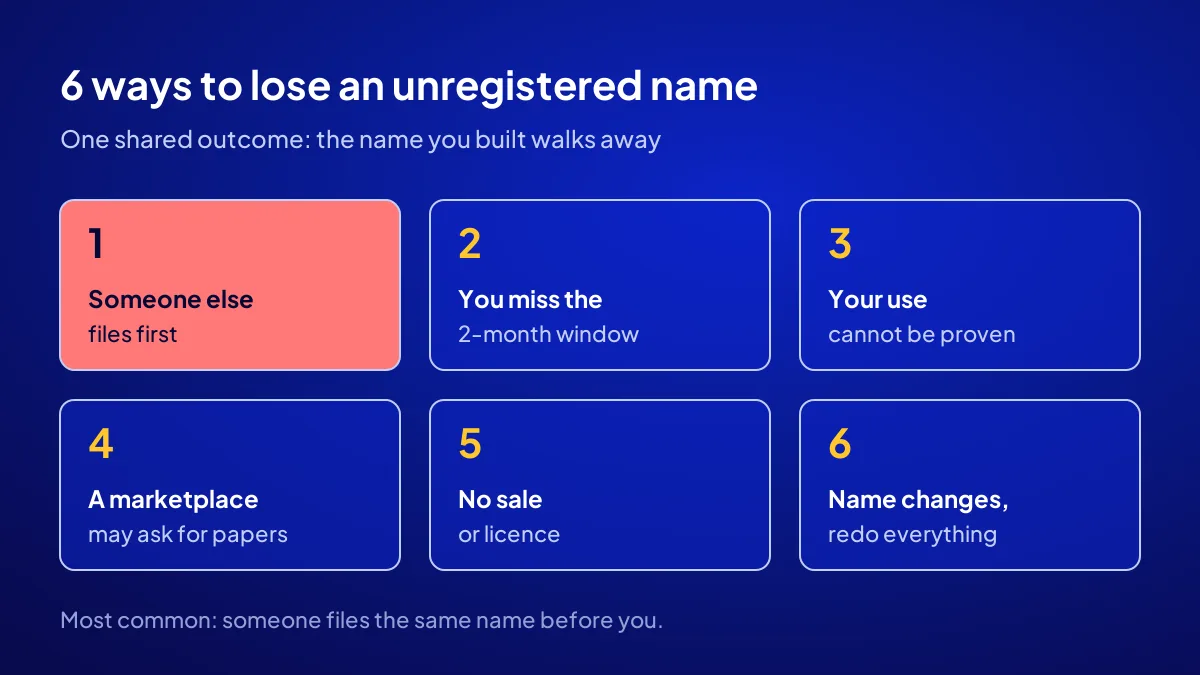
An unregistered name can slip away through six doors. The most common is someone else filing the same or a similar name before you. The rest show up online, on marketplaces and when you try to grow. By the time you notice, the packaging, the website and the name in your customers’ heads are already set.
- Someone files the same name before you and gets it registered.
- You miss the opposition window in the Official Trademark Bulletin.
- You cannot find dated documents to prove your use.
- A marketplace or ad platform may ask you for trademark papers.
- You cannot sell, license or safely hand the name to a partner.
- If the name changes, you redo everything from labels to content.
What happens if someone files your name first?
The application is published in the Official Trademark Bulletin, and a two-month opposition period runs from publication. Within that window, you can object by documenting earlier use in trade or showing the filing was made in bad faith. If the window closes, the route leads to court, which is long and costly.
If the name has to change, what leaves the till?
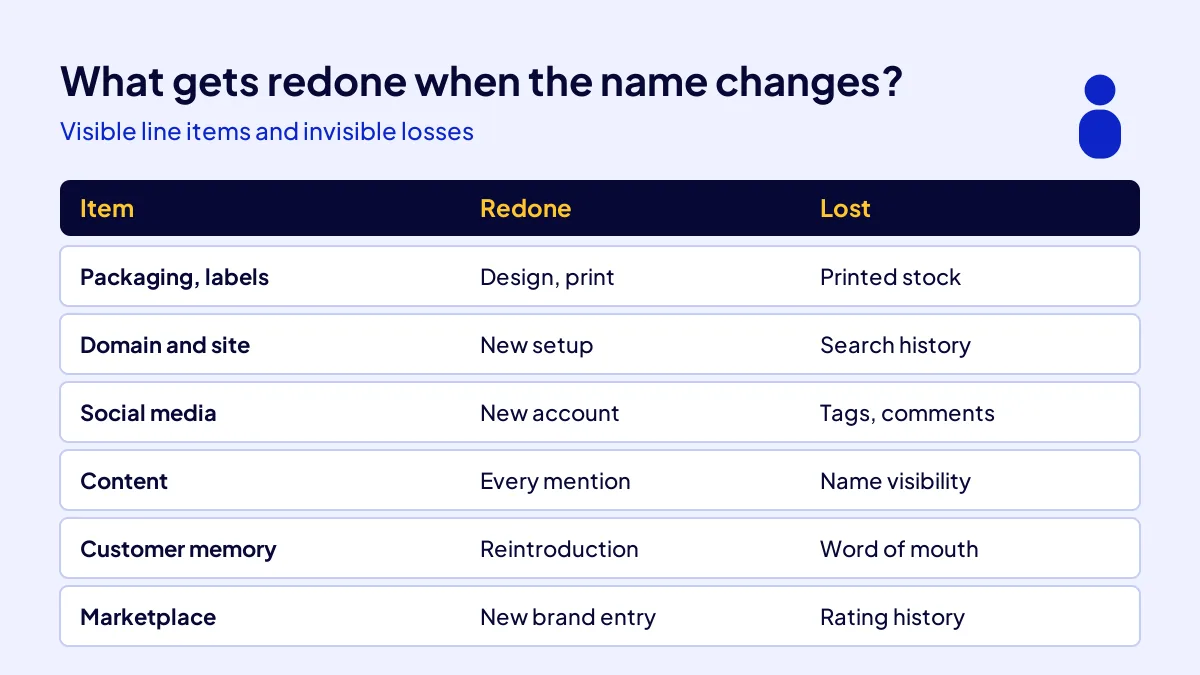
A name change is never a single line item; everything the name touches gets redone. Packaging stock goes in the bin, accounts become dead ends, and your content and search effort resets. The most expensive item is the invisible one: the name in your customer’s head.
| When the name changes | What gets redone? | What is lost? |
|---|---|---|
| Packaging and labels | Design and printing | Printed stock on hand |
| Domain and website | New address, new setup | The old address’s search history |
| Social media | New account or renamed handle | Tagged posts and comments |
| Content | Every article that mentions the name | Visibility for searches of the name |
| Customer memory | Reintroduction | Word of mouth, “the soap maker” tag |
| Marketplace store | New brand registration | Ratings and review history |
The unexpected item: search history
Once people search for you by name, the name becomes a digital address. Change it and someone else may answer that search.
Why is filing an application not enough on its own?
Because filing does not mean the name is available. If a similar mark is already registered in the same class, your application may meet an opposition or a refusal. So the order is: name first, availability check second, filing third. The surprising part is that the biggest losses often hit those who filed without checking, not only those who never filed.
What is the right order to prevent the loss?
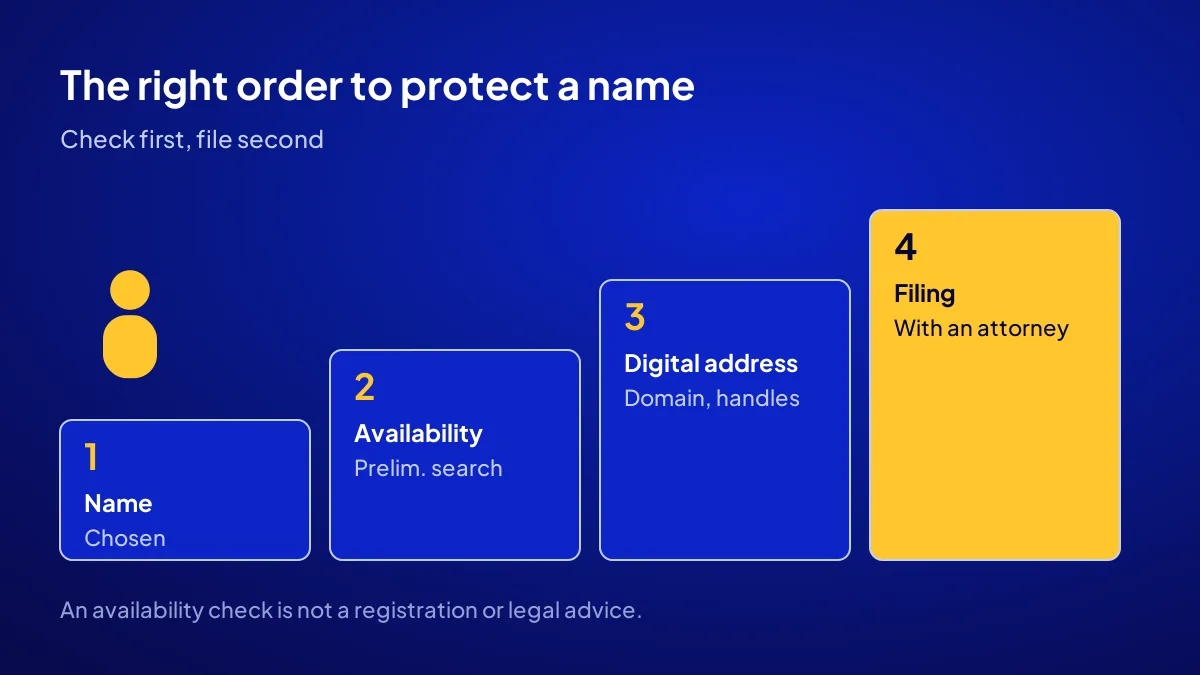
The right order has four steps: name, availability, digital address, filing. You choose the name, run a preliminary search in TÜRKPATENT records, secure the domain and accounts under the same name, then file for registration. Timing is covered in when to register a trademark.
Where does the Build Your Digital Brand campaign fit in this order?
The campaign builds the first three steps: naming consultancy, a TÜRKPATENT preliminary search and availability check, then domain, website and identity. The availability check is not a registration and does not replace legal advice. Trademark filing is a separate add-on, handled with a trademark attorney. So you file with a name that has already been checked.
Places and coupon
There are 12 brand places, and the last day is 1 November 2026. If you have the 10 percent coupon, just mention the code when you apply or during the call. Details and the form are on the Build Your Digital Brand campaign page.
Quick Summary
- In Türkiye, trademark rights come from registration; unregistered users carry the burden of proof.
- The first to file gets ahead; the bulletin gives a two-month opposition window.
- A name change takes packaging, website, accounts and search history with it.
- Filing alone is not enough; an availability check comes first.
- The right order: name, availability, digital address, filing.
- The campaign’s availability check is not a registration or legal advice.
Short Glossary
Official Trademark Bulletin: The Official Trademark Bulletin is the publication used to open trademark applications filed with TÜRKPATENT to opposition.
Availability check: An availability check is a preliminary review used to see whether a name clashes with similar records in the same classes.
Bad-faith filing: A bad-faith filing is an application used to register a name known to belong to someone else before they do.
Next Step
If you want to secure your name, have its availability checked first. Apply to the Build Your Digital Brand campaign and start with the name and availability check.
Sık Sorulan Sorular
The first. Good names occur to others too, and all you can say is “we have been using this for years”.
A large company’s legal team watches the bulletin regularly. A neighbourhood trader usually learns about a clash when a customer asks, “Is that your other branch?” By then, the horse may have bolted.
Most owners of unregistered names do not know the bulletin exists. The window opens quietly and closes quietly.
If a former supplier, dealer or partner who knew your name filed it, bad faith comes into play. You still need emails and contracts to show it. Speak to a trademark attorney or lawyer about your own case; nothing here is legal advice.
An invalidation or unfair competition case is possible, but you keep trying to sell while it runs. When the till is not ringing, that load is heavy.
Changing a name before launch is crumpling a sheet of paper. Changing it once the product is on the shelf is reopening the shop.
It checks whether the same or a similar name is registered for the same goods and services classes. We cover how it works in three steps in what is a trademark availability search.
A trademark is protected for specific goods and services under the Nice Classification. File for soap but forget retail services, and one side of your protection stays open.
No. A logo and colours dress a name up; they do not protect it. Read the difference in identity or brand.
A domain can pass to someone else within minutes. Reserving it and your social handles on naming day is cheap insurance. One principle is enough: get the name checked before you fall for it.
TRY 36,000 + VAT, fixed and paid upfront. At the general 20 percent rate the total is TRY 43,200; check the current rate on your invoice. It is designed for product brands, service brands and anyone turning their trade into a brand. The full picture is in our guide to building a digital brand.
No. The campaign’s TÜRKPATENT preliminary search and availability check looks at whether the name clashes with similar records. It is not a registration and does not replace legal advice. Trademark filing is a separate add-on, handled with a trademark attorney.
You can, but if someone else registers the same name, your use becomes open to dispute. You would need dated documents to prove earlier use. Ask a trademark attorney about your specific case.
You can file an opposition within two months of the application’s publication in the Official Trademark Bulletin. An earlier-use or bad-faith ground must be backed by documents. If the window has passed, the court route comes into play.
Updated: October 2026