
Is a Laser Hair Removal Centre a Beauty Salon or a Health Establishment?
The answer depends on the class of the device. Some of the devices used for laser hair removal fall into the medical device class, and a procedure carried out with those devices counts as a medical procedure. In that case a municipal licence alone is not enough: the process goes through the provincial health directorate and physician responsibility is required.
You may not have known this: two centres doing the same work can sit in two entirely different legal statuses depending on the device they use. One operates with a beauty salon licence, the other has to be structured as a health establishment. The difference is not the brand of the device but its class.
Why is the device class decisive?
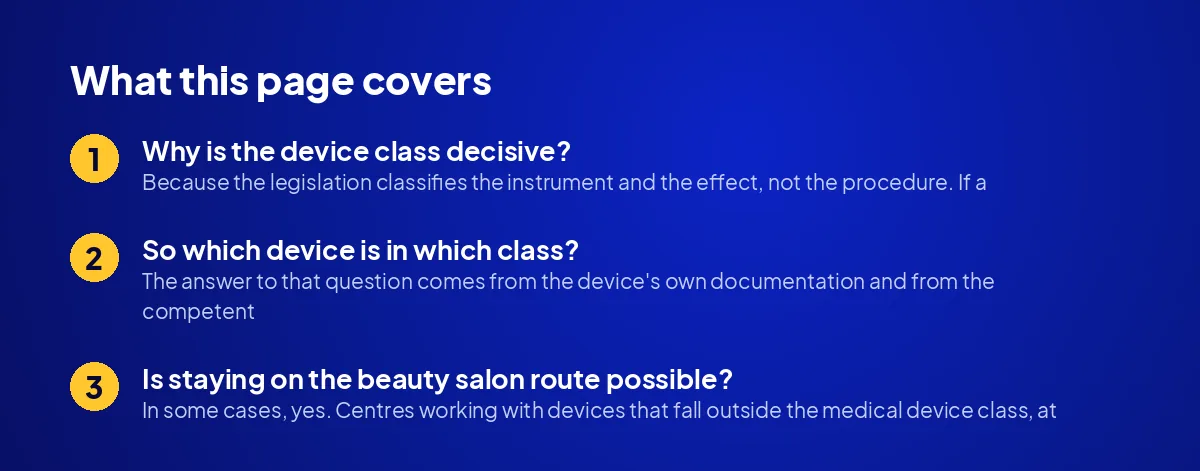
Because the legislation classifies the instrument and the effect, not the procedure. If a device is classified as a medical device, the application carried out with it enters the medical field too. Energy-based devices that act on the deeper layers of the skin and aim at a lasting result are generally assessed in that class.
Two different worlds
| Criterion | The beauty salon route | The health establishment route |
|---|---|---|
| Licensing authority | District municipality | Includes the provincial health directorate process |
| Responsible person | A specialist holding occupational competence | Physician responsibility is required |
| Premises requirements | General workplace requirements | Defined room and equipment requirements |
| Device records | Standard fixed asset | Traceability and record-keeping obligations |
| Set-up time | Weeks | Months |
| Start-up cost | Low | Markedly higher |
So which device is in which class?
The answer to that question comes from the device’s own documentation and from the competent authority, not from the company selling it. Every device has a conformity document and a classification, and the seller is obliged to provide them.
Is staying on the beauty salon route possible?
In some cases, yes. Centres working with devices that fall outside the medical device class, at lower energy and without a claim of lasting effect, can operate with a beauty salon licence.
Two things need care here. The first is how the result is promoted: permanent hair removal and hair reduction are different claims, and the first moves you towards the medical field. The second is the procedure itself. Even with a lower-class device, describing your application as a medical procedure will be taken into account at inspection.
Which documents are common to both routes?
A lease, the building’s occupancy permit, a tax certificate, a chamber registration, a hygiene training certificate for staff, and a social security workplace notice if you will employ anyone. Those six items are needed whichever route you take.
What differs: the type of licence, the responsible person, the premises requirements and the device records.
Three questions to ask before deciding
- What is the conformity document and classification of the device I am considering?
- With a device of that class, at this address, in what status may I operate? This is asked of the authority in writing
- If physician responsibility is required, can I build that structure, and does its cost fit my business model?
The third question is usually the one that decides. A structure requiring physician responsibility means a permanent cost item, and at small scale that cost changes the business model.
Now you know this
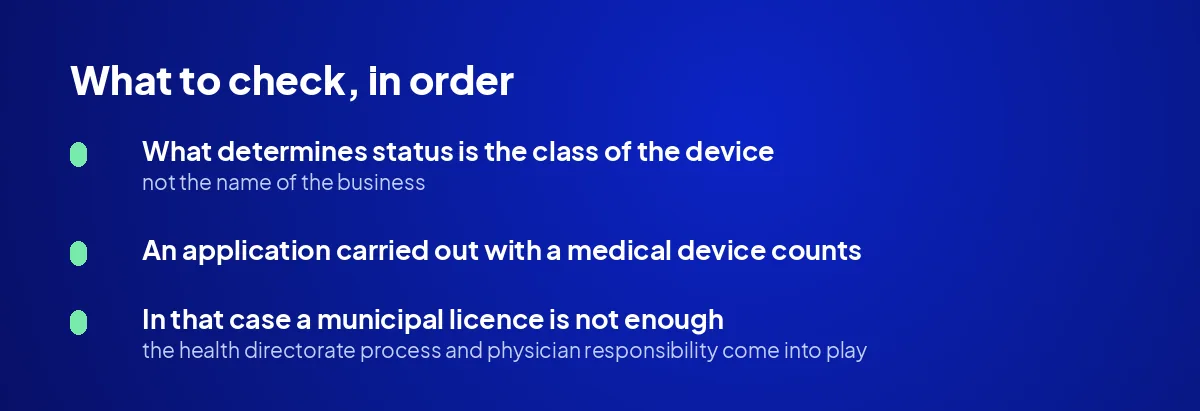
What determines the status of a laser hair removal centre is the class of its device. If you work with a medical device, health legislation comes into play and a municipal licence alone is not enough. The right move is to learn the device’s class and put a written question to the authority before you buy the device and before you take premises.
For a wider view of how the scope boundary works see our skin care salon refusal reasons article, and for the order authority by authority the business licence roadmap.
Device maintenance and calibration records
BU BÖLÜMÜN ÖZETİ
- Records to keep
- Why it matters
- Assessment before application
One obligation continues after you have the licence: regular maintenance and calibration of the device. This heading matters both at inspection and for the safety of your applications.
Records to keep
- The device’s serial number and purchase document
- Periodic maintenance dates and the company performing them
- Calibration reports
- Fault and repair history
- Tracking of the consumables used
Why it matters
A device whose calibration has drifted can deliver energy other than expected, which means both an ineffective application and a risk of burns. If something goes wrong, the first thing asked for will be the maintenance and calibration record.
Collect these records in one file and keep the maintenance calendar on a reminder. An annual maintenance contract makes the cost predictable and takes the follow-up off your hands.
Assessment before application
Matters such as skin type and medication use affect whether an application is suitable. Informing the client and taking consent beforehand is the right routine, both for their safety and for your own protection.
For how neighbouring branches differ, see why is a health and cosmetics shop licences and.
In Short
- What determines status is the class of the device, not the name of the business
- An application carried out with a medical device counts as a medical procedure
- In that case a municipal licence is not enough; the health directorate process and physician responsibility come into play
- Learn the device’s class from its conformity document, not from the seller
- A claim of permanent hair removal moves you towards the medical field
- Six documents are common to both routes; what differs is the licence type and the responsible person
- Physician responsibility is a permanent cost and at small scale it changes the business model
Quick Glossary
Medical device: a device manufactured for a medical purpose and subject to its own legislation. Conformity document: the document showing the standards a device was made to and its class. Physician responsibility: the requirement for procedures to be carried out under a physician’s supervision. Written opinion: the official reply from an authority containing its assessment of an activity.
Next Step
Let’s assess your device choice and your status decision together: quote form.
Frequently Asked Questions
Updated: September 2026
Sık Sorulan Sorular
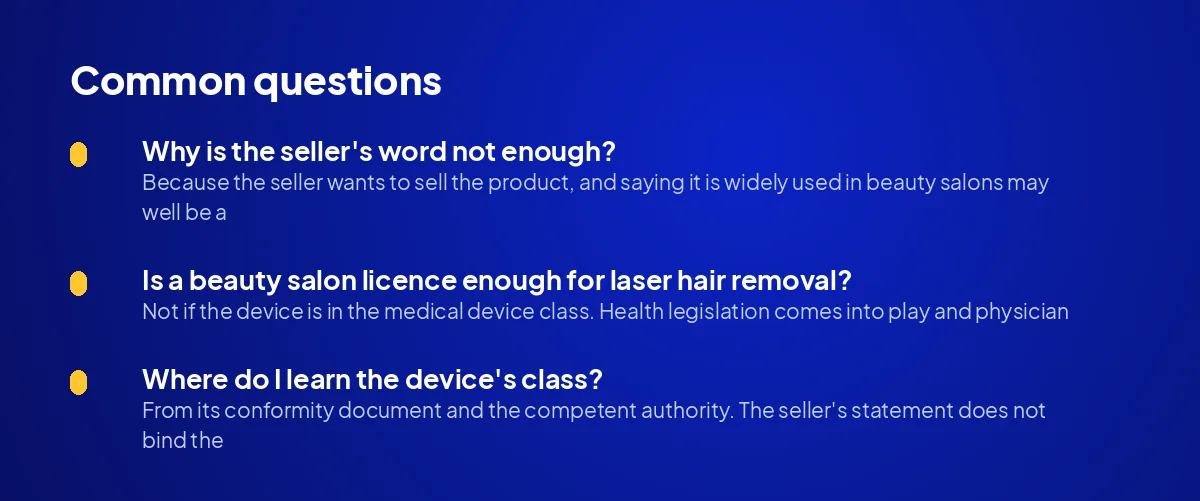
Because the seller wants to sell the product, and saying it is widely used in beauty salons may well be a true sentence from their side. But being widely used does not mean that use complies with the legislation. The licensing authority looks at the class of the device, not at what is common in the market.
The practical rule is this: before you buy, ask for the conformity document, learn the class, and put a written question to the district municipality and the provincial health directorate about what you may do with that class. Asking the question after buying does not change the answer; it only puts you in a harder position.
Not if the device is in the medical device class. Health legislation comes into play and physician responsibility is required.
From its conformity document and the competent authority. The seller’s statement does not bind the administration.
Physician responsibility is required in a structure within the health scope. Get a written opinion from the provincial health directorate on the scope and the working arrangement.
That claim moves you towards the medical field. Keep your promotional language consistent with your device’s class.
A lease, the occupancy permit, a tax certificate, a chamber registration, hygiene training and the social security notice.
Permission first. Asking after you have bought does not change the answer, it only puts you in a harder position.
It is the first record asked for if something goes wrong, and it is expected to be kept regularly.
It makes the cost predictable and takes the follow-up burden off you.
Skin type and medication use affect suitability, so informing the client and taking consent is the right routine.