
Building and Selling Niche Sites: The Door to Turning Traffic Into an Asset
Building and selling niche sites is the work of creating a site that answers a real question on a specific topic and draws steady traffic, then transferring it once its value has grown. What is sold is not a design but proven demand: the visitors who arrive every month and the income they generate. 🌱
This earning-gate article describes the work of the person who builds sites to sell: who suits it, how value forms, where the first buyer comes from and what the biggest risks are. This article is not a promise of income or investment advice; it describes what one business door looks like. Forward-looking sentences are labelled as forecasts.
The door itself: what is sold, and why now?
BU BÖLÜMÜN ÖZETİ
- The asset being sold
- The picture today
- Timing
A site becomes an asset once it produces steady traffic and documented income; designing that transformation is a business in itself.
The asset being sold
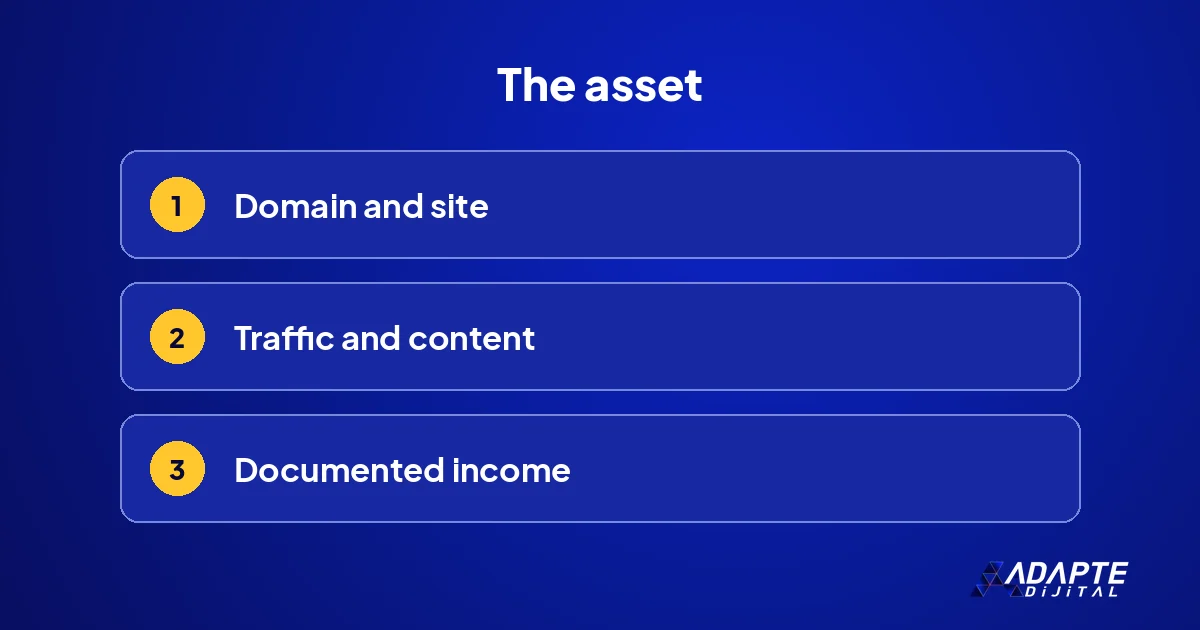
What is sold is a website along with the traffic, content, domain, any email list and income sources it brings. The buyer is an entrepreneur, an investor or a business in the same field that wants to take over a working site rather than start from scratch. Value depends less on how the site looks than on how steady and well documented its income is. 🧾
The picture today
Google began rolling out its November 2026 core update on 10 November 2026, and updates like this can shift a niche site’s traffic quickly. Google’s spam policies also treat repurposing expired domains to rank low-value content, and mass-producing pages mainly to manipulate rankings, as spam regardless of how the pages are made. A site built through fast, mass production has fragile value; a site that answers a real question has lasting value.
Timing
AI tools have made content cheap to produce, which means ordinary sites multiply while good sites stand out more. Sites that show expertise and genuine experience get a better chance to rise. We explain how a site’s value is calculated in how to value a website.
Whose work is this?
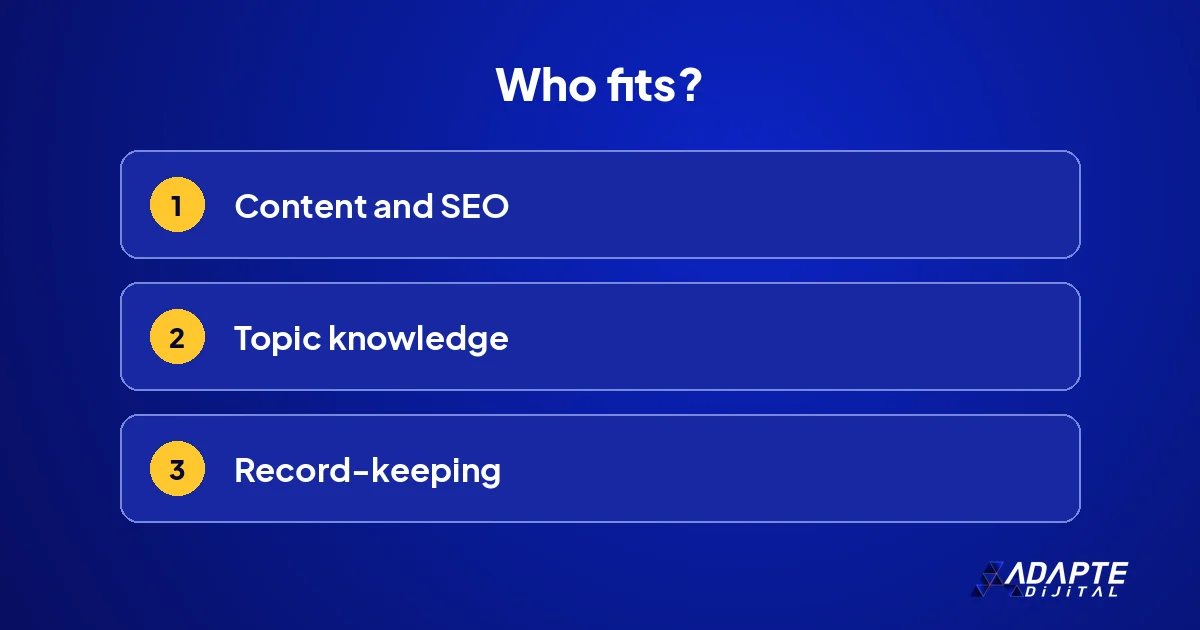
This work combines content and SEO knowledge with patience and good record-keeping.
The skills needed
The best candidate knows content, SEO and basic site management and has genuine knowledge or experience in a topic. Telling lasting demand apart from a passing trend is the most important skill here. Keeping income and traffic records in order also creates value on the day of sale. 🧠
The capital needed
To start, you need a domain, hosting and content work; the real capital is time. Turning a site into a sellable asset takes months, and you have to be prepared to work without expecting income during that time. Taking over an existing site and growing it is another way to start.
Where do buyers come from, and how does income form?
BU BÖLÜMÜN ÖZETİ
- The first buyer
- Income and value
- What not to promise
A niche site’s buyer is often someone already doing business in that topic.
The first buyer
The first buyer is most likely a business in the same field or an entrepreneur looking for a working site. Website and domain marketplaces, and businesses in the sector, are natural channels. Having traffic and income records in order before the sale decides how far the buyer trusts you. 🤝
Income and value
Until it is sold, a site can earn through advertising, affiliate partnerships or its own products; at sale, the steadiness and source of that income set its value. We give no figures here; value varies widely by site, topic and how well income is documented. We cover the market’s overall picture in numbers in the website and domain market in numbers.
What not to promise
There is no guarantee that a niche site will sell, or reach a particular price. Search updates, competitors and buyer interest change the outcome. This article is not investment advice; every site is assessed on its own data. ⚠️
Costs and the biggest risks
BU BÖLÜMÜN ÖZETİ
- Costs
- Traffic risk
- Policy risk
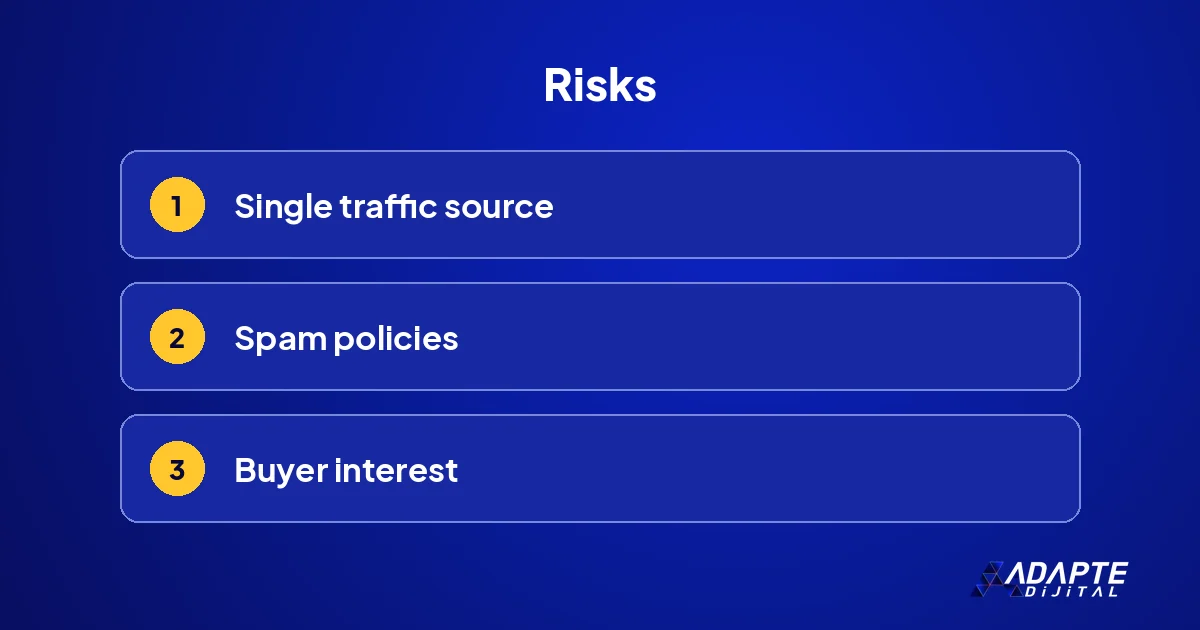
A niche site’s biggest risk is that its value depends on a single traffic source.
Costs
The lines are the domain and hosting, content production, technical upkeep, tools and due diligence during the sale. Content is the largest line; content that answers a real question well takes time and knowledge. A site built on cheap content can lose value at the first update. 🧮
Traffic risk
If most traffic comes from a search engine, a core update can change the site’s value overnight. Diversifying traffic sources, for instance by building an email list and direct visitors, makes the asset sturdier. The possibility that AI answers reduce clicks for some questions is also factored in.
Policy risk
Mass low-value content, abuse of expired domains and borrowing another site’s reputation all run against Google’s spam policies. A site grown through shortcuts can be penalised before or after the sale, which leads to disputes between buyer and seller. Clean growth is a condition of being sellable. 🔍
Horizon and the first 90 days
The first two items are forecasts; the third is a sequence you can start today.
The first 90 days
Month one: choose a topic you know that answers a real question, and validate the demand. Month two: publish the first 20 pieces of content and start keeping traffic and income records from day one. Month three: narrow or widen the topic based on the first data. Records kept from the start are the most valuable document on sale day. 🗓️
How do you approach this door with Adapte Digital?
BU BÖLÜMÜN ÖZETİ
- A single delivery package
- What we do on the asset side
- Where to start
On the digital asset side, we build a site as an asset and hand it over: the domain, content and measurement setup come with their documentation.
A single delivery package
Adapte Digital does not charge a monthly management fee. Work starts with a single delivery package whose scope is written down in advance: 36,000 TRY + VAT. If the work grows, the new need is defined as a separate add-on package, priced by what will be delivered rather than by the hours spent. 📦
What we do on the asset side
We work on topic selection, the first content structure and measurement setup together with the business. What a digital asset business involves is explained in what is a digital asset business.
Where to start
Our current packages and capacity are listed on our campaign pages; scope and price are written there before any work starts. 🧭
Quick Summary
- The door: building a site that answers lasting demand, documenting its traffic and income and transferring it as an asset.
- Google began its November 2026 core update on 10 November 2026.
- Google’s spam policies treat expired domain abuse and mass page production as spam.
- The biggest risks are dependence on one traffic source and growth through shortcuts.
- Sale and price cannot be guaranteed; no figures are given, and this is not investment advice.
Short Glossary
- Niche site
- A site focused on a specific topic or question that draws traffic on it.
- Core update
- A broad change Google makes to its search ranking systems.
- Expired domain
- A domain its previous owner did not renew, which can be registered again.
Frequently Asked Questions
Next Step
Write down three topics you know, and for each find five questions people genuinely ask; the topic with the most lasting questions is a candidate for your first site. Our campaign pages list the delivery packages that cover this work.
Sources: Google — Google Search Status Dashboard · Google Search Central — Spam policies for Google web search · Google Search Central — Introducing Search Generative AI performance reports in Search Console
Updated: November 2026
Sık Sorulan Sorular
One person can start with one or two sites. As the number of sites grows, content, technical upkeep and sales need a team or agent support. Managing each site with its own records and documents makes the sale process easier.
Forecast: as AI-assisted content production spreads, the number of niche sites will grow, but value will concentrate in the small number of sites that show genuine experience and expertise. We look at the two-year direction in starting a business with agents: the next 2 years.
Forecast: alongside traffic, buyers will start asking about a site’s visibility in AI answers and its brand value; documented visibility will become a new component of value. Update log. 12 November 2026: first publication. The forecasts on this page are re-read when they fall due; a forecast that turns out wrong is not deleted but corrected here.
Buyer interest continues for sites that answer a real question and document their income, but the risk for sites built on mass, low-value content has grown. Every site should be assessed on its own data.
Google’s policy looks at purpose more than method: mass-producing low-value pages to manipulate rankings counts as spam. Content that genuinely helps readers is assessed regardless of how it was produced.
We give no figures; value varies widely by site, topic and how well income is documented. This article is not investment advice.