
Digital company models abroad, how long does setup take in Estonia, the UK and Singapore?

According to official pages, company registration takes 1-2 days in Estonia via e-Residency and usually 24 hours online at the UK’s Companies House, while in Singapore most registrations are approved shortly after payment (e-Residency, GOV.UK and ACRA pages, accessed 14 October 2026). Registration fees are €265, £100 and S$300 respectively, and Estonia adds a €150 e-Residency state fee.
What this means for you: in all three countries the registration itself is fast; the real time and cost sit in identity checks, a local address and director rules. In Türkiye the Ministry’s digital company (dijital şirket) definition has not been published yet. No official source says Türkiye is modelling its scheme on these countries.
How long does it take, and what does it cost, to set up a company in Estonia with e-Residency?
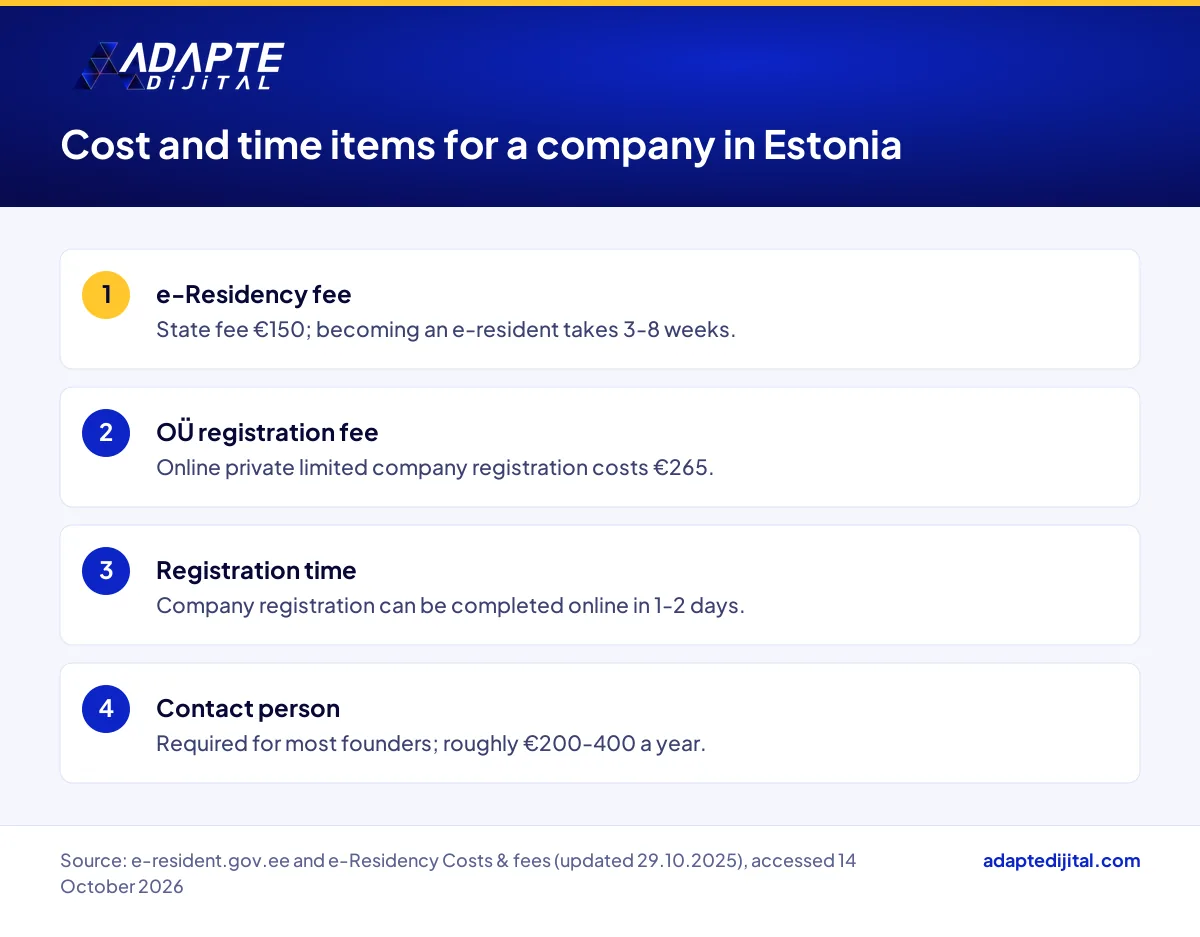
Registration can be done 100% online within 1-2 days, but you first need to become an e-resident, which takes 3-8 weeks. The state fee is €150 for e-Residency and €265 for registering a private limited company (OÜ), per the e-Residency costs page updated 29 October 2025. The official e-Residency site builds the programme around digital identity and remote access.
How long does online company setup take in the UK and Singapore, and what does it cost?
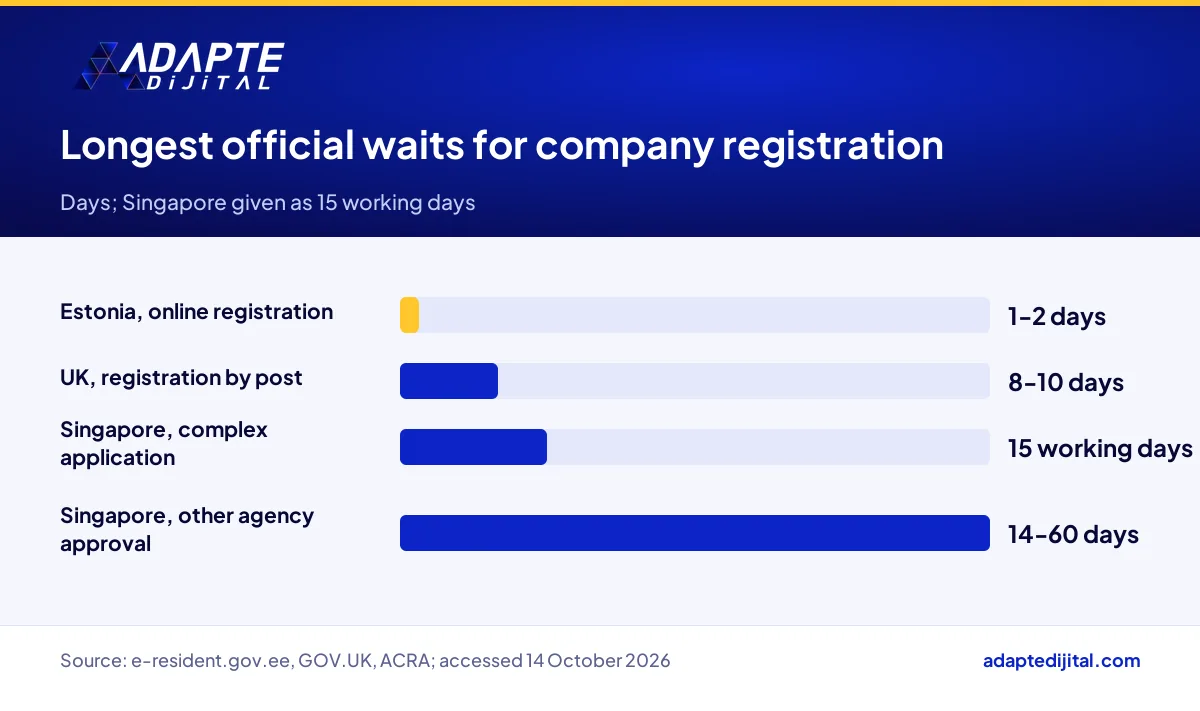
In the UK, online registration costs £100 and is usually completed within 24 hours; by post it is £124 and takes 8-10 days (GOV.UK, updated 3 February 2025). In Singapore the ACRA registration fee is S$300, and most registrations are approved shortly after payment (ACRA, updated 14 October 2026). In both countries speed is a given; the hurdle lies in document and people requirements.
Are the Estonian, UK and Singapore models a template for Türkiye’s digital company?
Official sources draw no such link. No Ministry statement says Türkiye’s digital company scheme is based on these countries. The comparison of the three models comes from a column by Ertan Barut in Dünya newspaper on 28 September 2026. The Research Desk lines up the three countries’ official figures on the same criteria below.
| Criterion | Estonia (e-Residency) | UK (Companies House) | Singapore (ACRA Bizfile) |
|---|---|---|---|
| Registration fee | €265 (+€150 e-Residency) | £100 online | S$300 |
| Registration time | 1-2 days | Usually 24 hours | Most shortly after payment |
| Precondition | Become an e-resident (3-8 weeks) | Identity check may apply | Login via Singpass or a CSP |
| Local requirement | Contact person for most | Registered office address | Resident director and local office |
Who does the option of incorporating abroad affect, and how?
Software and SaaS startups selling to foreign customers look at these options first. E-commerce businesses selling abroad are the second group. Accountants, lawyers and foreign trade consultants are affected indirectly, because two-country structures land on their desks.
What does online setup mean for a digital company on the web and data side?
All three countries run registration online, and Estonia adds electronic signatures through e-Residency. A company’s first digital assets take shape around registration: domain, business email, payment account and website. If Türkiye’s digital company scheme moves in a digital direction too, a startup that already has these assets starts a step ahead.
What should a founder waiting for the digital company definition do this week?
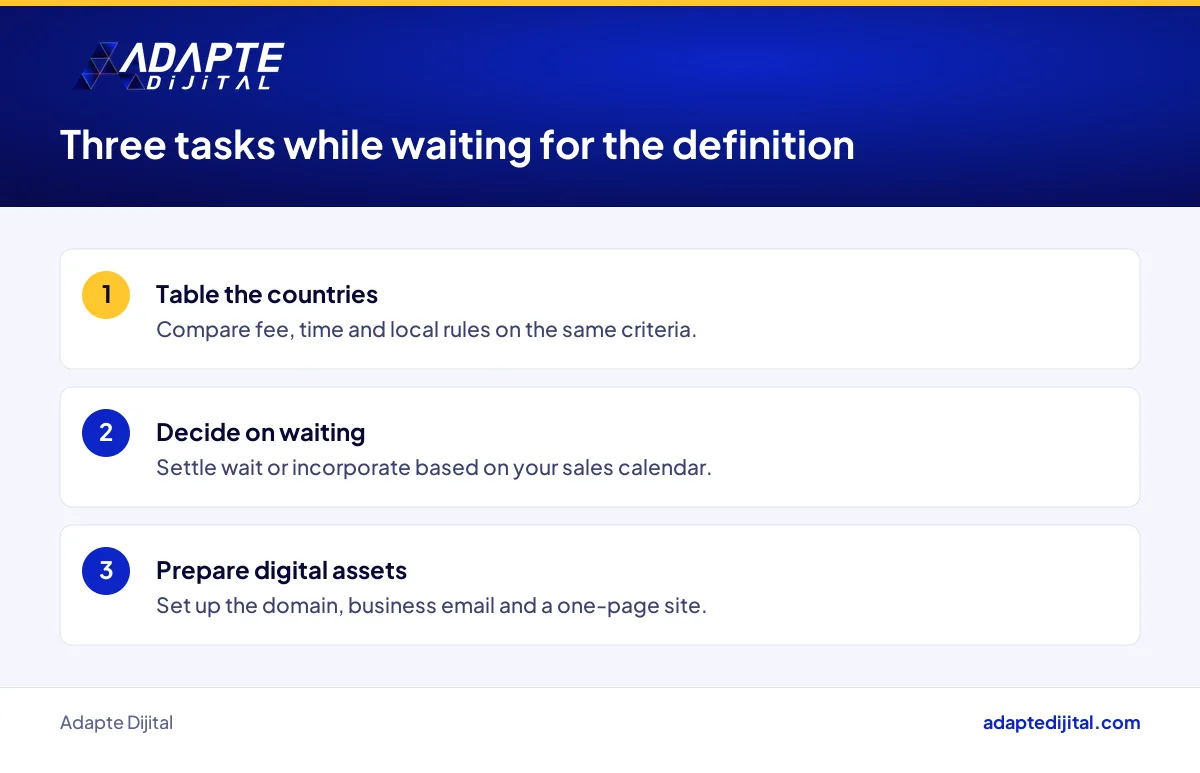
Three tasks fit into this week: put the country options for your target market in one table, decide whether to wait for Türkiye’s definition, and prepare your digital assets independently of the company. When deciding, look at yearly fixed costs, not just the registration fee.
Quick Summary
- In Estonia, registration takes 1-2 days, the fee is €265 and the e-Residency state fee is €150 (e-Residency pages).
- Becoming an e-resident takes 3-8 weeks, and most founders need a contact person costing roughly €200-400 a year (e-Residency).
- In the UK, online registration costs £100 and usually takes 24 hours; by post it is £124 and 8-10 days (GOV.UK).
- In Singapore the registration fee is S$300 and at least one resident director is required (ACRA).
- No official source says Türkiye models its scheme on these countries, and the digital company definition has not been published.
Short Glossary
- e-Residency
- e-Residency is the state-issued identity Estonia uses to give remote access to its digital services and electronic signatures.
- Companies House
- Companies House is the official UK registrar used to keep company records and run online incorporation.
- ACRA Bizfile
- ACRA Bizfile is the official online system used in Singapore for company registration and registry filings.
Frequently Asked Questions
Next Step
To assess the right company structure for your target market together, fill in the consult your expert form. Our digital company page, where we collect every question on the topic, also sums up the current status.
The definition and conditions of the digital company scheme are not final yet; check the latest information with the Ministry of Industry and Technology, KOSGEB and the Official Gazette before deciding. This is not legal or financial advice.
Support amounts and conditions can change; check the current terms on the institution’s official page before applying. This article is not financial or legal advice.
Sources: e-Residency official site (accessed 14 October 2026) · e-Residency, Costs & fees (updated 29 October 2025) · GOV.UK, Register your company (updated 3 February 2025) · ACRA, Registering a local company via Bizfile (updated 14 October 2026) · Dünya, column by Ertan Barut (28 September 2026)
Updated: October 2026
Sık Sorulan Sorular
e-Residency is a digital identity issued by the state. It gives remote access to Estonia’s digital services, online authentication and electronic signatures. You set up and manage the company with that identity.
The site’s counters show 144,647 e-residents from more than 170 countries and 44,082 companies they have founded; no date is given for the counters. Companies number roughly three in ten e-residents. Getting the identity is not the same as founding a company.
Most e-residents must appoint a contact person in Estonia under the Commercial Code. That service costs roughly €200-400 a year, according to the same costs page. It is a recurring cost on top of the one-off €265 registration fee.
The gap is £24 and about a week. The online channel is both cheaper and faster on GOV.UK’s own figures.
A registered office address, a business activity (SIC) code, a separate Government Gateway user for the company, at least one director and one shareholder, and details of people with significant control (PSC). Identity may need to be verified with GOV.UK One Login. If there are several directors, each one’s personal code is required.
Only the person who reserved the company name can register it, and that person must be appointed as a director or company secretary. A corporate service provider (CSP) can register on their behalf. Individuals log in with Singpass and CSPs with Corppass.
At least one director must meet the residency rules, and the registered office must be a Singapore address open to the public during office hours. Complex applications can take up to 15 working days, and those needing approval from another agency 14-60 days. For a founder abroad, the real question is how to meet this rule, not the fee.
Starting from the three examples, Barut proposes a model that links MERSİS, Türkiye’s central trade registry system, the TOBB registry network and Ministry criteria under a “give your data once” principle. That is one commentator’s proposal, not an official model.
According to the Investment Office guide, registration runs through MERSİS and is completed the same day at Trade Registry Offices. Foreign partners need a potential tax number and apostilled documents. Registration speed is not the problem; the document trail is long.
On 27 April 2026 Minister Kacır announced that foreign investors will be able to set up a company fully remotely through passport-based identity verification. No start date was given. No official comparison with any foreign model has been made.
Remote access to digital services suits a team spread across locations. The yearly contact person fee and accounting services still need to be counted. Cheap setup does not mean cheap running.
The UK’s registered office address and Singapore’s local office rule decide, from day one, which address goes on your documents. Settle the address before you register.
Bookkeeping, filing and tax obligations may arise in two countries. At that point the decision is a financial and legal one; this information is not investment or tax advice.
A domain that matches the company name, a business email and a one-page site that explains the product. A customer who cannot find your site walks away.
Manage a Turkish page, local contact details and local visibility channels such as a Google Business Profile separately. Even if the company is registered abroad, search results target the local reader.
That depends on your sales calendar. Our article on waiting for the definition or incorporating now lists the criteria one by one.
The goals in the Medium-Term Programme are a key signal. Our article on the digital company and one-stop office in the 2027-2029 programme sums up the status with the official reference.
Choosing the country, the sales channel and the document trail is a foreign trade decision. We do this work: our foreign trade consultancy service works out the structure and channel for your target market with you.
Company registration can be done 100% online, but you must first become an e-resident. The official pages read do not say where founders applying from Türkiye collect their digital ID card.
According to GOV.UK, online registration at £100 is cheaper than the postal route and is usually completed within 24 hours. Postal registration costs £124 and takes 8-10 days.
No official source says so. The three-country comparison is a proposal in a Dünya column; the Ministry’s digital company definition has not been published yet.