
Preparing a digital company before the definition, what does a KOSGEB application need?
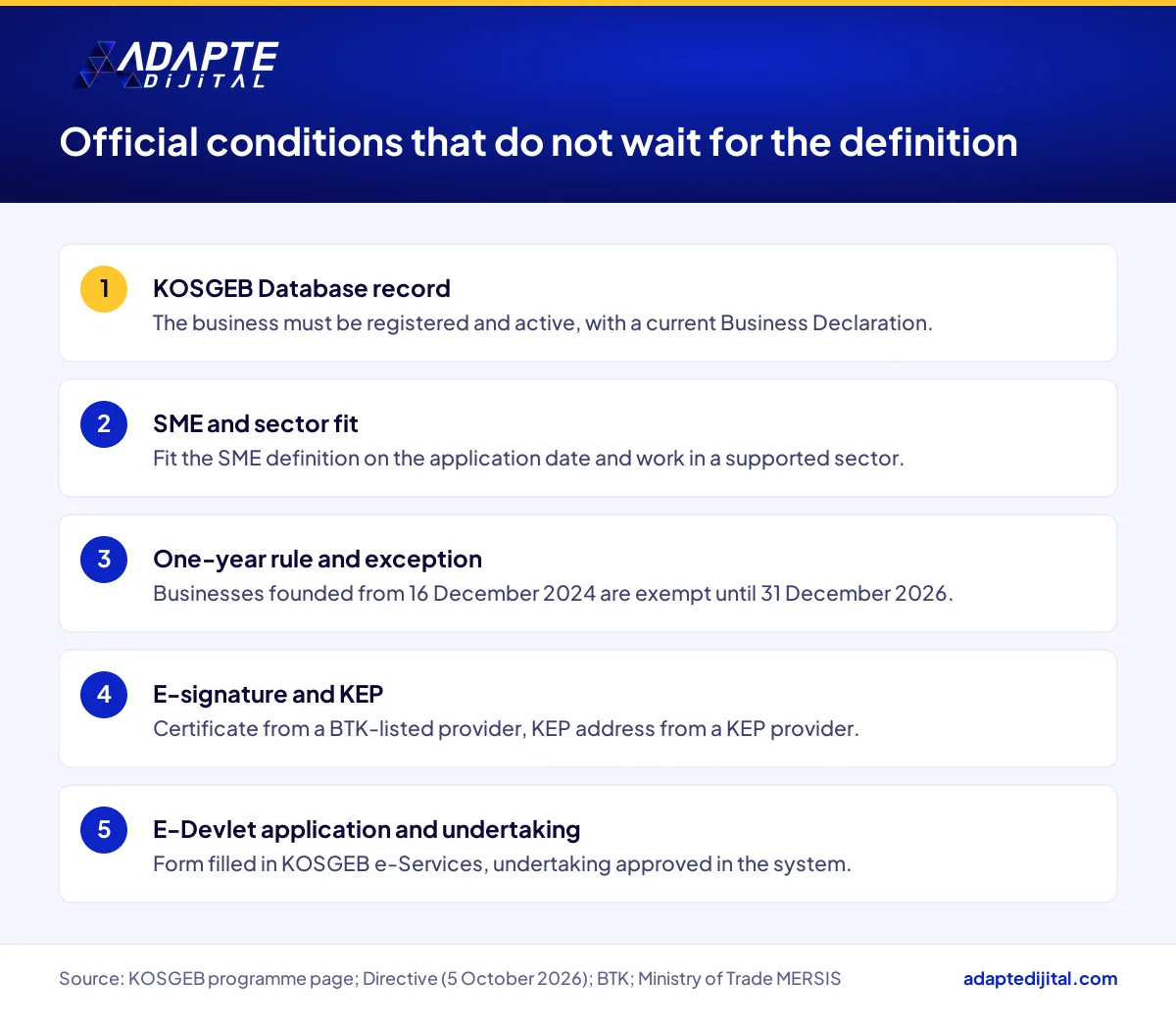
Most of the official conditions for KOSGEB Business Setup Support can be completed today, before any digital company (dijital şirket) definition exists: a KOSGEB Database record, an up-to-date Business Declaration, a check of the application window, e-Devlet access, an e-signature and KEP (KOSGEB Entrepreneur Support Programme page and Directive of 5 October 2026, accessed 14 October 2026). KOSGEB is Türkiye’s Small and Medium Enterprises Development Organization. As the Ministry of Industry and Technology had not published the definition as of 14 October 2026, no digital-company-specific document list exists. A website, a domain name and a bank account are business needs, not official conditions.
What this means for you: instead of chasing paperwork on the day the definition appears, you can build everything that does not depend on it now. Our digital company page breaks this split down topic by topic.
Which official KOSGEB conditions can a digital company candidate complete before the definition?
All of the common conditions. According to the KOSGEB Entrepreneur Support Programme page, every support requires the business to be registered and active in the KOSGEB Database with an up-to-date Business Declaration. The Directive adds three more: fitting the SME definition on the application date, applying within one year of incorporation and working in a sector KOSGEB supports. None of these waits for the digital company definition.
How does digital company preparation work step by step?
It takes four steps: e-signature and KEP, the articles of association in MERSIS, the KOSGEB record and Business Declaration, and finally the application through e-Devlet, Türkiye’s e-government gateway. Official texts give no durations or fees, so get your own quotes from providers.
Is entrepreneurship training required for a digital company, and why do the page and Directive differ?
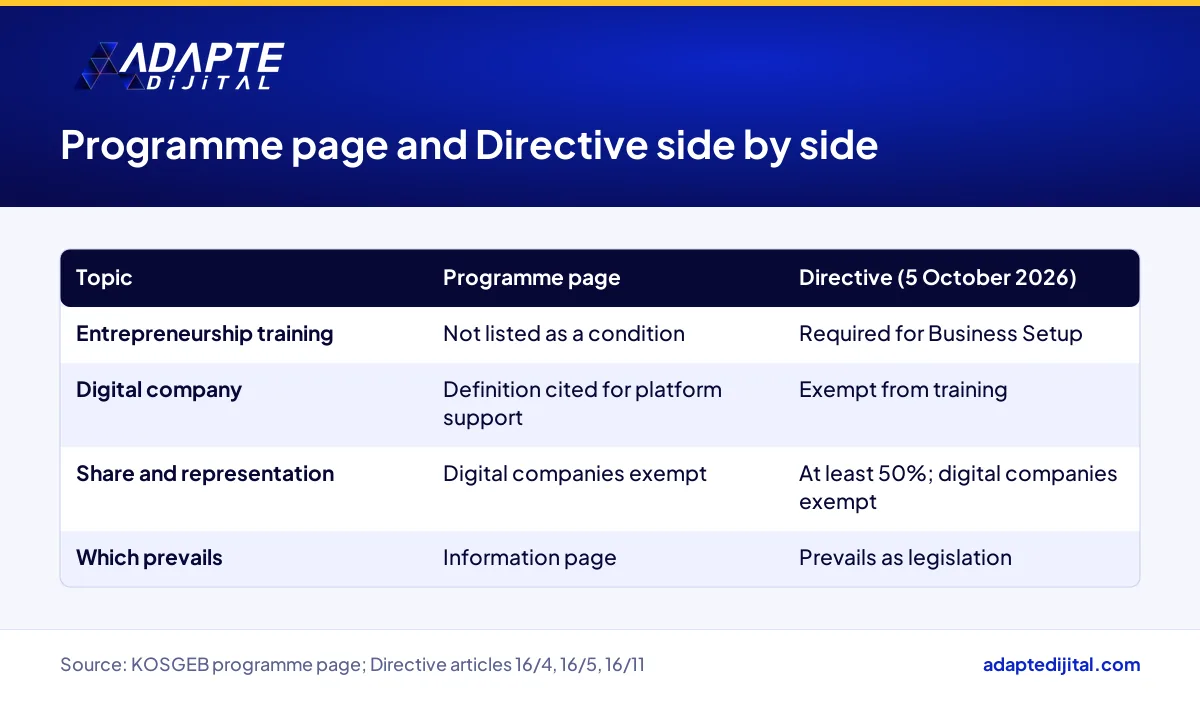
Under the Directive it is required, but a business fitting the digital company definition is exempt. The programme page does not list training as an application condition. Article 16/4 of the Directive, however, requires traditional entrepreneur training for Business Setup Support and carves out digital companies. Where the two differ, the legislation prevails, so the Directive applies.
Which founders does digital company preparation affect, and how?
The effect splits by incorporation date and ownership structure. Founders preparing software, app or e-commerce ventures in Istanbul, Ankara or Izmir in autumn 2026 face the same list. The winner is the solo founder who builds the groundwork early, while a crowded partnership has the hardest time.
Ahead: software and e-commerce ventures founded after 16 December 2024
Such a venture can apply for Business Setup Support until 31 December 2026 without hitting the one-year rule. If the database record, declaration and training are ready, only the fit check remains once the definition appears.
Under pressure: multi-partner teams below the 50% share
In a four-partner software team, no founder may reach a 50% share. For this team, the exemption from the share and representation condition matters, but it depends on the definition.
Are a website, domain and bank account official conditions for a digital company?
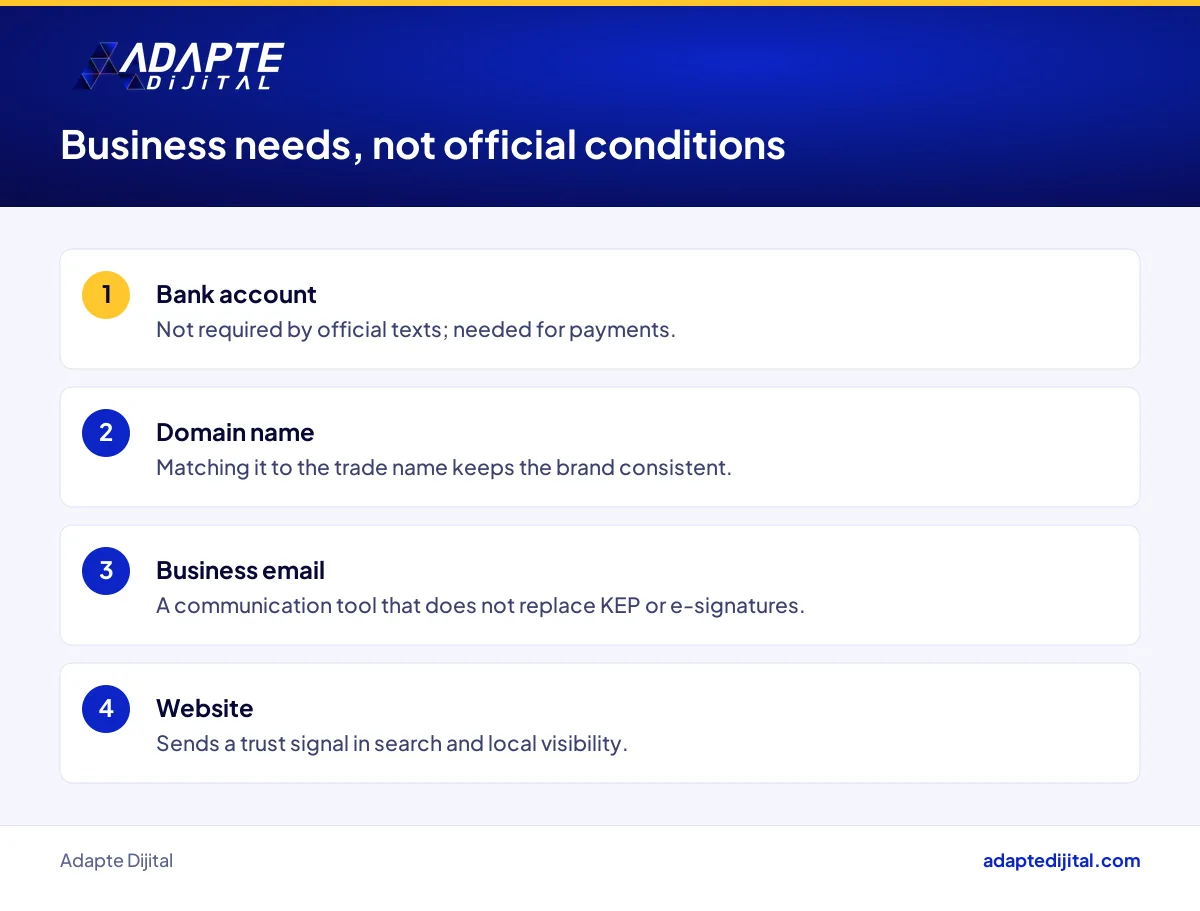
No, they are business needs, not official conditions. Neither the KOSGEB programme page, the Directive nor the MERSIS page requires a website, a domain, a bank account or a business plan template. They belong on the list as practical preparation for visibility to customers and investors.
Common mistake: treating practical items as official conditions
The most frequent mistake is assuming a bank account or website is a KOSGEB condition and delaying the application for them. The second is recording the 10-minute application video for Business Setup; per the programme page, the video is only for Business Development Support. The third is treating the Business Assessment Report as an application document; under the Directive, it is required at the payment stage.
What should a founder considering a digital company do this week?
BU BÖLÜMÜN ÖZETİ
- Monday: e-signature and e-Devlet access
- Wednesday: enrol in entrepreneurship training
- Friday: the checklist
Finish three jobs this week: apply for an e-signature, enrol in entrepreneurship training and fill in the checklist. None depends on the definition.
Monday: e-signature and e-Devlet access
Choose a certificate provider from the BTK list and apply, then check that your e-Devlet password works. Signing in MERSIS and applying through KOSGEB e-Services depend on these two.
Wednesday: enrol in entrepreneurship training
Enrol in the free training at lms.kosgeb.gov.tr. Since the exemption depends on the definition, holding the certificate is less trouble than an uphill application later.
Friday: the checklist
Official box: (1) e-signature, (2) KEP address, (3) articles in MERSIS, (4) KOSGEB record and current declaration, (5) training certificate, (6) incorporation date within the window. Practical box: (7) bank account, (8) domain, (9) website, none of which is an official condition. We build the practical box together with a digital roadmap through our digital consulting service.
Quick Summary
- The Ministry of Industry and Technology had not published the digital company definition as of 14 October 2026.
- A KOSGEB Database record and an up-to-date Business Declaration are common to every support (KOSGEB programme page).
- Businesses founded on or after 16 December 2024 can apply until 31 December 2026 without the one-year rule (KOSGEB programme page).
- The Directive requires entrepreneurship training and exempts digital companies, an exemption tied to the definition.
- A website, domain and bank account are business needs, not official conditions.
Short Glossary
- KEP
- KEP is the registered electronic mail system used to make the sending and delivery of messages legally provable.
- Qualified electronic certificate
- A qualified electronic certificate is the electronic identity document, obtained from BTK-authorised providers, used to create an e-signature.
- Undertaking
- The undertaking is the document approved in the system during a KOSGEB application, used to declare that the programme rules will be followed.
Frequently Asked Questions
Next Step
If you would like to pin down which item is missing from your own checklist, fill in the consult your expert form.
The definition and conditions of the digital company scheme are not final yet; check the latest information with the Ministry of Industry and Technology, KOSGEB and the Official Gazette before deciding. This is not legal or financial advice.
Support amounts and conditions can change; check the current terms on the institution’s official page before applying. This article is not financial or legal advice.
Sources: KOSGEB, Entrepreneur Support Programme (no date on page, accessed 14 October 2026) · KOSGEB Entrepreneur Support Programme Directive (dated 5 October 2026) · Ministry of Trade, MERSIS (12 May 2026)
Updated: October 2026
Sık Sorulan Sorular
Because the other steps stay locked while these two are missing. KOSGEB’s own guide explains the declaration in five steps. The declaration must be current on the application date.
The normal rule is to apply for Business Setup Support within one year of incorporation. According to the programme page, businesses founded on or after 16 December 2024 can apply until 31 December 2026 without this condition, as long as they meet the others.
That depends on your budget, your first customer and the weight you give each exemption; see our article on whether to wait for the definition or incorporate now.
Qualified electronic certificates come from providers on the list kept by BTK, Türkiye’s Information and Communication Technologies Authority. A KEP address, Türkiye’s registered email, comes from a KEP Service Provider, and sending a message requires an e-signature. According to BTK, legal entities must be listed in the KEP directory.
According to the Ministry of Trade’s page on MERSIS, Türkiye’s central registry system, the articles can be drafted there and signed with an e-signature or mobile signature. The e-archive and e-ledger duties that follow are covered in our article on virtual office and automated accounting.
Once the company exists, the KOSGEB Database record and the Business Declaration follow. The declaration must be up to date on the application date. Official sources give no duration for this step.
The Business Setup Support form is filled in through KOSGEB e-Services with an e-Devlet password. The programme page carries a business idea information form and a Business Monitoring Form, and under the Directive the programme undertaking is approved in the system during the application. An application not approved before the deadline is not assessed.
The exemption applies to businesses that fit the digital company definition. Since it is unpublished, nobody can say today whether your business will fit. A founder who skips training and relies on the exemption could be turned away if the definition comes out narrow.
According to the programme page, entrepreneurship training is free and offered through kosgeb.gov.tr or lms.kosgeb.gov.tr.
Under the Directive, the entrepreneur must hold at least 50% of the company and be authorised to represent it alone. In Business Setup Support, digital companies are exempt from both conditions. That exemption also depends on the definition, so plan the ownership structure with both outcomes in mind.
A domain that matches the trade name, bought alongside the incorporation papers, keeps the brand consistent from the start. Business email should not be confused with KEP or e-signatures: one is a communication tool, the others carry legal validity.
A digital company that does not show up in search is easy for customers to overlook. A site with a clear service page, contact details and a consistent trade name sends a trust signal in the first searches.
If it meets the common conditions, it can apply for Business Setup Support. Items specific to digital companies, such as Platform Costs Support and the training exemption, depend on the Ministry’s definition, which has not been published.
The Directive requires the training and exempts only businesses that fit the digital company definition. Since the definition is unpublished, taking the free training in advance is the safer path.
Neither the KOSGEB programme page nor the Directive requires a website, domain or bank account. These are practical steps for running the business, not official conditions.