
Hepsiburada survey, 75% of parents will buy clothing, how should online sellers prepare?
Back-to-school shopping in Türkiye splits into two separate baskets, according to a survey Hepsiburada commissioned with research firm Verinays (Perakende.org, 4 September 2026). Among parents of children from preschool to high school, 75% plan to buy clothing and shoes. Among university students, 35% have a computer or tablet on the list. The survey covered 823 parents and 600 university students.
What it means for you: an online seller who runs one generic “back to school” campaign misses one of the two customers. Parents expect discounts on shoes and clothing, students on laptops and tablets; both mostly pay in full and care about fast delivery. With most buying done within a month of school starting, this year’s window is largely closed by October 2026. The data is now a yardstick for next season’s stock, calendar and delivery promise.
What do parents and students buy differently in Hepsiburada’s back-to-school survey?
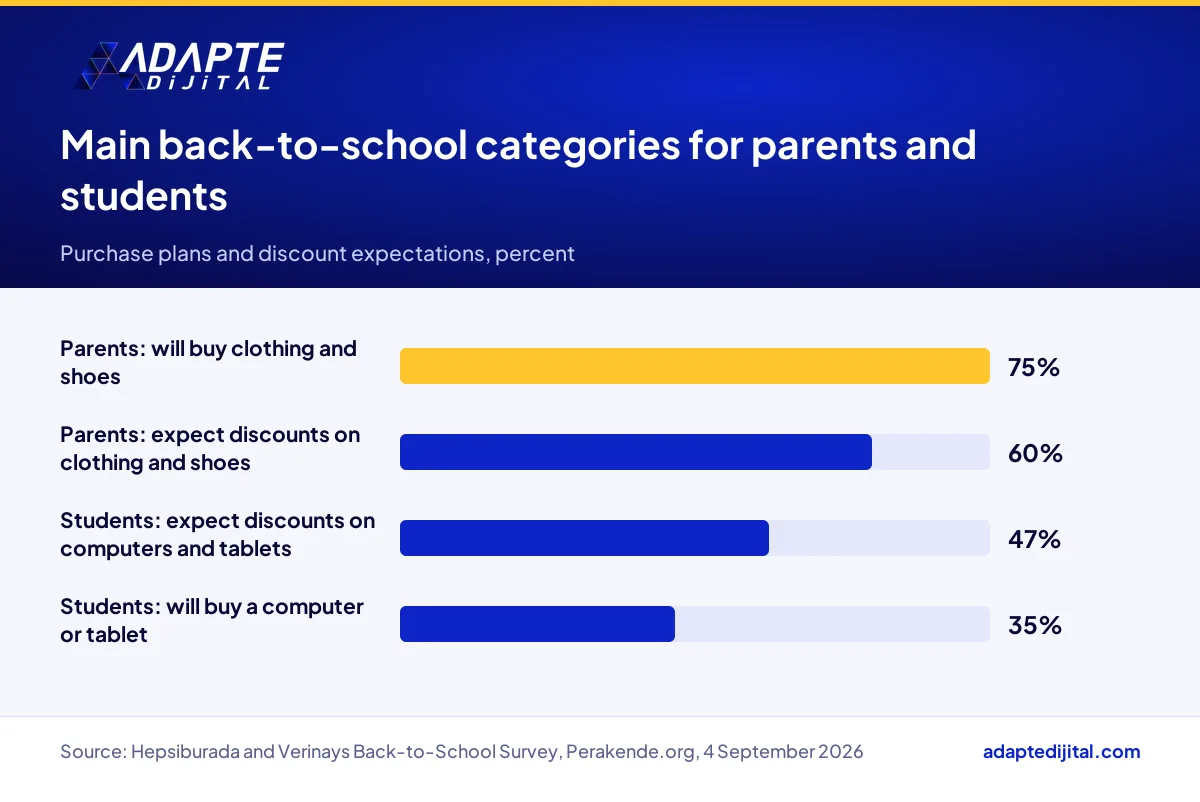
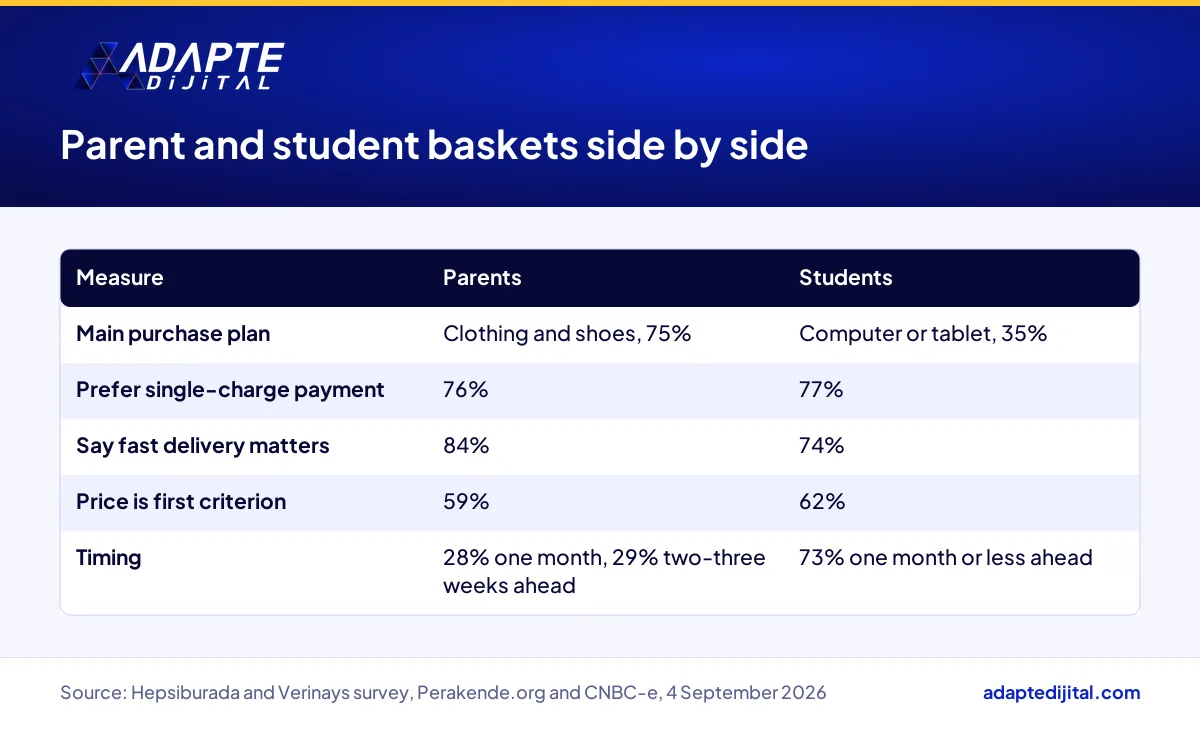
Product group, expected discount and priorities all differ. 75% of parents plan clothing and shoes, while 35% of students plan a computer or tablet. 60% of parents expect discounts on shoes and clothing, and 47% of students expect them on computers and tablets (Perakende.org). The common ground is price: according to CNBC-e, price is the first criterion for 59% of parents and 62% of students.
Price sets the first filter, quality makes the final call
CNBC-e reports that roughly 45% in both groups put quality first when choosing a brand. A page that hides the fabric, sole or processor loses at the basket the click price won.
How many weeks before school does back-to-school shopping start in Türkiye?
According to the figures reported by Perakende.org, 28% of parents shop one month before school opens and 29% two to three weeks before. 73% of students decide one month or less ahead. CNBC-e summarises the same bulletin as “one to two months before”, so for exact shares the Perakende.org percentages are the safer base.
You can build the campaign calendar in two waves
The first wave targets parents shopping a month ahead; the second targets those two to three weeks ahead and last-minute students. Range and size availability lead the first wave, delivery speed the second. One flat discount for four weeks misses both.
Which online sellers gain from the back-to-school data, and which ones struggle?
The winner is the seller with a wide size range in children’s clothing and shoes and fast shipping. Tech sellers with clear prices and clearly written payment options also make it onto the student’s list. Stores that answer the season with a generic discount, and small sellers with slow delivery, struggle. We read retail news through this lens on our retail page.
Children’s clothing and shoe sellers sit at the centre of demand
The 75% purchase plan and the 60% discount expectation point at the same category. A missing size in school shoes, tracksuits or shirts is a lost sale. For these sellers, the back-to-school window is the period to plan stock for first.
Electronics sellers win students with price and easy comparison
35% of students plan a computer or tablet, and 47% expect the discount in this category. Price comes first for 62% of them. A seller who gathers student-friendly configurations on one page and makes comparison easy gets ahead.
How do single-payment and instalment preferences shape a back-to-school campaign?
BU BÖLÜMÜN ÖZETİ
- The full price should be the first thing on the product page
- Most instalment buyers prefer short terms
- Bundles can lift the average basket
76% of parents and 77% of students prefer to pay in a single charge. Credit card instalments are preferred by 40% of parents and 28% of students. The report does not say how these shares relate, so do not add them together. The direction is clear: most pay in full, and instalments decide it for one segment.
The full price should be the first thing on the product page
Most buyers want the net price before adding to basket, so do not bury it under an instalment table. Make price, shipping fee and delivery date readable at a glance.
Most instalment buyers prefer short terms
According to CNBC-e, more than 80% of those who choose instalments prefer two to seven instalments at the cash price. Instead of pushing long terms, a clear “short instalments at the cash price” message catches this group. Tidy collections and records matter here too, which is why keeping SME bookkeeping on one platform concerns sellers too.
Bundles can lift the average basket
A bundle of shoes, tracksuit and socks raises the average basket without burying the discount in a single item. For students, a bag or charger next to the laptop does the same.
What does the back-to-school data change in search, ads and marketplace listings?
BU BÖLÜMÜN ÖZETİ
- Category pages should be ready before the season starts
- The fast delivery promise should be visible in the listing
- Ad budgets should be split between the two audiences
E-commerce in Türkiye reached about TL 4.6 trillion in 2025, and by number of transactions clothing and shoes took 14% and electronics 12% (Turkish Ministry of Trade). The two main back-to-school categories are also big lines in online sales. The season is fought in search, marketplace listings and ad auctions.
Category pages should be ready before the season starts
With shopping squeezed into the last month, update titles and category descriptions weeks before school opens. A new page takes time to find its place in search results.
The fast delivery promise should be visible in the listing
84% of parents and 74% of students say fast delivery matters. According to the same Ministry data, average parcel delivery time fell to 42.2 hours. A product with no visible delivery date in a marketplace listing hands the click to a faster rival at the same price.
Ad budgets should be split between the two audiences
Parents get a clothing and shoes message, students a computer and tablet message; one campaign cannot persuade both at once. Brands thinking about how much control they have over their own marketplace showcase face a related question: whether to open an official brand store on the marketplace.
What should an online seller do with the back-to-school data this week?
BU BÖLÜMÜN ÖZETİ
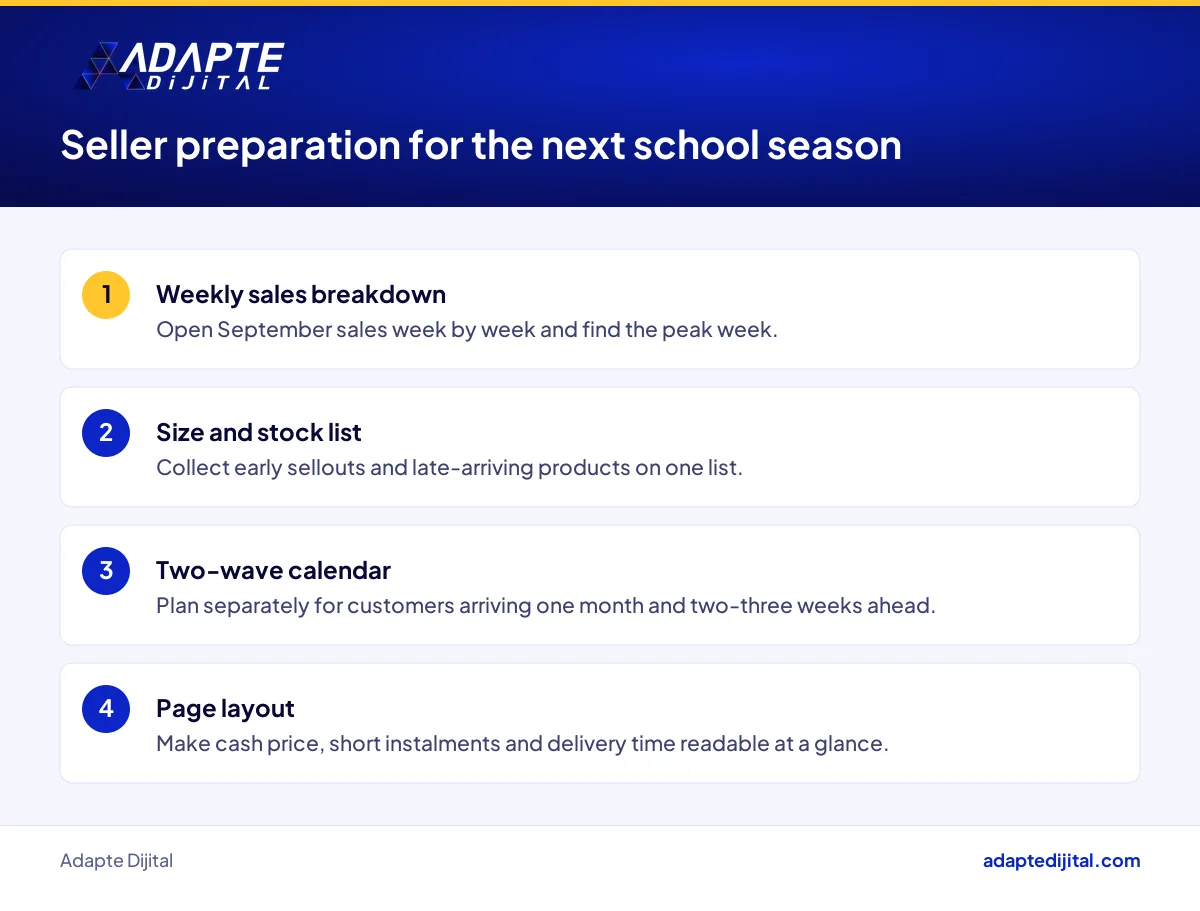
- Split September sales into weeks
- List the sizes that sold out and the stock that arrived late
- Fix the cash price and delivery time on product pages
Three jobs fit into this week: break September sales down by week, list stock and size gaps, and draft next season’s campaign calendar. No rushed campaign is needed now, just a measured plan that sets your own data against the survey.
Split September sales into weeks
Open the report week by week. Mark the periods one month and two to three weeks before school opened. The table shows right away whether your peak week matches the survey’s timing.
List the sizes that sold out and the stock that arrived late
Put the sizes, shoe numbers or models that ran out mid-season on one list. Add the products that arrived after the season and are now sitting on the shelf. Next season’s order quantities and order dates come out of these two lists.
Fix the cash price and delivery time on product pages
Check whether the cash price, the short instalment option and the delivery time are readable at a glance on your bestselling pages. Filling the gaps now gives those pages time to settle in search results before next season. We build season plans and page layouts with sellers as part of our e-commerce consulting work.
Quick Summary
- According to the Hepsiburada and Verinays survey, 75% of parents plan to buy clothing and shoes (Perakende.org, 4 September 2026).
- 35% of university students plan to buy a computer or tablet (Perakende.org).
- 28% of parents shop one month before school and 29% two to three weeks before (Perakende.org).
- 84% of parents and 74% of students say fast delivery matters (Perakende.org; CNBC-e).
- Next season’s stock, campaign and page plans should be built separately for parents and students.
Short Glossary
- Average basket value
- Average basket value is the retail metric used to measure the average amount a customer pays per purchase.
- Stock turnover
- Stock turnover is the measure used to show how many times goods entering the shelf or warehouse are sold and replaced in a given period.
- Single-charge payment
- Single-charge payment is the payment method used to collect a card payment in one go, without splitting it into instalments.
Frequently Asked Questions
Next Step
If you want to review your stock, campaign calendar and product pages for the next back-to-school season together, fill in the Consult Your Expert form and we will map out a plan for your business.
Sources: Perakende.org, “Anne babanın gözü ayakkabı ve giyimde; öğrencininki bilgisayarda”, 4 September 2026 · CNBC-e, same bulletin, 4 September 2026 · Turkish Ministry of Trade, 2025 e-commerce data
Updated: October 2026
Sık Sorulan Sorular
Children grow, and shoes get too small every season. For parents, school shopping repeats every year, which gives a good seller a chance at repeat business. A student’s laptop is bought every few years after long research, so there you work for the first sale.
Fieldwork dates, method and the sample’s city or income breakdown are not reported. No average budget is given, and budget figures elsewhere may come from other surveys. Read the percentages as direction, not market share.
Stock needs to be in the warehouse when the season starts, not on its way. A parent who arrives a month early and cannot find the right size moves on to another seller; the customer walks out the door. Planning stock turnover for bestselling sizes around those four weeks also cuts leftovers.
Putting your own sales data next to these percentages gives you the cheapest draft of next season’s calendar. Note now which week your average basket value rose and which size sold out first.
No. The survey measures the general school shopping intent of parents and students. A business selling from its own website, other marketplaces or a physical store can use the same timing and priority data.
No, the report contains no budget figure in TL. Budget figures in other outlets may belong to different or older surveys. Your own average basket value is a better basis for planning.
The first step is to set aside the season’s bestsellers in ready-to-ship packs before the season starts. The second is to agree dispatch cut-off times with your carrier for the season weeks. Stating delivery time on the product page sets the right expectation.