
MediaCat and Ipsos name Lovemarks in 16 categories, how can a small brand win love?
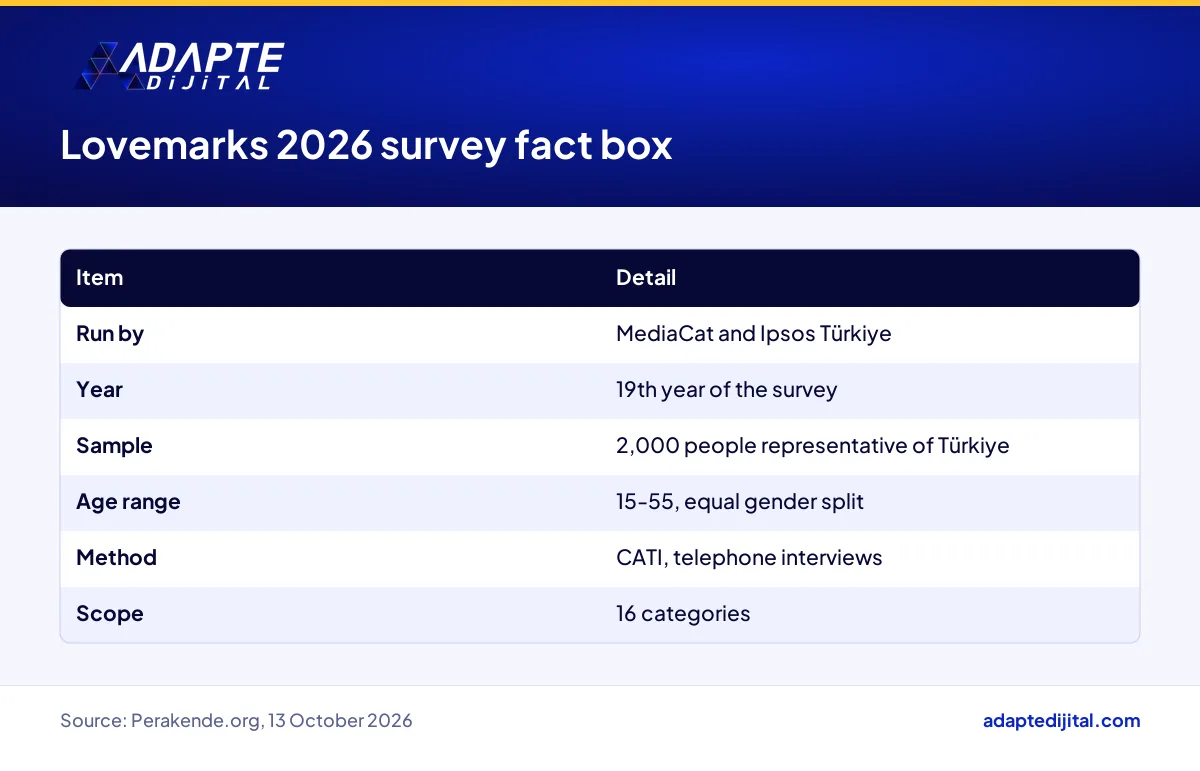
MediaCat and Ipsos Türkiye have released the Lovemarks 2026 results, ranking the brands consumers feel most attached to in 16 categories (Perakende.org, 13 October 2026). In the survey of 2,000 people aged 15 to 55 and representative of Türkiye, Trendyol leads e-commerce, Migros leads supermarkets, Migros One leads online grocery and Yemeksepeti leads online food ordering; the leader changed in fuel and in coffee.
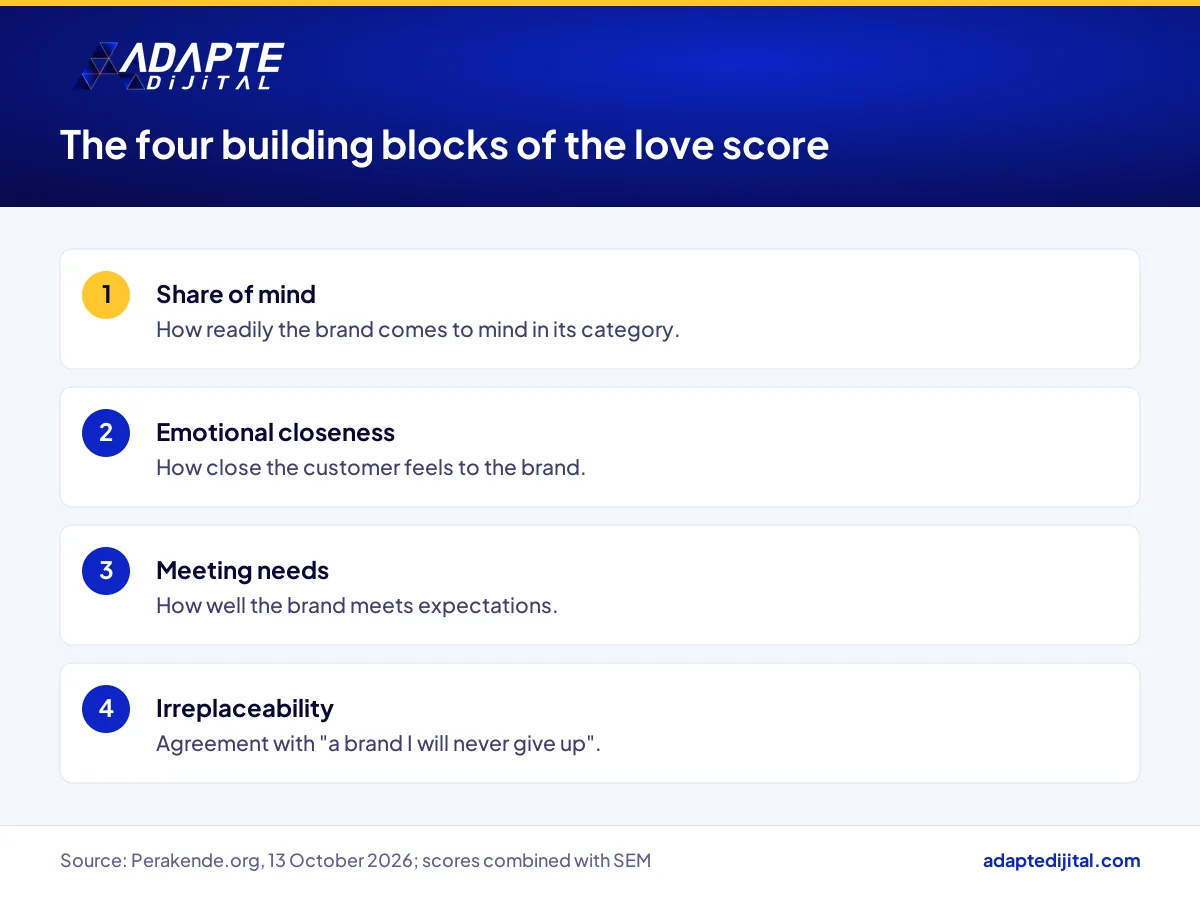
For a small brand, here is the point: even if your name is not on the list, the yardstick still applies to you. The survey measures love through share of mind, emotional closeness, meeting needs and being irreplaceable. Those four headings form a checklist any business, from a neighbourhood café to an online boutique, can test with its own customers.
Where does the Lovemarks 2026 survey measure brand love from, and how?
By combining four measures into one score. The survey, run by MediaCat with Ipsos Türkiye, looks at how strongly a brand comes to mind, how close people feel to it, whether it meets their needs and whether they agree with the statement “a brand I will never give up”. These answers are combined into a single index with Structural Equation Modelling (Perakende.org).
Which brands lead their categories in Lovemarks 2026?
Sixteen leaders were named: Shell, Erikli, Molfix, Arçelik, Domestos, Ülker, Trendyol, Yemeksepeti, Kurukahveci Mehmet Efendi, Bonus/Garanti BBVA, Migros One, Domino’s, Elidor, Tat, Migros and Philips (Perakende.org). Index scores and the brands in second and third place are not given in the report.
What does Ipsos’s split between trust and love tell a small brand?
It says trust alone is not enough. An additional Ipsos analysis, based on more than 30,000 interviews and covering 2026 data from 45 projects, finds a moderate link between trust and brand desire or preference (Perakende.org). Being trusted is a necessary threshold; what brings a customer back is an emotional bond.
How do the Lovemarks 2026 findings affect different businesses?
The bond with leading brands runs stronger among women and people over 45, and weaker among young people. According to the survey, in 14 of 15 categories the share of women who find the leading brand irreplaceable is higher than among men, with fuel the exception. In 13 of 15 categories, the bond among 15 to 24 year olds is lower than among people over 45 (Perakende.org).
What does brand love look like on your website, in search and on social media?
The digital form of share of mind is searches for your brand name; the digital form of closeness is how you answer reviews and messages. For small businesses in Türkiye in autumn 2026, these two signals are the most concrete measures of love you can track without a research budget.
What should a small brand owner do this week after the Lovemarks data?
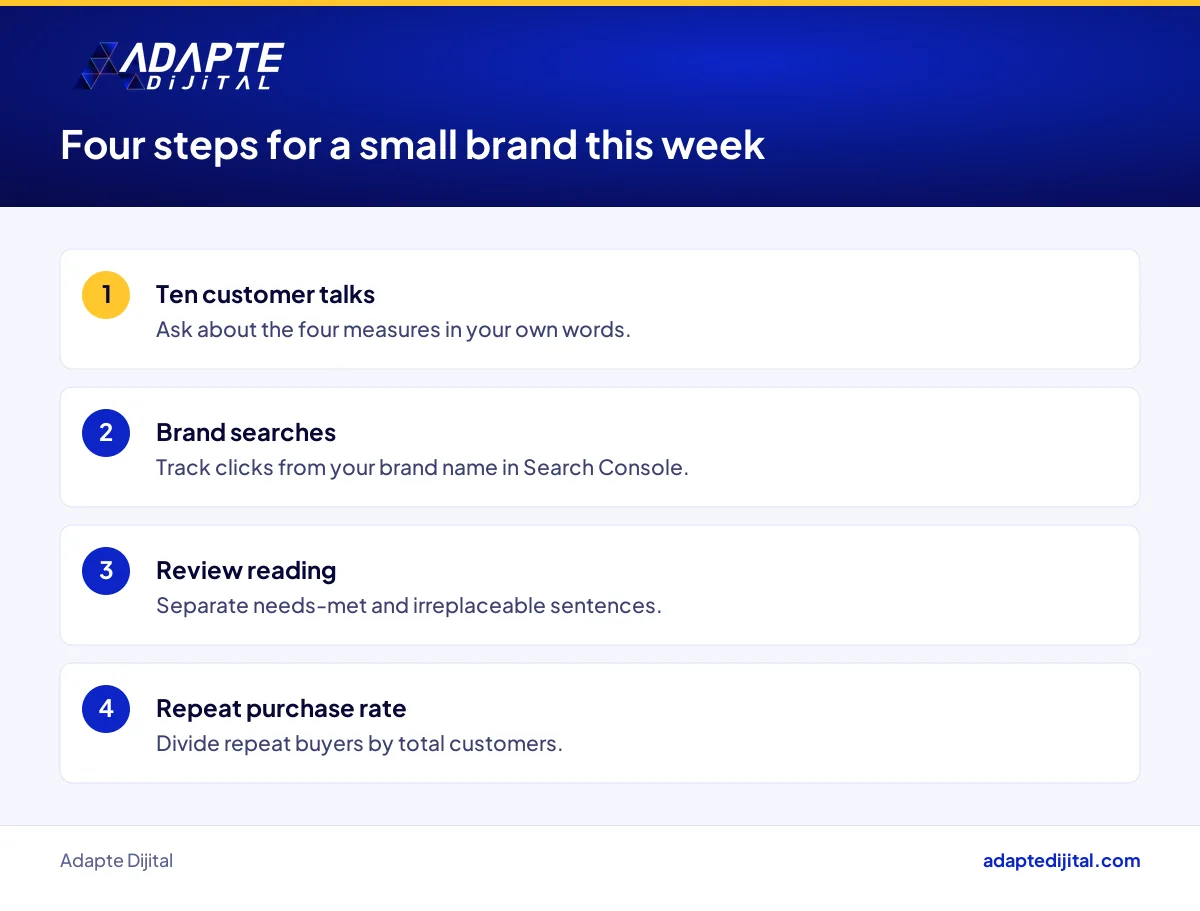
Test the four measures with your own customers. You do not need a research budget; a short talk with ten customers, a Search Console report and your latest reviews are enough to start. The aim is not to compare yourself with big brands but to see your own baseline.
Quick Summary
- MediaCat and Ipsos Türkiye named the leaders of 16 categories in Lovemarks 2026 (Perakende.org, 13 October 2026).
- The survey covered 2,000 people aged 15 to 55, interviewed by CATI (Perakende.org).
- The score is made up of share of mind, emotional closeness, meeting needs and being irreplaceable.
- In 14 of 15 categories, a higher share of women than men find the leading brand irreplaceable (Perakende.org).
- An additional Ipsos analysis finds a moderate link between trust and brand preference (Perakende.org).
Short Glossary
- Share of mind
- Share of mind is the marketing term used to describe how readily a brand comes to a consumer’s mind when they think of a category.
- CATI
- CATI is the abbreviation used for computer-assisted telephone interviewing.
- Structural Equation Modelling
- Structural Equation Modelling is the statistical method used to combine several measures, together with their relationships, into a single score.
Frequently Asked Questions
Next Step
Let’s read where your brand stands in your customers’ eyes across the four measures; fill in the consult your expert form. Our retail page, where we interpret the retail agenda for you, gathers the other stories as well.
Sources: Perakende.org, “Türkiye’nin kalbinde atan Lovemark’lar 2026’da kimler oldu?”, 13 October 2026 · DHA, 14 October 2025 · Ipsos Türkiye (linked in the text)
Updated: October 2026
Sık Sorulan Sorular
MediaCat launched the survey in 2007, and it has been repeated every year since 2009. 2026 marks its nineteenth year. The coffee category has been measured 10 times since 2017 and fuel 8 times.
The sample is 2,000 people representative of Türkiye, aged 15 to 55, split equally between women and men. Interviews were done by computer-assisted telephone interviewing, known as CATI. Fieldwork was spread over a long period, with breaks during public holidays; exact dates are not given in the report.
The survey names leaders in 16 categories, but the gender and age findings are given across 15. The report does not explain why. So when you read the findings, keep track of which number belongs to which analysis.
In nappies, Molfix leads with an index twice that of its closest rival. In credit cards and tomato paste, the gaps are very small. In a close category, love is a fragile advantage; a single bad experience can shift the order.
The leader changed in both categories; in 2026, Shell leads fuel and Kurukahveci Mehmet Efendi leads coffee. The report does not say who led before. Love is not a permanent title; it is won again each year.
On the retail side, Migros leads supermarkets, Migros One leads online grocery and Trendyol leads e-commerce. For context, the 2025 survey also covered 16 categories, and Trendyol was named the most loved e-commerce brand for the fifth time (DHA, 14 October 2025). We look at how store and online channels come together under one organisation through ETİD joining the TAMPF federation.
According to Özge Sönmez, Brand Health Tracking Service Line Leader at Ipsos Türkiye, “Trust reduces risk; love grows the desire to choose.” In practice, trust means your customer does not hesitate to buy from you. Love means they still choose you when a rival sells the same product for less.
On emotional closeness and on meeting needs. Share of mind takes a big advertising budget; closeness is built through the welcome at the till, accurate delivery and problems solved fast. A neighbourhood business that knows its customers by name can play on the same pitch as a large chain here.
Ask your customers the survey’s question in your own words: what would you do if we closed tomorrow? “I’d buy somewhere else” points to a customer held by price. “I’d go looking for you” is the first sign of being irreplaceable.
In bleach, irons and e-commerce, the gap between women and men exceeds 20 points. In cleaning, home appliances and online shopping, women are clearly more likely to find the leading brand irreplaceable. If you sell in these categories, track women customers’ experience separately.
Young people’s bond with brands is weaker in most categories, which suggests loyalty can change hands more easily. The exceptions are online food ordering and e-commerce, where young people’s bond is stronger. If you sell to young customers, note that the survey finds their stronger bonds in these two digital categories.
The leaders’ suppliers, dealers and the rivals sharing their shelf. In close categories, in-store display and shelf placement gain value. For the second brand sitting on the shelf, the gap may close at the last decision in front of the till.
If customers search for you by name, you hold a place in their mind. Track impressions and clicks from your brand name separately in Search Console. If that number does not drop when you pause advertising, the bond works independently of paid attention.
Reviews on your map profile and on marketplaces show how customers describe your brand. “Arrived fast” is a needs-met sentence; “I always buy from here” is an irreplaceable sentence. Tracking the balance between the two over time is how you build your own small index.
If the checkout page, delivery tracking or returns step works badly, trust breaks and love never forms. Who manages these decisions matters too; we discuss the corporate side through Çilek’s technology group head appointment.
Four questions are enough: where do you remember us from, how close do you feel to us, do we meet your needs, and what would you do if we closed. Write the answers into one table. The desk’s suggestion is to repeat the questions every quarter with exactly the same words.
Your own repeat purchase rate and average basket size. Divide the number of customers who bought a second time in the last three months by your total customers. If that rate is not rising, discounts are keeping the till ringing, not love.
Building brand voice, the customer journey and a measurement plan together is process work. We run that work as part of our brand consultancy.
It can learn the measures. Share of mind, emotional closeness, meeting needs and being irreplaceable are four headings any business can ask its own customers about.
The survey covered 2,000 people aged 15 to 55, representative of Türkiye, using computer-assisted telephone interviewing.
Not on its own. The additional Ipsos analysis finds a moderate link between trust and brand desire or preference. According to Özge Sönmez, trust reduces risk while love grows the desire to choose.