
ToptanTR links 2,000 makers with small shops, can corner stores match chain prices?
ToptanTR.com, a B2B e-commerce platform serving small shopkeepers in all 81 provinces of Türkiye, says it now brings more than 2,000 manufacturers, more than 7,500 sellers and 150,000 members into one system (Perakende.org, 12 August 2026). Its CEO, Sezgin Şener, says the goal is to remove the middlemen who sit between the maker and the neighborhood shop.
For a corner grocer, a cosmetics shop or a pet store anywhere in Türkiye in autumn 2026, the real question is simple. If the landed cost of the goods on your shelf drops, does the price gap with the chain supermarket close? It can narrow, but signing up to a platform is not enough on its own. You need a sourcing method that measures landed cost, order frequency and stock turnover together.
What does ToptanTR.com change in a small retailer’s supply chain?
It shortens three links: the path from maker to shop, the place where the order is placed and the moment payment is taken. The company says it handles 30,000 to 40,000 orders a month from a portfolio of 50,000 to 80,000 products (Perakende.org). A shopkeeper orders food, cleaning, electronics or clothing from one panel instead of driving around wholesalers’ warehouses.
Can a corner store using ToptanTR get close to chain supermarket prices?
Partly. The story says discount supermarkets make up roughly 40-45% of Turkish retail, but it gives no source for that share. When the gap widens, the customer walks out and heads to the chain. Lower landed cost narrows the gap, but it cannot erase a volume difference.
How does moving to a B2B platform like ToptanTR change a shopkeeper’s order data?
It takes the order off paper and the phone and puts it on record. Every order is stored with a date, a product and an amount. That record is the first data set that shows which product is gathering dust on the shelf and which one keeps the till ringing. The story does not say what data the platform shares back, but the order history stays with you.
Which shopkeepers gain from ToptanTR’s growth, and which ones feel the squeeze?
The biggest winner is the small multi-category shop in a district far from any wholesaler. A grocery that sells cosmetics, cleaning products and pet supplies together can gather different lines into a single order. The ones under pressure are regional wholesalers and distributors. As the middle layer thins, their share is open to question.
How far can you trust ToptanTR’s figures and targets?
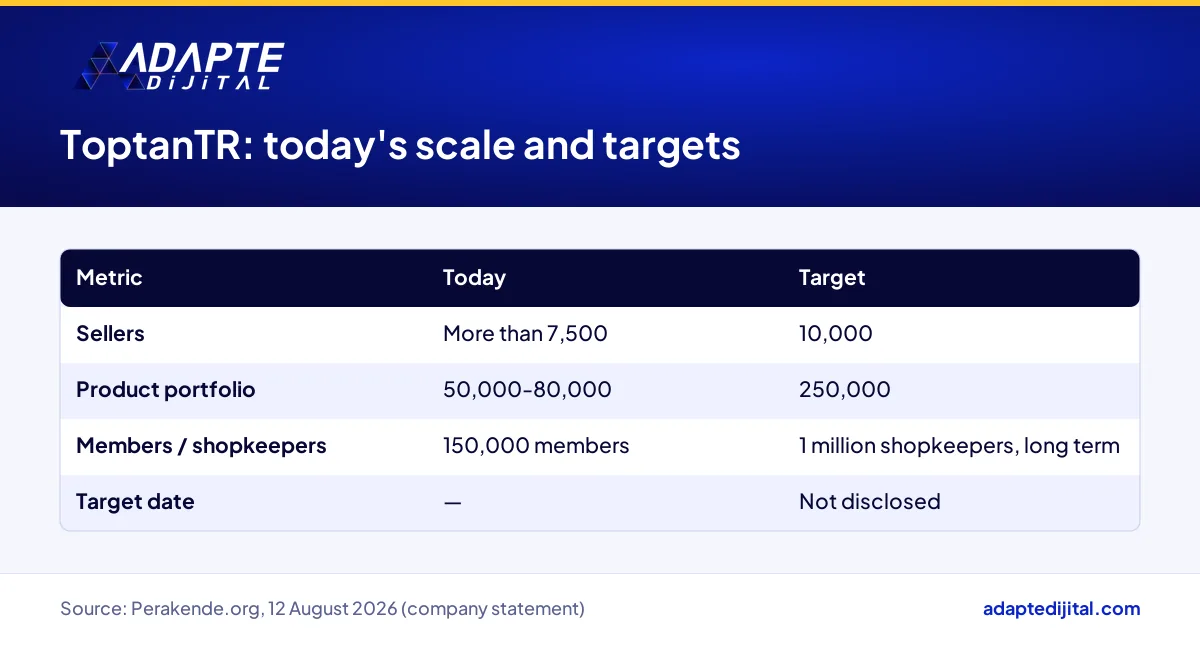
Trust them with caution. The maker, seller and member counts are company statements and do not appear on the company website. The company targets 10,000 sellers, 250,000 products and, in the long run, 1 million shopkeepers, but gives no dates for these goals. Base a sourcing decision on the service as it is today, not on the target.
What should a corner store or grocery owner do about sourcing this week?
Finish three jobs this week: list the purchase prices of your 20 best sellers, compare them with the platform price and place a small trial order. On the trial order, note the delivery time, the condition of the packaging and whether the invoice is correct.
Quick Summary
- ToptanTR.com says it serves shopkeepers in 81 provinces with more than 2,000 manufacturers and more than 7,500 sellers (Perakende.org).
- In the company’s example, a TL 100 product reaches the shop at TL 150 after four or five middlemen; this is the company’s account, not independent data.
- No dates were given for the targets of 10,000 sellers, 250,000 products and 1 million shopkeepers (Perakende.org).
- The marketplace launched in November 2023 and takes payment upfront (Ekonomist, 21 February 2024).
- The sound method for a shopkeeper is a price check on best sellers plus one small trial order.
Short Glossary
- B2B e-commerce
- B2B e-commerce is the trading model used when businesses sell to each other wholesale over the internet.
- Middle layer
- The middle layer is the term used for the wholesalers and distributors a product passes through between the maker and the retailer.
- ETBİS
- ETBİS is the abbreviation used for Türkiye’s Electronic Commerce Information System, where businesses selling online register.
Frequently Asked Questions
Next Step
If you want to look at your sourcing channels and online sales together, fill in the consult your expert form and we will start with your product list. We cover the rest of the retail agenda on our retail page.
Sources: Perakende.org, 12 August 2026 · ToptanTR company website (toptantr.com) · Ekonomist, 21 February 2024 and 4 June 2026 · Ministry of Trade e-commerce page
Updated: October 2026
Sık Sorulan Sorular
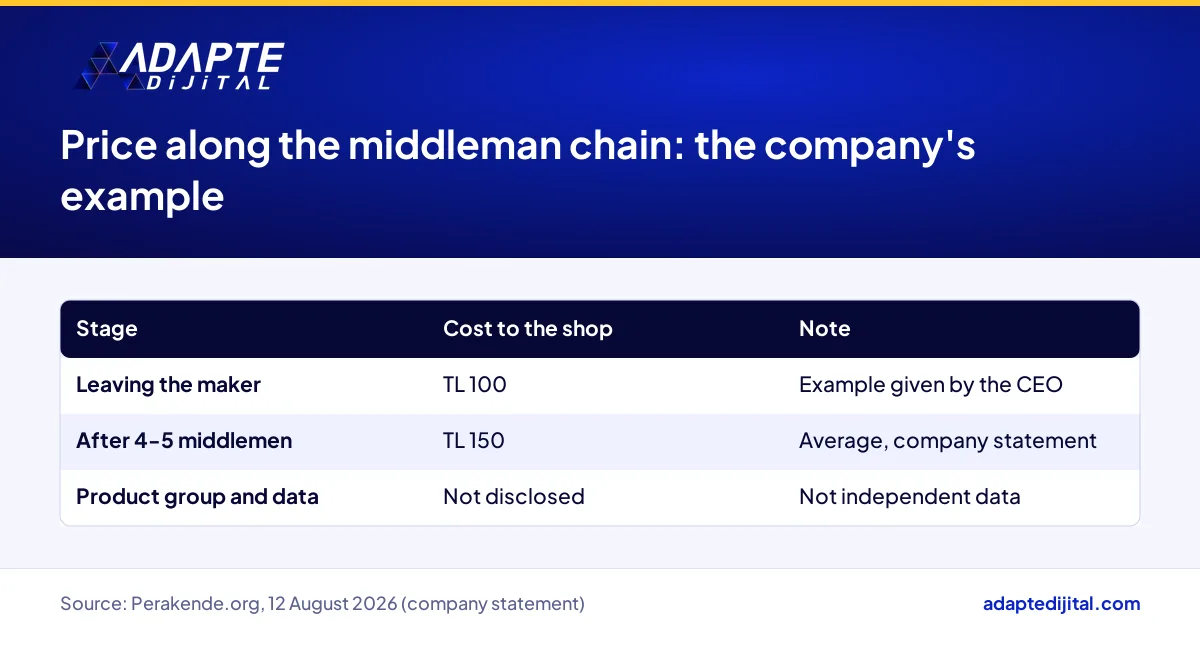
In Şener’s example, a product that leaves the maker at TL 100 passes through four or five intermediaries and reaches the local shop at an average cost of TL 150. This example is the company’s own account. It does not say which product group it refers to or what data it rests on, so it should not be read as an industry benchmark.
The maker wants to stop depending on a single distribution channel. Şener puts it this way, in translation: “The producer should not be bound to one particular channel.” For a small maker, that means a second route to market.
The headline presents ToptanTR as the shopkeeper’s “digital business partner”. The story does not detail whether that covers financing, logistics or advisory services. The company website states that orders are handed to the courier within three business days (toptantr.com).
Every shop works this out from its own invoices. Put the last three months of purchase prices for your 20 best sellers side by side. Compare them with the platform price, then add shipping and returns. On some lines the margin opens up, on others it barely moves.
A chain buys for many stores at once, and a single corner store cannot match that scale. What the corner store has is proximity, the informal tab it runs for regulars and the fact that it knows its customers by name. Closing part of the price gap buys time to keep that edge.
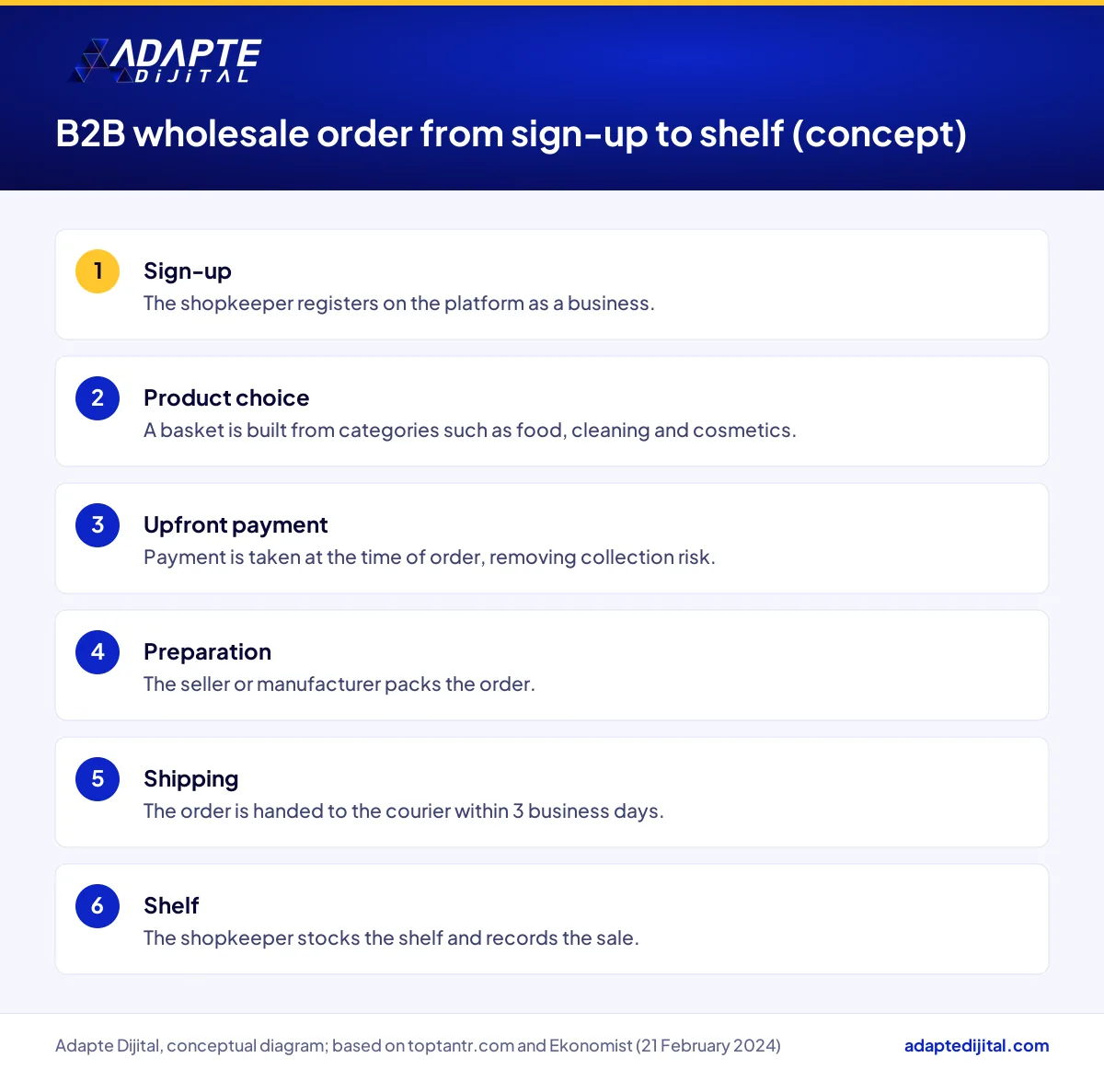
The diagram below is conceptual, since the platform’s technical details are not in our sources. The shopkeeper signs up, picks products by category and pays. According to Ekonomist (21 February 2024), payment on the marketplace is taken upfront, which removes the collection risk. The seller prepares the order, it goes to the courier and the shopkeeper restocks the shelf.
According to Ekonomist (4 June 2026), the platform runs on CommerceMinder, software built by the company’s own team. The same report says the company plans TL 500 million of investment for the rest of 2026.
Do this every month. Take the selling price, subtract the landed cost including the shipping share, and divide the result by the selling price. AINEO Motor, our calculation engine embedded in business articles, runs this margin calculation inside the page. You can build the same logic in a spreadsheet; what matters is calculating each product separately.
Corner stores in small towns and villages, mixed stationery and housewares shops, and small pet stores have the edge. For them, every trip to the wholesaler costs time and fuel.
Regional wholesalers and single-brand distributors face pressure on price and service. Because the platform takes payment upfront, a wholesaler who offers payment terms can still appeal to a shopkeeper who is short on cash.
Couriers and small manufacturers feel the effect indirectly. As the number of orders grows, parcel volume grows with it. A small manufacturer gains a direct route to shopkeepers across the country.
On the seller side, the distance between more than 7,500 today and 10,000 is relatively short. On the product side, the gap between a 50,000-80,000 portfolio and 250,000 is far wider. For the shopkeeper, the practical question is whether the product you need is listed today.
According to Ekonomist (February 2024), the marketplace launched in November 2023. The company itself was founded in 2018. Measure growth from the marketplace launch, not the founding year.
E-commerce in Türkiye falls under the Ministry of Trade’s e-commerce rules and ETBİS, the Electronic Commerce Information System where online sellers register. Before working with a platform, check its registration status with the official source. Verify with the official source; this is not legal or financial advice.
Pick fast-moving products whose price you know well: cleaning supplies, packaged food, personal care. That lets you compare basket size and cost per SKU. Leave short shelf-life products out of the first test.
You do not have to drop the wholesaler. For payment terms and urgent deliveries, the wholesaler is still valuable. Use the platform as a second channel first, and raise its share only if the price gap holds steady for a few months.
When the sourcing channel, stock tracking and your own online sales connect, cash flow becomes more predictable. We build that connection with shop owners as part of our e-commerce consulting work. If you are curious about what is changing in delivery, read our piece on the autonomous delivery box test. Another way to fund growth is covered in our story on a development bank loan.
The platform describes itself as a B2B service for small shopkeepers. Check membership terms and any minimum order on the company’s own website.
The company website says orders are handed to the courier within three business days. Delivery time can vary with the courier and your province.
There is no need to stop right away. Try the platform as a second channel first, and raise its share if price and delivery stay steady for a few months.