
Stellantis Pro One will test an autonomous delivery box, how will last-mile change?
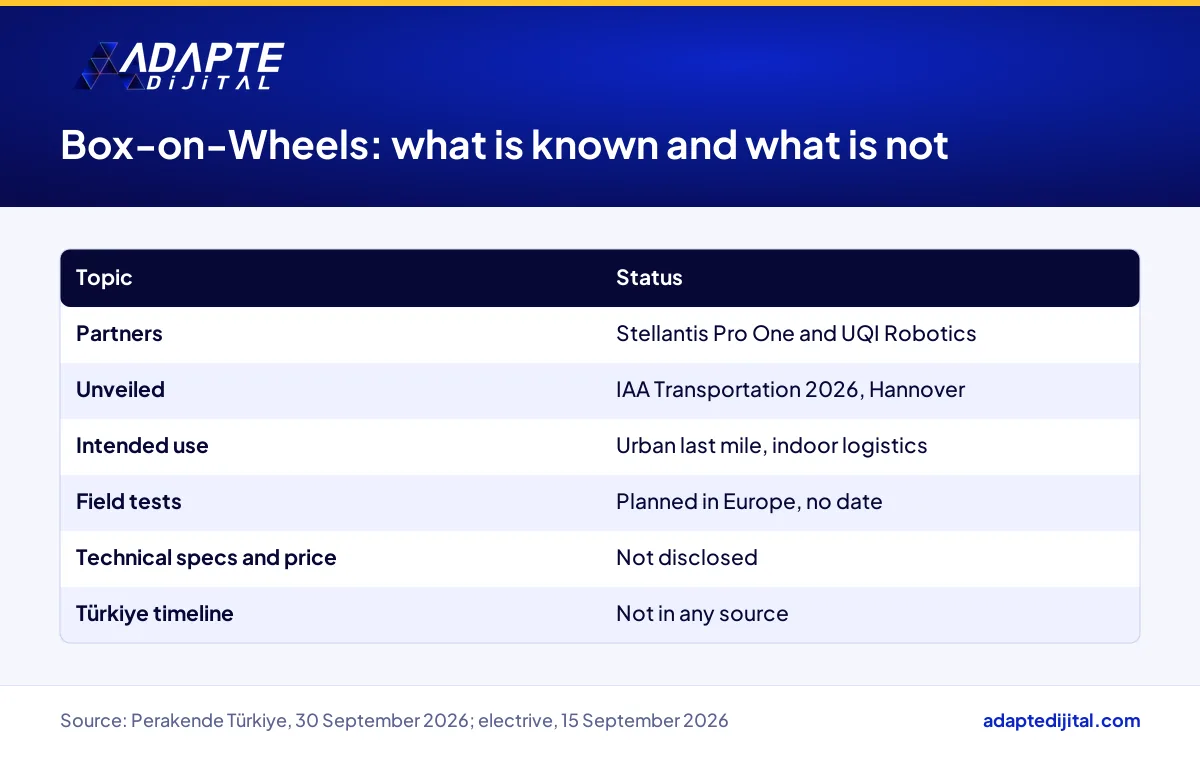
Stellantis Pro One, the commercial vehicle arm of Stellantis, has developed a driverless delivery concept called Box-on-Wheels with the autonomous logistics company UQI Robotics, and field testing is planned in Europe (Perakende Türkiye, 30 September 2026). The concept was unveiled at IAA Transportation 2026 in Hannover, Germany; the first international reports are dated 15 September 2026.
If you sell from your own website in Türkiye in autumn 2026, the issue is not this month’s courier bill. It is which vehicle will carry your parcel to the customer a few years from now. Technical specs, test dates and pricing have not been announced, and there is no information about Türkiye. Even so, measuring your last-mile cost today is how you avoid being caught off guard by a shift like this.
What exactly is the Box-on-Wheels concept from Stellantis Pro One and UQI Robotics?
Box-on-Wheels, or BOW, is a driverless last-mile delivery solution aimed at professional customers. Its intended uses are urban last-mile delivery and indoor logistics (electrive, 15 September 2026). Battery, range, load capacity and level of autonomy have not been disclosed. What exists today is a concept, an exhibition debut and a test plan.
When will the Box-on-Wheels tests affect the last mile of an online store?
Not in the short term. The project is at the validation stage in Europe, with no commercial launch date and no price. electrive reports that international expansion is possible in later phases, but names no country and no date. For now, the effect is indirect: a signal of how delivery could change.
How could an autonomous delivery box change the day of a small online workshop?
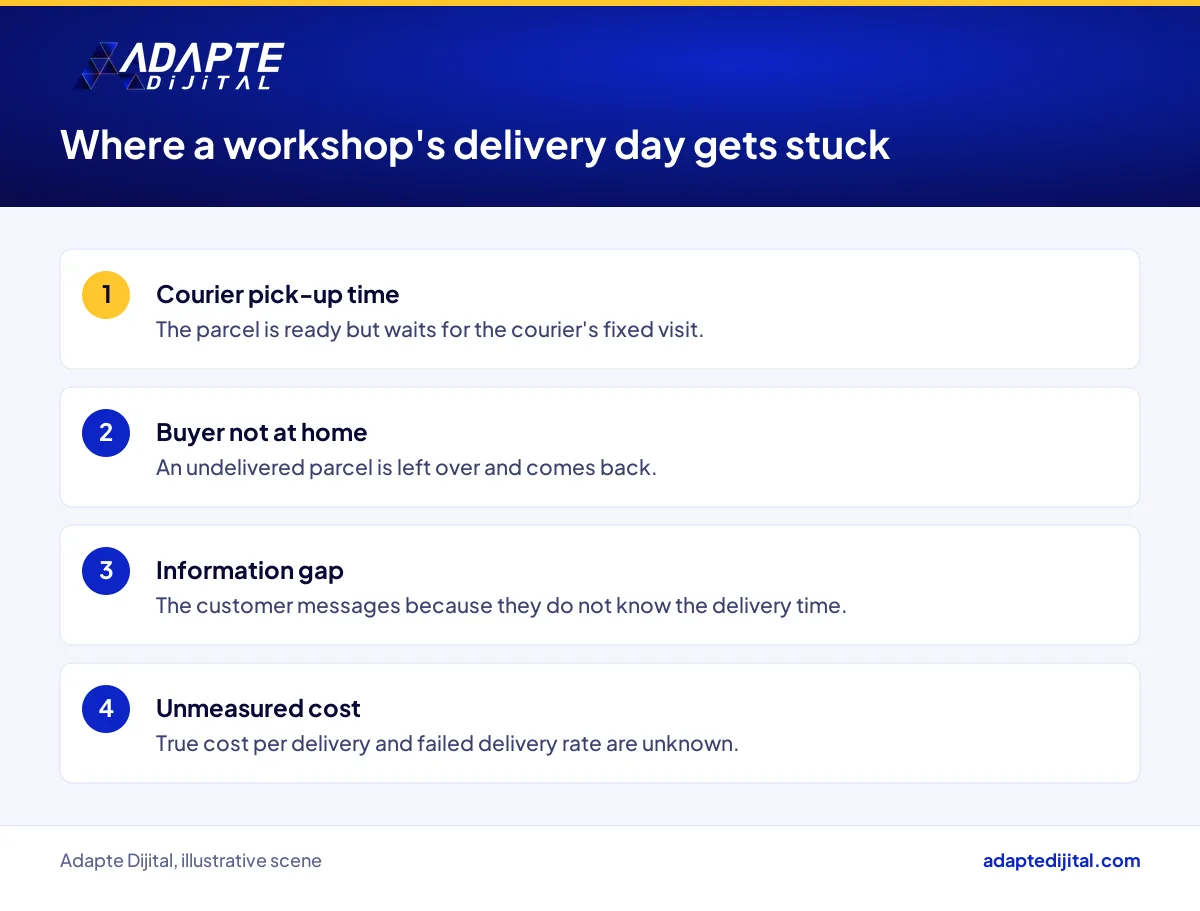
It could change it by separating delivery from people’s schedules. Let’s say you run a small workshop in the city center selling handmade soap online. Orders come in all day, but the courier picks up at a fixed time. Packed parcels wait for the courier, customers wait for their parcels, and the courier’s timetable sets the rhythm of your day.
Which retailers gain from autonomous last-mile delivery, and which ones face pressure?
Online sellers shipping many small parcels in dense urban areas stand to gain the most, since urban last-mile is the stated use. The mention of indoor logistics points to warehouses and other enclosed sites as well. Those who may struggle are businesses that tie their last mile to one courier relationship, and those delivering to scattered rural addresses.
How does the era of autonomous delivery affect an online store’s delivery page and search visibility?
It turns delivery information into part of the sale. Before leaving the cart, the customer is looking for an answer to “when will it arrive”. If delivery time, time slots and returns are not spelled out on the site, the customer walks away. That same information also shapes how search engines and AI assistants summarize your page.
What should an online store owner do about the last mile this week?
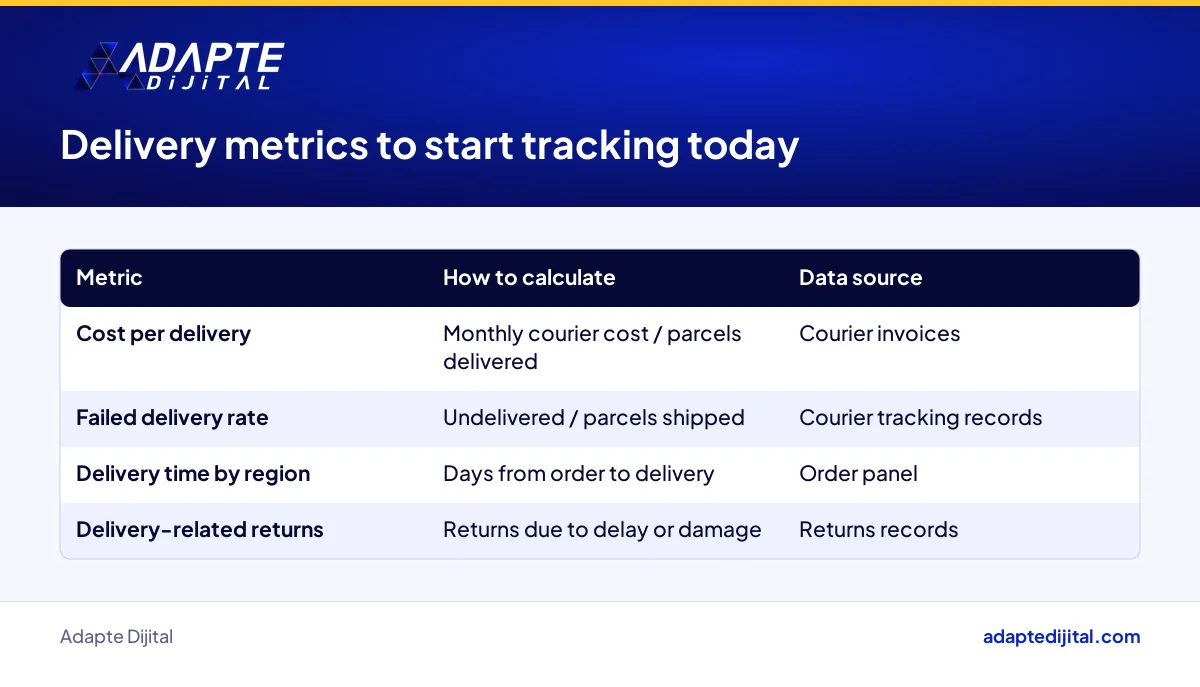
Put last month’s shipments into a spreadsheet. On each row, write the order date, delivery date, shipping cost and, if it failed, the reason. Then open your delivery page as a customer would and fill in whatever is missing. Those two jobs let you decide well, whatever delivery model comes next.
Quick Summary
- Stellantis Pro One and UQI Robotics unveiled the Box-on-Wheels autonomous delivery concept at IAA Transportation 2026 (Perakende Türkiye, 30 September 2026).
- Field validation is planned in Europe; test dates, technical specs and pricing have not been announced.
- None of the sources mention any plan for Türkiye.
- Stellantis Pro One is reported to have more than 21,000 sales and service points (Perakende Türkiye).
- The step for a business today is to measure cost per delivery and failed delivery rate.
Short Glossary
- Last mile
- Last mile is the term used for the final delivery stage, when a product travels from a distribution point to the buyer’s door.
- Indoor logistics
- Indoor logistics is the term used for moving materials and parcels inside buildings such as warehouses or factories.
- Field validation
- Field validation is the test stage used to check whether a technology works under real operating conditions.
Frequently Asked Questions
Next Step
If you want to review your delivery data and the delivery information on your site together, fill in the consult your expert form. You will find more developments on our retail page, where we interpret the retail agenda for you.
Sources: Perakende Türkiye, 30 September 2026 · electrive, 15 September 2026 · Stellantis press releases page
Updated: October 2026
Sık Sorulan Sorular
Stellantis Pro One has more than 21,000 sales and service points in the light commercial vehicle and pick-up segments. UQI Robotics was founded in September 2020 as a partnership between UBTECH and Miracle Automation. The story cites contracts worth more than 260 million euros and more than 7,000 robots in 66 cities and regions worldwide. The period these figures cover is not stated.
The European field validation will assess operational performance, customer value and scalability. In plain terms: does it work on the street, does it help the customer, and can it grow. Test cities and the timeline have not been announced.
The project is presented as aligned with Stellantis’s FaSTLane 2030 strategy. Stellantis Pro One executive Eric Laforge describes the work as “exploring how autonomous technologies, connectivity, and services could contribute” (electrive). You can follow other announcements on the Stellantis press releases page, although a release specific to Box-on-Wheels does not appear in the list at the moment.
There are three: unveiling, field validation and commercial use. Box-on-Wheels has passed the first and is preparing for the second. No source gives a date for the third.
No. None of the sources mention Türkiye at all. That is why every suggestion here is built on steps that help your business whether or not the vehicle ever arrives.
A major vehicle maker is now treating last-mile delivery as a product area of its own. That suggests delivery may one day come with more options and different pricing. The first step in getting ready is knowing what delivery costs you today.
It is mid-afternoon and a few parcels sit on the counter. One is left over from yesterday, because the buyer was not home and the parcel came back. The customer sends a message, and you call the courier company. The product is good, but delivery is slowing the till.
Conceptually, it could move the delivery slot to a time that suits the customer. Nobody knows yet what capacity it will have or what it will cost. But the real problem in the scene is clear: the delivery time is out of your hands. A lasting fix starts with giving the customer a choice of time.
Most of the problem, it turns out, is not the vehicle but information. The customer does not know when the parcel will arrive, and you do not know your failed delivery rate. Change the vehicle but keep that gap, and the parcel still comes back.
Boutiques offering same-day delivery in the city, cosmetics and personal care sellers, and shops sending everyday non-food goods are well placed. What they share is a high number of small parcels going to nearby addresses.
Small delivery businesses that have built their own courier teams may face price and speed pressure in the long run. Businesses shipping to rural and scattered addresses are likely to be the last to benefit from solutions designed for cities.
Warehouse operators and large sites with internal goods movement are touched indirectly through indoor logistics. Commercial vehicle service networks also become part of the change, since new kinds of vehicles need new kinds of maintenance.
Shipping time, delivery areas, shipping cost, return steps and what happens to a parcel that cannot be delivered. All of this should be one click away from the product page. In Türkiye, delivery obligations fall under the Ministry of Trade’s e-commerce rules. Verify with the official source; this is not legal or financial advice.
Cost per delivery, failed delivery rate, delivery time by region and returns caused by delivery problems. These four metrics are the only fair basis for comparison when an autonomous or any other delivery option arrives.
Divide one month’s total courier invoices by the number of parcels delivered that month. Keep failed deliveries and returns in a separate column. You will see your true cost per delivery and the regions where parcels keep coming back.
Delivery time slots, click and collect or pick-up points are possible today. Try one and watch what happens to your cart abandonment rate. Before adding more options, check whether the first one works.
We build delivery pages, courier integrations and measurement with businesses as part of our e-commerce consulting. If you are also thinking about sourcing, see our piece on B2B wholesale for small shopkeepers, and for growth funding, our story on Armada Gida’s development bank loan. One principle holds: you cannot improve a delivery you do not measure.
No information has been announced on this. Field validation for Box-on-Wheels is planned in Europe, and no source gives a timeline for Türkiye.
No, Box-on-Wheels is still a concept. What you can do today is measure your delivery cost and your failed delivery rate.
In Türkiye, delivery obligations fall under e-commerce legislation. Check current requirements with the Ministry of Trade’s official sources; this is not legal advice.