
Trendyol Luxe gathers 400+ global brands in one app, how can premium sellers stand out?
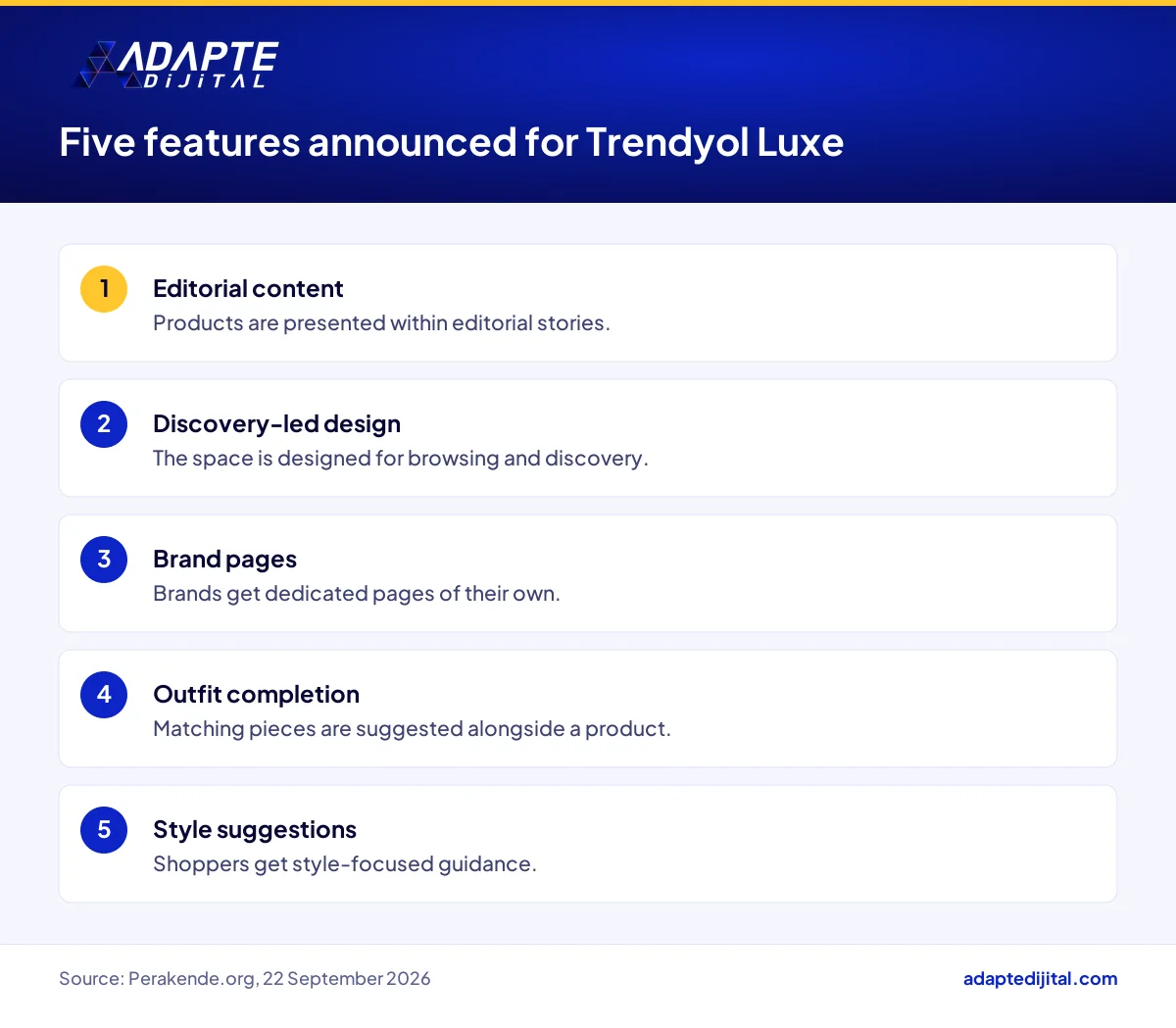
Trendyol has launched Trendyol Luxe, a premium shopping space that sits as a separate section inside its existing app and carries more than 400 global brands and over 200,000 products (company statement on Foreks, 21 September 2026; Perakende.org, 22 September 2026). Its motto is “Lüksün Yeni Yolu”, roughly “the new path of luxury”, and it spans seven categories from clothing to electronics. It is built around editorial content, discovery-led design, dedicated brand pages, outfit completion and style suggestions.
What it means for you: if you sell a premium brand on a marketplace in Türkiye in autumn 2026, your product now competes on story and presentation, not only on price and filters. In a curated window, a product with weak photos, a two-line description and an empty brand page just sits on the shelf. The statement says nothing about application rules, commission or which brands are in. So the work to do now is catalogue and content preparation.
What is Trendyol Luxe, and how is it different from the main Trendyol storefront?
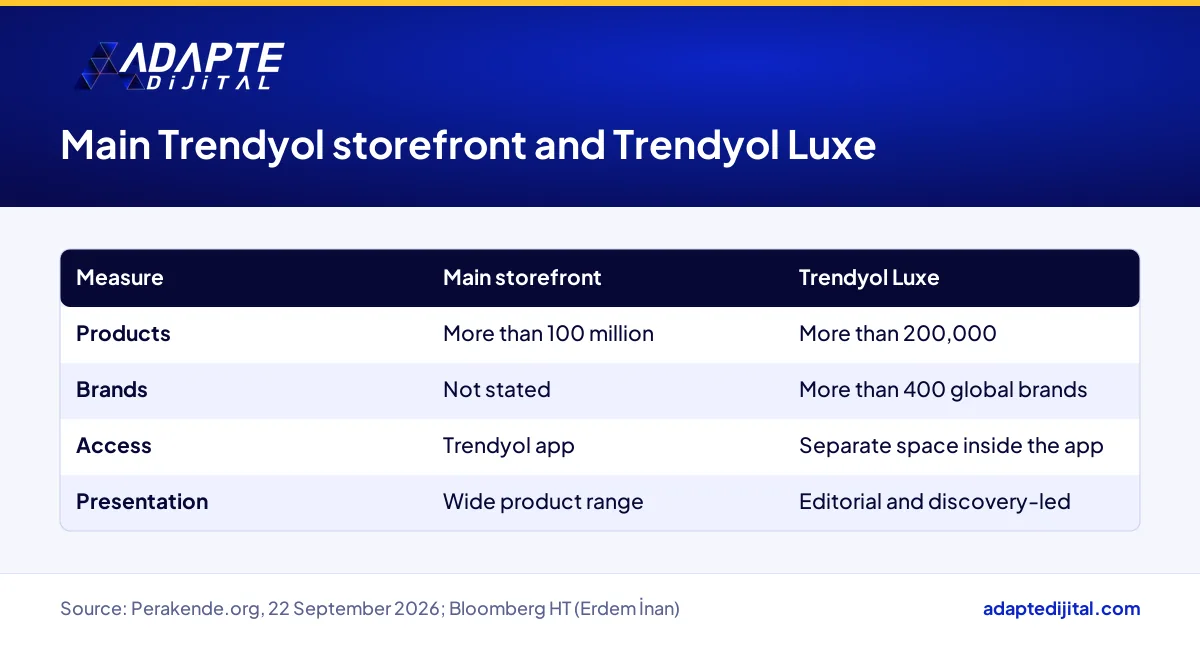
Trendyol Luxe is a space for premium products inside the Trendyol app; you do not need to download a separate app. The difference is scale and presentation. Trendyol Group CEO Erdem İnan told Bloomberg HT that the platform lists more than 100 million products, while Luxe carries just over 200,000. The company calls its approach “Personalisation 2.0”.
What does Trendyol Luxe mean for your business as a premium seller?
Three things: a narrower field of competition, higher expectations on presentation, and your brand story turning into a sales tool. In the main storefront, your product disappears among millions of listings. In a curated space there are fewer rivals, but every product page reads like a magazine page.
Which businesses does Trendyol Luxe affect, and how?
It affects premium clothing, bag, shoe and cosmetics brands most, and upper-segment sellers in home and electronics face the same equation. The winners are brands with visual and content work already done. The ones who struggle sell on price alone in the main storefront and leave their brand page empty. Product photographers, content producers and agencies that manage catalogues are affected indirectly.
Why does the brand page decide so much in Trendyol Luxe’s curated window?
Because in Trendyol Luxe, dedicated brand pages are where discovery comes to rest. When a shopper moves from an editorial piece to a brand, that page is where they decide whether to get to know you. An empty or generic page wastes the attention the editorial window just sent your way.
How does Trendyol Luxe affect a brand’s website, search and advertising?
The content you prepare for Luxe should speak the same language as your own digital presence. A rich brand page on the marketplace clashes with a two-line “about us” on your own website. Shoppers see the brand on Luxe and then search for it on Google; what they find either builds trust or chips away at it.
What should a premium brand owner do about Trendyol Luxe this week?
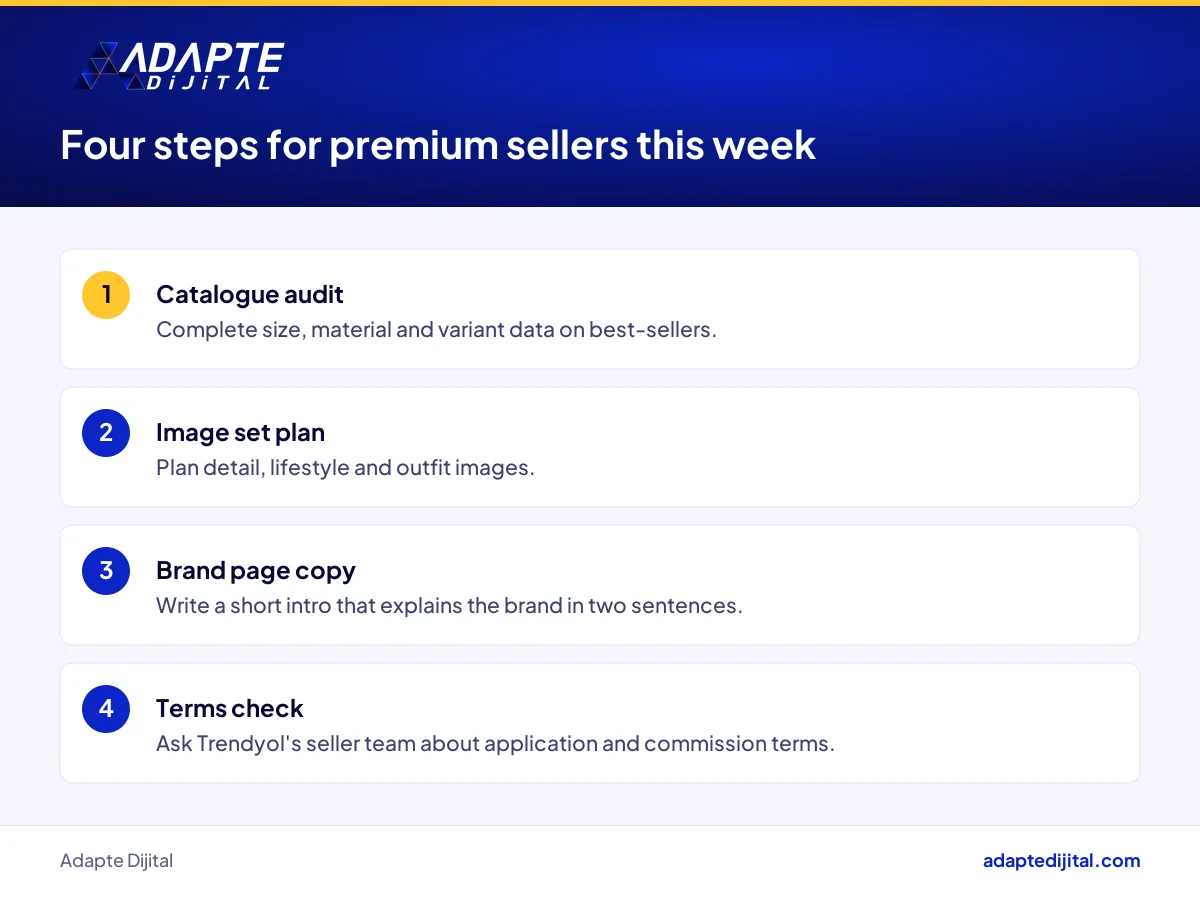
You can get four jobs done this week: a catalogue audit, an image set plan, brand page copy, and a check with Trendyol’s seller team on how to apply. Application rules, commission and acceptance criteria are not in the statement. Getting that information straight from Trendyol is safer than deciding on assumptions.
Quick Summary
- Trendyol has opened Trendyol Luxe, a separate premium space inside its app (Foreks, 21 September 2026; Perakende.org, 22 September 2026).
- Luxe carries more than 400 global brands and over 200,000 products (Perakende.org).
- The space is built on editorial content, discovery-led design, brand pages, outfit completion and style suggestions.
- Application rules, commission and the brand list are not in the statement and should be confirmed with Trendyol.
- For premium sellers, the priority is catalogue, image set and brand page preparation.
Short Glossary
- Curated storefront
- A curated storefront is the term used to describe a sales space where products are selected and presented within a story.
- Brand page
- A brand page is the marketplace page used to gather all of a brand’s products and its introduction in one place.
- SKU
- SKU is the abbreviation used to describe the stock code that identifies each product and variant separately.
Frequently Asked Questions
Next Step
If you want to assess together how ready your catalogue and brand page are for a curated storefront, fill in our consult your expert form.
Sources: Perakende.org, 22 September 2026 · Foreks, Trendyol statement, 21 September 2026 · Dünya, 2 October 2026 · Bloomberg HT · Trendyol, Meet Us
Updated: October 2026
Sık Sorulan Sorular
According to the statement, the space covers clothing, accessories, shoes, bags, cosmetics, home and electronics. The common thread is premium positioning. A handbag brand and a home textiles brand can appear side by side in the same editorial window.
Not much in technical terms. The statement uses the label for the approach but does not explain the technology behind it. There is no concrete information on artificial intelligence, so reading AI into it would be guesswork.
The statement includes comments from Erdem İnan, CEO of Trendyol Group, and Özge Anlı, Trendyol’s Deputy General Manager for Commercial Sales. For the company’s own description, a cross-border e-commerce platform founded in 2010, see Trendyol’s “Meet Us” page.
A space of 200,000 products is a small slice of a 100-million-product marketplace. Comparing those two numbers points to a separate visibility layer for premium brands. The seller’s question shifts from “how many people see me” to “is the person who sees me the right buyer”. We track other marketplace shifts on our retail page, where we interpret the retail agenda for you.
Editorial content and discovery-led design show the product in a space people browse. In that setting, a single studio shot and a three-line description look thin. The shopper walks away because they cannot picture the product as part of a lifestyle.
No, price is still one of the deciding factors. In a curated window, though, price alone does not make a product stand out. On items with a high average basket value, shoppers weigh trust and the brand’s voice alongside the price tag.
Premium brands with a tidy catalogue, a rich photo set and a written brand story start ahead. Dünya, a Turkish business daily, reported on 2 October 2026 that Luxe highlights Turkish designers alongside international brands. The same report says the longer-term aim is to help local design brands reach markets abroad.
Sellers who move stock only through discounts, with missing variant data and a messy SKU structure, will find it harder. Outfit completion suggests pieces that go together. A catalogue with inconsistent category and colour data gives that kind of pairing very little to work with.
For a premium store in an AVM, the Turkish term for a shopping mall, where every square metre has to earn its rent, Luxe can act as a second shop window. The shelf layout and window story from the store can move onto the digital brand page. That is one way to bring the in-store experience to an online shopper.
A two-sentence introduction that says who the brand is, featured collections and a consistent visual language. Keep the story short, but make it yours.
Size, material and care details have to be complete; premium buyers look for them. Adding one line on what the item pairs with gives the outfit completion feature solid ground to stand on. Copy-pasted descriptions erase the brand’s voice.
In discovery-led design, the image is the first point of contact. Instead of a single white-background shot, plan a set with a detail shot, a lifestyle scene and a close-up of the texture. Visual consistency helps shoppers recognise your brand across different products.
A shopper who meets your brand for the first time in a discovery-led space tends to look it up before deciding. When they search your brand name, your website, social accounts and reviews should look consistent. That search traffic is the visible trace of your marketplace exposure.
Yes. If titles, descriptions, sizes and images flow from one master catalogue, errors drop. The marketplace, your website and your ad campaigns all use the same data. A scattered catalogue risks showing one fact on Luxe and another on your site.
The statement does not describe any advertising model for Luxe, so there is nothing solid to plan around yet. On your own channels, we see content that tells the brand story preparing the ground for product ads. Drop-offs at checkout are a separate issue; we cover how to simplify the checkout step against cart abandonment in its own piece.
Pick your 20 best-selling products and check whether size, material, colour and care details are complete for each. Make sure variants are linked correctly. Write the gaps into one sheet; it becomes the to-do list for both Luxe and your own website.
For each product, plan a detail shot, a lifestyle scene and an outfit image. Shooting everything in one session helps on both cost and consistency. Build the outfit images to show how your own products complement each other.
If you also sell on your own website, the brand interest a marketplace creates should meet a smooth checkout there. We describe one route in our piece on connecting multiple virtual POS to Shopify stores. We handle catalogue, brand page and marketplace preparation as part of our e-commerce consulting work.
No. Trendyol Luxe is offered as a separate space inside the Trendyol app.
The application route and acceptance criteria are not in the statement. You need to get the current terms directly from Trendyol’s seller team.
According to the statement, the categories are clothing, accessories, shoes, bags, cosmetics, home and electronics.