
Baymard puts cart abandonment at 70.22%, how should online stores simplify checkout?
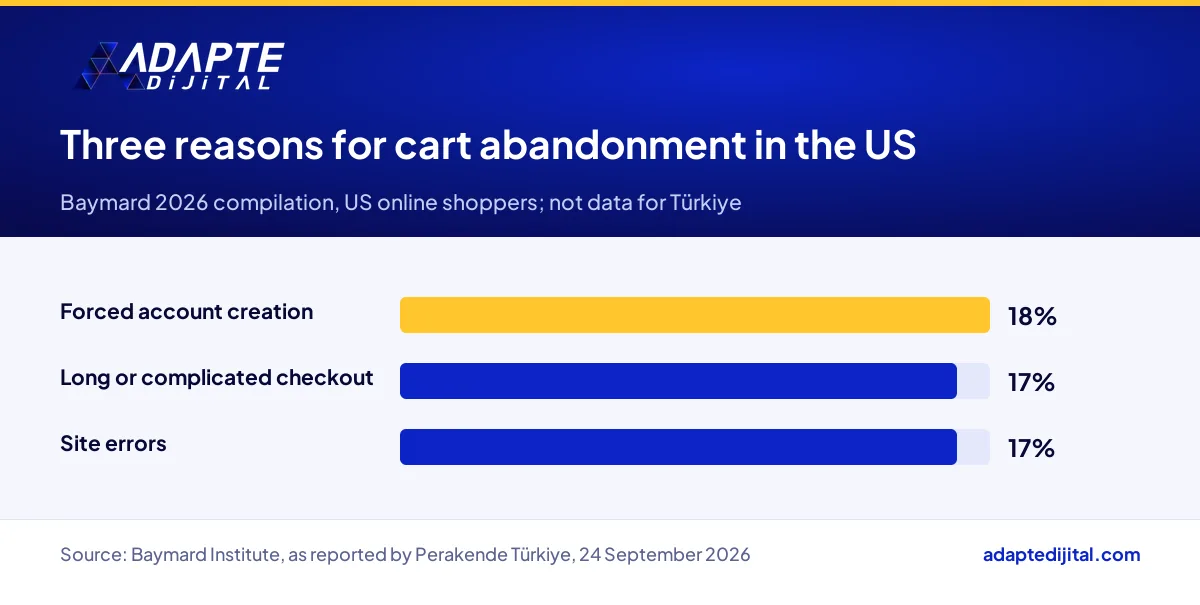
Seven in ten online shoppers who add a product to their cart do not finish the purchase: Baymard Institute’s 2026 figure, compiled from 50 separate studies, puts cart abandonment at 70.22% (Perakende Türkiye, 24 September 2026). The report also lists why shoppers in the United States walk away: being forced to create an account (18%), a long or complicated checkout (17%) and site errors (17%). The commentary comes from Hakan Çınar, founder and creative director of the Turkish agency Magna Works.
Here is what it means for you: the visitor you paid to bring in reaches the cart and turns back at the till. These numbers are a global compilation and US data, not a rate for Türkiye. Still, forced accounts, long forms and site errors are three concrete checkpoints you can measure in your own store this week.
What does Baymard’s 70.22% cart abandonment rate tell an online store?
It tells you that an add-to-cart is not a sale. By Baymard’s compilation, roughly 7 out of every 10 people who put a product in the cart leave without paying. The figure pools 50 studies; there is no rate specific to Türkiye. The report itself states plainly that the reasons do not apply directly to the Turkish market.
Why do shoppers who add to cart give up at the checkout step?
The US data in the report highlights three causes: forced account creation, a long or complicated checkout and site errors. All three are obstacles the shopper meets after deciding to buy. They like the product, then get stuck on a form, a password or an error screen before they ever enter card details.
Which online businesses does cart abandonment hit, and how?
It hits hardest the stores that buy traffic through ads, sell mostly on mobile and run a long checkout. In Türkiye in autumn 2026, fashion, cosmetics and home goods stores growing on Google and social ads are a typical example. Marketplace sellers feel it more indirectly, because the marketplace runs the checkout for them.
How does cart abandonment affect Google Ads cost and landing page quality?
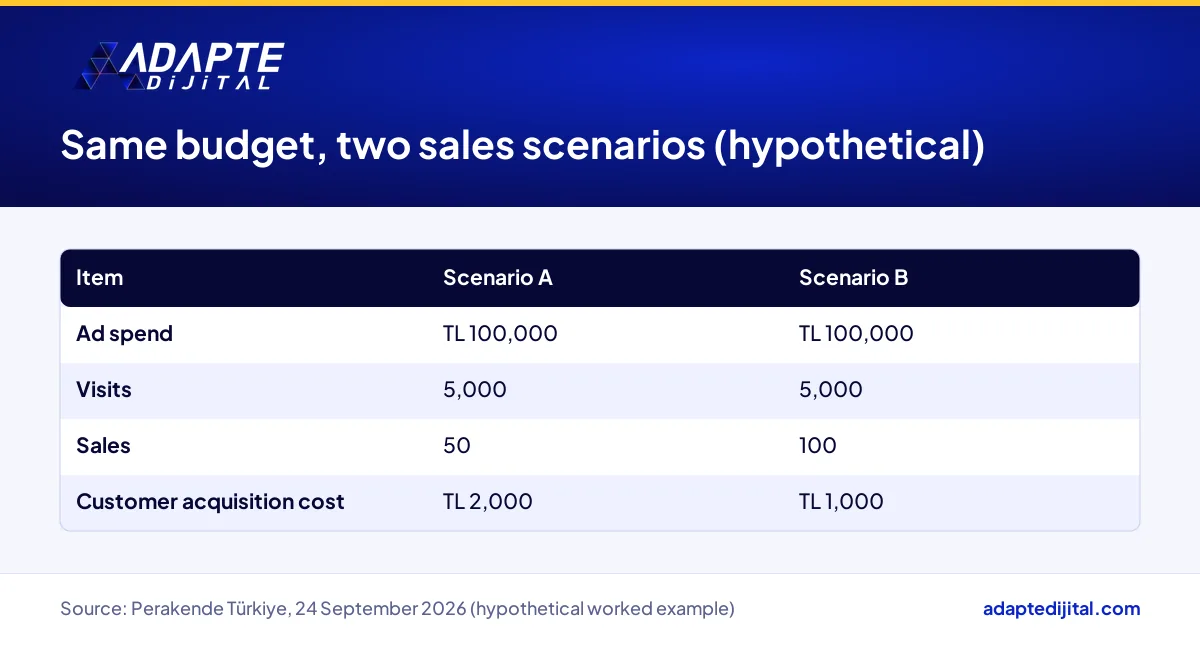
In two ways: it inflates your customer acquisition cost, and it feeds into ad quality through the landing page experience. In the report’s example, TL 100,000 of ad spend brings 5,000 visits; at 50 sales the cost per customer is TL 2,000, at 100 sales it is TL 1,000. These are assumptions, not data from a real store.
How do you simplify the checkout step in five steps?
With the five measurement and fix steps the report suggests: mobile loading, product information, form fields, error logs and controlled A/B tests. Write a number next to every step; without a number you cannot measure improvement. Go in order, and do not change everything at once.
What should an online store owner do about cart abandonment this week?
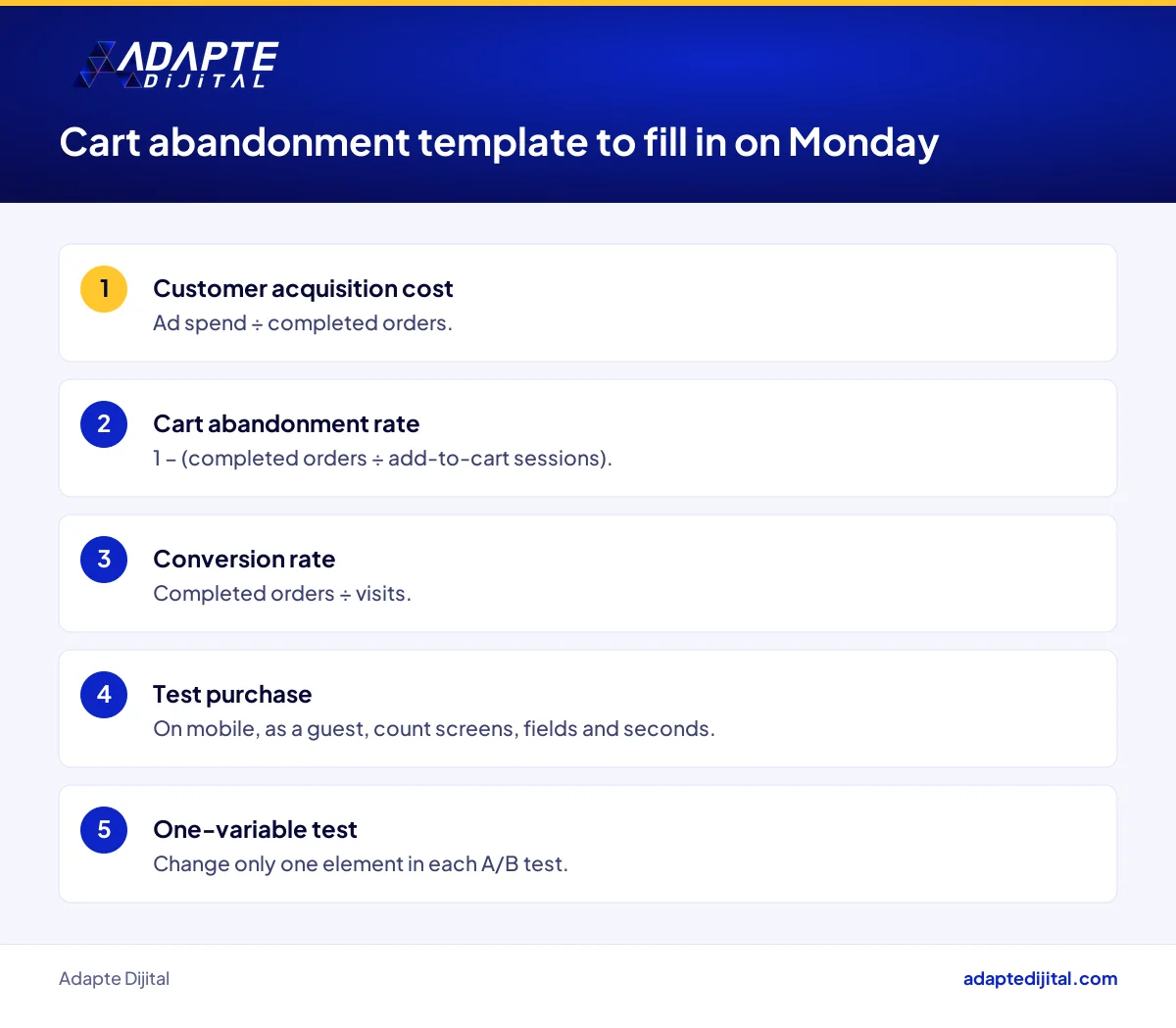
Do three things this week: calculate your own abandonment rate and acquisition cost, run a test purchase through your checkout, and pick the single biggest obstacle for your first test. An improvement without a number stays an idea. The template below is a one-page to-do list you can fill in on Monday.
Quick Summary
- By Baymard’s 2026 compilation, 70.22% of shoppers who add to cart do not complete the purchase (Perakende Türkiye, 24 September 2026).
- In US data, the reasons are forced accounts at 18%, long checkout at 17% and site errors at 17% (Perakende Türkiye).
- These are not rates for Türkiye; every store should measure its own.
- In a hypothetical example, doubling sales on the same budget cuts acquisition cost from TL 2,000 to TL 1,000 (Perakende Türkiye).
- Fix order: mobile loading, product information, form fields, error logs and controlled A/B tests.
Short Glossary
- Cart abandonment
- Cart abandonment is the term used to describe a visitor who adds a product to the cart and leaves without paying.
- Customer acquisition cost
- Customer acquisition cost is the per-order cost used to show ad spend divided by the number of sales.
- Quality Score
- Quality Score is the Google Ads rating used to show how relevant an ad and its landing page are.
Frequently Asked Questions
Next Step
If you want to review your store’s checkout step and acquisition cost together, fill in our consult your expert form.
Sources: Perakende Türkiye, 24 September 2026 · Baymard Institute, cart abandonment compilation (as reported) · Republic of Türkiye Ministry of Trade, Electronic Commerce
Updated: October 2026
Sık Sorulan Sorular
No. A sentence like “70% of carts are abandoned in Turkish e-commerce” would be wrong. The only accurate rate you have is your own store’s rate. So the first job is to measure it.
Use this formula: cart abandonment rate = 1 − (completed orders ÷ sessions with an add-to-cart). Pull the last 30 days from your analytics dashboard. Compare the result with your own previous months, not with the Baymard compilation.
Because they were measured on US shoppers, and the report says they do not transfer directly to Türkiye. Treat the 18% and 17% shares as signposts, not as a diagnosis of your store. You can follow developments in the Turkish market on our retail page, where we interpret the retail agenda for you.
The 18% share shows that many shoppers do not want to sign up just to buy. Setting a password and confirming an email is extra weight on a first purchase. Offering guest checkout removes that obstacle.
Every field and every extra page adds time between the decision and the payment. The report recommends reducing the number of form fields.
Errors are often invisible; the customer does not write to you, they just leave. The report recommends keeping error logs for the checkout step. Logs of card declines, timeouts and pages that fail to load show you exactly where the loss happens.
The store that offers guest checkout, keeps the form short and loads fast on mobile. It takes more orders on the same ad budget.
Stores that force sign-up, do not monitor infrastructure errors and sell items with a low average basket value. With a small basket, the ad cost of each lost order weighs heavier. The till stays quiet while the ad invoice keeps running.
Ad agencies, platform providers and payment companies all sit inside this picture. The technical side of payments is part of the abandonment story; we look at raising payment success with multiple virtual POS separately. We also cover the shop-window side on marketplaces in our piece on Trendyol Luxe and premium sellers.
Budget and visits stay fixed; only the number of sales changes. By our arithmetic, that means the conversion rate moves from 1% to 2%. Your customer acquisition cost halves without touching the ad budget.
Hakan Çınar puts it simply: a falling cost per click “is not a positive sign on its own”. If cheap clicks reach the cart and vanish at payment, a low click cost hides a high acquisition cost. The line to watch in your report is cost per order, not cost per click.
The report points out that landing page experience affects Google Ads Quality Score. It gives no figure for how large that effect is. A slow page with unclear product information weakens both the customer’s trust and your ad performance.
Record the mobile load time of your product and checkout pages every week; your first measurement becomes your baseline. On the product page, make delivery time, return terms and the total price clear before checkout. The report lists clear product information as one of its five recommendations.
Count the fields in your checkout form and ask of each one: “can the order be completed without this”. Turn on guest checkout. Put card declines, timeouts and page errors at the checkout step into a weekly table.
Changing the form, the design and the payment provider in the same week. Even if results improve, you will not know what worked. In a controlled A/B test, keep to three rules: one variable, enough time and the same traffic source.
Write four lines for the last 30 days: ad spend (A), sessions with an add-to-cart (B), completed orders (C) and visits (D). Customer acquisition cost = A ÷ C; cart abandonment rate = 1 − (C ÷ B); conversion rate = C ÷ D. Add a new column to the same table every month.
On your phone, without signing in, add a product to the cart and go all the way to payment. Note how many screens, how many form fields and how many seconds it takes. Every point where you get stuck becomes the first item on your checklist.
When you remove fields, keep the legal duties such as invoicing and consumer information intact. In Türkiye, e-commerce is monitored under ETBİS, the e-commerce information system, and related rules on the Ministry of Trade’s e-commerce page. Verify with the official source; this is not legal or financial advice. We set up checkout flows and measurement as part of our e-commerce consulting work.
Nobody knows from this data. The 70.22% figure is a global compilation Baymard built from 50 studies; the report gives no rate specific to Türkiye.
You can manage that risk by offering an account after payment. A one-click option to create an account once the order is complete lets you collect members without blocking the purchase.
The number of sessions with an add-to-cart and the number of completed orders are enough. You can pull both from your analytics dashboard each month.