
Armada Gida signs 110 million dollar loan, how can an SME reach development finance?
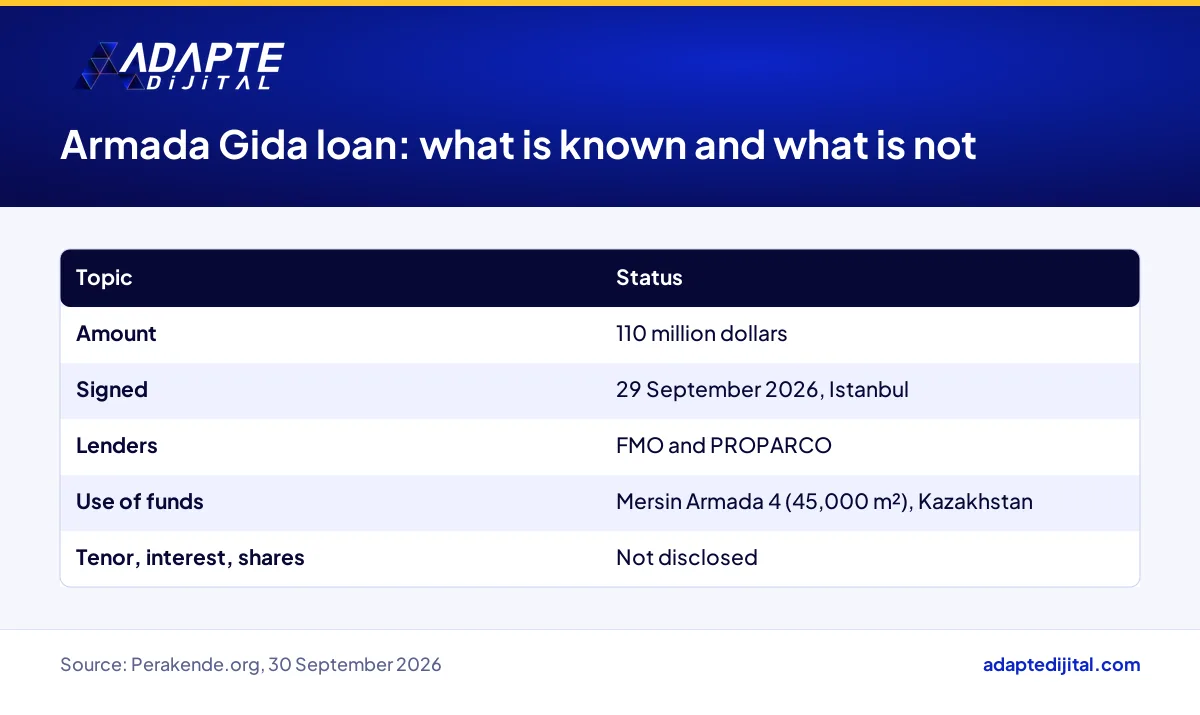
Armada Gida, a Turkish pulse and grain processor, signed a 110 million dollar long-term syndicated loan with FMO, the Dutch development bank, and PROPARCO, the French development finance institution, in Istanbul on 29 September 2026 (Perakende.org, 30 September 2026). The loan is earmarked for the planned 45,000-square-meter Armada 4 complex in Mersin and for expanding pulse processing in Kazakhstan.
For exporting food and agriculture businesses in Türkiye in autumn 2026, the message is clear: development banks are an active source of long-term growth finance. That door is not open to everyone. Getting through it starts with pinning down your own investment numbers and how well your sector fits.
What is Armada Gida’s 110 million dollar loan from FMO and PROPARCO paying for?
It pays for two investments: the Armada 4 production and storage complex in Mersin, and pulse processing in Kazakhstan. The Mersin site is planned at 45,000 square meters. The story describes the Kazakhstan plant as having “a 70% partnership structure”, but it is not clear who holds that stake. Cost, capacity and completion date for the plants have not been disclosed.
Which companies do development finance institutions like FMO and PROPARCO lend to?
Companies with concrete investment along the production, processing, trading and distribution chain. FMO’s agribusiness, food and forestry page says it finances companies at these four stages. FMO calls itself the Dutch entrepreneurial development bank, invests in more than 85 countries and says it helps other financiers enter challenging markets.
How much of an SME’s growth plan should development finance cover?
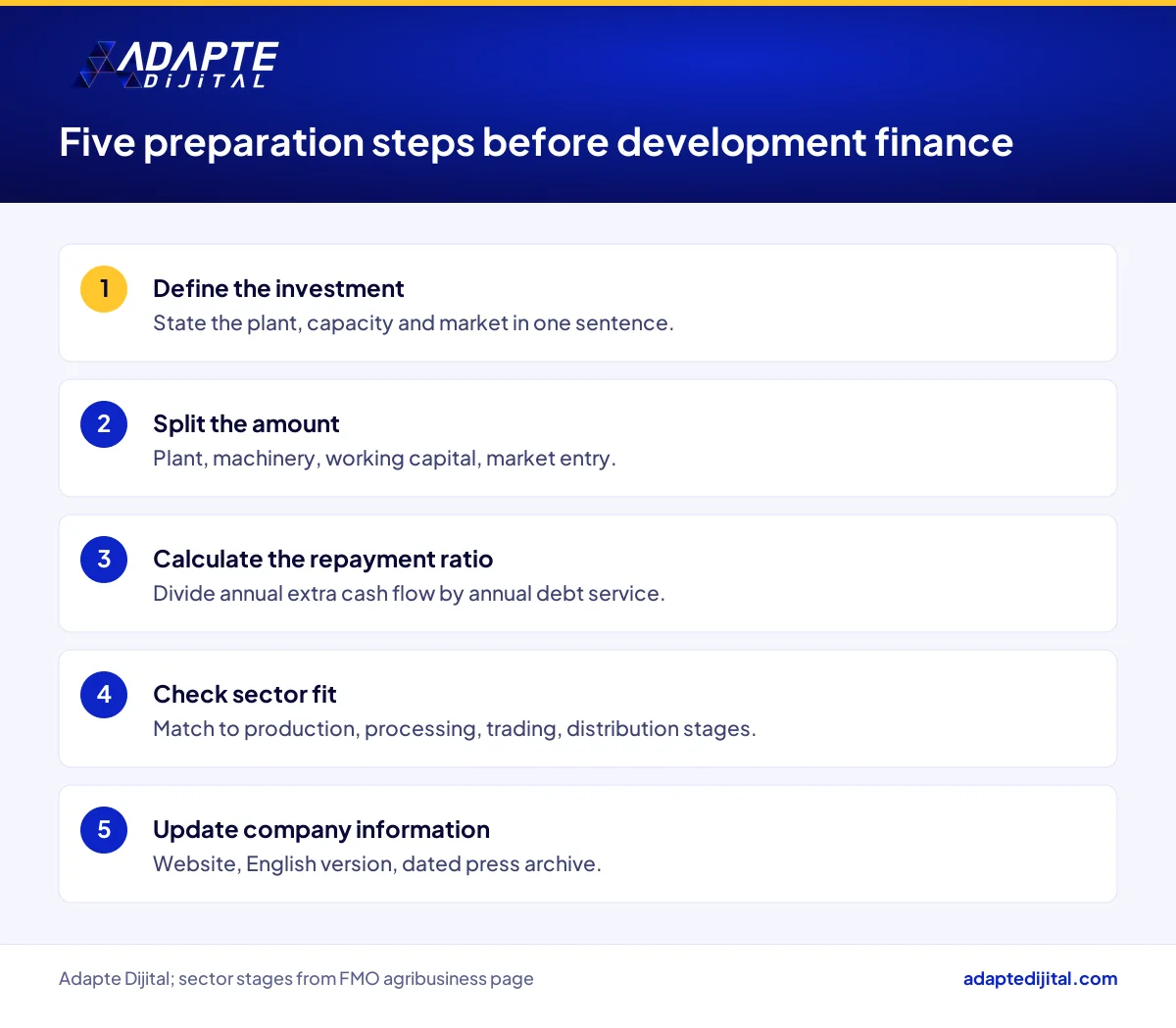
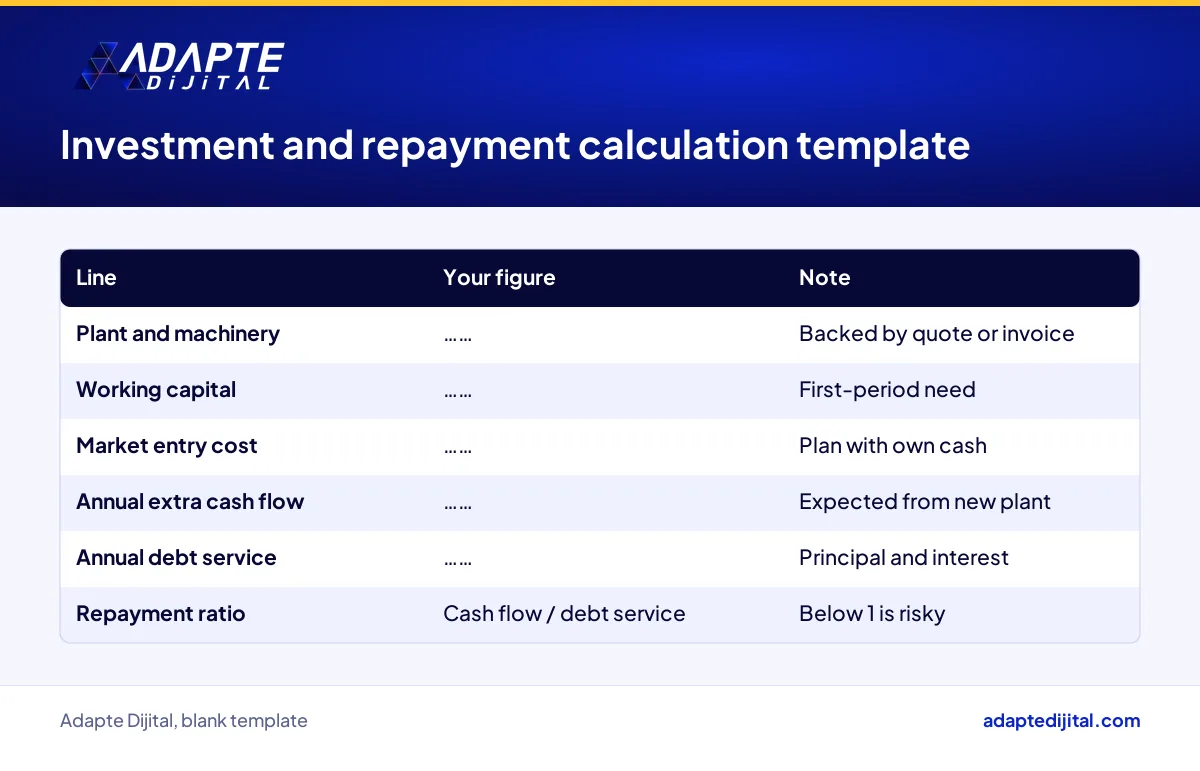
Not the whole investment, only the part that needs to be spread over the long term. Split the plan into three lines: plant and machinery, working capital and market entry. Long-term debt fits the first line best. Planning working capital with short-term funds and market entry with your own cash spreads the risk.
Who does Armada Gida’s loan affect in the food and export sector, and how?
The most direct effect could be on the pulse and grain supply chain around Mersin. A new production and storage complex may bring work to local growers, hauliers and packaging suppliers. Small processors in the same product group that cannot scale up may feel pressure. The indirect effect is on other export-focused food companies and what they expect from finance.
Why does digital visibility matter for a company seeking development bank finance?
Because the first review often starts on a screen, not at a desk. When an analyst looking at a loan searches your company name, your corporate site, production details and news archive come up. Information missing from your site is a gap for anyone looking in from outside.
What should an exporting SME owner do about development finance this week?
Do five things this week: define the investment in one sentence, break the amount into lines, calculate your repayment ratio, match your sector to the development banks’ sector lists and update your corporate site. This is not investment advice. Verify with the official source; this is not legal or financial advice.
Quick Summary
- Armada Gida signed a 110 million dollar syndicated loan with FMO and PROPARCO in Istanbul on 29 September 2026 (Perakende.org).
- The loan is earmarked for the planned 45,000-square-meter Armada 4 complex in Mersin and pulse processing in Kazakhstan (Perakende.org).
- Tenor, interest and the lenders’ shares were not disclosed; the 10 years mentioned is a growth horizon, not the tenor.
- FMO says it finances agribusiness companies at the production, processing, trading and distribution stages (FMO).
- The first step for an SME is to split the investment into lines and calculate the repayment ratio with its own figures.
Short Glossary
- Syndicated loan
- A syndicated loan is the term used for a loan that more than one lender provides to a single company on shared terms.
- Development finance institution
- A development finance institution is a lender used to channel long-term funding into private companies with development goals in mind.
- Debt service
- Debt service is the term used for the total principal and interest due in a given period.
Frequently Asked Questions
Next Step
If you want to review your growth plan and export readiness with the numbers on the table, fill in the consult your expert form. You will find more developments on our retail page, where we interpret the retail agenda for you.
Sources: Perakende.org, 30 September 2026 · FMO corporate website and agribusiness sector page
Updated: October 2026
Sık Sorulan Sorular
The amount, signing date, lenders and use of funds are known. The tenor in years, the interest cost and the split between FMO and PROPARCO are not in the story. Although it is called syndicated, only two institutions are named; whether other banks take part is unclear.
Armada Gida aims first for regional leadership in the MENA region, then for global growth. Chairman Fethi Kalıpçı Sönmez describes the signing, in translation, as “a very important step on the road to our goal of regional leadership.” The company puts plant-based protein and sustainable nutrition at the center of its pitch.
No. When FMO’s Director of Agribusiness, Hans Bogaard, refers to the next 10 years, he is talking about the company’s journey to becoming global. The loan tenor has not been disclosed. Be careful with any commentary that does not make this distinction.
The company sources and trades pulses and grains and processes them into value-added plant-based foods. That puts it in more than one of the stages FMO lists. Tying the loan to a plant and to processing capacity shows the money is going into physical investment, not an abstract growth plan.
On the same date, FMO announced 30 million euros of green finance for Garanti Leasing to fund climate investments in Türkiye (FMO, 30 September 2026). That shows development banks work through more than one channel in the country. For a small business, reaching this money through a bank or leasing company may be a route worth asking about.
FMO says it has built its agribusiness portfolio since 2012 in Latin America, Eastern Europe, Asia and Sub-Saharan Africa. Our sources give no detail on PROPARCO’s portfolio.
Use this formula: total investment = plant + machinery + first-period working capital + market entry cost. Back every line with a quote or an invoice. A plan built on guesswork gets sent back at the first meeting.
Divide the new plant’s annual extra cash flow by your annual debt service. If the result is below 1, cash gets tight and the till stops turning. You cannot fix this ratio without knowing the rate and tenor, but you can see its range across a few scenarios.
Asking for the loan to plug a working capital hole. In this deal, the money is tied to a specific plant and a processing capacity. A company that seeks debt to cover a shortfall ends up describing a problem at the bank’s table, not growth.
Logistics, storage and packaging businesses in Mersin could win a share of the new plant’s supply needs. Pulse farmers and cooperatives could gain a steady buyer. Because no completion date has been given, the timing is uncertain.
Firms processing the same products at a small scale may face price and capacity pressure. When a large plant lowers unit costs, the margin of a processor that stays small gets thinner.
Retailers and food brands selling plant-based protein products may benefit indirectly from more supply options. Leadership also matters in growth decisions, a theme we cover in our piece on Yatas Group’s internal promotions.
Plant addresses, production capacity, product groups, export markets, certificates and the management team. Press releases should be dated and archived. An English version is a basic requirement for a foreign lender.
AI assistants summarize whatever sources they find for the person asking about your company. If your site is missing or out of date, the summary is built from what others have written. Regular, verifiable information keeps that first impression in your hands. We explain how retailers can build AI-powered marketing in our piece on Evidea’s marketing appointment.
Write one sentence: which plant, what capacity, which market. In Armada Gida’s case, that sentence is as plain as “a 45,000-square-meter production and storage complex in Mersin”. If your sentence runs past one line, the plan is not ready yet.
Instead of going straight to a development bank, ask your own bank or leasing company about their development finance channels. The Garanti Leasing deal shows that this kind of funding can reach the market through intermediaries. If your export paperwork is not in order, we prepare it with you as part of our foreign trade consultancy.
Put your own figure on each line: plant, machinery, working capital, market entry, annual extra cash flow and estimated debt service. On the last line, calculate the repayment ratio. If it is below 1, reduce the amount or split the investment into phases.
Our sources do not say whether FMO lends directly to small firms. A realistic first step is to ask your bank or leasing company about their development finance channels.
The tenor, interest and the shares of FMO and PROPARCO were not disclosed. The 10 years mentioned in the story is not the tenor but a comment on the company’s growth horizon.
An investment definition, a line-by-line investment amount, a repayment calculation, recent financial statements and up-to-date company information are the basics. Confirm the exact list with the institution’s official source.