
Halleder and KolayBi join forces, should SMEs keep bookkeeping in one place?
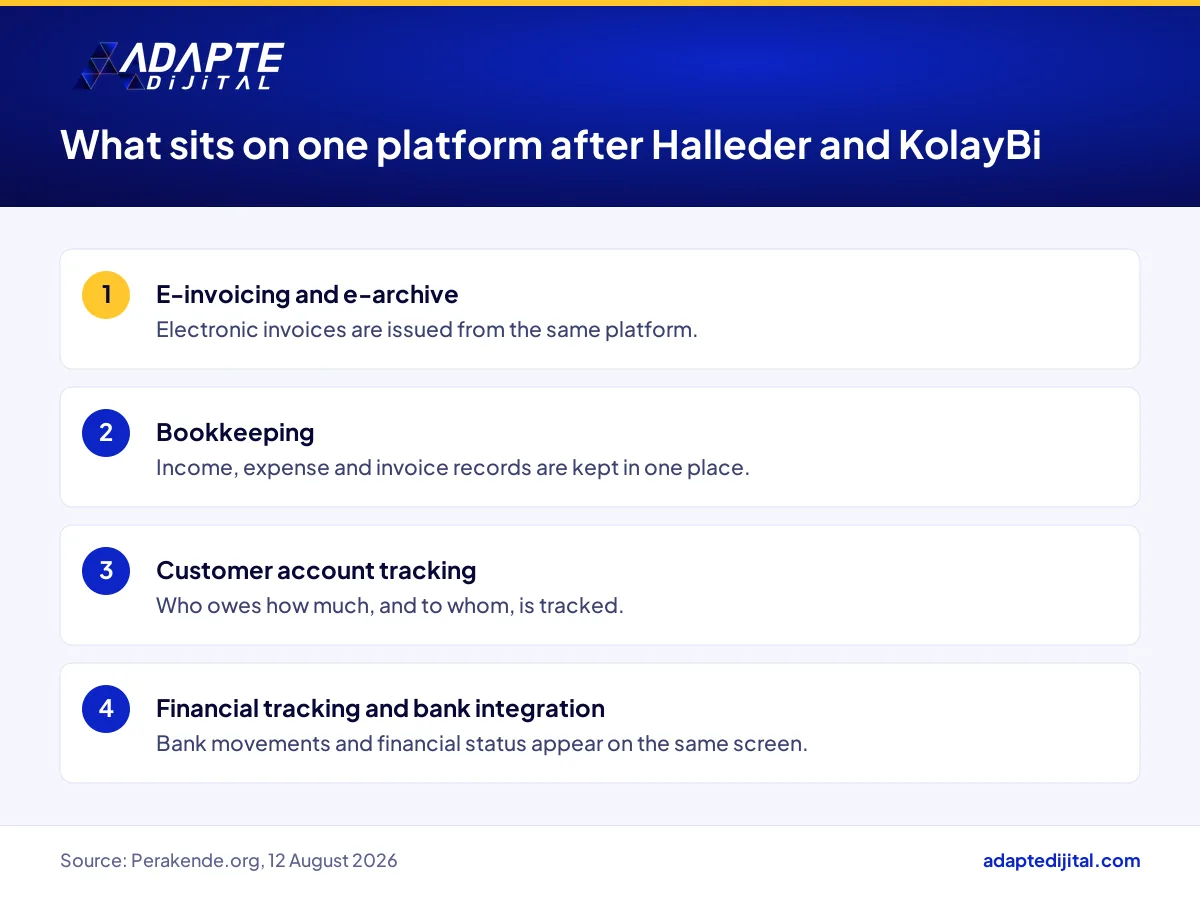
Halleder, the SME platform of Tam Finans, has entered a strategic partnership with KolayBi, a bookkeeping and financial management platform (Perakende.org, 12 August 2026). It is an integration, not an acquisition or merger. Users will be able to reach e-invoicing and e-archive invoicing, bookkeeping and customer account tracking, financial tracking and bank integration from a single platform. The target is small and medium-sized enterprises (SMEs).
Here’s something most people don’t know: behind Halleder stands a factoring company, a finance firm that turns invoiced receivables into cash before they fall due. So invoicing and financing now sit side by side. Your question: what does one screen for invoices, accounts, banking and financing give you, and what does it risk?
What exactly does the Halleder and KolayBi partnership bring together?
It puts two separate services behind one door. KolayBi’s bookkeeping side (invoicing, income and expenses, customer accounts) will work in integration with Halleder’s SME finance platform. Users will reach e-documents, banking and financial tracking from one place. The companies stay separate; what merges is the user experience.
What does linking bookkeeping and a finance platform give an SME?
BU BÖLÜMÜN ÖZETİ
- Double entry and reconciliation work can shrink
- Cash flow appears on one screen
- Financing requests rest on records
Time, visibility and a shorter path to financing. Invoices in one program, accounts in a spreadsheet, bank movements in an app: it is like shopping at three supermarkets and stuffing every receipt into one pocket. A single platform files them in one folder from the start.
Double entry and reconciliation work can shrink
Reconciliation means checking whether your records match those of the other party or the bank. When the same information is typed into two places by hand, each extra entry is another chance for a mistake. If bank movements flow into the records automatically, this check gets shorter; how the integration handles it in practice is not detailed in the report.
Cash flow appears on one screen
When issued invoices, receivables coming due and the money in the account sit side by side, next month’s cash table stops being a guess. Sometimes the feeling that the till is not turning comes less from weak sales than from not seeing where receivables are waiting.
Financing requests rest on records
Factoring is built on invoices and receivables, so those are the documents a financing request leans on. Records already on the platform need no gathering. What financing products the integration will offer, and on what terms, has not been announced.
Which businesses does the Halleder and KolayBi integration matter to most?
BU BÖLÜMÜN ÖZETİ
- Sole proprietors and small online sellers
- Suppliers selling on credit terms
- Businesses working with a dealer network
Mostly small businesses that issue their own invoices, sell on credit terms and have no dedicated accounting staff. Makers and distributors selling on credit to chains or dealers have receivables waiting to turn into cash. Small retailers who are paid up front benefit more from easier invoicing and records. For a mid-sized company already using enterprise accounting software, the benefit may be limited.
Sole proprietors and small online sellers
In 2025, about 75% of the roughly 634,000 businesses selling online in Türkiye were sole proprietorships and 21% were limited companies (Turkish Ministry of Trade). So the need for digital bookkeeping rests mainly on one person or a small team.
Suppliers selling on credit terms
An SME supplying big chains can issue an invoice and then wait weeks for payment. Sales on paper, no cash in the account. We discuss what management changes at a chain mean for suppliers in our piece on CarrefourSA’s new CEO.
Businesses working with a dealer network
For a business waiting on dealer payments, tracking customer accounts is daily work. Digital collections and single-platform bookkeeping are two links in the same chain. We cover the collection side in our article on digitising dealer payment collection.
What should an SME check before moving bookkeeping to a single platform?
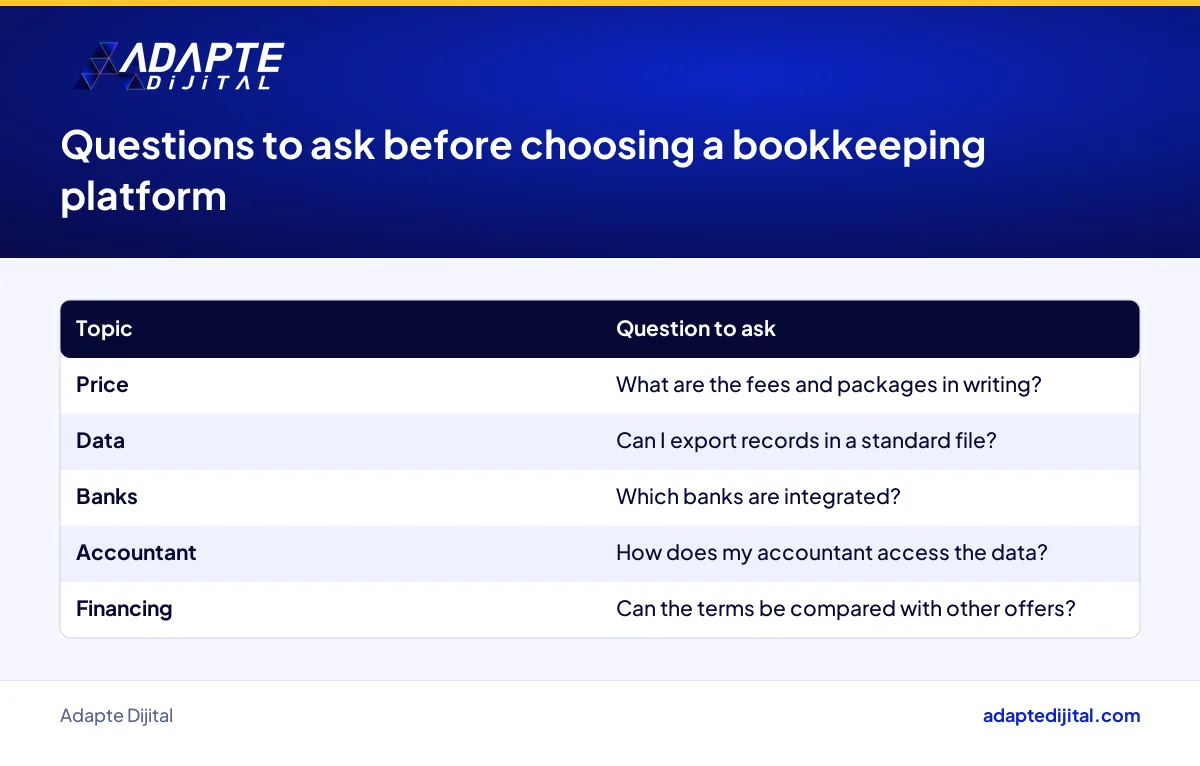
Five things: price, data portability, bank compatibility, how your accountant works with it and financing terms. Price, start date and partner banks are not in the report, so get this information from the platform in writing. Convenience comes with dependence on one provider, so find the exit before you walk in.
Judge the financing offer separately from the record-keeping service
Financing from the platform holding your records is practical, but it should not be your only option; compare its cost with other offers. Verify with the official source; this is not legal or financial advice.
What does single-platform bookkeeping change for e-invoicing, bank data and marketplace sales?
On the digital side, what changes is the direction of the data flow. When marketplace payouts, card collections and bank movements meet in one record, you can see which channel truly leaves a profit. E-invoicing and e-archive invoicing are the legal ground under that flow.
Marketplace sales should match the records
A marketplace payment usually reaches your account as a net amount after commission and shipping deductions. A business that never matches gross sales to net collections cannot see why profit stays flat while revenue grows. If a platform lets you set this matching as a rule, the month-end table cleans itself up.
What should an SME owner do about bookkeeping this week?
BU BÖLÜMÜN ÖZETİ
- Write all your tools on one page
- Match one month of invoices and collections
- Send written questions to candidate platforms
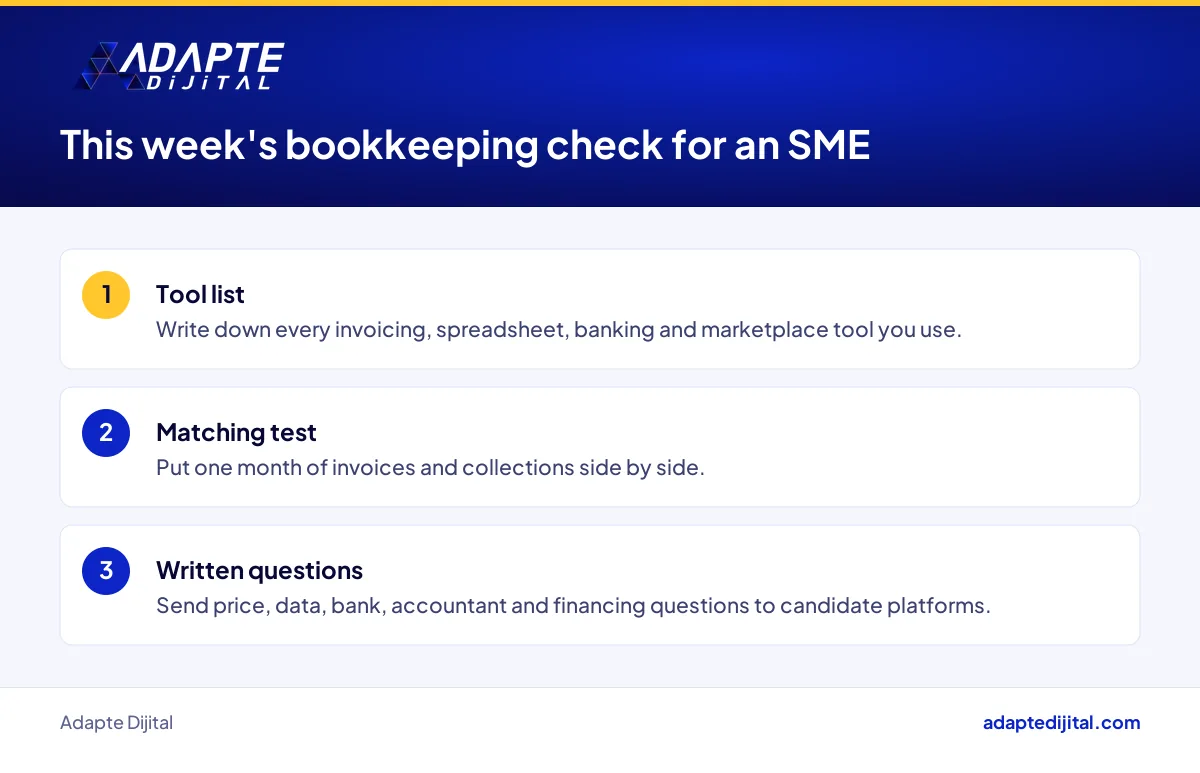
Do three things this week: list the tools you use today, try matching one month of invoices and collections in a single table, and send your five questions to candidate platforms in writing. Your own records, not a sales pitch, will show whether it is worth it.
Write all your tools on one page
Invoicing program, spreadsheet, banking app, marketplace panel: write them one under another. Next to each, note who enters data and how often. The lines where the same information goes into two places show where an integration would help you.
Match one month of invoices and collections
Put last month’s issued invoices next to the payments that reached your account. The items that do not match show where your customer account tracking breaks down.
Send written questions to candidate platforms
Ask in writing about price, data export, bank compatibility, accountant access and financing terms. Compare the answers in one table. We set up record-keeping, collection and finance flows to fit each business as part of our digital transformation management work with SMEs.
Now you know: Halleder and KolayBi did not merge, they connected. That link brings the screen where an invoice is issued closer to the screen where financing is requested. Whether the switch suits you depends on your own records and the written answers you collect. We follow SME news on our retail page.
Quick Summary
- Halleder and KolayBi entered a strategic partnership; it is an integration, not an acquisition (Perakende.org, 12 August 2026).
- SME users will reach e-invoicing, e-archive, bookkeeping, customer account tracking and bank integration from one platform.
- Halleder is described as the SME platform of the factoring company Tam Finans (Perakende.org).
- Pricing, start date and partner banks have not been announced.
- In 2025, 75% of businesses selling online in Türkiye were sole proprietorships (Turkish Ministry of Trade).
Short Glossary
- Bookkeeping
- Bookkeeping is the record system used to keep a business’s daily invoice, collection, payment and customer account entries.
- Factoring
- Factoring is the financing method used to turn receivables from invoices on credit terms into cash before they fall due.
- Reconciliation
- Reconciliation is the check used to confirm that a business’s records match those of the other party or the bank.
Frequently Asked Questions
Next Step
If you want to talk through whether bringing your invoicing, collections and finance flow into one system suits your business, fill in the Consult Your Expert form and we will look at it together, starting from the tools you use today.
Sources: Perakende.org, Halleder joins forces with KolayBi, 12 August 2026 · Ekonomist, Tam Finans report · Webrazzi, KolayBi investment report, 15 August 2022 · Turkish Ministry of Trade, 2025 e-commerce data · Revenue Administration (GİB), Tax Procedure Law General Communiqué 550
Updated: October 2026
Sık Sorulan Sorular
Bookkeeping, called “ön muhasebe” (pre-accounting) in Turkish, is the daily record a business keeps before anything goes to its accountant. The statutory books and tax returns are prepared by the certified accountant, the “mali müşavir”. Clean bookkeeping means a clean file for the accountant.
Halleder is described as the SME platform of the factoring company Tam Finans. Tam Finans was acquired in 2024 by the Egyptian group MNT-Halan (Ekonomist). KolayBi raised 1.15 million dollars in August 2022 in a round led by TechOne Venture Capital, and at that time more than 40,000 companies were said to use it (Webrazzi). These figures are old; current user numbers are not reported.
The report quotes Halleder General Manager Emirhan Gökalp and KolayBi CEO Rauf Gökhan Boyana. Gökalp says, in our translation, “we are developing it as a living digital ecosystem”. That wording points to a structure meant to grow over time, not a one-off connection.
Being able to export invoices, customer accounts and bank records in a standard file format keeps your hands free if you want to switch platforms tomorrow. Ask before you sign.
How bookkeeping records reach your accountant decides the month-end workload. If your accountant has no access to the platform and no regular export, the time a single platform saves gets lost again at month end. Choose together with your accountant.
In Türkiye, the framework for e-invoicing (e-Fatura) and e-archive invoicing (e-Arşiv) is set by General Communiqué 509 of the Tax Procedure Law and widened from time to time by amending communiqués. One example is Communiqué 550, published in the Official Gazette on 7 October 2023. Check the current announcements of the Revenue Administration (GİB) for the turnover level at which the switch becomes mandatory; this is not legal or financial advice.
No. In the report carried by Perakende.org, the deal is described as a strategic partnership and integration. The two companies stay separate; users reach both platforms’ services from one place.
The report does not include pricing or a start date. Get current fee and package details from the platforms directly, in writing.
Bookkeeping makes daily records easier, but statutory books and tax returns remain the accountant’s job. Choosing the platform together with your accountant makes the month-end handover smoother.