
Boyner’s price guarantee reached 2 million shoppers, does markdown fear delay sales?
Around 2 million shoppers have used Boyner’s “İndirim Korumalı Alışveriş” (markdown-protected shopping) programme so far, according to the Turkish department store chain (Hibya News Agency, 15 October 2026). The company also says it has handed out about 1.7 billion Paracık, its loyalty currency, with an average gain of TL 857 per customer.
This is not a new launch. The programme started as a pilot in 2024, and the October 2026 story brings updated figures from the company. What it means for you: when a shopper walks away saying “it will be on sale soon anyway”, a large chain is choosing to pay to remove that doubt. For a smaller retailer, the real question is what the same promise would cost at your own till.
What is known about Boyner’s markdown-protected shopping programme?
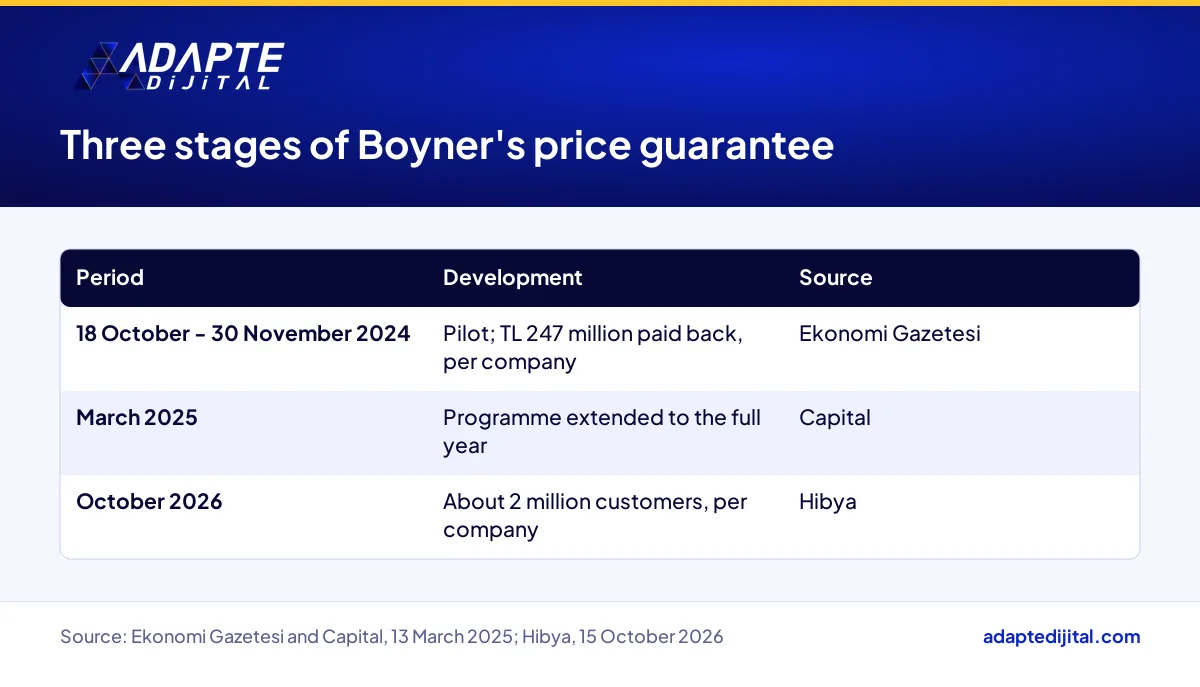
Three things are known: the programme’s name, when it started and the figures the company has shared. The pilot ran from 18 October to 30 November 2024, and in March 2025 Boyner announced it would run all year (Capital, 13 March 2025). The October 2026 numbers are also company statements. For the duration, scope and form of the payout, check current information on Boyner’s website; this article does not state them because they could not be verified on Boyner’s own pages.
Does markdown fear really make shoppers delay a purchase?
No source in this story measures it, but the risk is highest near the end of a season and on higher-priced items. Picture it: a shopper sees a coat in the window, checks the tag and leaves, thinking “it will be marked down in two weeks”. According to Capital, Boyner placed its pilot right before the year-end sale season and presented the guarantee as a way to bring that decision forward.
How can a small retailer calculate the cost of a price guarantee like Boyner’s?
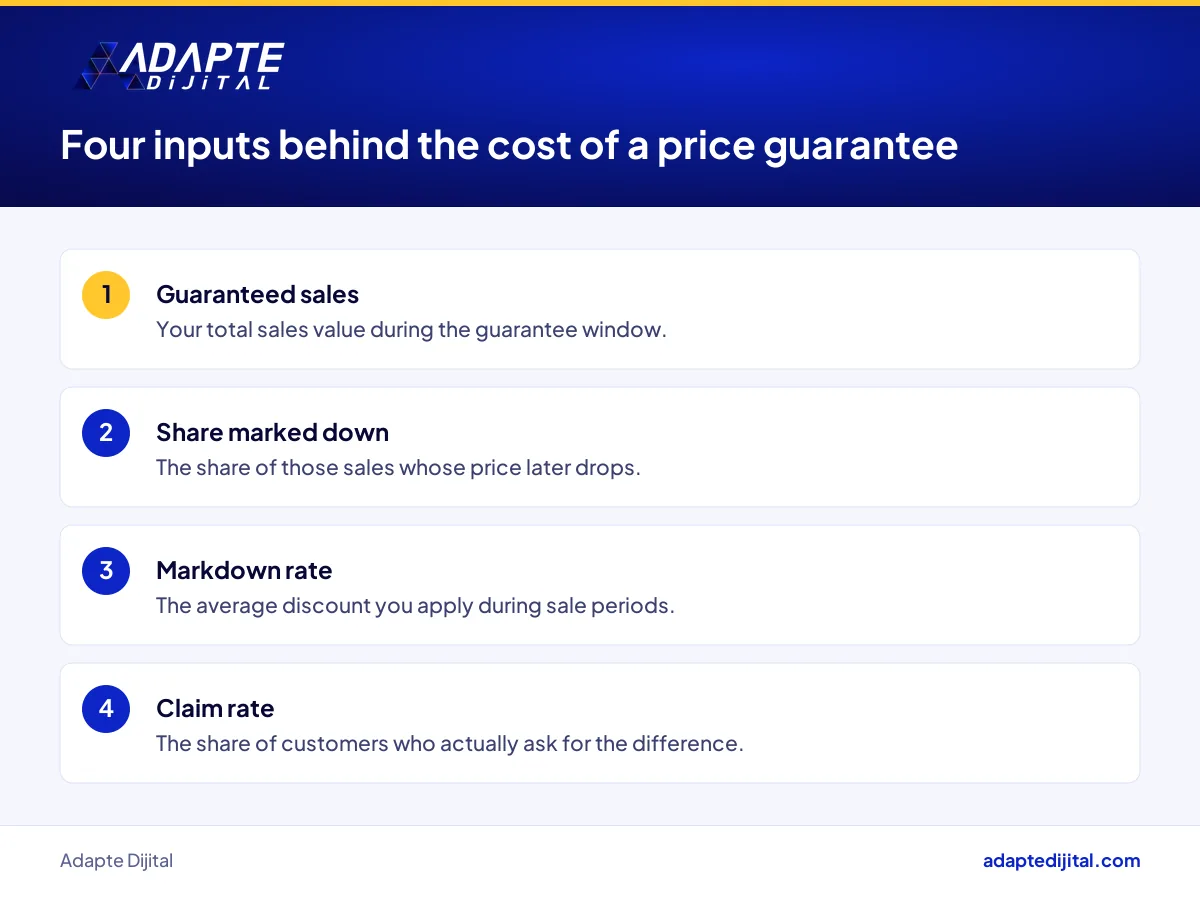
With your own numbers, by multiplying four inputs. Take the value of guaranteed sales, the share of those items that later drop in price, your average markdown rate and the share of customers who actually claim the difference. The result is your upper-limit cost for the period. Set it against the revenue you would rescue from delayed sales.
Who does Boyner’s price guarantee affect, and how?
The most direct effect falls on clothing, shoe and accessory chains and independent boutiques in the same AVMs, the Turkish term for shopping malls. The likely winners are large stores that can pull sales into the start of the season. Small retailers without the cash buffer to match the promise face the most pressure, and suppliers who plan stock around the sale season feel it indirectly.
How can a retailer make a Boyner-style price guarantee visible online?
With one clear sentence on the product page, in the basket and in price-comparison searches. If the guarantee’s window and conditions do not appear on the product page, the shopper simply does not notice it. Digital channels also make it easier to track price changes and calculate the difference automatically.
What should a store owner weighing a price guarantee do this week?
BU BÖLÜMÜN ÖZETİ
- Pull last season’s data
- Write the conditions in one sentence
- Build the pricing decision together with digital visibility
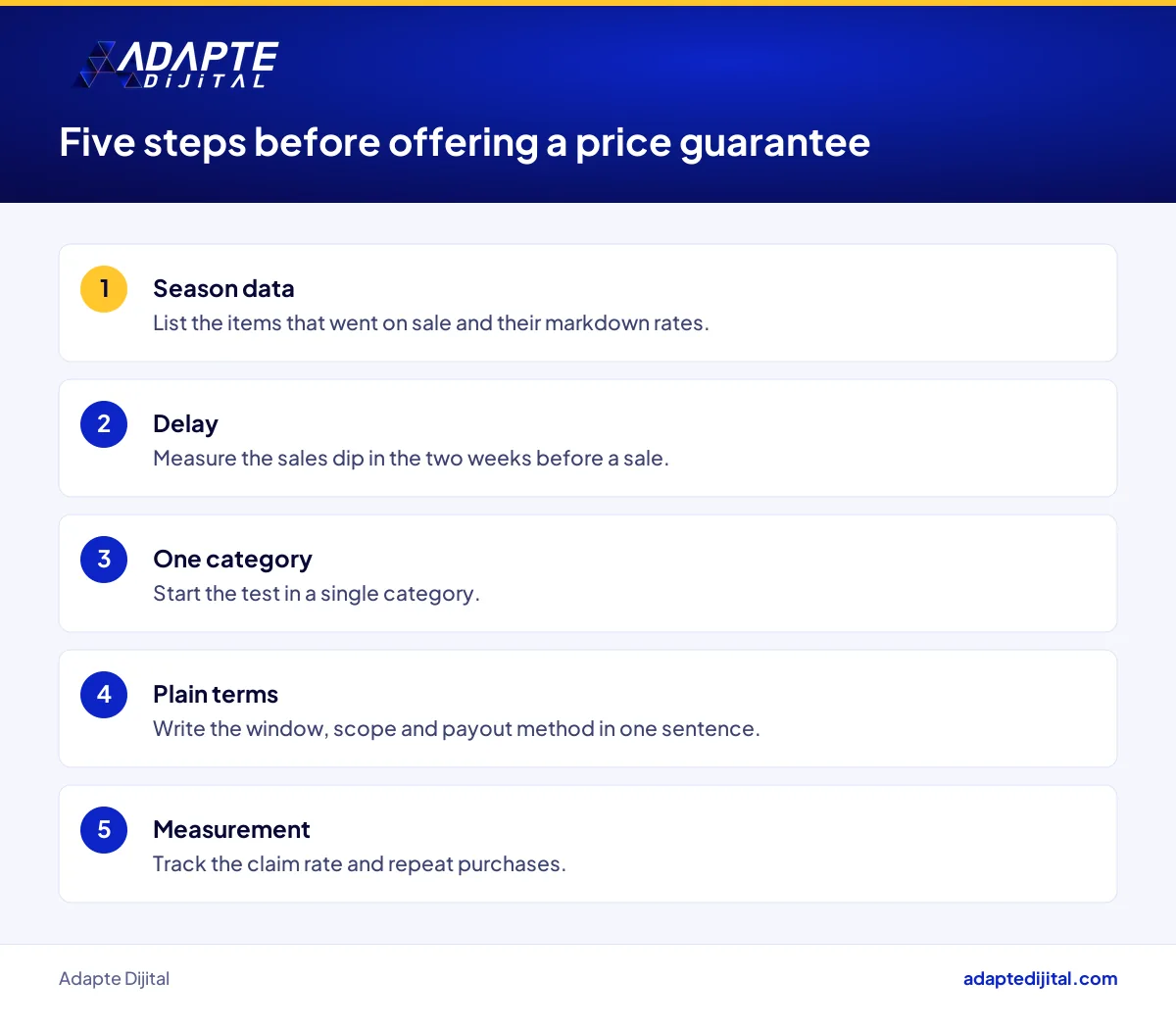
Put last season’s markdown calendar and the sales share of discounted items into one table. Our desk recommends a test in a single category first, with a short window and plain conditions. A guarantee rolled out across the whole store without measurement hides its own cost.
Pull last season’s data
List which items went on sale, at what rate, and how much sales dropped in the two weeks before the markdown. These three numbers show how much delayed buying you really have.
Write the conditions in one sentence
Window, scope and payout method should be short enough to understand at a glance. Check your consumer obligations against official sources. Verify with the official source; this is not legal or financial advice.
Build the pricing decision together with digital visibility
Setting up a price guarantee alongside product pages, ads and a measurement plan is one of the jobs we handle in digital consulting.
Quick Summary
- According to the company, about 2 million customers have used Boyner’s price guarantee programme (Hibya, 15 October 2026).
- The company states an average gain of TL 857 per customer (Hibya, 15 October 2026).
- The programme began as a 2024 pilot and was extended to the full year in March 2025 (Capital, 13 March 2025).
- According to the company, the 2024 pilot paid back a total of TL 247 million (Ekonomi Gazetesi, 13 March 2025).
- Duration, scope and payout terms should be checked on Boyner’s own pages.
Short Glossary
- Price guarantee
- Price guarantee is the retail commitment used to refund the customer the difference if an item’s price drops after purchase.
- Markdown
- Markdown is the retail term used to describe cutting the price of unsold stock during or at the end of a season.
- Average basket value
- Average basket value is the retail indicator used to measure the average amount spent per purchase.
Frequently Asked Questions
Next Step
If you want to weigh your pricing and markdown decisions with your own data, fill in our consult your expert form.
Sources: Hibya News Agency, 15 October 2026 · Capital, 13 March 2025 · Ekonomi Gazetesi, 13 March 2025 · Boyner website (linked in the text)
Updated: October 2026
Sık Sorulan Sorular
According to Ekonomi Gazetesi (13 March 2025), the company said the pilot covered about 400,000 purchases, with an average of TL 620 and a total of TL 247 million paid back. Capital reported the same figure as “400,000 people”. So read the 2024 figure as purchases and the 2026 figure as customers; they are not the same unit.
They show the programme’s scale, not its cost. The company says about 2 million customers have used it and the average gain is TL 857. No source gives the TL value of 1.7 billion Paracık, or any effect on sales or return rates.
As part of the relationship after the sale. Eren Çamurdan, CEO of Boyner Büyük Mağazacılık, describes the customer relationship as something that continues once the purchase is done. In the same story, the company also mentions a second scheme, “Dilediğin Zaman İade” (return any time), which it says removes the return deadline for unused items; its terms have not been verified either.
Seasonal clothing, shoes and electronics, where prices visibly move. On basics whose price stays flat all year, shoppers have little reason to wait. The problem grows in categories where customers have learned your markdown calendar by heart.
No. Some waiting shoppers buy elsewhere during the sale, and some never buy at all. The till stays quiet that week, the item gathers dust on the rail, and when it finally sells at a discount, the margin is already smaller.
It removes the reward for waiting. If shoppers know the difference will be covered when the price drops, buying today carries no risk for them. In return, the business funds part of its markdown period backwards, on sales it has already made.
First, your sales value during the guarantee window. Second, how many of those items later go on sale. Third, your average markdown rate, and fourth, the share of customers who ask for the difference.
In a business that discounts often, most guaranteed sales overlap with a markdown and the cost multiplies. In a business with two fixed sale periods a year, that share falls. Simplifying your markdown calendar before offering a guarantee changes the calculation itself.
The money stays in the business. If the difference comes back as loyalty points or a gift voucher, the customer spends it at your till again. This turns part of the cost into a new sale, but it only builds trust if you explain it clearly.
A shopper who knows that, over there, a price drop means getting the difference back. In Turkish malls in autumn 2026, before the sale season, that comparison can sway decisions on items with a high average basket value. A small store can answer with a predictable markdown calendar and service rather than price.
If sales shift to the start of the season, delivery schedules move earlier too. End-of-season overstock may shrink, but who carries the markdown cost goes back on the table in the supply contract.
No. In a business with thin margins and an irregular markdown calendar, the guarantee becomes a commitment that eats profit after the fact. How you signal price in store matters as much as location; we look at large-format store economics through MediaMarkt’s Ankara Podium store.
The name of the guarantee, how long it applies and how the difference is paid. If the terms sit on a separate page, the product page should reach it in one click. A vague “price promise” line produces complaints.
The guarantee becomes a message you can use in ad copy instead of price. A line such as “if it goes on sale, you keep the difference” can stop a comparing shopper from waiting. Its conditions need to be as clear on the page as they are in the ad.
Pre-season share of sales, the claim rate and repeat purchases after a payout. We discuss models that combine loyalty and payment partnerships with customer data in our piece on MetropolCard and Bilet.com.
Terms such as the window, scope and payout method were not verified for this article. Check the current terms on Boyner’s own website.
Yes, but first calculate its cost against your markdown calendar. Starting with one category, a short window and plain conditions limits the risk.
No. The guarantee pays back the difference on items whose price drops during a sale, so the more often you discount, the more it costs.