
160 years of shopping malls show a pattern, should retailers pick location over scale?
From Galleria Vittorio Emanuele II in Milan to Iran Mall in Tehran, 160 years of shopping mall history keep repeating one lesson, writer Özcan Akışık argues: location and access come before scale (Perakende Türkiye, 2 October 2026). The same analysis notes that Türkiye’s 445 malls reached about $59 billion in sales in 2025, with sales per square meter up 30%.
What it means for you: if you are hunting for a mall unit, “the biggest and newest center” is not automatically the right answer. In 2025, mall sales in Türkiye rose while visitor numbers fell 3%. Fewer people come, those who come spend more, and the center that gives people a reason to visit pulls ahead.
What do 160 years of shopping mall history tell a retailer looking for a store location today?
They say size alone does not bring customers. According to Akışık, location and access come before scale, and an anchor tenant can carry a center or sink it. His short formula: “The measure is no longer square meters, but the reason to visit.” For a retailer looking for mall space in Türkiye in autumn 2026, that changes the first question at the leasing table.
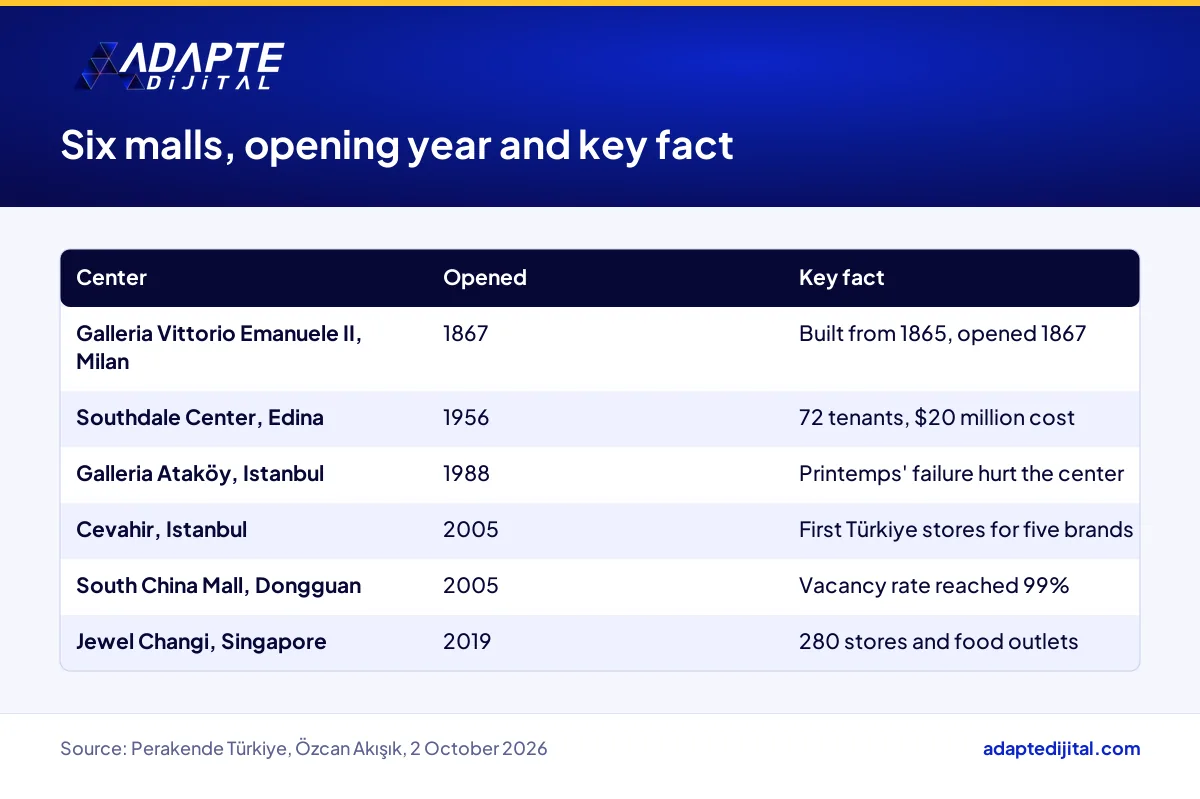
What criteria do Cevahir, Galleria Ataköy and South China Mall leave for tenants?
They leave three: the strength of the anchor tenant, the center’s ability to attract brands entering the market, and the trend in the vacancy rate. According to Akışık, an anchor tenant can carry a center or sink it.
How does rising mall revenue with falling footfall in Türkiye change store selection?
It shifts the choice from crowds to spending. Under the 2025 AVM Index from AYD, Türkiye’s shopping centers and retailers association, and Akademetre, sales per square meter rose 30% while visitor numbers fell 3%. Growth was 35.3% in Anatolia and 25% in Istanbul. According to Akışık, Türkiye’s focus is moving from new floor space to the productivity of existing space, so ask about visitor spending, not just visitor counts.
How does the mall location-versus-scale choice affect different businesses?
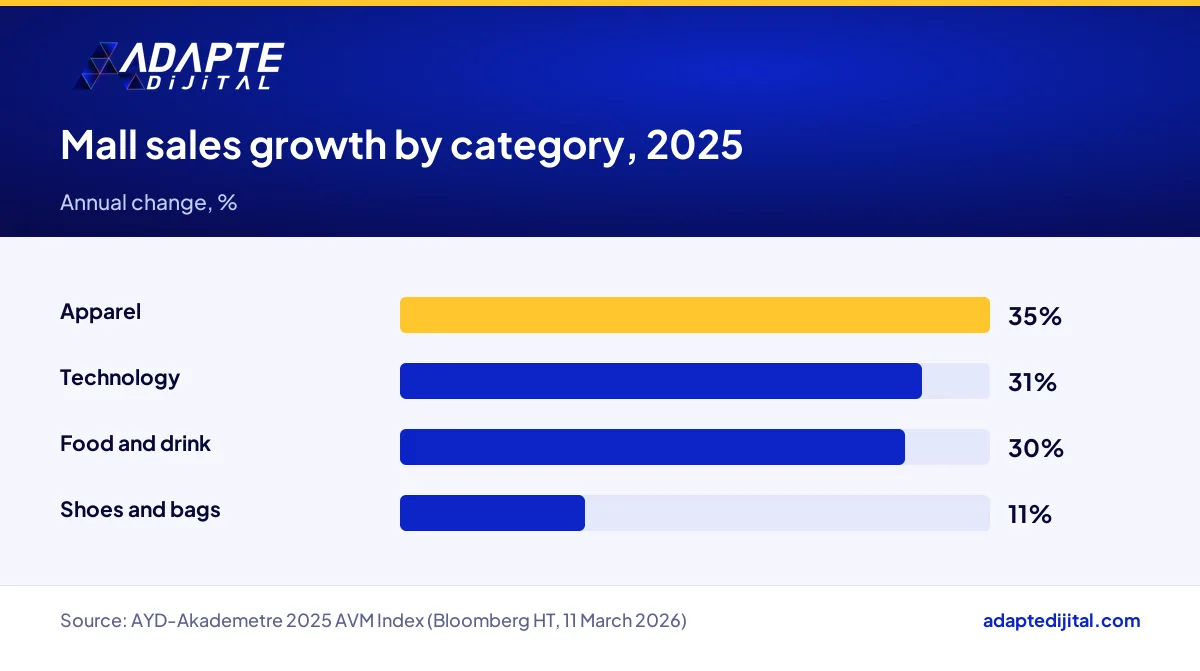
Categories that rely on access and a reason to visit gain, while stores that count only on crowds struggle. Food and drink, apparel and technology retailers take a direct share from a strong location. The indirectly affected group is high-street shops around malls and local retailers in provinces still waiting for a center.
How does digital visibility feed into a mall store’s location decision?
Digital visibility is the bridge that carries a center’s reason to visit to your door. Before they leave home, shoppers search on their phones for the center, the store and its opening hours. A store missing from maps and local search cannot call back the customer who turned around at the door, however good its unit.
What should a business owner looking for mall space do this week?
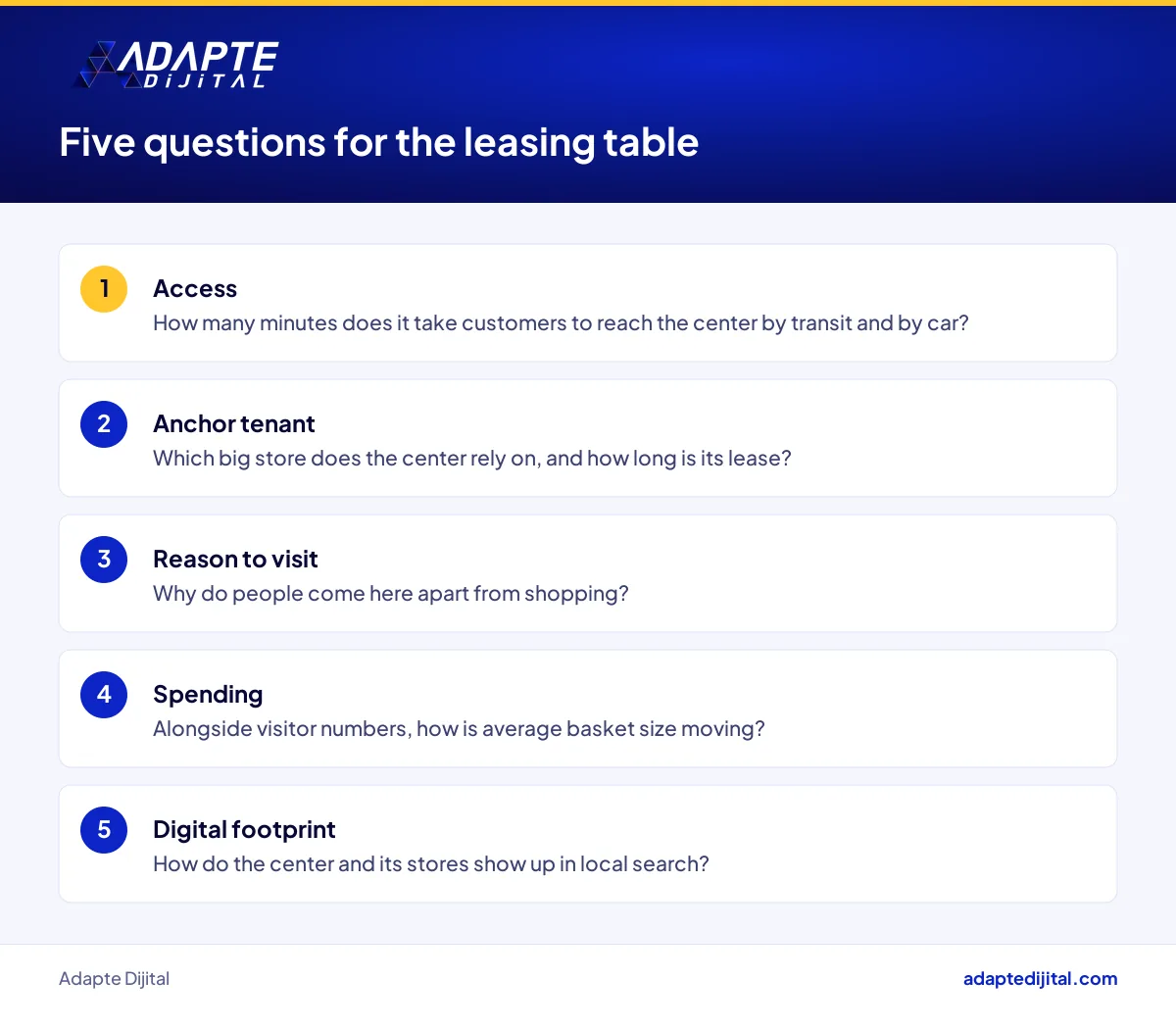
This week, rank candidate centers by access, anchor tenant and reason to visit rather than by floor area. Ask every center the same five questions and get the answers in writing. These figures are for information only; for lease and investment decisions, verify with the official source and your adviser, as this is not legal or financial advice.
Quick Summary
- According to Akışık, location and access come before scale in mall investment (Perakende Türkiye, 2 October 2026).
- Türkiye’s 445 malls had about $59 billion in sales in 2025 (AYD-Akademetre).
- In 2025, sales per square meter rose 30% while visitor numbers fell 3% (AYD-Akademetre).
- South China Mall’s vacancy rate reached 99% before the center revived in 2015 (Perakende Türkiye).
- For tenants, the main tests are the anchor tenant, access and the reason to visit.
Short Glossary
- Anchor tenant
- An anchor tenant is the retail term used for a large, well-known store that draws visitors to a shopping center.
- Vacancy rate
- Vacancy rate is the indicator used to show the share of unleased space in a shopping center’s total area.
- Sales per square meter
- Sales per square meter is the productivity measure used to compare stores by dividing sales revenue by floor area.
Frequently Asked Questions
Next Step
If you want to compare candidate malls on access, anchor tenant and digital visibility together, fill in the consult your expert form.
Sources: Perakende Türkiye, Özcan Akışık, “Milano’dan Tahran’a: AVM yatırımlarının 160 yıllık dersleri”, 2 October 2026 · AYD-Akademetre 2025 AVM Index (Bloomberg HT, 11 March 2026) · GYODER Gösterge reports
Updated: October 2026
Sık Sorulan Sorular
According to the article, construction of Milan’s Galleria Vittorio Emanuele II starts in 1865 and it opens in 1867. Southdale Center opens on 8 October 1956 in Edina, in the United States, with 72 tenants. Its architect is Victor Gruen and it costs $20 million.
Scale means high cost and a long payback. The idea for American Dream dates from 1996; the center opens in 2019 at a cost of about $5 billion, closes in 2020 because of the pandemic, and its bond payments falter.
The “why malls fail” framing is Akışık’s interpretation, not a research finding. The foreign cost, visitor and floor-area figures in the article have not been independently verified. Read them as a source of questions, not benchmarks.
Galleria Ataköy, an Istanbul mall, opens in 1988. According to the article, the failure of its anchor tenant Printemps hurts the center. The lesson for a tenant: before you sign, ask which big store the center leans on and how long that store’s lease runs.
Cevahir in Istanbul opens in October 2005 with 358,000 m² of enclosed space. Next, Debenhams, Zara Home, Bershka and Stradivarius open their first stores in Türkiye there. When a center becomes the first address for new brands, curious shoppers follow, and that means traffic for you as a neighboring tenant.
South China Mall in Dongguan opens in 2005 and its vacancy rate climbs to 99%; it only comes back to life in 2015. We read this case as the extreme example of Akışık’s thesis that location comes before scale. When a shop is empty all day, a bigger floor plate saves nothing.
The same index puts 2025 sales growth at 35% for apparel, 31% for technology, 30% for food and drink and 11% for shoes and bags. Do not confuse your category’s trend with the center’s average.
Türkiye opened 4 malls in 2025 and plans 5 for 2026: two in Istanbul, the others in Ankara, Elazığ and Muğla. Thirteen provinces have no mall at all. While new supply stays limited, good locations in existing centers become more valuable.
The figures belong to AYD and Akademetre, and they also appear in Bloomberg HT’s report of 11 March 2026. For periodic real estate indicators, you can follow the Gösterge reports of GYODER, Türkiye’s real estate and REIT association. Check the numbers against the latest official release before you decide.
Chain apparel, food and drink and technology stores in centers with strong metro or main-road links. Sales growth in these categories was 30% or more in 2025.
Stores with low basket sizes in large but poorly connected centers. When footfall drops, a crowd-dependent model is hit first; the till goes quiet while the rent stays the same every month. For slower-growing categories such as shoes and bags, a location mistake costs more.
Local retailers in the 13 provinces without a mall, and high-street shopkeepers in the cities getting a new center in 2026. A new center changes the route of neighborhood shopping. We look at how the open-air model fits this balance in our piece on Forum Bornova’s 20th year.
Look at which stores appear in searches for the candidate center’s name and how current their map listings are.
In a well-connected center, nearby-audience ads work more efficiently. In a poorly connected one, you need a wider radius and more budget to persuade shoppers to make the trip. That gap is a hidden cost that belongs in your rent calculation.
Read a store-specific promo code, direction requests from your map listing and till data together. That shows whether weak sales come down to location, the window or the price.
Travel to the center once by public transport and once by car, and time both trips. Check how far the car park and the nearest stop are from your unit. Will your customer make this trip every week?
Ask which big stores the center relies on, how long their leases run and how much tenant turnover there has been in recent years. The Printemps case at Galleria Ataköy is a reminder that the failure of one large tenant can weigh on a whole center.
Look at the events calendar, the food court and the service stores: why do people come here apart from shopping? To see what a social responsibility program adds to a retail brand, read about Watsons and L’Oréal meeting women producers in Kuşadası.
To make the location decision with local search and measurement data, we run this analysis through our digital consulting service. On our retail page, where we interpret the retail agenda for you, you can follow other mall developments.
Not always. According to Akışık, location and access come before scale, and South China Mall’s vacancy rate reached 99%. Base the decision on access and the reason to visit, not on floor area.
In 2025, visitors fell 3% while sales per square meter rose 30%. Shoppers who come spend more, so ask about average basket size as well as visitor numbers.
It can be. At Galleria Ataköy, the failure of Printemps hurt the center. Before signing, ask about the lease terms of the big tenants and the center’s backup plan.