
Outlet Center İzmit starts its 53rd bargain fair, how should a store plan a clearance sale?

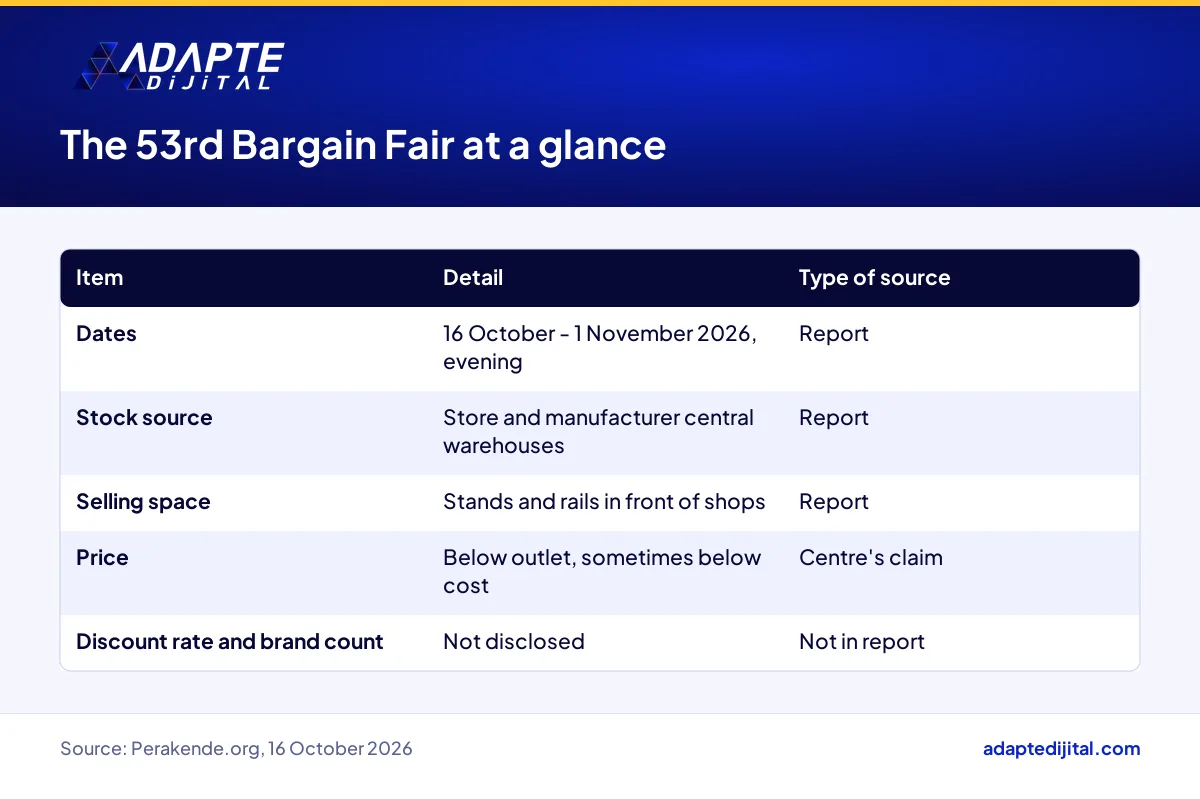
Outlet Center İzmit opened its 53rd Traditional Bargain Fair on 16 October, and it runs until the evening of 1 November 2026, with slow-selling items from stores’ and manufacturers’ central warehouses sold on stands and rails in front of the shops (Perakende.org, 16 October 2026). According to the centre’s announcement, prices are below outlet prices and, for some items, below cost; no discount rate was given.
Here is why it matters to you: every store has slow-moving stock, yet the timing, place and price rule for clearing it are often left to chance. For an owner selling clothing, shoes, home textiles or accessories, the fair in İzmit, a city east of İstanbul, shows how clearance can run on a fixed calendar in a limited format.
When does Outlet Center İzmit’s 53rd Bargain Fair run, and in what format?
The fair started on 16 October and ends on the evening of 1 November 2026 (Perakende.org). It sells slow-moving stock waiting in the central warehouses of stores and manufacturers. Products are displayed not inside the shops but on stands and rails set up in front of them. Brand and store counts, opening hours and the operator are not given.
Why does Outlet Center İzmit move slow-moving stock to the shop front?
For three reasons: visibility, separation and speed. A rail in front of the shop stops passing shoppers before they even step inside. Selling warehouse stock in a separate area keeps the new season inside the shop free of a discount look. A fixed end date gives shoppers a reason to buy today.
How can a store plan a clearance sale, using Outlet Center İzmit as an example?
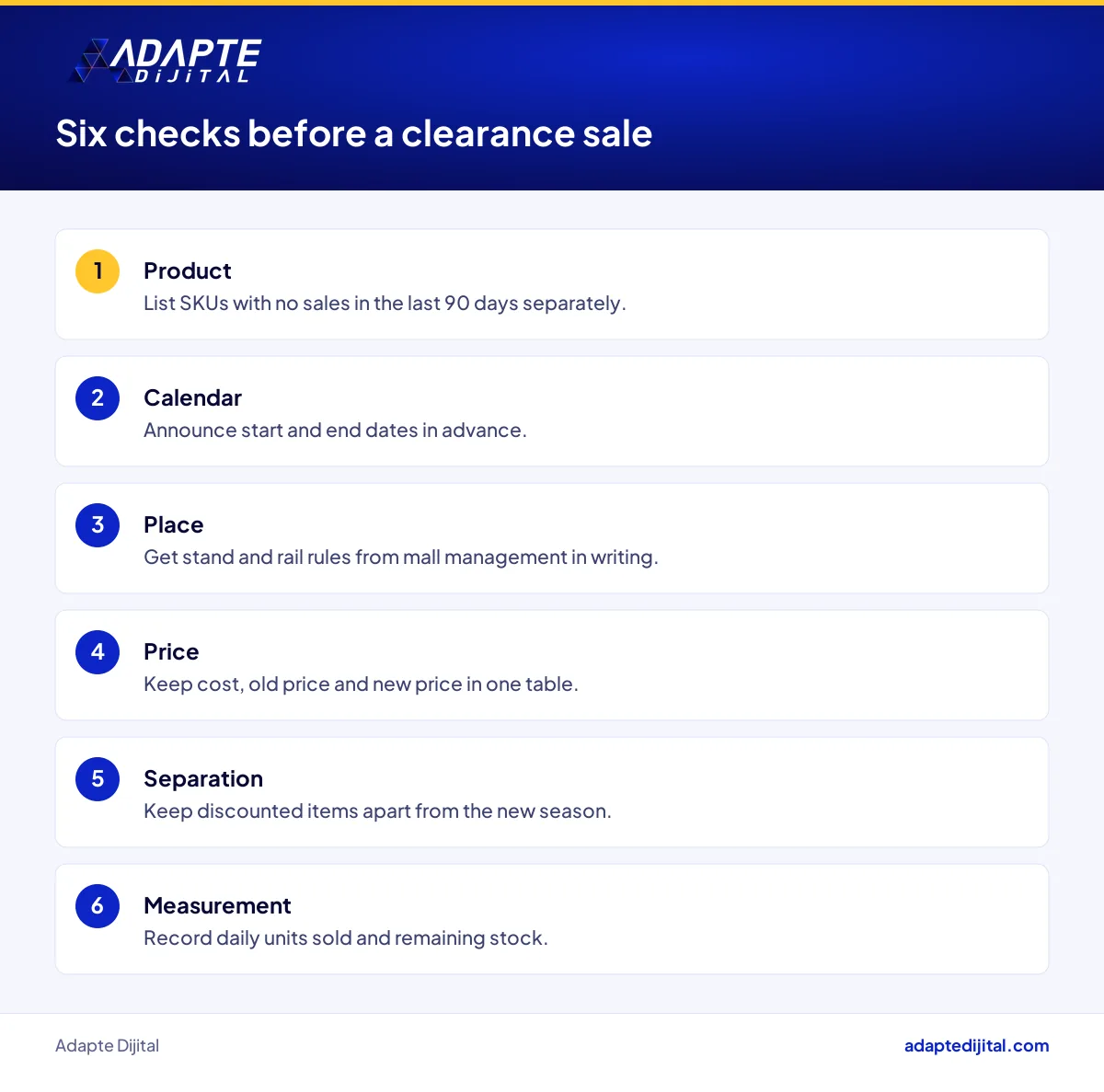
Through a calendar, a price rule and a channel decision. First decide which items to clear, then when, where and at which price step to sell them. Our recommendation as a desk: start the markdown decision in the warehouse, not at the till. The checklist below sums up the store and mall side of the plan.
- Product: list SKUs with no sales in the last 90 days, separately for warehouse and store.
- Calendar: announce start and end dates in advance, and do not extend them.
- Place: get the stand and rail rules from mall management in writing.
- Price: keep cost, old price and new price in one table.
- Separation: keep discounted items physically apart from the new season.
- Measurement: record daily units sold and remaining stock every evening.
Which businesses do fair discounts like Outlet Center İzmit’s affect, and how?
Manufacturers and stores turning warehouse stock into cash gain, and so can food and drink tenants who share the extra footfall. High-street shops and small boutiques nearby, trying to sell the same product groups at full price in the same weeks, struggle. In autumn 2026, shoppers buying clothing and home textiles in Kocaeli province may plan their late-October shopping around the fair dates.
How should a clearance campaign like Outlet Center İzmit’s be promoted online?
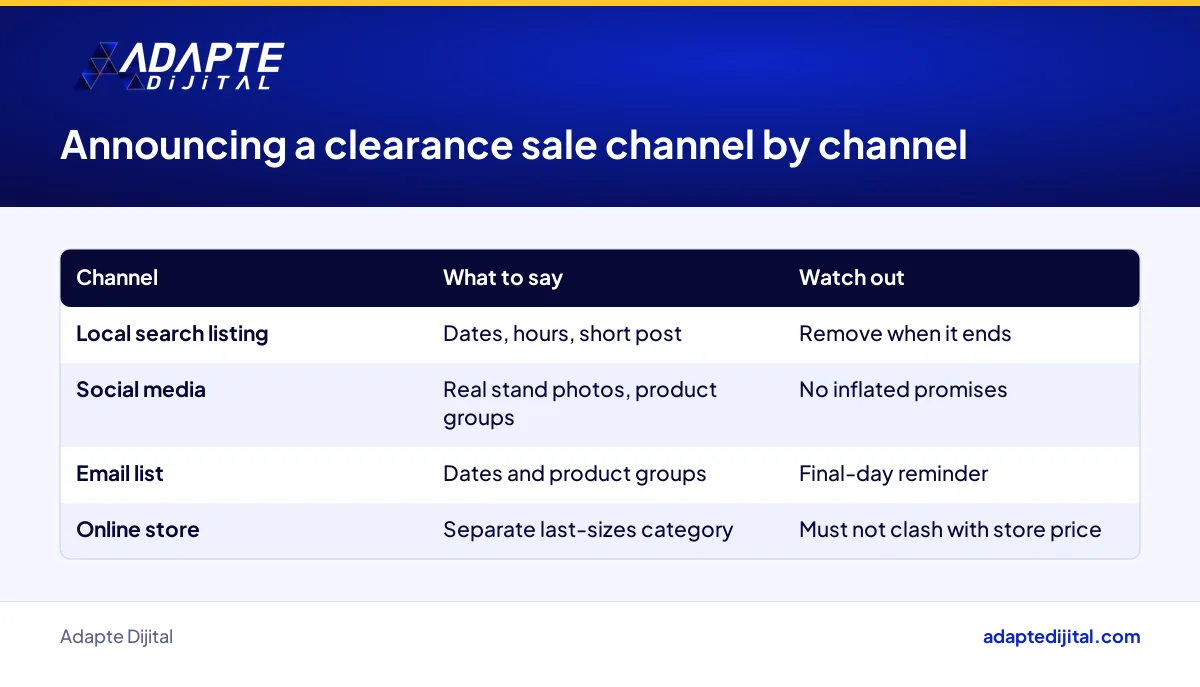
By stating the dates, place and product groups clearly. Shoppers have three questions about a fair-style campaign: when, where and what is on offer? Your local search listing, social media and email list should repeat the same sentence. If you cannot promise a discount rate, do not write one; name the product groups instead.
What should a store owner with slow-moving stock do this week, after Outlet Center İzmit’s example?
This week, count warehouse and store stock separately and list every item with no sales in the last 90 days. Put cost, old price and target price side by side for each one. Then set start and end dates and talk to mall management about the stand rules. If the list is not ready, do not announce a sale date.
Quick Summary
- Outlet Center İzmit’s 53rd Traditional Bargain Fair runs from 16 October to 1 November 2026 (Perakende.org, 16 October 2026).
- The fair sells slow-moving stock from the central warehouses of stores and manufacturers.
- Products are displayed on stands and rails in front of the shops.
- According to the centre, prices are below outlet prices and below cost for some items; no discount rate was given.
- The centre says it has offered factory sale prices since 1997; this is its own claim.
Short Glossary
- Outlet centre
- Outlet centre is the name used for a shopping centre where brands sell past-season and surplus stock at reduced prices.
- Stock clearance
- Stock clearance is the term used to describe selling slow-moving or past-season items within a set period and price rule to empty the warehouse.
- Tenant mix
- Tenant mix is the term used to describe how a shopping centre’s retail, food and service tenants are spread across types.
Frequently Asked Questions
Next Step
Let’s build your store’s clearance calendar and price rule together; fill in the consult your expert form.
Sources: Perakende.org, report on Outlet Center İzmit’s 53rd Traditional Bargain Fair, 16 October 2026 · Ministry of Trade, shopping malls page
Updated: October 2026
Sık Sorulan Sorular
It shows a long-running format, though how often it is held each year is not stated. A repeated format can become a shopping habit customers mark on their calendar.
According to the announcement, the centre has offered factory sale prices since 1997 and calls itself Türkiye’s first “real” outlet centre. These are the centre’s own claims, with no independent confirmation. The report comes from a single source and names no spokesperson.
Shopping malls (AVM, the Turkish term for a shopping mall) fall under the Ministry of Trade’s shopping mall rules, and the framework is on the Ministry of Trade shopping malls page. Rules on setting up stands in front of a shop may depend on the centre’s own house rules. A tenant should get those rules in writing from management before a campaign.
Warehouse stock ties up rent and capital, yet no customer sees it. The shop front brings it to customers without a new sales floor, so the shop’s sales per square metre draw on two stocks.
Draw a physical line between discounted items and the new season: the shop front for the fair, the inside at full price. This separation helps protect the share of full-price sales at the till.
No. It suits categories that sell from a rail, quickly and without fitting: T-shirts, socks, home textiles, accessories. For items that need sizing and trying on, stand sales add fitting room traffic and returns.
Items that have not sold for a long time, have broken size or colour runs and will be hard to sell next season too. Such an item just sits on the shelf and takes up warehouse space every day. Build the list from the sales report, not from guesswork.
Do the sum with your own numbers: the item’s cost to you, its selling price so far and the monthly cost of holding it. Selling below cost can make sense only if the cost of holding the item exceeds the gap. Check the rules on discount sales and price labels with the official source; this is not legal or financial advice.
Keep the discount time-limited, the space small and the tone calm. A brand that is always on sale teaches customers that waiting makes things cheaper. We look at how markdown expectations delay sales in our piece on Boyner’s price guarantee.
Warehouse stock goes straight to customers, cash flow eases and space opens for the new season. In return, the brand has to manage the cost of being seen at low prices with care.
During the fair, a boutique selling the same groups struggles on price; customers walk out, assuming the outlet is cheaper. The small shop’s answer is not price but alterations, personal advice and after-sales care.
The fair can raise footfall, an opening for cafes and restaurants. In a centre with a balanced tenant mix, a bargain trip stretches with a coffee and a meal. We cover a training and grant scheme for small food businesses in our piece on Coca-Cola Türkiye’s grant for women-led food businesses.
Campaign dates, opening hours and a short post. A shopper searching “İzmit outlet” who sees no current information will not make the trip; remove the post when the campaign ends.
Real stand photos, product groups and final-day reminders. Honest wording such as “last sizes” instead of inflated discount promises cuts returns and complaints. Add the store location to every post.
If the same item has a different price online, customers compare. Selling fair items only in store keeps channels apart. Opening a separate “last sizes” category online is a more controlled route.
The real aim of clearance is to turn money tied up in the warehouse back into cash. If the warehouse is full but the till is not turning over, the weeks before rent and payroll can be a natural window. On the day the campaign ends, you should already know where leftover stock goes.
Consider wholesale transfer, donation or another channel instead of a second markdown round. Permanent discounts damage the store’s price image. Record what is left as an input to next season’s buying decision.
When there is no time to build the price rule, local promotion and measurement plan together. We plan clearance calendars and announcements through our digital marketing work. Retail news is interpreted for you on our retail page.
It ends on the evening of 1 November 2026. The fair started on 16 October.
The announcement gives no rate. According to the centre, prices are below outlet prices and, for some items, below cost.
Verify with the official source; this is not legal or financial advice. Financially, the decision depends on cost, holding cost and cash needs together.