
Therapy practice website pages: 9 pages that build trust and a pre-launch checklist
A therapy practice website builds trust with 9 pages: home, about, areas of work, first session, online sessions, office and access, FAQ, privacy and contact. The first three show who you are, the middle three ease first-session nerves, the last three protect client data and meet the rules. If the copy is ready, preparation takes about two weeks.
Türkiye’s health promotion regulation also asks websites for two lines: the date of the last update and contact details for the site editor. Most new practices miss this. Below, each page comes with the time it takes, what you need and the most common mistake.
Which 9 pages make up a therapy practice website?
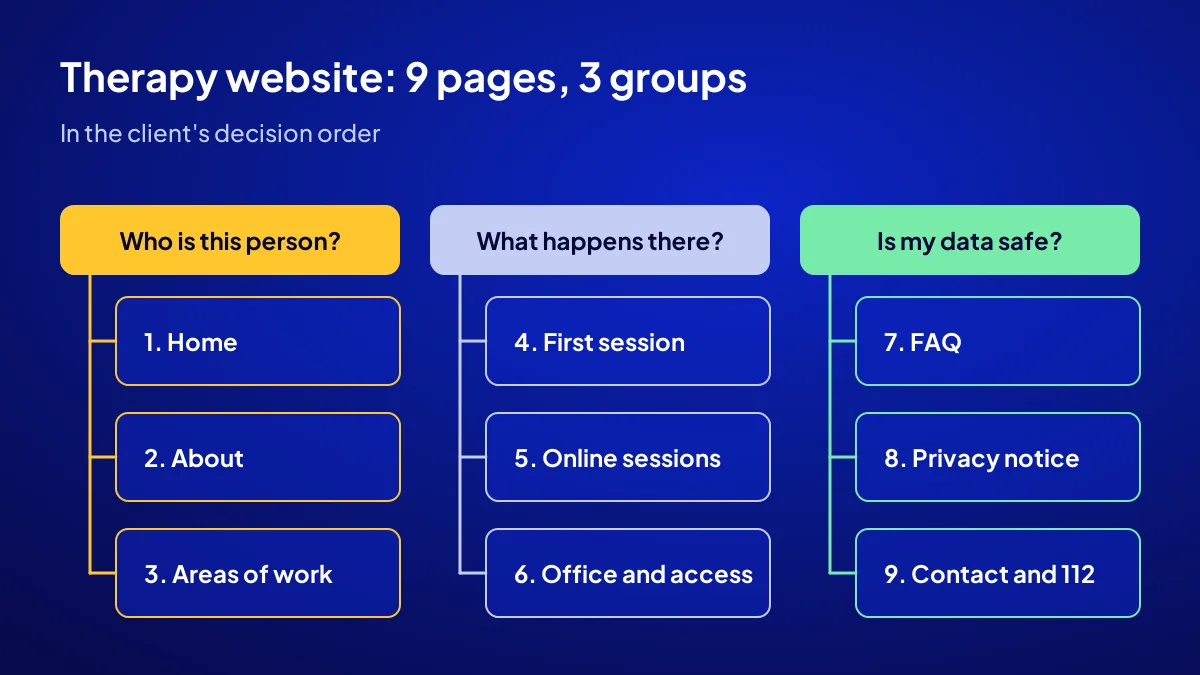
Group the nine pages in the client’s decision order: “who is this person”, “what will happen there”, “is my data safe”. Each page answers one question in a client’s mind. For how a site is built, see how is a website built.
- Home: title, district, area of work at a glance.
- About: training, title, supervision.
- Areas of work: with whom, using which methods.
- First session: length, flow, what to expect.
- Online sessions: how to join, privacy.
- Office and access: address, entrance, parking.
- FAQ: short and informative.
- Privacy and personal data: the privacy notice.
- Contact: simple form, phone, emergency note.
How are the 3 pages on title and approach prepared?
BU BÖLÜMÜN ÖZETİ
- 1. Home
- 2. About
- 3. Areas of work
The first three pages answer “can I trust this person?”. Google says its systems give even more weight to experience, expertise and trustworthiness on topics such as health. So documents speak here, not decoration: title, training, supervision, areas of work.
1. Home
Time: 1 day. Needed: a one-line positioning, title, district, phone. The first screen shows who, where and how to reach you. A selective client checks from a phone in Bebek or Mavişehir; with no answer in three seconds, they turn away before walking in.
2. About
Time: 1 day. Needed: diploma, title certificate, training and supervision list. Use your title exactly as documented; clinical psychologist, psychologist and psychological counsellor are different titles. This page answers Google’s “who created the content” question.
3. Areas of work
Time: 2 days. Needed: age groups, topics and the methods you are trained in. Name the method, not the outcome. Leave out any method you are not trained in or whose evidence is disputed.
Which 3 pages ease first-session nerves?
BU BÖLÜMÜN ÖZETİ
- 4. First session
- 5. Online sessions
- 6. Office and access
For someone coming to therapy for the first time, knocking on the door is the hardest moment. The middle three pages let them rehearse it: how the session goes, how online works, how to reach the office. Why an Instagram feed cannot answer these alone is covered in is Instagram enough for a therapy practice.
4. First session
Time: half a day. Needed: session length, first-session flow, confidentiality policy. A plain line is enough. Fees are not written here; they are shared by phone or when booking.
5. Online sessions
Time: half a day. Needed: your video tool, joining steps, a quiet-room tip. If you do not work online, skip this page; showing a service you do not offer erodes trust.
6. Office and access
Time: half a day. Needed: full address, map, nearest stop, parking, a photo of the entrance. Details matter to a premium client: a separate entrance, short waits, a calm corridor. Finding parking in Nişantaşı is a test of patience; name the nearest car park.
How is client data protected on the site?
BU BÖLÜMÜN ÖZETİ
- 7. FAQ
- 8. Privacy and personal data
- 9. Contact and emergency note
The last three pages protect client data. Mental health information is special category data under Türkiye’s Personal Data Protection Law, processed under strict conditions. The safest path is not to collect it at all. The form asks for name, phone and a suitable time, not for the client’s story.
7. FAQ
Time: 1 day. Needed: the 6 or 9 questions you hear most on the phone. Write informative answers to “psychologist or psychiatrist?”, “how many sessions?”, “how is confidentiality protected?” without steering anyone.
8. Privacy and personal data
Time: 1 day, with legal support. Needed: privacy notice, cookie notice, retention period. Do not publish a template without a discreet lawyer reading it; with health data there is no margin for error.
9. Contact and emergency note
Time: half a day. Needed: phone, simple form, hours and a line saying “In an emergency, call 112”. State when you reply to form messages. Someone in crisis should be pointed to the emergency line, not a form.
Which two lines does the regulation require on a website?
BU BÖLÜMÜN ÖZETİ
- Line 1: last updated
- Line 2: editor contact
- How you look in search results
The health promotion regulation of 12 November 2025 requires websites to state clearly the date of the last update and contact details for reaching the site editor. Keywords and search result information cannot break the rules either, so page titles and descriptions are in scope.
Line 1: last updated
Time: 10 minutes. Add a line such as “Last updated: October 2026” at the bottom of every page, and update it whenever the page changes.
Line 2: editor contact
Time: 10 minutes. Put the content owner’s name and email in the footer; working alone, that is you.
How you look in search results
Time: 1 hour. Read each page’s title and description. Phrases like “best psychologist” or “guaranteed solution” break the rules even if they only appear in search results.
Which sentences stay off the site?
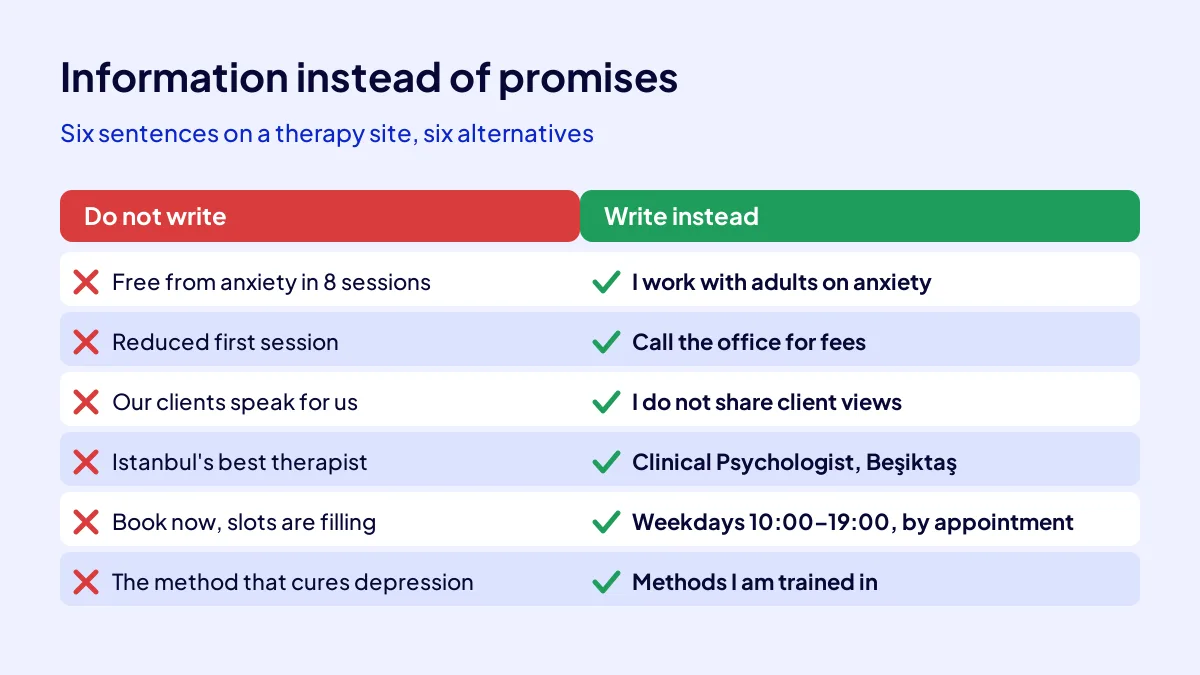
The regulation bans fee, discount and campaign information, turning client satisfaction into promotion, and directly steering content. On a psychologist’s site, outcome and time promises join the list. The table shows what to write instead of the most common sentences. The full rules are in therapy practice advertising rules.
| Do not write | Write instead |
|---|---|
| “Free from anxiety in 8 sessions.” | “I work with adults on anxiety.” |
| “Reduced first session.” | “Call the office for fee information.” |
| “Our clients speak for us.” | “In line with confidentiality, I do not share client views.” |
| “Istanbul’s best therapist.” | “Clinical Psychologist, Beşiktaş.” |
| “Book now, slots are filling up.” | “Appointments: weekdays 10:00–19:00.” |
| “The method that cures depression.” | “Methods I am trained in: …” |
Common mistake: Launching a template site without deleting its “happy client reviews” section. Even empty, the heading leaves open a door the regulation bans.
Which 9 items do you check before launch?
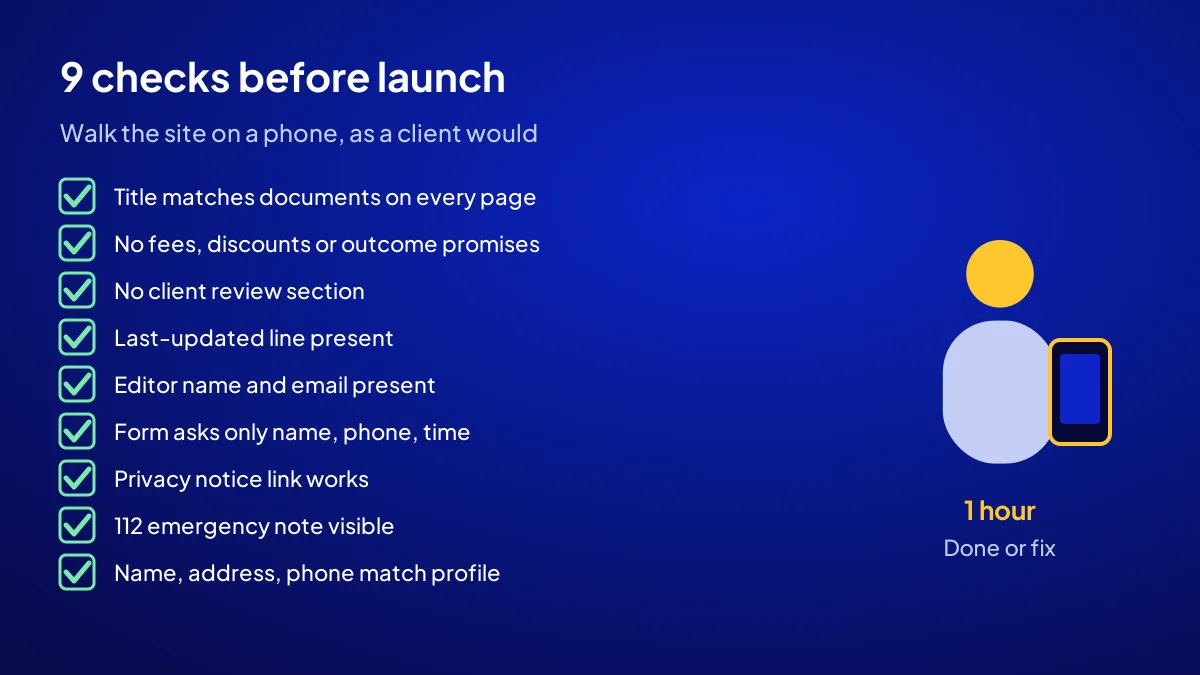
Before launch, walk the site on a phone as a client would. The nine checks take about an hour; each is “done” or “fix”. The broader three-month plan is in the first 90 days of a new therapy practice.
| Check | Where to look | Status |
|---|---|---|
| Title matches documents on every page | About, footer | …… |
| No fees, discounts or outcome promises | All pages | …… |
| No client review section | Home template | …… |
| Last-updated line present | Bottom of each page | …… |
| Editor name and email present | Footer | …… |
| Form asks only name, phone, time | Contact | …… |
| Privacy notice link works | Below the form | …… |
| 112 emergency note visible | Contact | …… |
| Name, address, phone match Google profile | Footer and profile | …… |
Getting the site built in one go
The Build Your Digital Brand campaign includes positioning, identity, a domain, one year of hosting, a 6-page brand site and 108 AI SEO-ready articles across 6 keyword groups. Three of the nine headings, such as FAQ, online sessions and access, sit as sections or articles. TRY 36,000 + VAT, upfront; the domain is in your name. Details are on the campaign page.
The site’s place in promotion
A site works together with the profile, content and colleague network. See the whole picture in our new therapy practice promotion guide.
Quick Summary
- Nine pages answer three questions: who, what happens there, is my data safe.
- With copy ready, the site takes about two weeks.
- The regulation requires a last-updated line and editor contact.
- The form collects no mental health information; name, phone and time are enough.
- No fees, discounts, outcome promises or client reviews on the site.
- Nine items are checked on a phone before launch.
Short Glossary
Privacy notice: A privacy notice is the legal text used to tell people why and how their personal data is processed.
Special category data: Special category data is the legal category used to protect sensitive information such as health under stricter conditions.
Site editor: The site editor is the person whose contact details are used to reach whoever is responsible for website content.
Next Step
To set up positioning, identity, website and 108 articles together, apply for the Build Your Digital Brand campaign. There are 12 brand slots, deadline 1 November 2026; just mention the 10% coupon when you apply.
Frequently Asked Questions
Source: Google Search Central — Creating helpful, reliable, people-first content
Sık Sorulan Sorular
The health promotion regulation bans sharing fee, discount and campaign information. Sharing fees by phone or when booking is the safest path. Check the regulation for your own case.
Mental health information is special category personal data, processed under strict conditions. Asking only for name, phone and a suitable time protects both confidentiality and you.
The package includes a domain, one year of hosting, a 6-page brand site and 108 AI SEO-ready articles; the domain is in the client’s name and second-year hosting renewal is on the client. TRY 36,000 + VAT; TRY 43,200 with 20 percent VAT (check the current rate on your invoice).
Updated: October 2026