
7.5% of Businesses Use AI
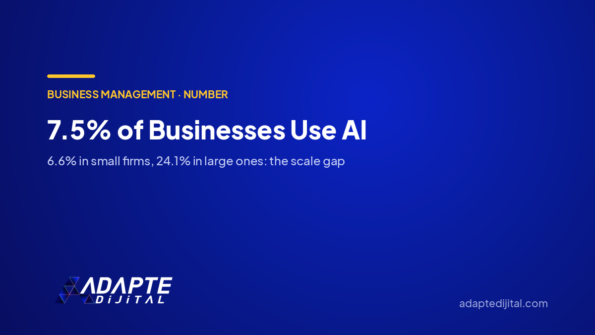
Seven businesses in a hundred use AI. Which side of that line is yours on? Türkiye’s statistics office published its first official AI figures. Adoption among enterprises rose from 2.7 percent in 2021 to 7.5 percent in 2025. Three times higher in four years.
The real story is not in the average but in the spread. Among businesses with 10-49 employees the rate is 6.6 percent. Between 50 and 249, it is 9.6. At 250 and above, 24.1. So one in four large businesses uses it. In small ones, roughly one in fifteen.
What the Number Says
BU BÖLÜMÜN ÖZETİ
- The scale gap is widening
- The sector gap is even bigger
- Use clusters on the sales side
Three findings stand out.
The scale gap is widening
The difference between large and small is nearly fourfold. It does not come from access to technology; the tools are open to everyone and most are cheap. It comes from who gives the subject time. A large business has a unit thinking about it. In a small one, the same person handles sales and production.
The sector gap is even bigger
In information and communication the rate is 47.1 percent. In finance and insurance, 21.1. In other sectors it drops sharply. What counts as ordinary in one sector counts as pioneering in another. So compare yourself with your sector, not the national average. That is where you compete.
Use clusters on the sales side
The most common area among adopters is marketing and sales, at 46.5 percent. Production and service processes, R&D and business management follow. So the first step is usually taken on the customer-facing side. There are two reasons. Results show up quickly and risk stays low. A misfired email draft is cheaper than a misfired production decision.
What the Headline Misses
BU BÖLÜMÜN ÖZETİ
- The rate fell for a year
- Most non-users are not even considering it
- Individuals are ahead of businesses
Three details matter.
The rate fell for a year
The series does not rise smoothly. It reached 5.5 percent in 2023, dropped to 4.4 in 2024, then jumped to 7.5 in 2025. That dip says something: some early attempts were abandoned. Then, as tools matured, people came back. So dropping out is part of this road. What matters is not giving up on trying.
Most non-users are not even considering it
Only 9 percent of enterprises not using AI said they were thinking about it. The rest do not have it on the agenda at all. Read that as competitive intelligence. If you have ten competitors, nine of them probably never discuss this. That is an opening. Even a small pilot would set you apart.
Individuals are ahead of businesses
About one in five people in the country uses generative AI. In businesses the rate is 7.5 percent. The gap means something concrete: your employees may already be using these tools. Where the organisation sets no rules, use advances on its own, unrecorded and unsupervised.
What a Business Should Do
BU BÖLÜMÜN ÖZETİ
- Cost: an hour to measure your own rate
- First step: compare against your sector
- Next step: bring the shadow use into order
Three steps suffice.
Cost: an hour to measure your own rate
Ask the team one question: who uses an AI tool in their work, and for what? An hour-long round gives you your own rate. Most businesses find it higher than expected, because the use started off the record. Nobody said anything because nobody asked.
First step: compare against your sector
The national average misleads. If you are not in information technology, 47 percent is not your benchmark. Look at what competitors in your sector are doing. Is anyone making a difference in customer communication? In quote preparation, in stock forecasting? Those three questions finish your sector scan in an afternoon.
Next step: bring the shadow use into order
If employees are using it, write a rule. Which data can go in, which cannot? That rule fits on one page and can be written today. Long rules go unread; short ones get applied. The level ruler is the natural sequel.
7.5 percent is a low rate. But a low rate means being early, not being late.