
Multinet Up Puts Meal Card Use at 17.2%: Card or Cash, Which Costs an Employer Less?
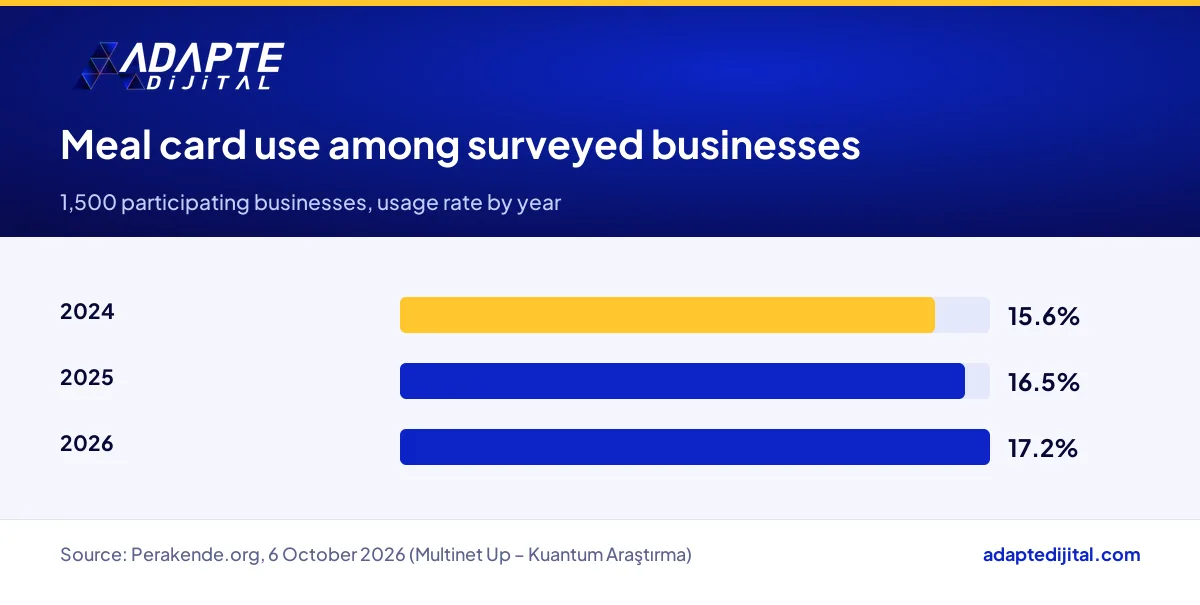
Meal card use among the businesses surveyed by Multinet Up, a Turkish employee-benefits provider, reaches 17.2% in 2026, according to a study carried out with Kuantum Araştırma (Perakende.org, 6 October 2026). The rate was 15.6% in 2024 and 16.5% in 2025. The survey covers 1,500 businesses in 12 provinces and 15 main sectors, and 80.4% of participants are micro or small companies.
What it means for you: card or cash meal support is a payroll cost decision in 2026. The daily income tax exemption is TL 330 including VAT on a card and TL 300 in cash. Multiply the gap by headcount and working days and it shows in the annual budget.
How fast is meal card use growing in the Multinet Up survey?
Slowly, but every year. Among surveyed businesses, use moves from 15.6% in 2024 to 16.5% in 2025 and 17.2% in 2026. The satisfaction score rises from 4.3 to 4.5 and then 4.6 out of 5. It is steady spread, not a sudden jump.
What is the 2026 tax gap between a meal card and a cash meal allowance in Türkiye?
According to Multinet Up’s daily meal allowance exemption page, the 2026 income tax exemption is TL 330 a day including VAT on a meal card and TL 300 a day in cash. The legal basis is an amendment to the General Communiqué on Income Tax in the Resmî Gazete, Türkiye’s Official Gazette, dated 31 December 2025, issue 33124 (5th repeat). The amounts apply until 31 December 2026.
Meal card or cash: which option suits which Turkish employer?
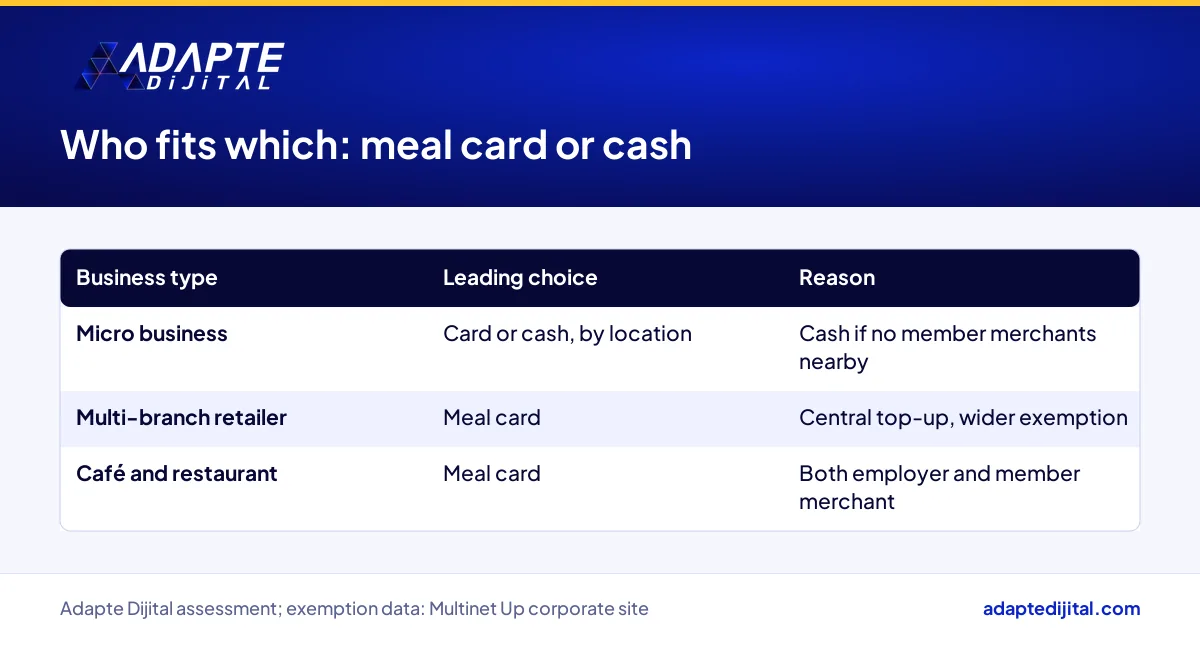
The card leads on tax and premiums; cash leads on flexibility. Cash lets staff spend anywhere, but its exemption limits are narrower. Four criteria and your business profile decide the winner.
| Criterion | Meal card | Cash |
|---|---|---|
| Income tax exemption (2026, daily) | TL 330 including VAT | TL 300 |
| SGK premium (per provider page) | Uncapped exemption | Exemption up to TL 158 |
| Spending freedom | Limited to member merchants | Unrestricted |
| Admin workload | Provider contract, monthly top-up | Extra line on payroll |
| Who it fits | Larger teams, multi-branch retailers | Micro firms with few member merchants nearby |
How does wider meal card use affect different Turkish businesses?
Winners are restaurants, cafés and grocers that accept the cards, because cardholders head their way at lunch. Small traders who are not member merchants lose out; a customer asking to pay by card walks out the door. Micro employers can ease payroll costs, while accounting offices and food suppliers feel it indirectly.
What does the meal card decision change on a business’s digital side?
Two things. As a member merchant, cardholders find you on maps and in search; if your card acceptance is invisible, they go next door. As an employer, meal support flows as data through payroll and HR software; scattered data means redoing the same sum by hand every month.
What should a Turkish business owner do about meal benefits this week?
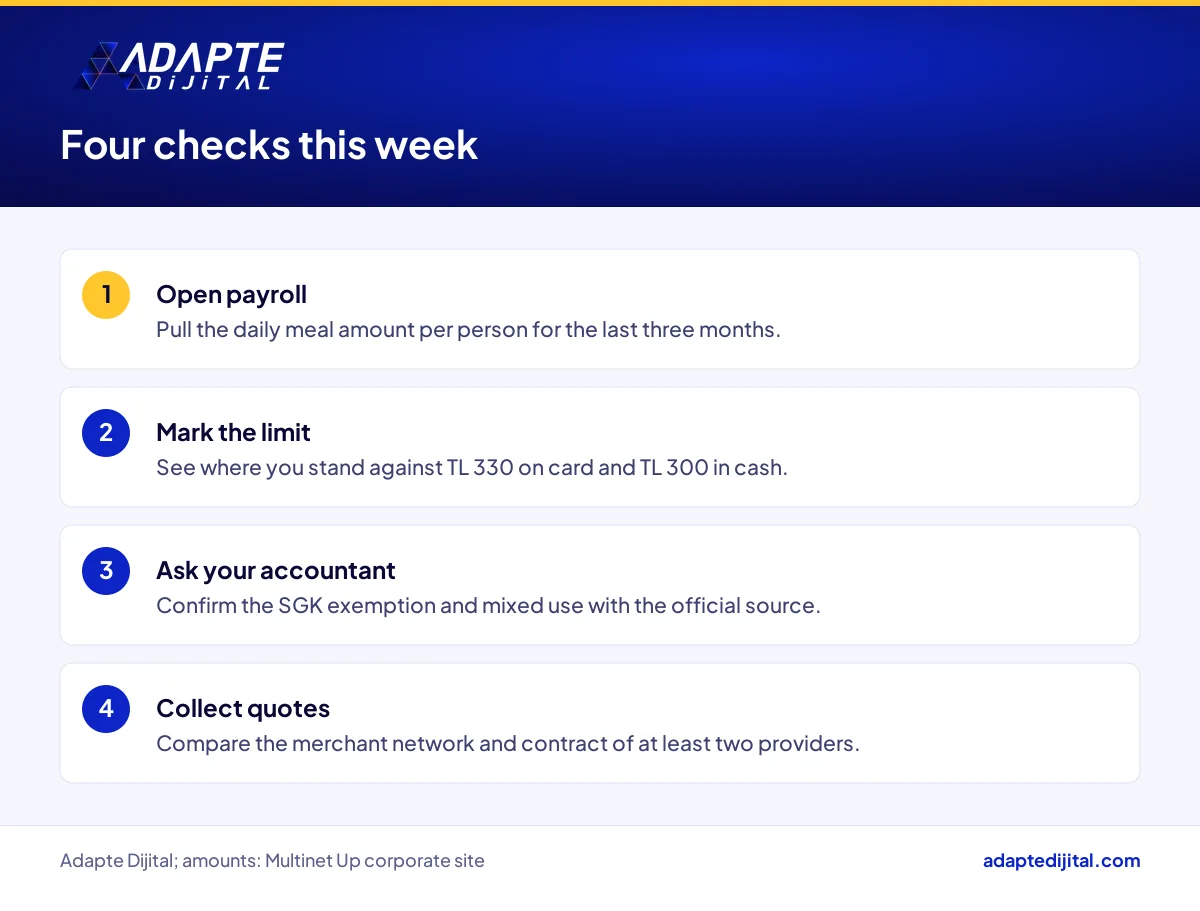
Four tasks. Work out what meal payments really cost on payroll, and run both limits through it with your accountant. Get written quotes from at least two providers. If you are a member merchant, update your map listing and website for card acceptance the same week.
Quick Summary
- According to Perakende.org, meal card use among surveyed businesses reaches 17.2% in 2026.
- The survey covers 1,500 businesses in 12 provinces and 15 sectors, and 80.4% of participants are micro or small firms.
- According to Multinet Up’s page, the 2026 income tax exemption is TL 330 including VAT on a card and TL 300 in cash.
- The card leads on cost, while cash leads on spending freedom.
- For cafés and shops that accept meal cards, showing that acceptance on maps and the website is essential.
Short Glossary
- Meal allowance exemption
- Meal allowance exemption is the rule used to keep an employer’s daily meal support for staff outside income tax up to a set amount.
- Member merchant
- Member merchant is the term used for a restaurant, café or grocer that signs with a meal card provider and accepts card payments.
- Income tax base
- Income tax base is the term used for the wage amount on which an employee’s income tax is calculated.
Frequently Asked Questions
Next Step
If you want to work out together how your meal benefit choice hits payroll and how your card acceptance shows up in local search, fill in the consult your expert form.
Sources: Perakende.org, 6 October 2026 · Multinet Up, daily meal allowance exemption page (linked in the text).
Updated: October 2026
Sık Sorulan Sorular
No. The rate reflects use within the 1,500 surveyed businesses. The report gives no fieldwork dates, method, or list of provinces and sectors, so do not read it as a national share.
Some 80.4% of participants are micro or small companies. The finding is closer to the neighbourhood shop and small office than to a large holding group.
Ali Emre Sever, CEO of Multinet Up, says the company does not assess its growth opportunity only through more businesses starting to use meal cards. The report puts its 2026 brand awareness at 94.2%, without saying who measured it or against which brands.
Meal support up to the limit is not added to the employee’s income tax base. Agree with your accountant how any excess is taxed, and make sure your payroll software treats the two limits separately.
SGK is Türkiye’s Social Security Institution. According to Multinet Up’s page, meal card payments are exempt from SGK premiums with no cap, while cash payments are exempt up to TL 158 in 2026. That amount is not confirmed by the Official Gazette or SGK, so verify it with SGK first.
That is not settled. Today’s amounts run until 31 December 2026, so check the new rules at year end before you lock your 2027 budget.
Four are enough: income tax exemption, SGK premium, spending freedom and admin workload. The first two are money; the last two are workflow. The final row shows who each option fits.
On cost, the card wins. Wider exemptions on income tax and SGK mean a lower payroll burden for the same benefit, and the gap grows with headcount.
Let’s say your shop sits in an industrial estate with no card-accepting restaurant nearby. The card just sits in the employee’s wallet, and the tax advantage loses its point.
On a team of three to five, you count every lira to make it to month end. The card’s wider exemption gives the same benefit at lower cost, unless nobody near your staff accepts it.
As branches multiply, tracking cash meal payments store by store gets harder. A card lets head office top up everyone in one go and see a single line on payroll.
A café owner is both employer and member merchant. You can pay your own team on a card and use the exemption, and you draw cardholders at lunch. The provider agreement sets your terms; read its fee clauses before they eat into your average basket.
Meal card spending carries restaurant and grocery turnover, and that flows indirectly into supplier orders. If you are a food producer looking at outside funding to grow, see our piece on how Doğuş Çay’s IFC financing shows a food firm what lenders expect. We gather the rest of the sector’s news on our retail page, where we interpret the retail agenda for you.
At lunch, an employee searches for a nearby place that takes their card. If your Google Business Profile lacks payment options, current hours or a menu, you fall behind locally. Check your listing in the provider’s app too.
The question asked most at the till needs a clear answer: which cards you take, and when. Use the same wording on the menu, the contact page and the door sticker.
Card top-ups, payroll and leave days should live in one system; otherwise staff on leave still get topped up. We look at how benefit orders match HR data in our piece on how TokenFlex links benefit orders to the ERP HR module.
Open the last three months of payroll and note the meal amount per person, per day. Mark it against the TL 330 card and TL 300 cash limits; anything above goes to tax for no good reason.
Ask three things: how the card and cash limits hit your payroll, whether the SGK exemption amount matches current legislation, and whether a mixed approach is possible. Verify with the official source; this is not legal or financial advice.
Check whether the member merchant network sits around where your staff work, how easy top-ups and cancellations are, and how long the contract runs. We set up the side where your card acceptance shows correctly in local search and on your site through our digital consulting service. When the till is quiet, the problem is sometimes not price but customers who cannot find you.
If there are places near your staff that accept the card, the card usually comes out ahead on cost. If not, cash may work better; make the call with your accountant, based on your payroll.
No. The rate shows use among the 1,500 businesses in the survey run for Multinet Up and should not be generalised to the whole country.
The current amount applies until 31 December 2026. For the 2027 amount, check the rules published at year end with the official source.