
MKS warns about fake fire door certificates, how can a business verify the paperwork?
MKS General Manager Yusuf Adnan Botanlıoğlu has warned businesses about the risk of fake fire door certificates (Perakende Türkiye, 28 September 2026). According to the warning, the issuing body, manufacturer name, product model, dimensions and fire resistance class on the certificate must match the delivered door exactly. The certificate number must also be checked against the issuing body’s own records.
Here is what it means for you: if you are buying doors for a store, a warehouse or a unit in an AVM (the Turkish term for a shopping mall), the paper in your hand is not proof on its own. You need to compare the document with the door on site and with the issuing body’s record. That takes five matching items, one number check and three standard names.
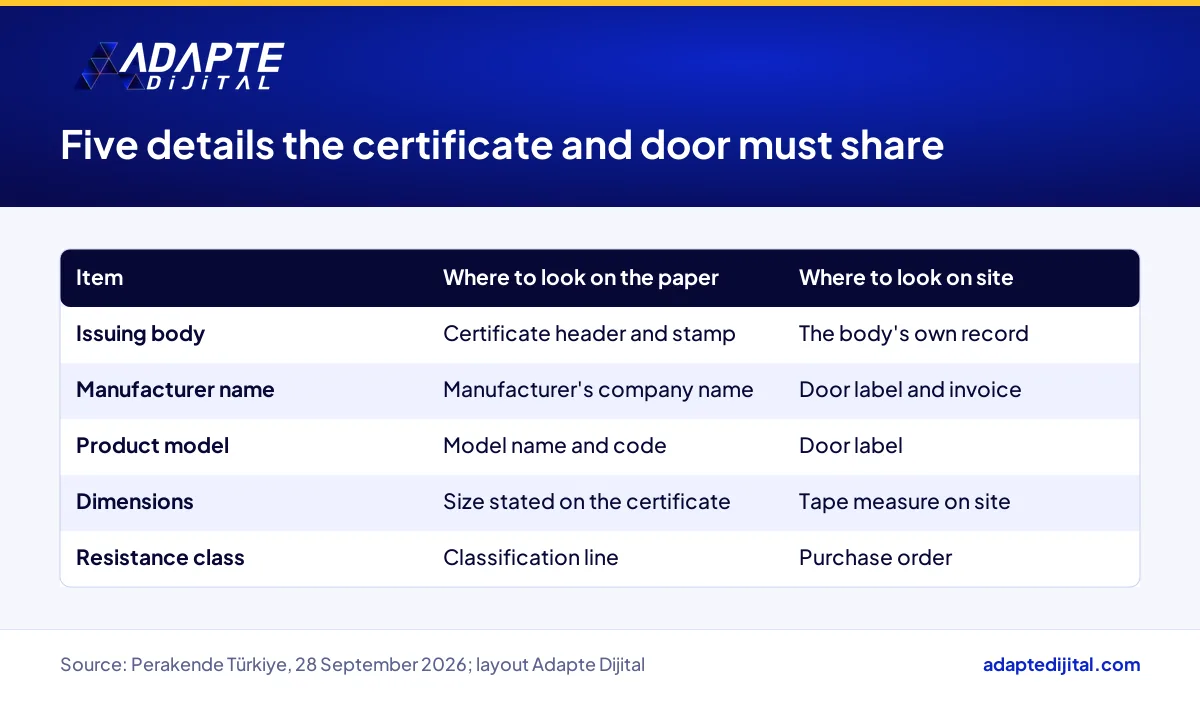
Which five details on an MKS-style fire door certificate must match the delivered door?
BU BÖLÜMÜN ÖZETİ
- Step 1: Match the issuing body and the manufacturer
- Step 2: Measure the model and size on site
- Step 3: Read the fire resistance class
Five details must match: the issuing body, the manufacturer name, the product model, the dimensions and the fire resistance class. If even one is off, the document may not belong to that door. Run the check on delivery day, before anyone signs the handover record.
Step 1: Match the issuing body and the manufacturer
Compare the body named on the certificate and the manufacturer’s company name with the name on the invoice. The dealer and the manufacturer can have different names, and that is normal. What is not normal is a manufacturer on the certificate who never appears on the door’s label.
Step 2: Measure the model and size on site
Match the model on the certificate with the model on the door label. Take the size with a tape measure and write it next to the figure in the document. Then compare the hardware details listed in the test report with what is fitted on the door in front of you.
Step 3: Read the fire resistance class
The resistance class shows how long the door is classified to hold back a fire. The time you ordered and the class on the certificate must be the same. If they differ, you did not receive what you ordered.
Which businesses does a fake fire door certificate put at risk?
It puts businesses that open new stores, set up warehouses or lease mall units most at risk. These buyers usually get doors through a contractor or a fit-out crew. They often file the certificate without ever reading it, and the risk stays with whoever skipped the check.
How do you verify a fire door certificate number?
You verify it in the issuing body’s own records. A logo or stamp on the page is not enough. Go to the body’s official website yourself, and do not treat a link or QR code printed on the document as your only source.
Step 4: Look up the number in the issuing body’s records
If the Turkish Standards Institution issued the certificate, the TSE website has an online certificate lookup under its e-Services section. If another body issued it, use that body’s own lookup channel. Save a dated screenshot of the result.
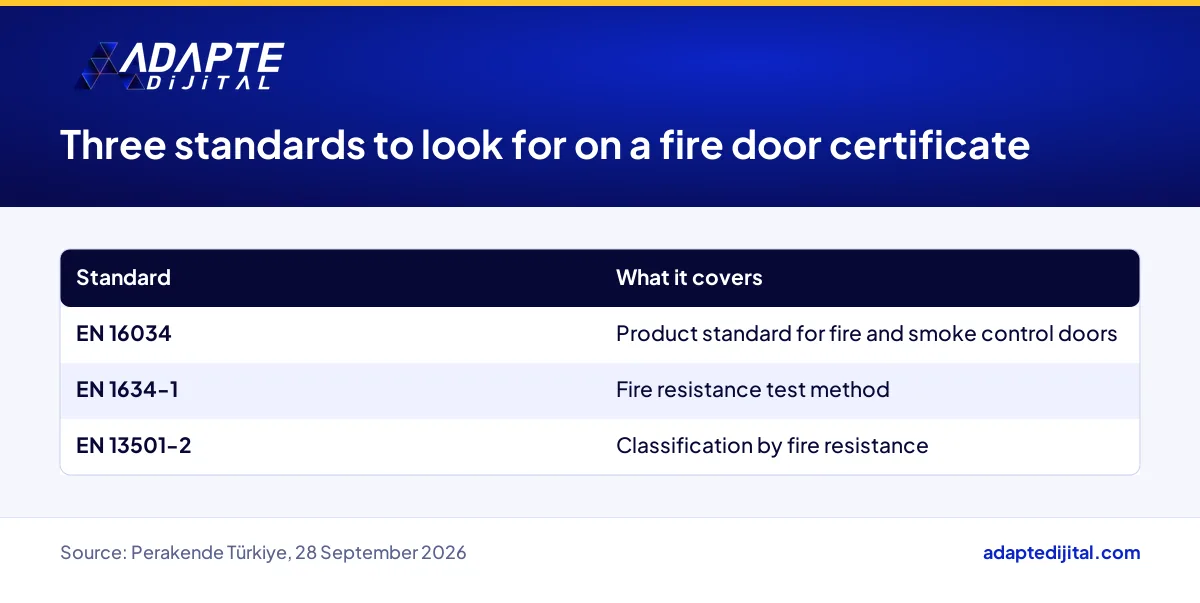
Step 5: Look for the three standard names on the document
The report names three European standards. EN 16034 is the product standard for fire and smoke control doors. EN 1634-1 is the fire resistance test method, and EN 13501-2 is the classification standard.
Why does MKS put verifiability ahead of price when buying fire doors?
Because the gap between a document and a product only shows up during a fire. The report cites a UK government statement of 16 May 2018. It says a door at Grenfell Tower, made to resist fire for 30 minutes, failed in a police test after about 15 minutes. The fire was in 2017; the statement on the door test came in 2018.
How should fire door paperwork be archived and checked online?
Open one digital folder per door: certificate, test report, lookup screenshot, photo of the door label and handover record. Name the folder after the store and the door’s location. When an inspector arrives, you open the file instead of searching for it.
What should a store owner buying fire doors do this week?
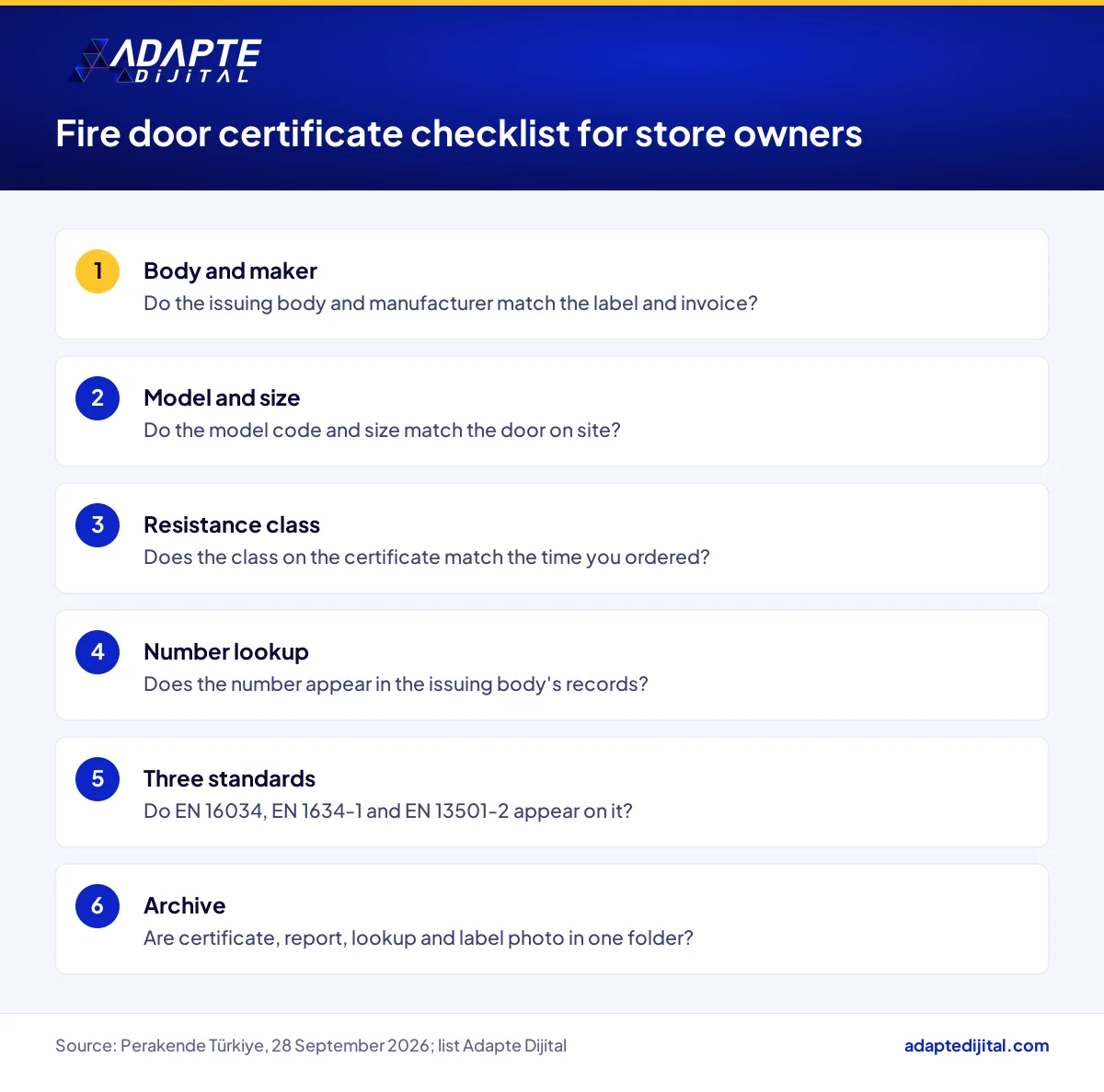
This week, open the paperwork for your existing doors one by one and run the checklist below. If you are placing a new order, ask for the certificate at the quote stage, not after delivery. The list has five matching items and two checks.
Quick Summary
- MKS General Manager Yusuf Adnan Botanlıoğlu warned about the risk of fake fire door certificates (Perakende Türkiye, 28 September 2026).
- The issuing body, manufacturer, model, dimensions and resistance class must match the delivered door exactly.
- The certificate number should be checked in the issuing body’s own records.
- Look for EN 16034, EN 1634-1 and EN 13501-2 on the document.
- Per the 16 May 2018 statement cited in the report, a 30-minute door at Grenfell failed in a test after about 15 minutes (Perakende Türkiye).
Short Glossary
- Fire resistance class
- Fire resistance class is the label used to show how long a door is classified to resist fire.
- Conformity assessment
- Conformity assessment is the process used to determine, through testing and inspection, whether a product meets the relevant standard.
- Handover record
- Handover record is the signed document used to record the condition in which a product was received.
Frequently Asked Questions
Next Step
If you would like to bring your store and warehouse paperwork into one checking routine, fill in the consult your expert form; we get back to you based on your business’s situation.
Sources: Perakende Türkiye, 28 September 2026 · Ministry of Trade, information on the Regulation on Shopping Centres · Turkish Standards Institution
Updated: October 2026
Sık Sorulan Sorular
In Türkiye, shopping malls fall under the Regulation on Shopping Centres, which sets rules for design approval and licensing (Official Gazette, 26 February 2016, issue 29636). A store operator’s building safety paperwork ties into that process. Check the current text of the regulation with the official source; this is not legal or financial advice.
On the high street, there is no mall management to run the check, so it falls straight to the owner. We look at how chains make the street-or-mall call in our piece on Evidea’s new Atakum store. In a warehouse, the door often separates the stock area, so it protects goods and people at the same time.
Manufacturers and dealers whose certificates can be verified gain indirectly. When a buyer asks for paperwork, a seller with open records can step out of the price race and sell on trust. Businesses that keep insurance and renovation files also end up with a cleaner archive.
Ask the seller for the full test and classification report. Send a written question to the body named on the report. Until you get an answer, write “certificate verification pending” on the handover record.
Never write a price down on its own; always write its verification status next to it. Use this template: match score = matched items / 5. If the score is below 5/5, if the number lookup fails or if the three standards are missing, drop that quote whatever the price.
Reading the certificate from the supplier’s PDF and never looking at the door label. In that case, a genuine certificate can travel with the wrong door. Buy cheap, buy twice, as the saying goes, except here the second purchase can come after a fire.
Put the quotes in a table with three columns: price, match score and number lookup result. First set aside the quotes that score 5/5 and pass the lookup. Compare price only among those, so you only ever negotiate between verified products.
A serious supplier lists product models, standard names and certificate numbers openly on its site. Look twice at a seller whose search results show only campaigns and prices, with no certificate page. Business buyers who cannot find the paperwork online often move on without asking for a quote.
If you sell doors, insulation or building materials, yes. Publishing certificate numbers with their lookup channel saves business buyers time. When you add forms and tracking tools to your site, also read our piece on the cookie consent panel decision.
For each door, ask in this order: do 1) the issuing body, 2) the manufacturer name, 3) the model, 4) the size and 5) the resistance class match; 6) does the number appear in the issuing body’s records; 7) do EN 16034, EN 1634-1 and EN 13501-2 appear on the document? Without seven yes answers, the door file stays open.
Add a clause saying the certificate number will be given in writing before delivery and payment will be held if it cannot be verified. That clause filters out window dressing at the quote stage. Have your lawyer review the contract wording.
We set up certificate archives, supplier checks and digital record keeping with businesses as part of our digital consulting work. We gather other rules that matter to store operators on our retail page, where we read the retail news for you.
Compare the five details on the certificate with the door label, and look up the certificate number in the issuing body’s own records. If both checks pass, you have strong evidence the document belongs to that door.
If the door stands in your business, you should see the file too. Ask the contractor in writing for the certificate, the report and the lookup result, and add them to your archive.
No. The report gives no number or rate of fake certificates in Türkiye; the warning is framed as a general buying principle.