
Şımart Teknoloji opens a 15,600 m² plant in Ankara, how does a marketplace brand scale up?
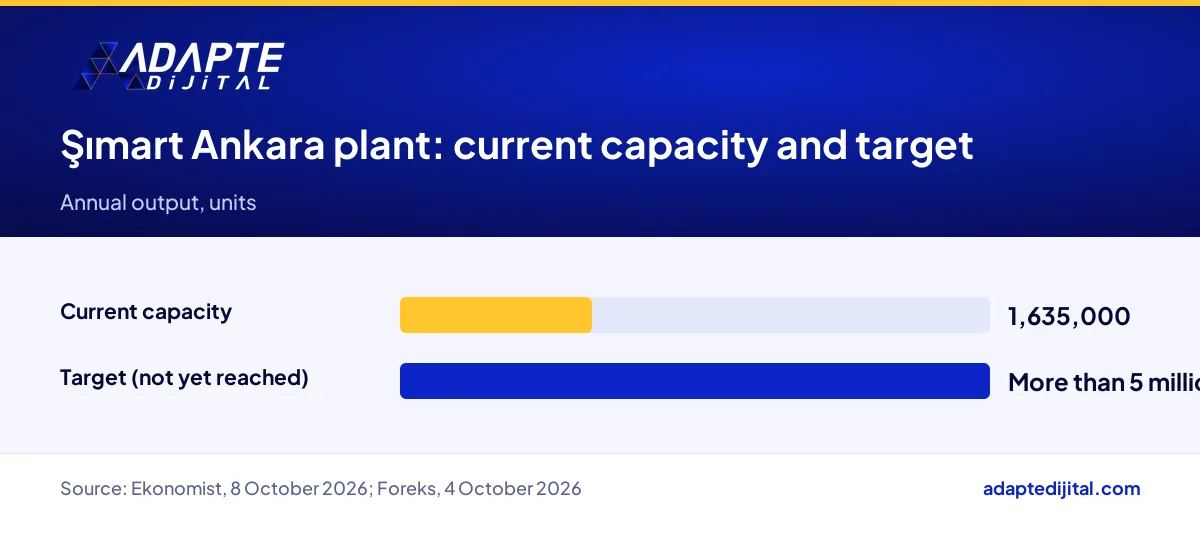
Şımart Teknoloji, a Turkish robot vacuum and smart device brand, opened its 15,600 m² production plant in Kahramankazan, Ankara on 3 October 2026 (DHA, 3 October 2026; Foreks, 4 October 2026). The plant’s current annual capacity is 1,635,000 units, the company aims to take it above 5 million units, and it employs 80 people according to the company (Ekonomist, 8 October 2026).
What does it mean for you? A brand that sells on marketplaces such as Trendyol, Hepsiburada and n11 has built its own plant and funded it entirely from equity. Every seller growing on marketplaces faces the same question: when, on what data and in what order do you move into your own production?
What capacity does Şımart Teknoloji’s Ankara plant open with?
It opens with an annual capacity of 1,635,000 units. Of the 15,600 m² site, 10,200 m² is covered and 5,400 m² is open space (Ekonomist; Foreks). The company aims to raise capacity above 5 million units and headcount from 80 to 200. Both numbers are targets, not levels already reached.
What steps took Şımart Teknoloji from marketplaces to its own plant?
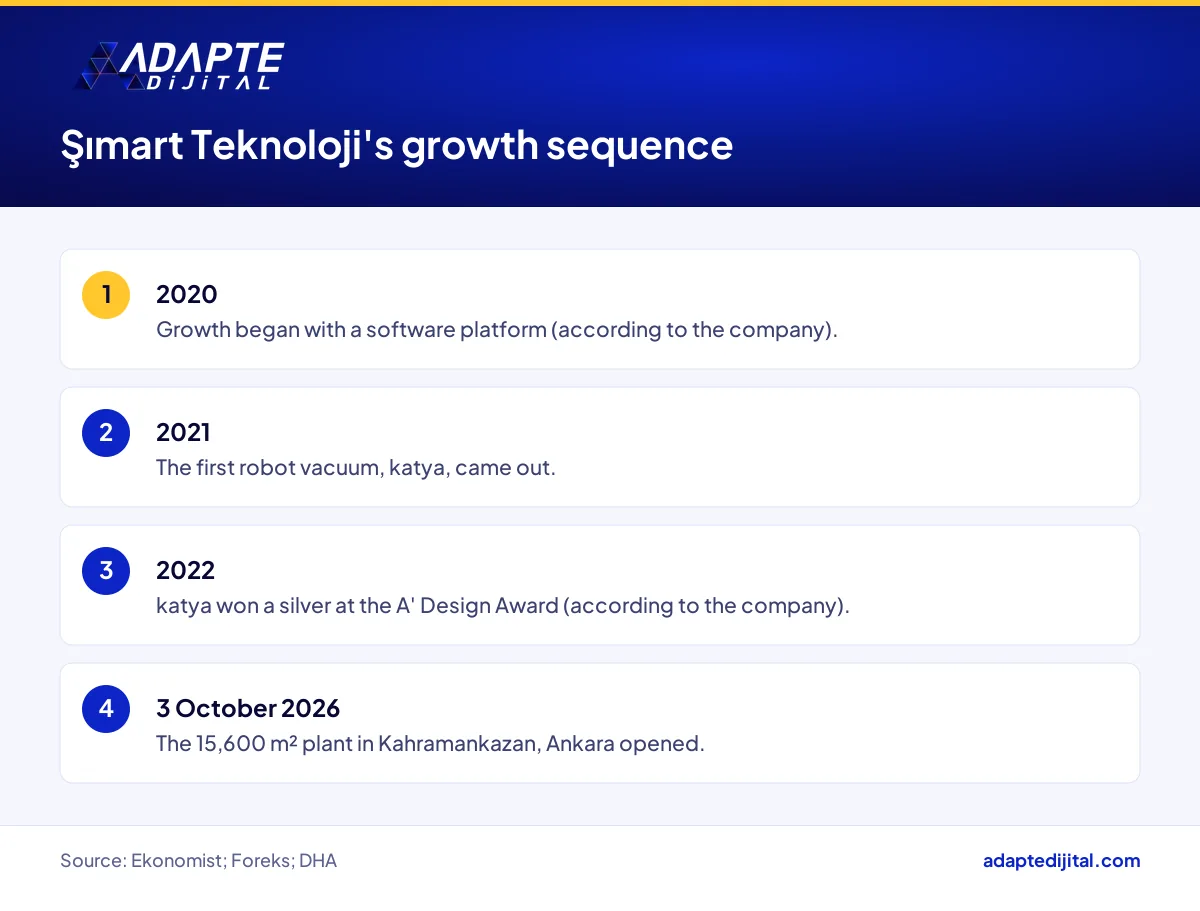
Four steps: software, product, channels and production. According to the company, its growth began in 2020 with a software platform; its first robot vacuum, “katya”, came out in 2021 and won a silver at the A’ Design Award in 2022 (Ekonomist; Foreks). The plant, opened on 3 October 2026, is the latest step in that sequence.
When should a marketplace brand move from contract manufacturing to its own production?
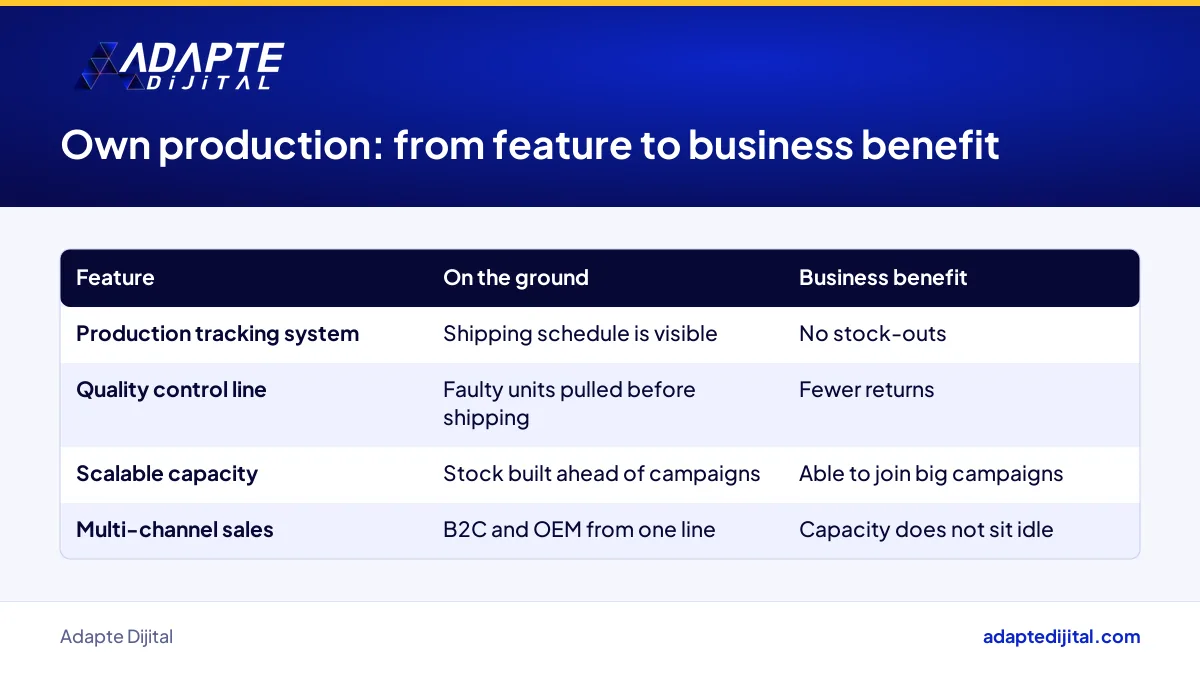
When sales volume becomes predictable and the product is your own design. Own production gives you more control over delivery and quality, but it raises fixed costs. The table below turns the features of own production into business benefits.
| Feature of own production | What it means on the ground | Business benefit |
|---|---|---|
| Own production tracking system | You see which product ships when | No stock-outs on marketplaces |
| Quality control line | Faulty units are pulled before shipping | Fewer returns and bad reviews |
| Scalable capacity | Stock built up ahead of campaigns | Able to join big campaigns |
| Multi-channel sales | B2C and OEM from the same line | Capacity does not sit idle |
Who does Şımart Teknoloji’s move into its own production affect, and how?
Sellers of imported products in the same marketplace category feel the competition; domestic component suppliers see an opportunity. Supporting industry and logistics firms around Kahramankazan in Ankara may be affected indirectly. Electronics chains and marketplaces gain another domestic option on the shelf and on screen.
What changes in marketplaces, search and data for an e-commerce brand moving into its own production?
Three things change: you own the product data, stock information becomes firm, and brand searches gain weight. On a marketplace, returns and delivery times drive your seller rating, and own production affects both directly. Check the registration duties for e-commerce businesses in Türkiye on the Ministry of Trade’s ETBİS page, the country’s e-commerce information system; this is not legal advice.
What should a marketplace seller do this week after the Şımart news?
This week you can put the production decision into numbers. Pull a table of SKU-level sales and returns for the last twelve months, and add your contract manufacturer’s delivery record next to it. Moving into your own production is a decision that takes a year; this week’s job is to prepare its data.
Quick Summary
- Şımart Teknoloji’s 15,600 m² plant in Kahramankazan, Ankara opened on 3 October 2026 (DHA; Foreks).
- Current annual capacity is 1,635,000 units; more than 5 million units is a target (Ekonomist; Foreks).
- According to the company, it employs 80 people and aims for 200 (Ekonomist).
- The investment was funded from equity and the amount was not disclosed (Ekonomist).
- The products sell on Trendyol, Hepsiburada, MediaMarkt and n11 and reach 12 countries (Foreks).
Short Glossary
- Contract manufacturing
- Contract manufacturing is the production model used when a brand has its products made by a partner manufacturer instead of in its own plant.
- OEM
- OEM is the business model used to make products that are sold under another brand’s name.
- Equity financing
- Equity financing is the type of funding used when a company pays for an investment from its owners’ money and retained earnings rather than loans.
Frequently Asked Questions
Next Step
Let’s prepare the data and channel plan for your own production decision together; fill in the consult your expert form.
Sources: DHA, report on the opening of Şımart Teknoloji’s Ankara plant, 3 October 2026 · Ekonomist, interview with Mehmet Türker, 8 October 2026 · Foreks, 4 October 2026 · Ministry of Trade, ETBİS (linked in the text)
Updated: October 2026
Sık Sorulan Sorular
According to the company, the plant has fully and semi-automated production lines, robotic arms, AI-assisted quality control and its own ERP and production tracking system (DHA). ERP is software that brings purchasing, stock, production and accounting into one system. The quality control claim is the company’s own; there is no independent confirmation.
From equity. Board chairman Mehmet Türker told Ekonomist the Ankara investment was made “entirely with our own equity”. The investment amount was not disclosed, in line with company policy, and no estimate is given here.
A different employment figure was also mentioned in speeches at the opening. The company’s own statement is 80 employees, with a target of 200 (Ekonomist; Foreks). This piece uses the figure given by the company.
Across four channels: B2C, B2B/OEM, B2G and B2Construction (DHA; Ekonomist). OEM means making a product that is sold under another brand’s name; B2G means selling to the public sector. The products are on sale at Trendyol, Hepsiburada, MediaMarkt and n11 (Foreks).
According to the company, it has more than 80 active products and over 400,000 active users, and aims for 1 million users in three years (DHA; Ekonomist). Its products reach 12 countries, including the UK, Europe and the US. Revenue, export value and market share do not appear in the sources.
The company holds 5 Domestic Goods Certificates, Türkiye’s “Yerli Malı Belgesi” (according to the company, DHA). This certificate is a tool domestic producers use in public procurement. Read alongside the B2G channel, it shows how own production can open a door to public-sector sales.
Monthly sales by SKU, return rate, your contract manufacturer’s delivery time and the number of out-of-stock days. If these numbers hold steady over several seasons, you can plan capacity. If they swing, it is safer to stabilise your sales base first.
Şımart funded the investment from equity rather than outside finance (Ekonomist). In a high-interest period, that choice removes the interest burden but ties up cash. Which suits you depends on your cash flow; this is not financial advice.
Yes: bring a critical component or final assembly in-house and keep the rest with a contract manufacturer. That puts quality control in your hands while keeping fixed costs in check. For many brands, the road to own production starts with this in-between step, not a single leap.
Domestic suppliers working in plastics, circuit boards, packaging and assembly. A brand with its own plant creates a new potential customer for these firms. Public bodies looking for domestic products in procurement also gain an option.
Sellers of imported products in the same category who compete on price alone. If a domestic maker delivers faster, a seller with long import lead times may find stock just sitting on the shelf at campaign time. This is not a market share forecast, only a change in the competitive conditions.
A factory is not the only way to build your own brand; community and content grow it too. An example of linking customer shares to sales is covered in our piece on Teknosa’s Totem 2002 campaign. Production and marketing decisions belong at the same table.
When you make the product, technical specs, warranty and parts information come first-hand. Marketplace listings, your own website and a retail chain’s product page can all draw on the same accurate data. Consistent data builds trust in search and on comparison pages.
When a shopper sees your product on a marketplace and then searches for your brand, your own site and reviews close the decision. Giving products a distinct name, as Şımart did with “katya”, gives shoppers something to search for. Traffic that arrives by brand name lowers your ad costs.
Every marketplace has its own product data, language and return rules. Şımart’s products reach 12 countries (Ekonomist; Foreks). For sellers considering a new European marketplace, our piece on easyShop offers a step-by-step checklist.
A four-column table: product, monthly sales, return rate, delivery time from the contract manufacturer. The feeling that the till is not turning over often comes from stock-outs in a single product. The table makes that product visible.
The one with the steadiest sales and the lowest returns. Moving that product into own production, or onto the middle path, keeps the risk in one line item. Complementary products that lift your average basket come in the second step.
Planning marketplace, own website and retail chain channels together is a specialist job. We run this planning through our e-commerce consulting work. Retail and production news is interpreted for you on our retail page.
It can, but its sales and return data should first stay steady for several seasons. Bringing a critical component or final assembly in-house is a sensible step before a full plant.
No, more than 5 million units is the target. Current annual capacity is 1,635,000 units (Ekonomist; Foreks).
That depends on the business’s cash flow and interest conditions. Şımart chose equity; ask your financial adviser about your own case, as this is not financial advice.