
Who should start a business online? 6 profiles: shops, workshops and services
Who should start a business online first? Anyone who wants to know if people search for their business before signing a lease, buying a machine or pulling up the shutters. Three groups fit best: those opening a shop or branch, those setting up a workshop, and those building a business that lives online from day one.
Below are six imagined profiles from those groups, because a scene is easier to recognise than a definition. All six want to see demand before tying up serious money.
Which three groups gain most from opening online first?
BU BÖLÜMÜN ÖZETİ
- Those opening a place
- Those making something
- Those born online
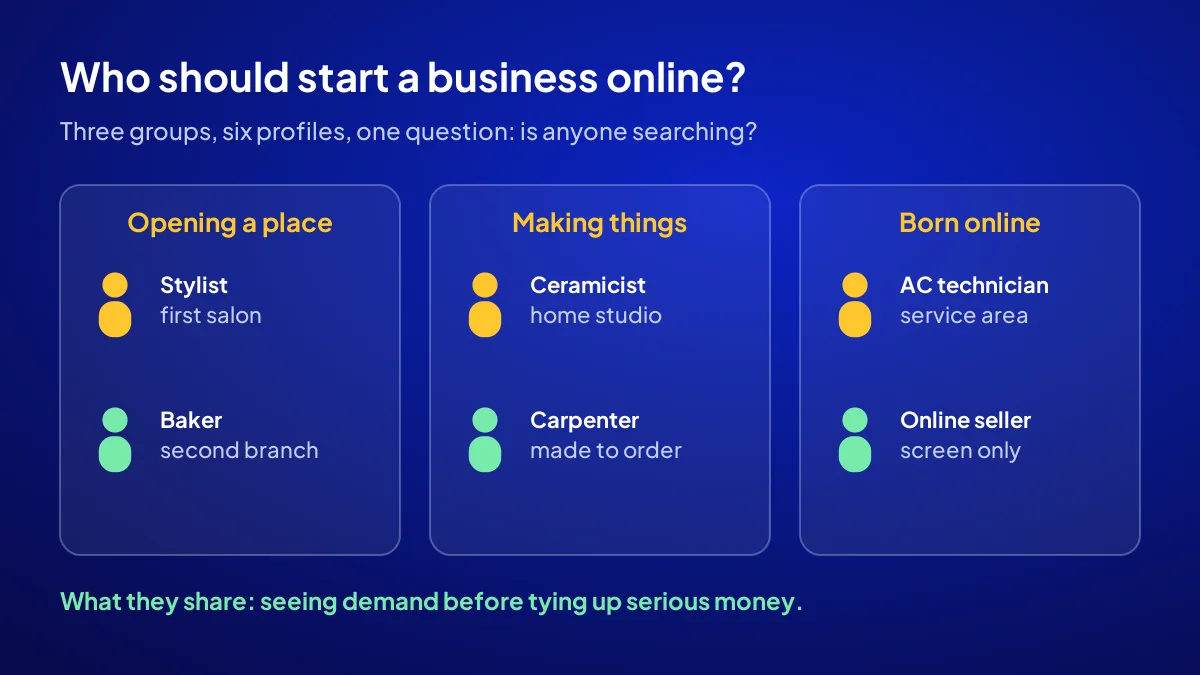
In 2026, Adapte’s Start a Business Online campaign in Türkiye serves three groups: those opening a place, those making something and those running fully online. A shop owner measures the district, a maker the product, an online seller the searcher. The full logic sits in open online before you open a shop.
Those opening a place
Shop or second-branch planners. Their risk is the lease and deposit. Opening online first shows where searches come from before they pick an address.
Those making something
Workshop or small-production starters. Their risk is machinery and stock. Seeing who searches for the product sets the size of the first batch.
Those born online
People with no shopfront, working from a screen or at the customer’s door. For them the site, content and measurement are the business itself.
Profiles 1 and 2: waiting before they sign the lease
BU BÖLÜMÜN ÖZETİ
- Profile 1: a stylist opening a first salon
- Profile 2: a baker weighing a second branch
- What the two share
The first two profiles are about to open a physical place but have signed nothing yet: one a first shop, the other a second branch. Both have a district in mind, but neither knows how many people there search for them. Opening online first collects that answer without paying rent.
Profile 1: a stylist opening a first salon
Picture a stylist in Beylikdüzü, Istanbul, ten years in someone else’s salon and ready for a mirror of their own. A shop in Yakuplu is on the shortlist. Opening online first, with a service area, shows which neighbourhoods ask for appointments.
Profile 2: a baker weighing a second branch
Picture a bakery owner in Esenyurt whose till keeps ringing, torn between two districts for a second branch. Search Console and GA4 show which district sends searches, turning a hunch into a reading.
What the two share
For both, regional demand measurement matters most; the site and articles bring the traffic to measure.
Profiles 3 and 4: making things and looking for buyers
BU BÖLÜMÜN ÖZETİ
- Profile 3: a teacher starting a ceramics studio
- Profile 4: a carpenter who works to order
- A maker’s first question
Profiles three and four make something. Their problem is not the shopfront but who will buy beyond friends and neighbours. For them, opening online means appearing for people who search the product name and taking orders on WhatsApp.
Profile 3: a teacher starting a ceramics studio
Picture an art teacher near retirement, planning a small kiln at home for mugs, plates and classes. Investing in both without knowing which is searched more stretches the budget too far.
Profile 4: a carpenter who works to order
Picture a carpenter in Hadımköy whose work always comes from the same three furniture dealers. A site in their own name, articles on made-to-measure work and WhatsApp Business reach end customers directly.
A maker’s first question
A maker first measures which product name gets searched. The 108 articles in 6 keyword groups make that visible.
Profiles 5 and 6: no shopfront, ever
The last two profiles have no door for customers. One takes the service to the customer’s home, the other sells only online. Their online presence is their only window, yet the two stand differently on Google, and it pays to know that early.
Profile 5: a door-to-door air-conditioning technician
Picture an air-conditioning technician in Büyükçekmece. Customers never walk in; the technician goes to them. On Google, the business shows a service area instead of an address. How that works is explained in what is a service area business.
Profile 6: an entrepreneur selling only online
Picture someone selling natural soap from home, never meeting customers. Under Google’s guidelines, a Business Profile is for businesses customers visit or serve at their location. Here the weight is on the site, articles and measurement.
Six profiles in one table: what does each measure first?
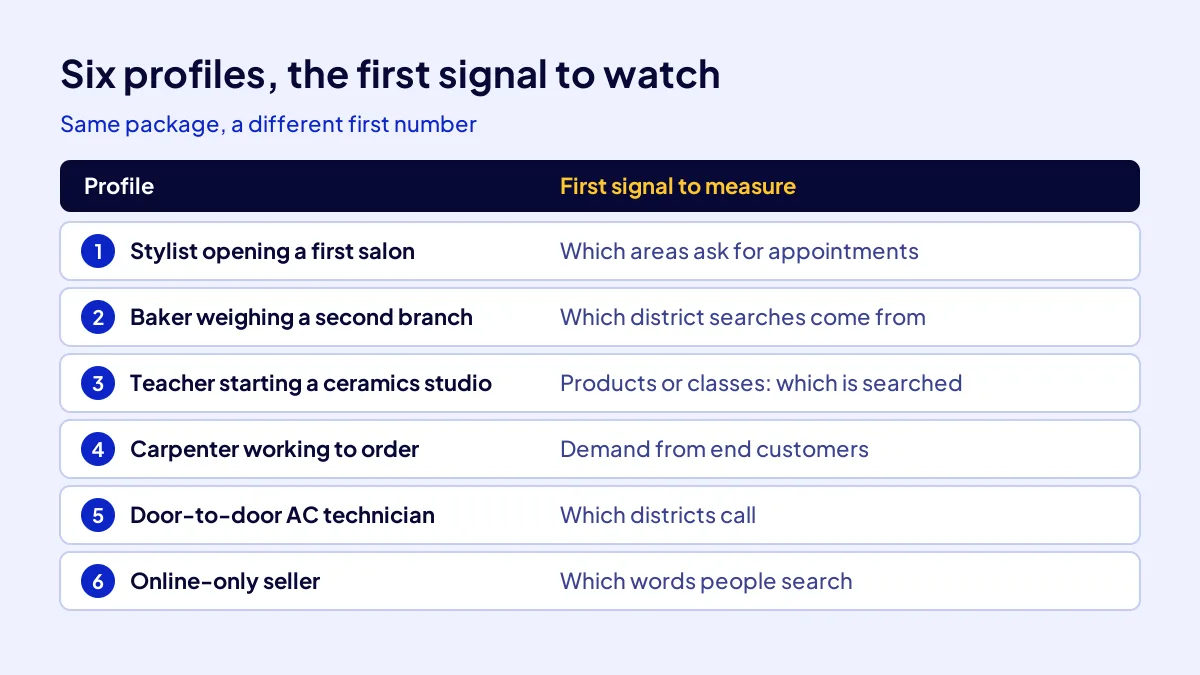
All six get the same package: domain and 1 year of hosting, a site with 6 main and 12 sub-pages, 108 articles, 3 social accounts, measurement and WhatsApp Business. The difference is the number they watch in month one. Find the row that sounds like you.
| Profile | Shopfront | First signal to measure | Most useful item |
|---|---|---|---|
| 1. Stylist opening a first salon | Not yet | Which neighbourhoods ask for appointments | Regional measurement, Business Profile |
| 2. Baker weighing a second branch | One branch | Which district searches come from | Search Console, GA4 |
| 3. Teacher starting a ceramics studio | Home studio | Products or classes: which is searched more | 6 keyword groups |
| 4. Carpenter working to order | Workshop | Demand from end customers | Website, WhatsApp Business |
| 5. Air-conditioning technician | None, goes to the door | Which districts call | Service area, Business Profile |
| 6. Online-only seller | None, sells on screen | Which words people search | 108 articles, measurement |
How to read the table
Read the third column of your row: that is the question for the end of month one. A strong number grounds the decision; a weak one leaves room to change course.
What stays fixed
All six pay TRY 36,000 + VAT, upfront and fixed. At 20% VAT that is TRY 43,200; check the current rate on your invoice. Domain and hosting are in your name.
Who is it still too early for?
BU BÖLÜMÜN ÖZETİ
- Those without a settled idea
- Those open for years
- Those waiting for a brand identity
Starting a business online suits people who already know what they will sell. If you have not chosen the business, decide that first. If your shop has been open for years and you just want to be found, a visibility service may suit you better. This package is for businesses being born.
Those without a settled idea
At the “I’ll open something, but what” stage there is no demand to measure yet.
Those open for years
A business with settled customers and a sign needs to be found, not set up.
Those waiting for a brand identity
Logo and brand identity are optional and priced separately; you can start without them.
How can three questions tell you where you fit?
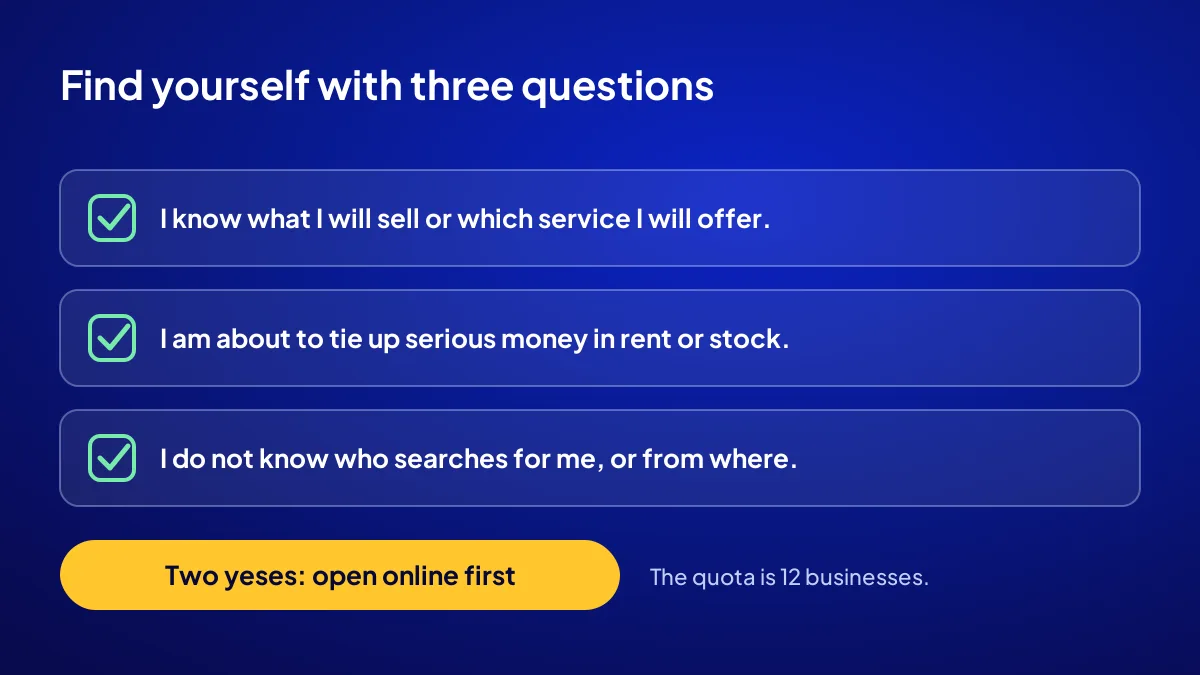
Answer three questions honestly and they lead you to a row in the table. Two yeses mean opening online first suits you. What each route costs over the first six months is worked out in three scenarios in shop first or website first.
- Do I know what I will sell or which service I will offer?
- Am I about to tie up serious money in rent, machinery or stock?
- Do I not yet know who searches for me, and from which district?
Why the quota matters
The campaign takes only 12 businesses this period and closes when full. For details and to apply, see the Start a Business Online campaign page.
What to tell us when you apply
Describe your business and area; Adapte replies with a domain and plan proposal.
None of these six lacks courage; they just won’t tie their money to a blind guess. See who is searching first, then pick up the keys.
Quick Summary
- Starting a business online suits anyone who wants to see demand before tying up serious money.
- Three groups: those opening a place, those making something and those born online.
- Each profile watches a different first signal: district, product name or search term.
- An online-only business may not meet Google Business Profile guidelines.
- It is too early for those without a settled idea; long-open shops need a different route.
- The price is the same for all: TRY 36,000 + VAT, upfront and fixed, 12 places.
Short Glossary
Service area business: A service area business is the type used on Google to describe a business that serves customers at their location rather than at its own address.
Demand signal: A demand signal is the measurement data used to show how many people search for a business, from where and with which words.
Keyword group: A keyword group is the cluster used to plan content by gathering searches with the same intent under one heading.
Next Step
If you found yourself in one of the six profiles, the next move is to measure before you sign a lease. Apply to the Start a Business Online campaign and get a domain and plan proposal for your business.
Frequently Asked Questions
Source: Google Business Profile Help — Guidelines for representing your business on Google
Sık Sorulan Sorular
Profile six often weighs a marketplace against an own site; see own site or marketplace. An e-commerce setup is optional in the campaign and priced separately.
Yes, the package is built for exactly that. Your business opens online first, and you appear with your service area instead of an address.
Under Google’s guidelines, a Business Profile is for businesses customers can visit or serve at their location. Fully online sellers rely on the site, articles and measurement.
An e-commerce setup is optional in the campaign and priced separately. The core package covers the corporate website, 108 articles and measurement setup.
Updated: October 2026