
How Does the Turnkey Website Process Work? 6 Steps from First Call to Launch
The turnkey website process runs in six steps: you describe your business, the sector setup and page map are presented, you approve the domain name and design direction, the site and its 108-article plan are built, measurement is installed with GA4 and Search Console, and the keys are handed over with access, panel and page map. Each step has one thing asked of you and one checkpoint.
Work starts as soon as payment is made. After you approve the sector setup and the domain name, you receive a written build calendar. The pace depends mostly on how quickly approvals come back, not on how much you write, because you are not asked to write anything.
How does a turnkey website project begin in steps 1 and 2?
It begins with a conversation and a plan. In step 1 you describe your business. In step 2 you receive the sector setup: design language, page map, 6 keyword groups and a content plan prepared for your industry. Nothing is built before you approve this plan, so the first two steps decide the shape of everything after them.
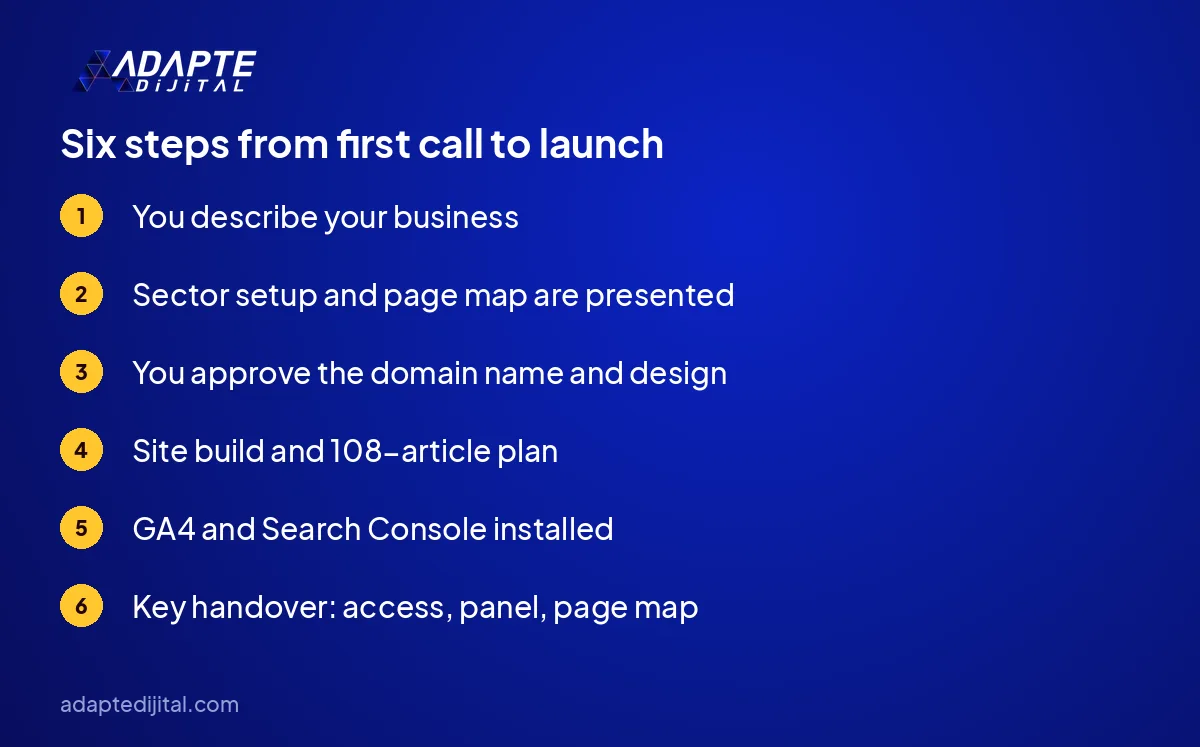
Step 1: You describe your business
Six points cover it: what you do, who you serve, which area you work in, the question customers ask most, how you differ from competitors, and your phone or WhatsApp line. Text, photos and a logo are not requested.
- What you provide: one conversation covering the six points.
- Checkpoint: all six points are answered before step 2 starts.
Step 2: The sector setup and page map are presented
You receive the page map with 6 top pages and 12 subpages, the 6 keyword groups and the design language. Each item comes with a short reason.
- What you provide: approval or one round of notes.
- Checkpoint: every page on the map has a purpose you recognize.
What is approved in step 3 and built in step 4?
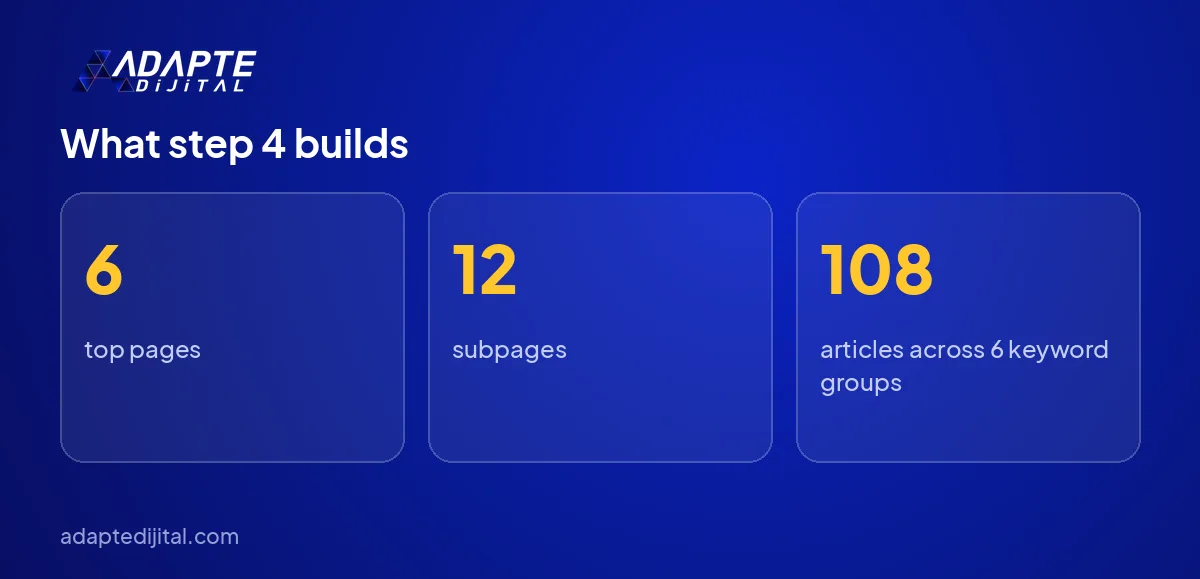
Step 3 locks two decisions: the domain name and the design direction. Both arrive as options with reasons, and you choose. Step 4 is the build itself: 6 top pages, 12 subpages, 6 categories and the 108-article plan. Some articles go live at launch, and the rest are placed on a publishing calendar.
Step 3: Domain name and design direction
The domain you choose is registered in your name. The design direction sets colors, layout and tone for your sector. These two approvals, together with the sector setup, release the written build calendar.
- What you provide: one choice for the domain, one for the design.
- Checkpoint: the domain registrant is you, not the agency.
Step 4: The build and the 108-article plan
Pages are built and written by Adapte. Technical SEO, speed and AI SEO are part of the build, not an add-on. The 108 articles are spread across the 6 keyword groups.
- What you provide: nothing new; questions are welcome.
- Checkpoint: you can see which articles launch first and which follow.
How are measurement and handover done in steps 5 and 6?
Step 5 installs measurement: Google Analytics 4 for visitor behavior and Search Console for how Google sees the site. Step 6 is the handover: access, the measurement panel and the page map. After step 6 the matter is closed. There is no subscription, and any new request becomes a new development with its own delivery list and price.
Step 5: GA4 and Search Console
Both tools are connected before handover, so the first visit is already measured. Search Console also lets you submit a sitemap and follow page status. Google explains it on the Search Console overview, and the GA4 help center covers the reports.
- What you provide: an email address for panel access.
- Checkpoint: you can open both panels yourself.
Step 6: The key handover
You receive access, the measurement panel and the page map. The first year of hosting is included, and the second-year renewal is yours, announced in advance.
- What you provide: a final check of the handover list.
- Checkpoint: you log in with your own credentials and know the renewal date.
All six steps run inside one fixed price of 36,000 TRY + VAT, paid up front. Review the full turnkey delivery list.
What does the timeline of a turnkey website depend on?
BU BÖLÜMÜN ÖZETİ
- The clock starts with payment
- Two approvals release the calendar
- Decisions set the pace more than labor does
The timeline depends on two approvals and one written document. The work starts with payment. The build calendar is issued after you approve the sector setup and the domain name. From then on, that calendar is the reference, and no day count is quoted before it.
The clock starts with payment
Payment and the start of work happen together. The sector setup begins right away.
Two approvals release the calendar
Sector setup and domain name. Until both are approved, any date would be a guess. After both, the date is written down.
Decisions set the pace more than labor does
Most of the build runs on our side, so the speed of your replies matters most. Our article on how long a corporate website takes compares this with the classic route.
Which owner habits slow the process down?
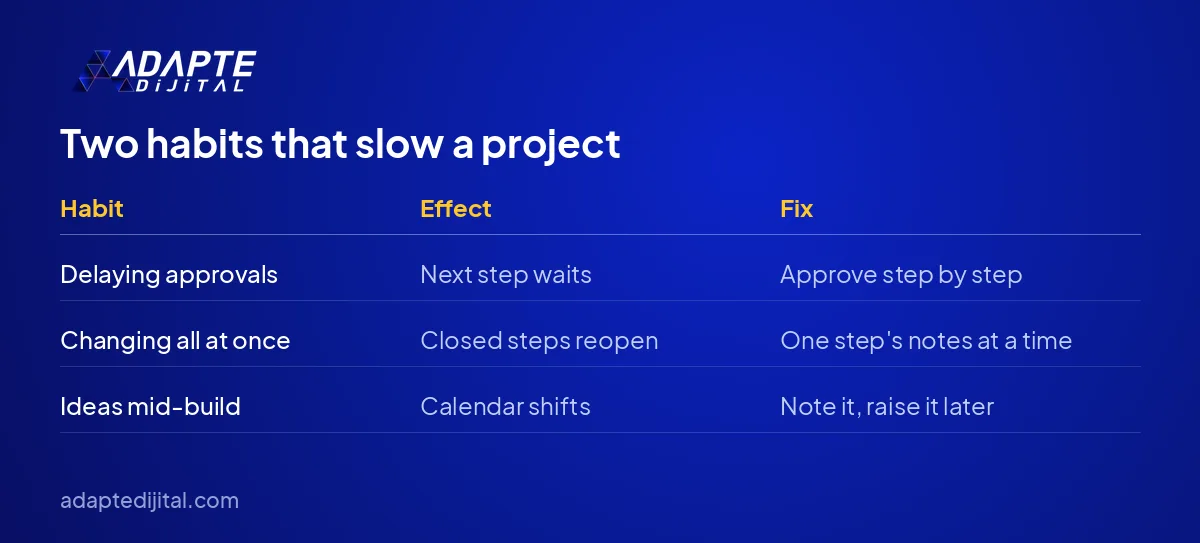
Two habits cause most of the slowdown: delaying approvals and changing everything at once. Both happen with good intentions. An approval left for later holds up the step behind it, and a wave of changes reopens steps that were already closed.
Delaying approvals
Step 3 cannot start until step 2 is approved. A short reply on the page map is worth more than a perfect reply later. For the full list of what you approve, see the 6-item approval list for business owners.
Changing everything at once
A new domain idea after the design is approved, plus a new page after the build has started, reopens two steps together. Note the idea, finish the current step, then raise it. The other causes of delay are in why turnkey projects drag on.
What does the six-step process look like as one template?
The table below is the whole process on one page. Each row lists the step, the one thing asked of you and what we deliver. Keep it next to your build calendar. If a row asks you for text, photos or a logo, something has gone off the plan.
| Step | From you | From us |
|---|---|---|
| 1. Briefing | One conversation on six points | Notes for the sector setup |
| 2. Sector setup | Approval or one round of notes | Page map, 6 keyword groups, design language |
| 3. Domain and design | One choice for each | Domain in your name, written build calendar |
| 4. Build | Nothing new | 6 top pages, 12 subpages, 108-article plan |
| 5. Measurement | An email for access | GA4 and Search Console installed |
| 6. Handover | A final check | Access, panel, page map |
Use the table as a checklist
Each row closes only when its checkpoint is met. If a checkpoint fails, the next row waits. That rule keeps the order clean.
Keep the handover row for later
The last row is your reference after launch. For the classic route, compare it with how a corporate website is built, and for the overall picture, see the turnkey roadmap for business owners and the definition of a turnkey site.
Quick Summary
- Six steps: briefing, sector setup, domain and design, build, measurement, handover.
- Each step has one input from you and one checkpoint.
- Work starts with payment; the build calendar follows two approvals.
- No day counts are quoted before the sector setup and domain are approved.
- Delayed approvals and changing everything at once cause most slowdowns.
Short Glossary
- Sector setup
- Sector setup is the term used for the design language, page map, keyword groups and content plan prepared for one industry.
- Build calendar
- Build calendar is the term used for the written schedule issued after the sector setup and domain name are approved.
- Checkpoint
- Checkpoint is the term used for the condition that must be met before the next step begins.
Frequently Asked Questions
Next Step
For a turnkey website, step 1 is a conversation about your business. Then you receive the sector setup with a page map, keyword groups and a domain name suggestion, and the build starts after your approval. This period is limited to 12 businesses. Start step 1 with your application.
Sources: Google Search Console · Google Analytics 4 Help
Updated: November 2026
Sık Sorulan Sorular
No day count is given in advance. Work starts with payment, and a written build calendar is issued once the sector setup and domain name are approved.
A conversation about the business and approvals at each step. Text, photos, a logo and technical setup are not requested.
Access, the measurement panel with GA4 and Search Console, and the page map. The domain is in the owner’s name and the first year of hosting is included.