
Saat&Saat listed with a 3.7 billion lira IPO, what can going public bring a retailer?
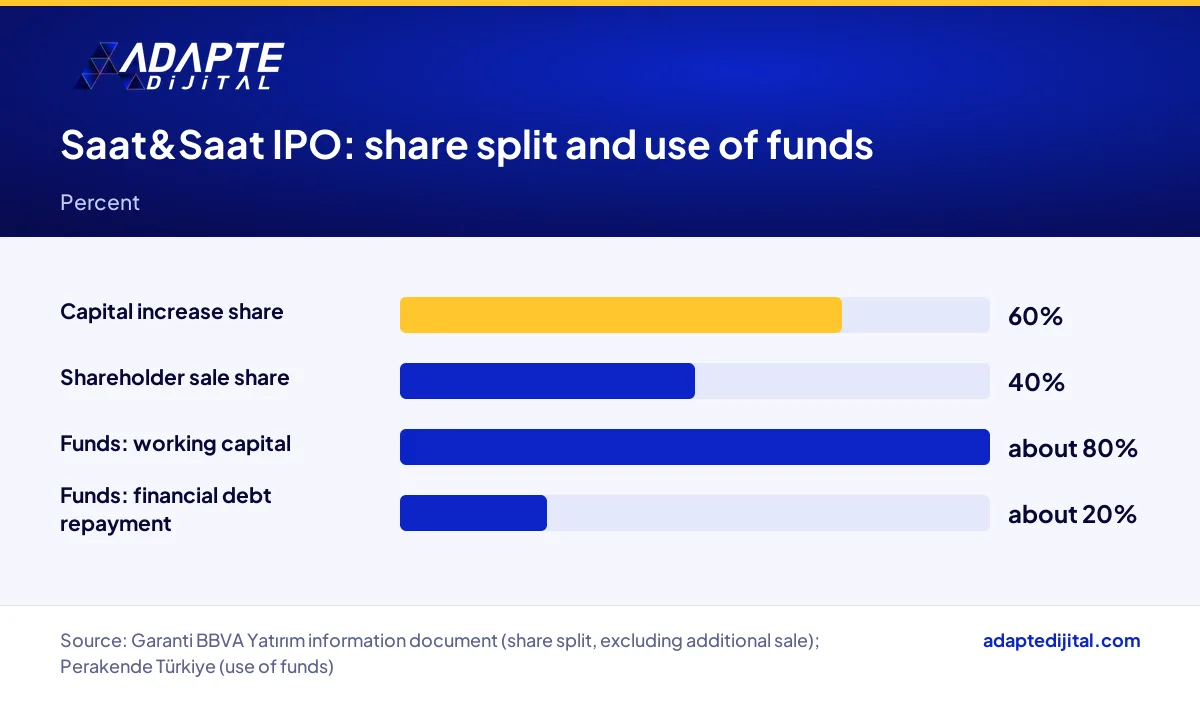
Saat&Saat, the Turkish distributor for a range of watch brands, started trading on Borsa İstanbul’s Star Market under the ticker SSAAT on 16 July 2026 (Perakende Türkiye, 3 August 2026). The IPO size is TL 3.75 billion, with a free float of 10.14%. Of that amount, the part that actually reaches the company is TL 2.25 billion in gross proceeds; the rest comes from existing shareholders selling their shares. About 80% of the funds go to working capital and about 20% to paying down financial debt.
If you own a growing retail or distribution business, this news tells you something simple. An IPO is a financing route that sits next to a bank loan. But the price is not interest, it is transparency. For a retail owner in Türkiye thinking about growth in autumn 2026, the real question is not “can I raise money?” but “can I show my numbers to everyone, every quarter?”
How much money did Saat&Saat actually receive from its IPO?
The company received gross IPO proceeds of TL 2,249,350,488, roughly TL 2.25 billion. The IPO size, meanwhile, is TL 3,748,917,480. The difference comes from shares sold by existing shareholders, and that money goes to them, not to the company. According to the Garanti BBVA Yatırım information document, the share split is 60% capital increase and 40% shareholder sale.
Where will Saat&Saat spend the money from its IPO?
About 80% of the funds go to working capital and about 20% to paying down financial debt. For a distributor, working capital means the cash needed to bridge stock, receivables and supplier payments. The company published its first report on how the funds are being used on KAP on 18 August 2026.
What obligations does becoming a listed company bring a retailer like Saat&Saat?
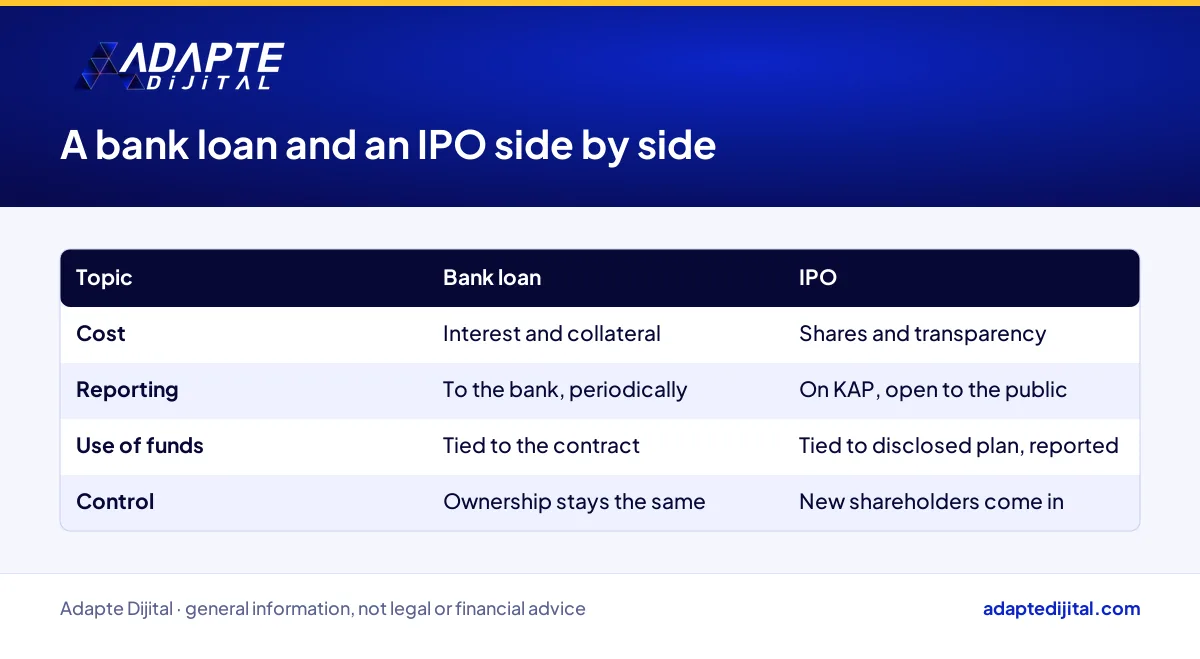
It brings three main obligations: regular financial reporting through KAP, timely public disclosure of material developments, and reporting on how IPO funds are used. In short, the company’s books go on a table anyone can read. The details depend on regulation. Verify with the official source; this is not legal or financial advice.
How does the IPO trend in retail, seen through Saat&Saat, affect different businesses?
Chains and distributors with a clear revenue base, tidy records and growth held back by cash needs are the group most likely to benefit. As of 31 March 2026, Saat&Saat’s trailing 12-month revenue is about TL 13.4 billion, with an adjusted EBITDA margin of 32.4%. Family businesses with messy records, on the other hand, struggle to get through the same door.
What changes on the digital side for a listed retailer like Saat&Saat?
The company’s digital presence now speaks to two audiences: customers and investors. Brand-name searches start to include KAP filings, finance news and investor questions. An investor relations section on the website, consistent corporate information and the right page showing up in search results all gain weight.
What should a retail owner who wants to grow like Saat&Saat do this week?
BU BÖLÜMÜN ÖZETİ
- Prepare a one-page financial summary
- Write down today where the money would go
- Build your reporting routine together with digital
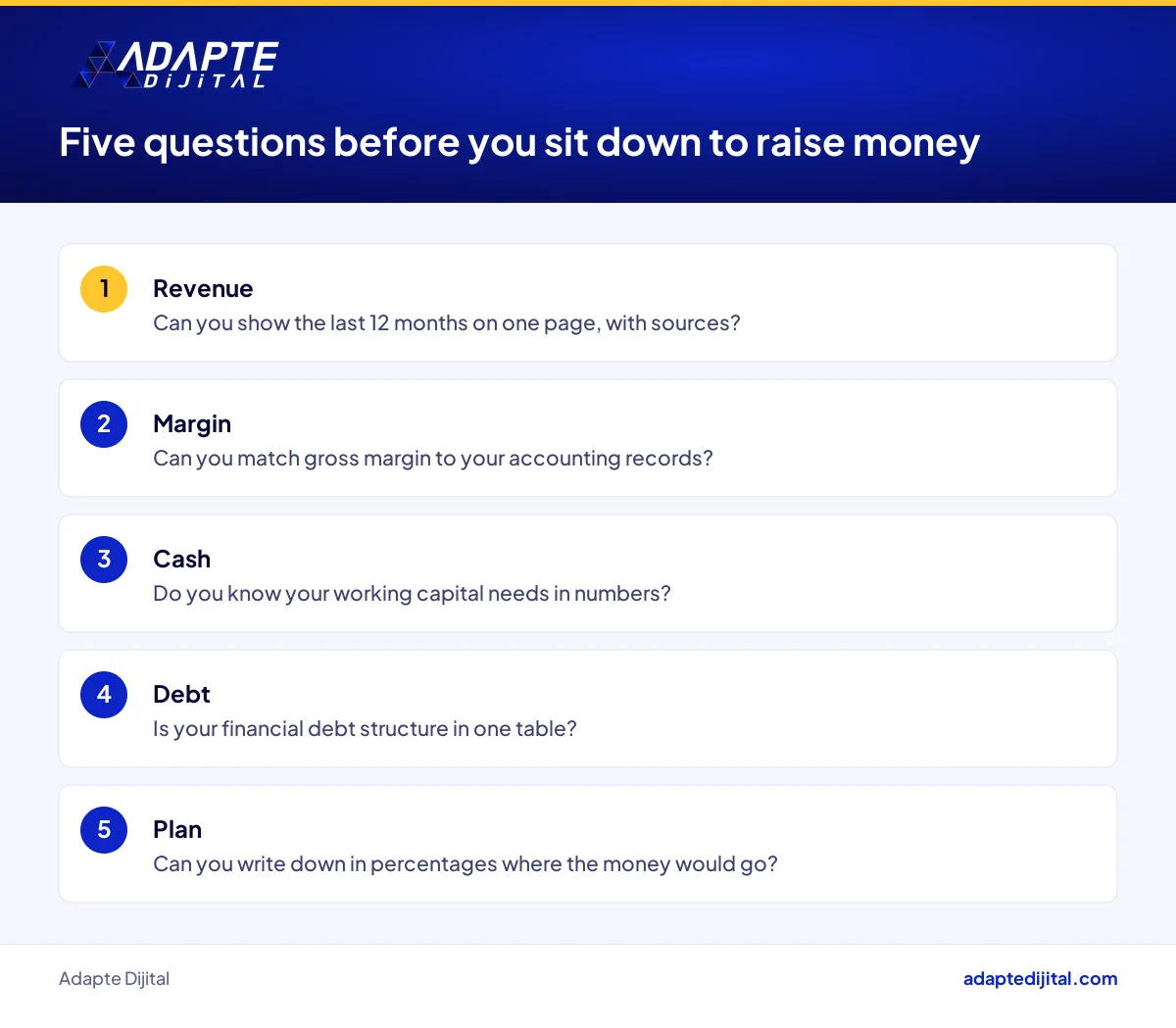
This week, do not file for an IPO; run a readiness test. Can you produce your last 12 months of revenue, your margin and your debt structure on a single page, with sources? If you cannot, you need that page first, whatever financing route you choose.
Prepare a one-page financial summary
Revenue, gross margin, working capital needs and financial debt. Four lines, each matched to your accounting records. This page is the first thing anyone asks for, at a bank meeting or an investor meeting.
Write down today where the money would go
Saat&Saat discloses its use of funds as percentages. When you find financing, write down where you would spend it in percentages too: stock, debt, stores, digital infrastructure. A plan you cannot write down is a plan you cannot present.
Build your reporting routine together with digital
Tie your finance and digital reports to the same calendar. This is work we do; through digital consulting, we set up this reporting routine with retailers. We also interpret the retail agenda for you on our retail page. My decision is clear: an IPO is not a goal, it is a door that opens for a company able to show its numbers to everyone.
Quick Summary
- Saat&Saat started trading on Borsa İstanbul’s Star Market under the ticker SSAAT on 16 July 2026 (Perakende Türkiye).
- The IPO size is TL 3.75 billion, while gross proceeds to the company are TL 2.25 billion (KAP report).
- The share split is 60% capital increase and 40% shareholder sale (Garanti BBVA Yatırım information document).
- About 80% of the funds go to working capital and about 20% to debt repayment (Perakende Türkiye).
- The company published its first use-of-proceeds report on KAP on 18 August 2026.
Short Glossary
- Capital increase
- Capital increase is the term used to describe a company issuing new shares and keeping the money raised.
- Free float
- Free float is the percentage used to show the part of a company’s shares held by investors trading on the exchange.
- EBITDA
- EBITDA is the financial indicator used to express earnings before interest, tax, depreciation and amortisation.
Frequently Asked Questions
Next Step
If you want to review your growth plan and your reporting routine together, fill in the consult your expert form.
Sources: Perakende Türkiye, 3 August 2026 · KAP, Saat ve Saat Sanayi ve Ticaret A.Ş. report on the realisation of assumptions, 18 August 2026 · Garanti BBVA Yatırım, Saat&Saat IPO information document · Para Dergi, 16 July 2026
Updated: October 2026
Sık Sorulan Sorular
Look, in a capital increase the company issues new shares and keeps the money. In a shareholder sale, an existing owner sells part of their stake, and not a single lira goes into the company. At Saat&Saat, share capital is TL 620,222,018 before the IPO and TL 660,388,991 after it. That increase reflects the newly issued shares.
Book-building ran from 6 to 8 July 2026 at TL 56 per share. The offering drew 709,901 applications, 709,776 of them from individual investors. Demand was 1.78 times the allocation for domestic retail investors and 1.22 times for domestic institutions. The consortium leaders are Halk Yatırım and Garanti BBVA Yatırım.
Let me ask you one thing. When you read “a TL 3.7 billion IPO” in the news, do you assume the company raised TL 3.7 billion? Most of us do. The right way to read it is to separate the IPO size from the money that actually reaches the company.
A distributor typically buys from the brand up front or on short terms, then sells to stores and wholesale points on credit. In between, stock sits on the shelf and receivables wait to be collected. Saat&Saat has 185 sales points and 603 wholesale points, so its cash cycle stretches across a wide network.
Close to a fifth of the funds goes to reducing financial debt. That can mean a lighter interest bill. Still, the report gives no figure for the effect on profit, so we do not guess at one.
After an IPO, the company has to report how it uses the funds. Saat&Saat’s use-of-proceeds report on KAP, covering 1 January to 30 June 2026, is the first example of that duty. What was promised and what was done sit side by side in a public document.
Let’s say you pull your monthly revenue together from a different spreadsheet every month. That habit does not survive in a listed company. The numbers have to be auditable, consistent and on time. Saat&Saat is an organisation with 1,150 employees, which is a very different starting point from a 20-person business.
Decisions are no longer made only at the owner’s desk; you answer to investors. That also puts building a more institutional team on the agenda. We look at why home-grown managers matter through FLO Group’s internal promotions.
I run Adapte Dijital as a joint-stock company too. We are not listed, but I know how much discipline it takes to put the numbers on the table at the end of every month. Skip the month-end report once, and the next month brings twice the work.
Distributors representing several brands and chains growing through stores and franchises. Saat&Saat works with more than 30 brands and runs stores, franchises and shop-in-shop points together. In a structure like that, scale gives you a story you can tell investors.
Businesses with no reporting habit, where the owner knows revenue and margin off the top of their head. Here’s what I’ve noticed: most owners who want to grow talk about financing, not reporting. Yet at the IPO table, reporting is the first file anyone opens.
Dealers, franchisees and suppliers working with a listed distributor. When the other side reports more consistently, expectations at the contract table get clearer too. Staff are affected as well; we look at using perks to keep a team through TokenFlex’s Flexclusive programme.
For a brand like Saat&Saat, a customer searching for a watch and an investor searching for the ticker SSAAT end up on the same site. If the customer looking for a store lands on the balance sheet page, and the investor looking for a report lands on a product page, both walk out the door. Your page structure has to separate those two intents.
An IPO forces a company into monthly number discipline. That same discipline makes it easier to track average basket value, conversion rate and profitability by channel on the e-commerce side. My system idea is simple: close the finance report and the digital report on the same day, from the same table.
Talking about timing in a watch company’s IPO is a little too easy, but I cannot resist. Here’s the serious side: a company that reports its numbers on time also makes decisions on time in its digital channels.
That depends on your revenue, your record-keeping and the conditions set by regulation. Get information from official sources and licensed intermediaries. This is not investment advice, nor legal advice.
No. Only the proceeds from shares issued through a capital increase go to the company. In a shareholder sale, the money goes to the shareholder selling the shares.
The use of funds is tied to the plan disclosed in the IPO and is reported on KAP. Saat&Saat’s use-of-proceeds report dated 18 August 2026 is one example.