
FLO Group promoted two insiders to deputy GM, should retailers promote from within?
Two directors who have been with FLO Group since 2005 now sit one level from the top: Herman Barin becomes Deputy General Manager for Category Management and Moşe Yohay becomes Deputy General Manager for Footwear Product Management (Perakende Türkiye, 4 August 2026; Ekonomist, 18 June 2026). The company says the aim is a more integrated, data-driven way of running category management, product management and purchasing.
Here is what it means for you. Every growing retailer ends up at the same table sooner or later. Do you grow your key managers from your own team, or bring them in from outside? FLO’s choice, announced in summer 2026, puts a concrete example on that table.
Which two managers did FLO Group promote to deputy general manager in summer 2026?
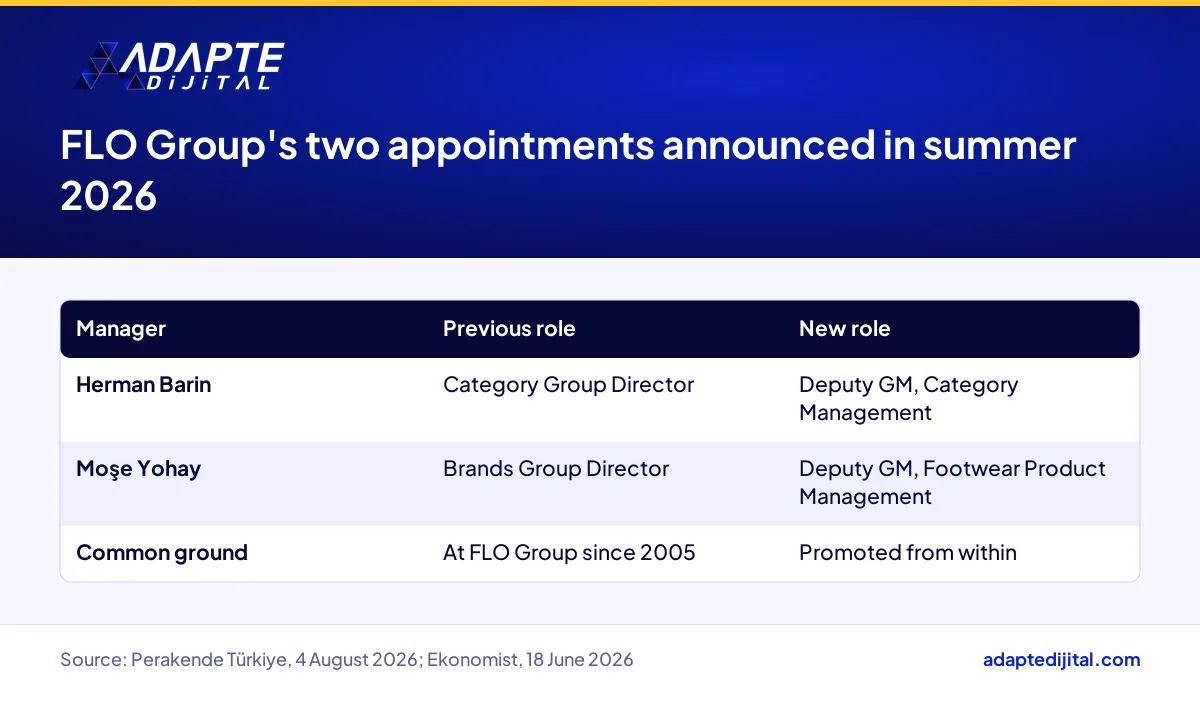
Both come from inside the company. Herman Barin moves from Category Group Director to Deputy General Manager for Category Management. Moşe Yohay moves from Brands Group Director to Deputy General Manager for Footwear Product Management. Both have worked at FLO Group since 2005.
Should a retailer grow key managers from within or hire them from outside?
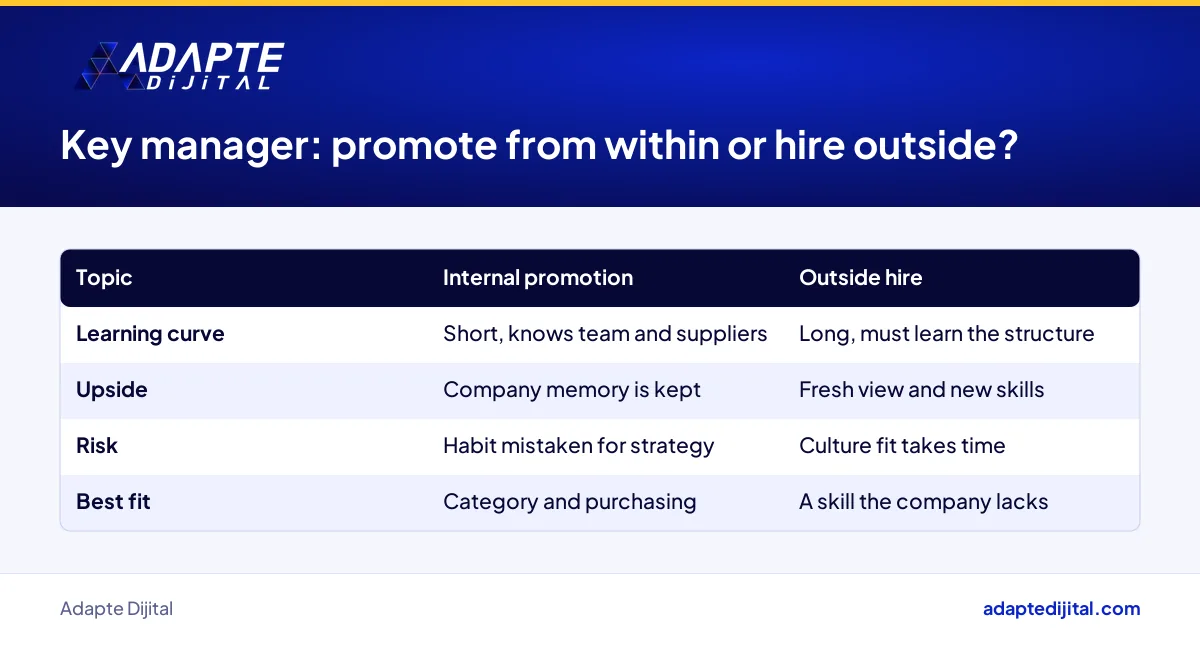
For jobs that carry the company’s memory, such as category management and purchasing, promoting from within is often the safer bet. Hiring from outside makes sense when you need a skill the company has never had. The right question is not “who is better” but “what knowledge does this seat need”.
Who feels the effect of FLO’s choice to promote from within?
The most direct effect is likely felt by middle managers inside the company, who see that the path up is open. Under pressure is the recruitment side of the sector, which is used to poaching managers from rivals. Indirectly affected are smaller footwear and apparel retailers with thin management benches.
What skills does a manager need to run category and purchasing with data?
Three: reading sales data, bridging category and purchasing, and persuading a team with numbers. Product knowledge sits underneath all three as the foundation. Loving the product is no longer enough; you also have to explain why it is not selling.
What does promoting from within change on a retailer’s e-commerce and data side?
An internal promotion creates value to the extent that store knowledge carries over into e-commerce decisions. In the Turkish Ministry of Trade’s 2025 e-commerce report, apparel, footwear and accessories rank first in e-commerce at TL 428.7 billion. In that category, a manager who reads online and store data separately sees only half the picture.
I make this mistake too: deciding from a single source
After years of building digital teams for businesses, I still catch myself trusting a single report too much. So here is a system I suggest: feed every category decision from at least three sources, namely store sales, e-commerce sales and search demand. If the three do not point the same way, the decision can wait a week.
What should a growing retailer do this week to build its management bench?
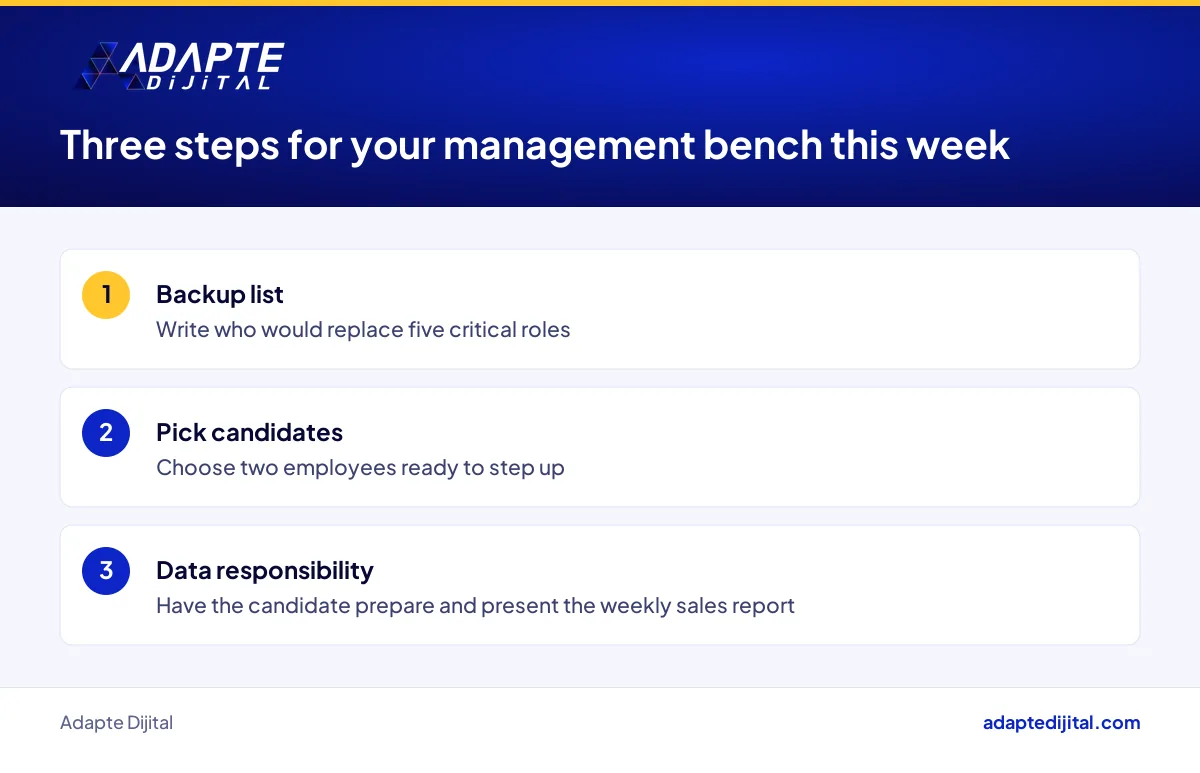
Do three things this week: map out backups for your key roles, pick two people ready to step up and hand them a data responsibility. These steps ask for calendar time, not budget. One morning of your week is enough to start.
On our retail page, where we read the retail news for you, we look at appointment and management stories through the same lens. My decision is clear: look inside first for the key seat, but teach that person to read data before the promotion, not after.
Quick Summary
- FLO Group promoted Herman Barin and Moşe Yohay, both with the company since 2005, to deputy general manager (Perakende Türkiye, 4 August 2026).
- The company’s stated aim is more integrated, data-driven category management, product management and purchasing.
- Reading the internal appointments as a growth choice is the publication’s interpretation, not the company’s.
- Apparel, footwear and accessories led Turkish e-commerce in 2025 at TL 428.7 billion (Ministry of Trade).
- A small retailer can start building its own management bench this week with a backup list and a data responsibility.
Short Glossary
- Category management
- Category management is the method used to plan product groups around customer demand and make shelf, price and stock decisions together.
- Internal promotion
- Internal promotion is the practice used to fill a vacant or new management role with an existing employee.
- Stock turnover time
- Stock turnover time is the metric used to measure how long a product takes from arriving in the warehouse to being sold.
Frequently Asked Questions
Next Step
If you would like to review your management bench and your data-led decision routine together, fill in our consult your expert form.
Sources: Perakende Türkiye, 4 August 2026 · Ekonomist, 18 June 2026 · KAP, disclosure dated 14 June 2024 · FLO 2024 draft IPO prospectus · Turkish Ministry of Trade, Outlook of E-Commerce in Türkiye Report 2025
Updated: October 2026
Sık Sorulan Sorular
Barin has more than 20 years of experience in category management, brand management and purchasing. He holds a sociology degree from Istanbul University and an MBA. Look, sociology and shelf planning seem far apart at first glance. Yet category management starts with understanding why people pick that particular pair of shoes.
Yohay has more than 21 years of experience in the footwear sector and a chemical engineering degree from İTÜ, Istanbul Technical University. In product management, someone who speaks the language of materials, lasts and sourcing starts with an edge. A manager who knows the product has shorter conversations with suppliers.
The reports do not give a start date for the new roles. Ekonomist published the appointments on 18 June 2026, and Perakende Türkiye on 4 August 2026. The most accurate way to put it is that the appointments were announced in summer 2026.
An insider knows the suppliers, the store managers and last season’s product that sat on the shelf. The learning curve is short and the team already knows them. Now, let’s say the new season’s buying is three weeks away; an outside hire would still be learning where the corridors lead.
The risk begins with the sentence “we’ve always done it this way”. A manager who has spent many years in one company can mistake habit for strategy. So an internal promotion needs to be balanced with outside data and a fresh pair of eyes.
Perakende Türkiye reads the two internal appointments as a choice to keep growing with the company’s own pool of managers. That is the publication’s assessment, not a company statement. The only aim the company states is a more integrated, data-driven way of working.
When two senior roles go to insiders, the levels below read it as a clear message: stay and you can rise. In retail, where staff come and go through the same door as customers, that message is a retention tool in its own right.
As big chains grow their own managers, fewer good buyers and category specialists circulate in the job market. A small shop then finds it harder to hire a ready-made manager from outside. We look at a similar pressure on boutiques in our piece on MANGO’s store plan for Türkiye.
According to FLO’s 2024 draft IPO prospectus, the company had more than 850 stores, operations in 30 countries and more than 15,000 direct employees. Those figures come from a draft and may be out of date. Even so, a structure of that size handing category decisions to insiders is a signal worth noting for a small business too.
It means interpreting sell-through speed at SKU level, stock turnover time and average basket size together. A manager who knows which size sells out in which store, and which one sits on the shelf, buys the season with far less guesswork. We cover how to set up data-led management in our piece on Jimmy Key’s new general manager.
The category team says what will sell; the purchasing team decides what gets bought. When the two work at separate tables, the warehouse fills with the wrong stock and the shelf fills with gaps. The “integrated way of working” FLO describes aims to close exactly that gap.
Let me ask you one thing: when your store manager says “this model won’t sell”, what do you have in hand? A hunch, or a report? A manager who talks in data takes the argument out of the personal and puts it on a shared spreadsheet.
Here’s what I’ve noticed: a buyer who has known the stores for years is often surprised the first time they read the return reasons on the e-commerce screen. A fit that causes no trouble in the store can keep coming back from online orders. When those two data sets meet on one screen, buying decisions get sharper.
What customers search for on your site and on marketplaces shows demand that is not on your shelves yet. A product people search for but cannot find is the clearest trace of a lost sale. Your category manager should see that list every week.
Write down your business’s five critical roles on paper: purchasing, category, store management, e-commerce and finance, say. Next to each, answer “if this person left tomorrow, who would step in?” The empty line shows you your biggest risk.
Ask your candidate to prepare a weekly sales report and present it to the team. Whoever prepares the report is the one learning the job. In three months, you will see for yourself who can really read the data.
If there is no infrastructure or reporting routine to read data in-house, even a great candidate sits idle. Setting up reporting, e-commerce data and decision flows is what we do in our digital consulting work. On FLO’s IPO process, see the 14 June 2024 disclosure on KAP, Türkiye’s public disclosure platform, where Gözde GSYO, a Turkish venture capital investment trust that holds 11.50% of FLO, announced an application to SPK, the Capital Markets Board, for FLO’s IPO. This is not investment advice.
In most cases yes, because an employee who knows the job becomes productive quickly. Before the promotion, though, give that person responsibility for reading data and presenting reports.
The reports do not give a start date. The appointments were announced in summer 2026; Ekonomist published them on 18 June and Perakende Türkiye on 4 August.
If you need a skill the company has never had, such as knowledge of a new channel or technology, an outside hire can deliver results faster.