
Jimmy Key names Erhan Çiçek general manager, how do retailers build data-led management?
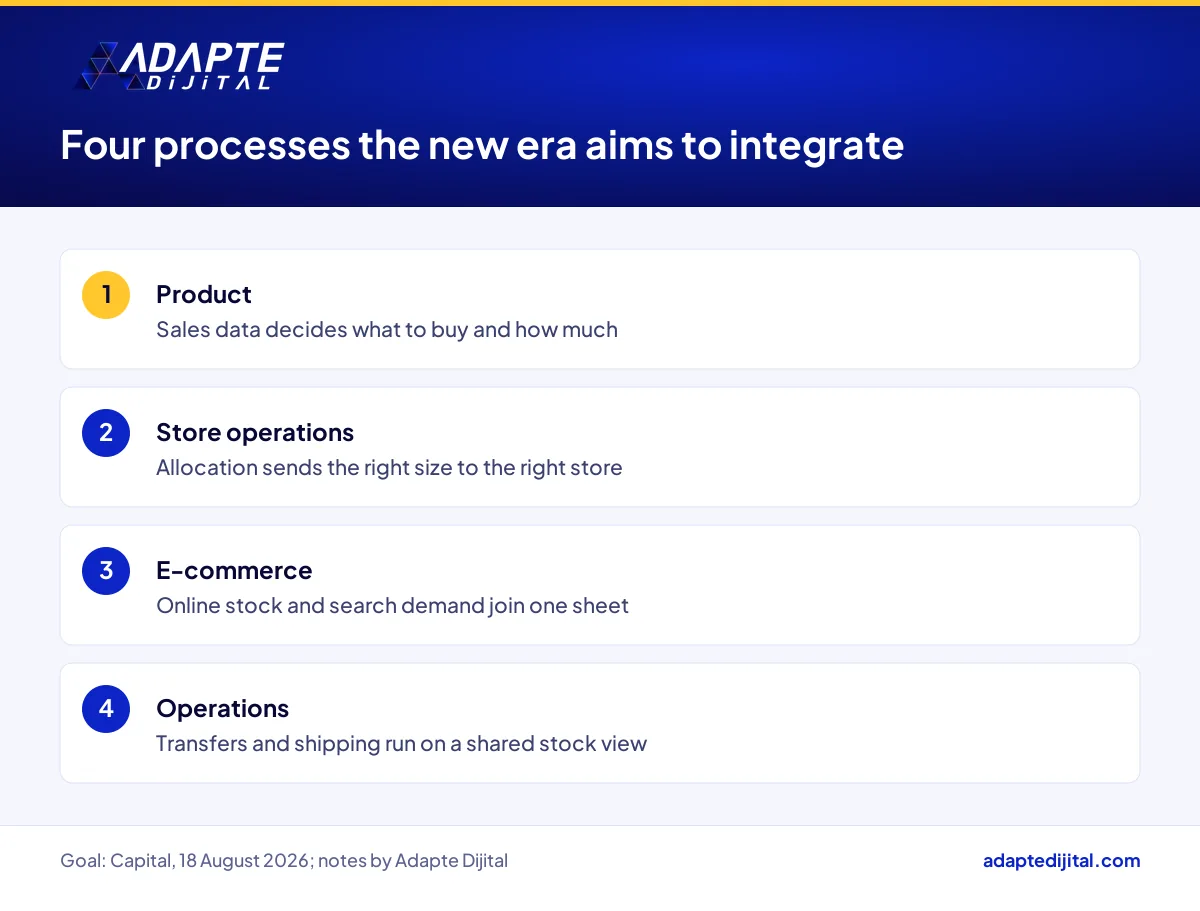
Erhan Çiçek, until now Director of Product Management and Deputy General Manager at Jimmy Key, has become the brand’s general manager (Perakende.org, 18 August 2026). The new era aims to bring product, store operations, e-commerce and operations processes together into one flow.
For you, the point is this: a manager rooted in product planning, allocation and pricing now holds a retail brand’s top seat. That sharpens the question every retailer with stores and online sales asks: how do you decide with data instead of gut feeling?
What does Erhan Çiçek’s path to Jimmy Key’s top job tell us?
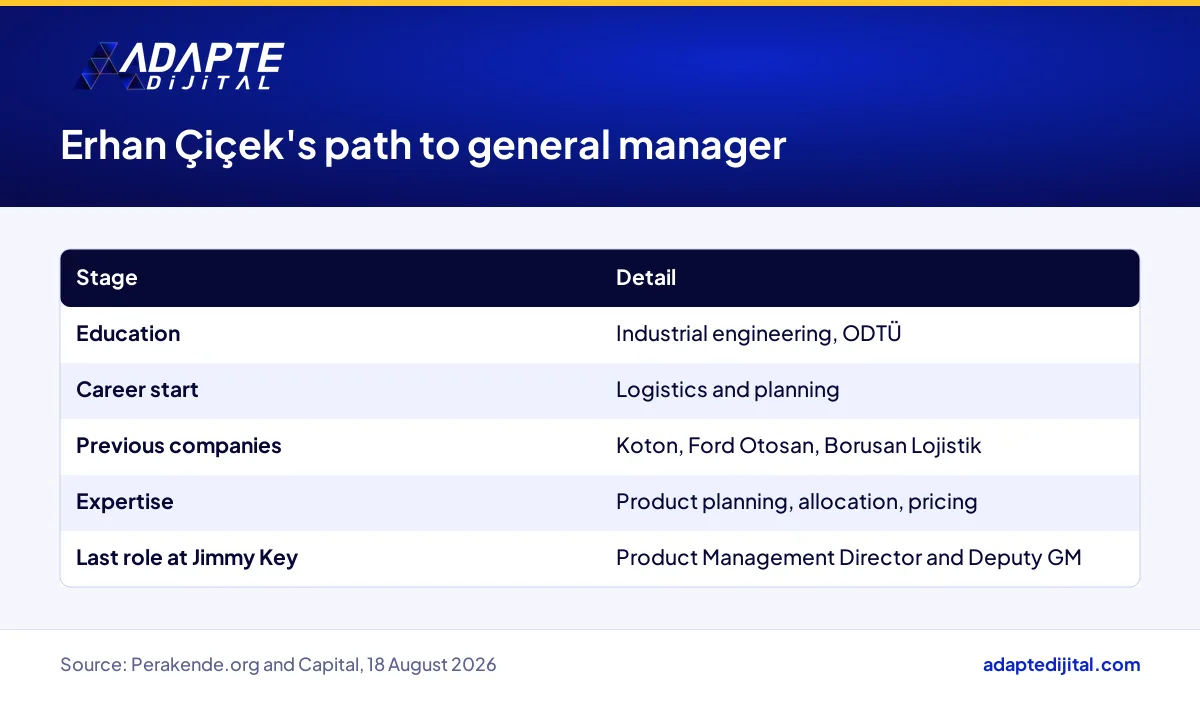
It shows that planning is now a route to the top of a retail business. Çiçek graduated in industrial engineering from ODTÜ, Middle East Technical University, and started his career in logistics and planning. In retail he specialised in product planning, allocation and pricing. That background points to a style of management that decides with numbers.
How do apparel retailers run product planning, allocation and pricing with data?
By tying every decision to a sales or stock figure. Product planning decides what to buy and how much, allocation decides how many units go to which store, and pricing decides when to mark down. In Çiçek’s words, the aim includes “strengthening a data-driven decision-making culture”.
Who feels the effect of a planner becoming Jimmy Key’s general manager?
The brand’s own product, store and e-commerce teams feel it most, because their decisions get tied to the same spreadsheet. Outside the company, small apparel boutiques that order on instinct and businesses new to multichannel selling feel the pressure. Indirectly, mall landlords may also notice which tenants run their stock more efficiently when they plan the tenant mix.
How can a retailer with stores and online sales bring its data together digitally?
With one product code, one stock view and one sales report. The store till, the e-commerce site and the marketplace listings should all draw from the same SKU list. In the Turkish Ministry of Trade’s 2025 e-commerce report, apparel, footwear and accessories are the largest category at TL 428.7 billion; at that size, data kept in silos gets expensive.
Where does a small apparel retailer get stuck moving from gut feeling to data?
Mostly in scattered data and in habit. If sales live in the till, stock lives in a notebook and online orders live in another panel, decisions still fall back on instinct. The turning point is seeing those three sources on one sheet for the first time.
A representative scene: a boutique owner’s Saturday morning
The scene below is representative and does not describe a real person. A boutique owner with a few stores in İzmir checks her phone behind the counter on a Saturday morning. The small size of a popular dress has sold out in this store, and a customer leaves empty-handed. The same size is sitting on a rail in her store across town.
What should a store owner do this week to move to data-led management?
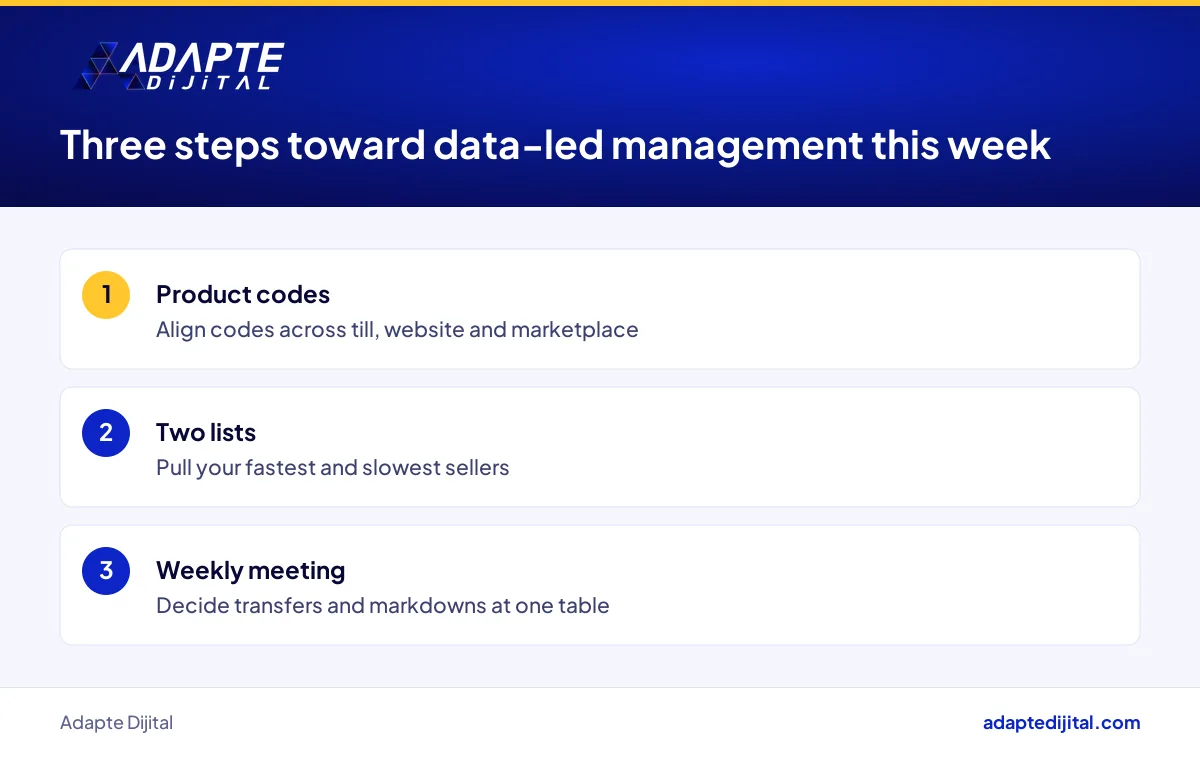
Take three steps this week: align product codes across every channel, pull a list of your fastest and slowest sellers, and set one weekly decision meeting. None of them needs new software. All of them can be started in one afternoon.
On our retail page, where we read the retail news for you, we look at appointment stories through the same lens. Your own sheet could come together on your counter for the first time this week.
Quick Summary
- Erhan Çiçek moved from Director of Product Management and Deputy General Manager to general manager of Jimmy Key (Perakende.org, 18 August 2026).
- The new era aims to integrate product, store operations, e-commerce and operations (Capital, 18 August 2026).
- Çiçek specialises in product planning, allocation and pricing.
- Apparel, footwear and accessories were the largest e-commerce category in Türkiye in 2025 at TL 428.7 billion (Ministry of Trade).
- A small retailer can start without software, using shared product codes and a weekly decision meeting.
Short Glossary
- Allocation
- Allocation is the process used to share warehouse stock among stores and channels based on sales data.
- Product planning
- Product planning is the work used to decide how much of each product to buy in a season, based on sales and stock data.
- Tenant mix
- Tenant mix is the concept used to describe the spread of sectors and brands among the stores in a shopping mall.
Frequently Asked Questions
Next Step
If you would like to plan together how to bring your store, e-commerce and stock data into one flow, fill in our consult your expert form.
Sources: Perakende.org, 18 August 2026 · Capital, 18 August 2026 · Ekonomi Gazetesi, 30 July 2025 · Turkish Ministry of Trade, Outlook of E-Commerce in Türkiye Report 2025 · Turkish Ministry of Trade, Shopping Malls page
Updated: October 2026
Sık Sorulan Sorular
Çiçek previously worked at Koton, Ford Otosan and Borusan Lojistik. Apparel retail, automotive and logistics meet on one CV. The common thread is getting goods to the right place at the right time.
His last roles at Jimmy Key were Director of Product Management and Deputy General Manager. In other words, someone who knows the brand from the product side becomes its general manager. We discuss the upsides and risks of promoting from within in our piece on FLO Group’s two internal appointments.
The report does not say who the previous general manager was, when the appointment takes effect or how the brand’s ownership is structured. Current store and country counts were not shared either. So this piece works only with what has been announced.
Allocation is sharing the stock in the warehouse out among your stores. If a size sells out in one store while it gathers dust in another, the problem is distribution, not the product. Data-led allocation catches that imbalance early.
The markdown decision is made on sell-through speed and remaining stock, not on a feeling that “the season is over”. Discounting a fast seller too early leaves margin on the table. Discounting a slow seller too late leaves cash sitting in the stockroom.
Even the best reporting software can lose to “I just like this model” in a meeting. A data culture is the habit of looking at the numbers first, whoever’s idea it is. When that habit starts at the top, it spreads down.
Teams start working from one shared picture of stock and sales instead of separate targets. That creates friction at first, as everyone trades their own report for a shared one.
As big brands allocate with data, they have the right size in the right store more often. The small boutique keeps telling the same customer “sorry, your size is gone”. We look at this from the boutique’s side in our piece on MANGO’s store plan for Türkiye.
Ekonomi Gazetesi reported on 30 July 2025 that Jimmy Key had 72 physical stores in Türkiye and 16 abroad, and operated in 24 countries. Those figures are more than a year old and may not be current. Still, handing a multi-country business to a planner is worth noting.
If the site says “sold out” while the item sits in a store’s back room, you lose the sale twice. A shared stock view also lets you ship online orders from the nearest store. Whatever channel the customer comes through, they should see the same shelf.
Your site’s search box and Google searches show demand that is not on your shelves yet. A colour or fit people search for often but cannot find is a hint for your next order. That list belongs on the first page of your planning meeting.
Customers search on a map before they come to the store. If your Google Business Profile shows up-to-date stock or campaign information, online interest turns into a customer walking through the door. Your map listing works like a digital extension of your shop window.
That evening she puts till, stock and online order records side by side for the first time. She sees that the store she thought was slow is in fact being stocked with the wrong sizes. The following week she splits the order by the sell-through speed in that sheet, not by feel.
A small, regular routine. Looking at the same report every Monday does more than a big software investment. Data that nobody looks at is just a file.
Compare the product codes in your till software, on your website and on the marketplace in one spreadsheet. If one product has different codes, pick one and apply it everywhere. Without this step, no report is reliable.
Sell-through speed, remaining stock and the split by size are enough. Ask one question in the meeting: which product is in the wrong store? Make the transfer and markdown decisions at the same table based on the answer.
A retailer with a store in an AVM, the Turkish term for a shopping mall, operates under Law 6585 on the Regulation of Retail Trade and the Regulation on Shopping Malls; check the current texts on the Ministry of Trade’s shopping malls page. Verify with the official source; this is not legal or financial advice. Building a structure that joins stores, e-commerce and operations into one flow is what we do in our digital transformation management work.
No. You can start with shared product codes, a regular sales and stock sheet and a weekly decision meeting; software comes later.
Yes, because stock is also shared between your store and your online channel. Knowing which size sells in which channel directly affects your orders.
The report does not say who the previous general manager was or when the appointment takes effect.